International Baccalaureate · DP 1: Analysis and Approaches SL
Transformations of Functions
I
Translations, Stretches and Reflections
I.1
Translations
Recappreviously studied — click to reread
Function transformations allow us to take a basic “parent” function and modify it to create a new, related function. By applying a sequence of transformations, we can shift, stretch, compress, or reflect the graph of the parent function.
Understanding these transformations is essential, as it allows us to predict the graph of a complex function based on a simpler one and to model real-world phenomena by adjusting a basic function to fit observed data. The transformations are vertical and horizontal translations, stretches and compressions, and reflections.
Understanding these transformations is essential, as it allows us to predict the graph of a complex function based on a simpler one and to model real-world phenomena by adjusting a basic function to fit observed data. The transformations are vertical and horizontal translations, stretches and compressions, and reflections.
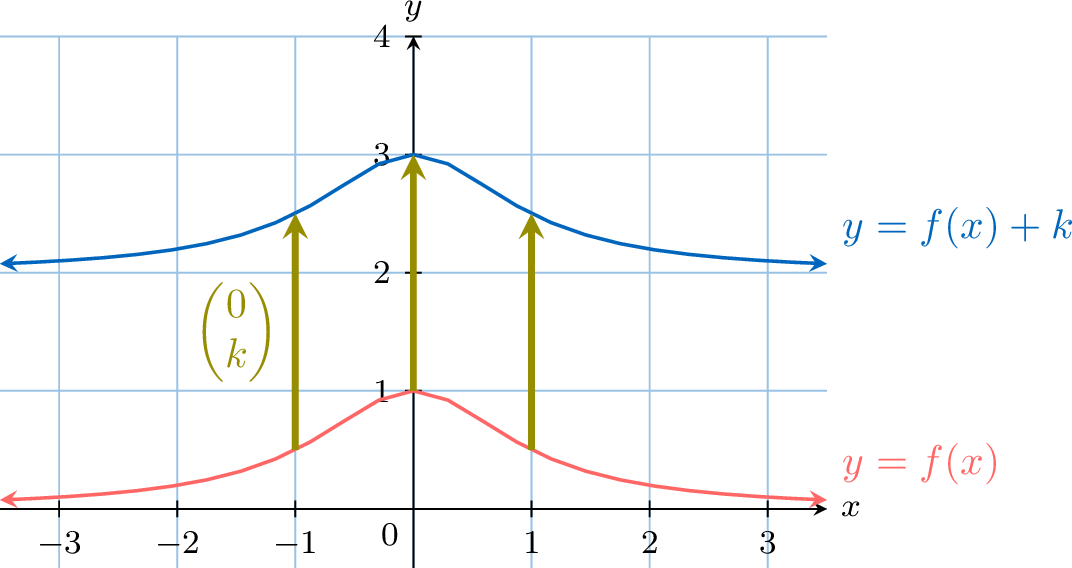
Definition — Vertical Translation by Adding a Constant
A vertical translation shifts the graph of a function up or down. The transformation is defined by:$$g(x) = f(x) + k$$ This transformation maps a point \((x, y)\) on the graph of \(f\) to a new point \((x, y+k)\) on the graph of \(g\). - If \(k>0\), the graph is translated \(\boldsymbol{k}\) units up.
- If \(k<0\), the graph is translated \(\boldsymbol{|k|}\) units down.
Definition — Horizontal Translation
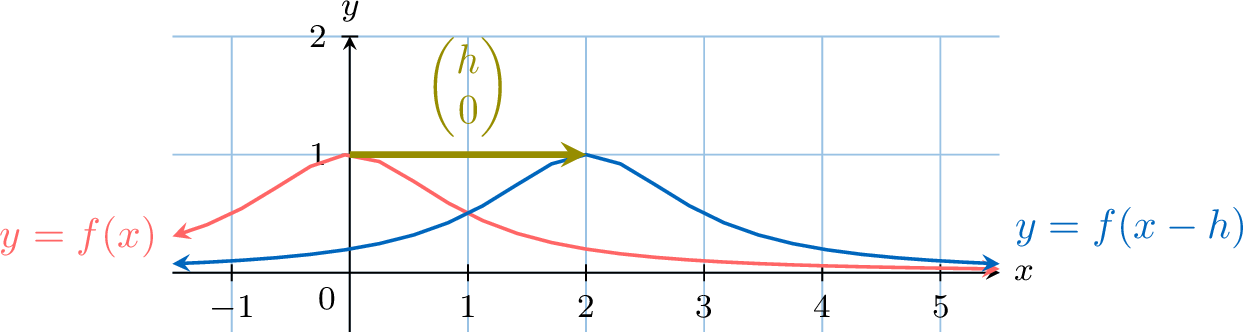
A horizontal translation shifts the graph of a function left or right. The transformation is defined by:$$g(x) = f(x-h)$$ This transformation maps a point \((x, y)\) on the graph of \(f\) to a new point \((x+h, y)\) on the graph of \(g\). - If \(h>0\), the graph is translated \(\boldsymbol{h}\) units to the right.
- If \(h<0\), the graph is translated \(\boldsymbol{|h|}\) units to the left.
Example
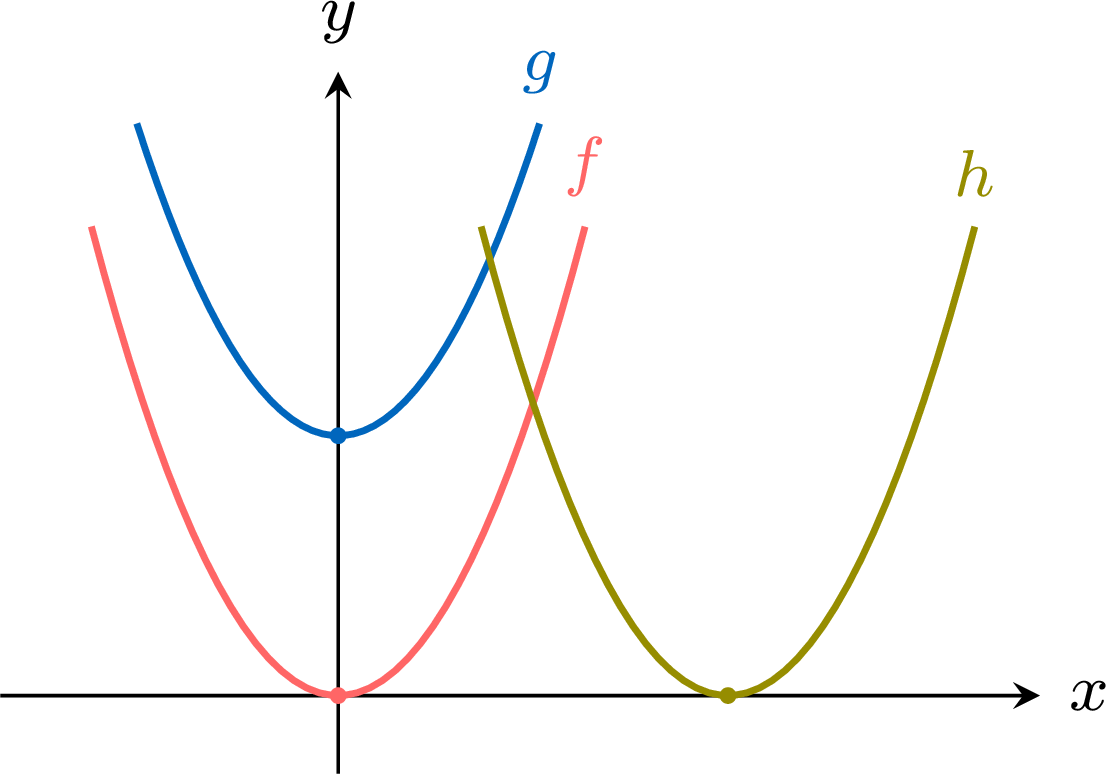
From the graph of \(f(x) = x^2\), plot \(g(x) = f(x) + 2\) and \(h(x) = f(x - 3)\). - \(g(x) = f(x) + 2\): every output is raised by \(2\) — a vertical translation \(2\) units up. The vertex \((0, 0)\) moves to \((0, 2)\).
- \(h(x) = f(x - 3)\): the input \(x = 3\) now plays the role \(0\) used to play — a horizontal translation \(3\) units to the right. The vertex \((0,0)\) moves to \((3, 0)\).
Translation by a Vector
The vertical and the horizontal translations combine into one. The translation by the vector \(\begin{pmatrix} h \\ k \end{pmatrix}\) moves each point \((x, y)\) of the graph of \(f\) to the point \((X, Y) = (x + h, y + k)\). Since \(x = X - h\) and \(Y = f(x) + k\), the image points satisfy \(Y = f(X - h) + k\); writing \((x, y)\) again for the coordinates, the image of the graph of \(y = f(x)\) is the graph of $$y = f(x - h) + k.$$ For example, the translation by the vector \(\begin{pmatrix} 3 \\ -2 \end{pmatrix}\) maps the graph of \(y = x^2\) onto the graph of \(y = (x - 3)^2 - 2\), and its vertex \((0, 0)\) to \((3, -2)\).
Skills to practice
- Translating Graphs
I.2
Stretches
Recappreviously studied — click to reread
Definition — Vertical Stretch
A vertical stretch stretches or compresses the graph of a function vertically. It is defined, for a number \(a \neq 0\), by:$$g(x) = a \cdot f(x)$$ This transformation maps a point \((x, y)\) to \((x, ay)\). - If \(|a|>1\), the graph is stretched vertically by a factor of \(|a|\).
- If \(0 < |a| < 1\), the graph is compressed vertically by a factor of \(|a|\).
- If \(a < 0\), the stretch or compression is followed by a reflection in the \(x\)-axis (\(a = -1\) gives the reflection alone).

Definition — Horizontal Stretch
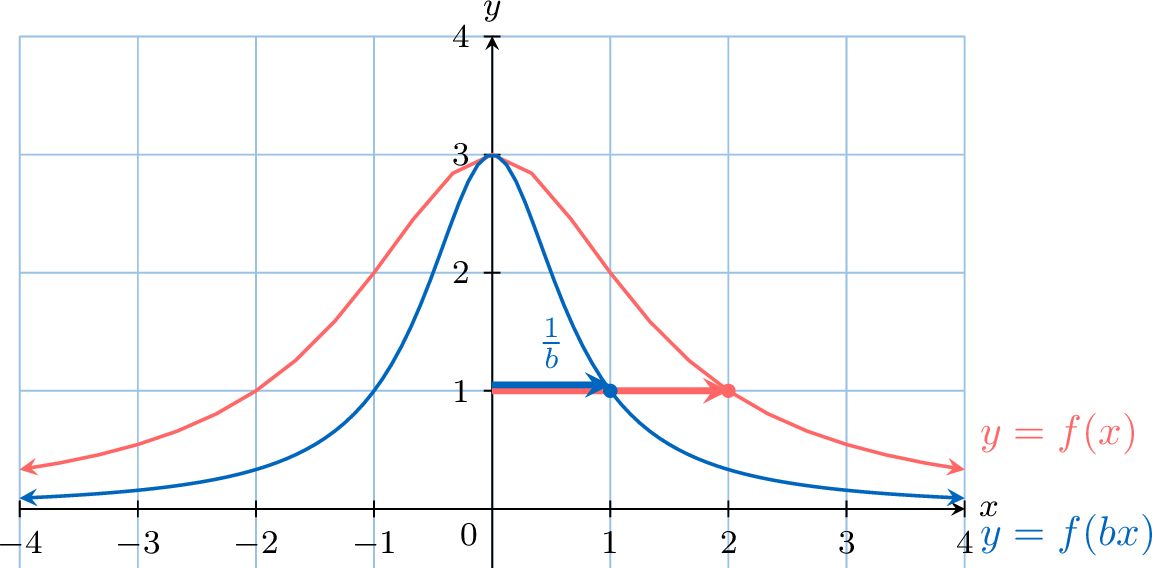
A horizontal stretch stretches or compresses the graph of a function horizontally. It is defined, for a number \(b \neq 0\), by:$$g(x) = f(bx)$$ This transformation maps a point \((x, y)\) to a new point \((\frac{x}{b}, y)\). - If \(|b|>1\), the graph is compressed horizontally by a factor of \(\frac{1}{|b|}\).
- If \(0 < |b| < 1\), the graph is stretched horizontally by a factor of \(\frac{1}{|b|}\).
- If \(b < 0\), the stretch or compression is followed by a reflection in the \(y\)-axis (\(b = -1\) gives the reflection alone).
Example
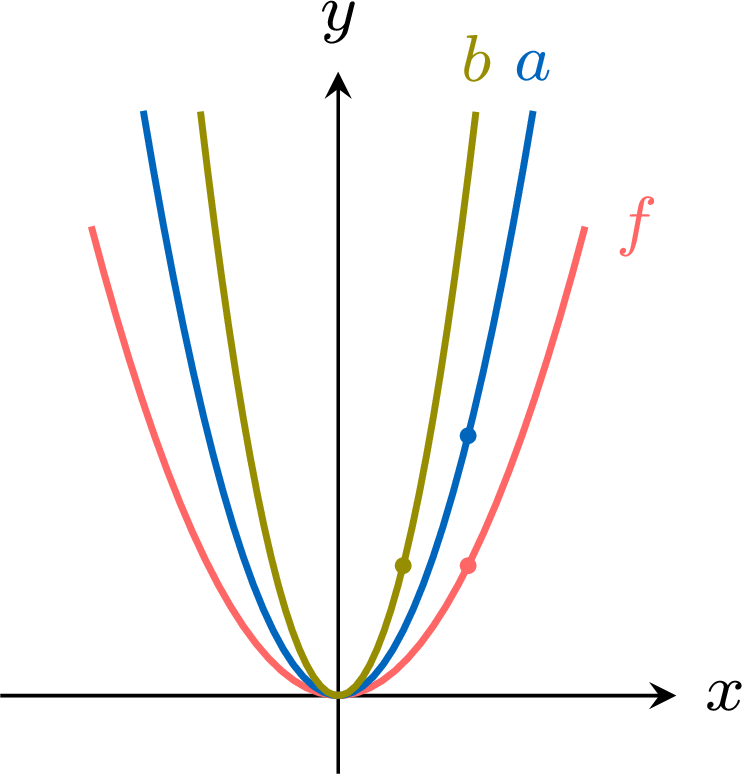
From the graph of \(f(x) = x^2\), plot \(a(x) = 2f(x)\) and \(b(x) = f(2x)\). - \(a(x) = 2f(x) = 2x^2\): every output is doubled — a vertical stretch by factor \(2\). The point \((1, 1)\) moves to \((1, 2)\).
- \(b(x) = f(2x) = 4x^2\): the input is consumed twice as fast — a horizontal compression with scale factor \(\frac12\): every \(x\)-coordinate is halved. The point \((1, 1)\) moves to \(\left(\frac12, 1\right)\).
Stretches and Scale Factors
The number by which a stretch multiplies the distances to the axis that stays fixed is its scale factor. For \(a > 0\), the graph of \(y = a f(x)\) is the image of the graph of \(y = f(x)\) under the vertical stretch with scale factor \(a\): each point \((x, y)\) goes to \((x, ay)\). For \(b > 0\), the graph of \(y = f(bx)\) is its image under the horizontal stretch with scale factor \(\dfrac{1}{b}\): each point \((x, y)\) goes to \(\left(\dfrac{x}{b}, y\right)\). A scale factor greater than \(1\) moves the points away from the axis that stays fixed (the \(x\)-axis for a vertical stretch, the \(y\)-axis for a horizontal one), a scale factor between \(0\) and \(1\) brings them closer to it: the graph of \(y = f(2x)\) is the image of the graph of \(f\) under the horizontal stretch with scale factor \(\dfrac{1}{2}\), a compression.
Skills to practice
- Stretching Graphs
I.3
Reflections
Recappreviously studied — click to reread
Definition — Reflection in the x-axis
A reflection in the x-axis flips the graph of a function vertically. It is a special case of vertical stretch where \(a=-1\). It is defined by:$$g(x) = -f(x)$$ This transformation maps a point \((x, y)\) to \((x, -y)\). 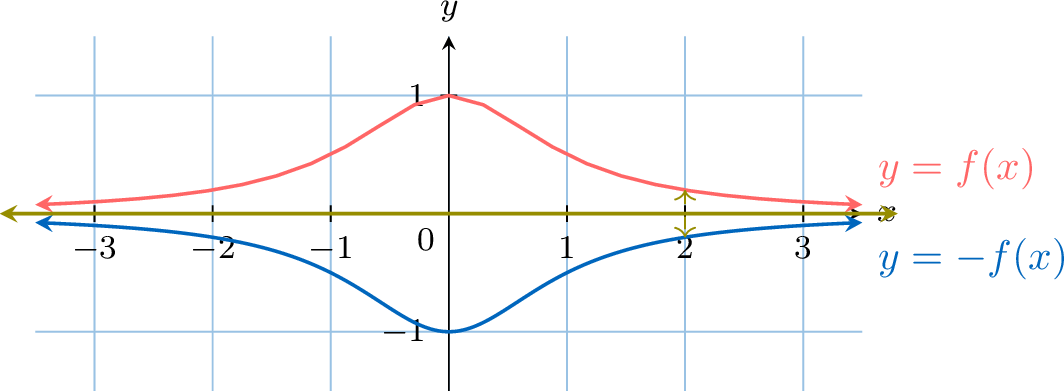
Definition — Reflection in the y-axis
A reflection in the y-axis flips the graph of a function horizontally. It is a special case of horizontal stretch where \(b=-1\). It is defined by:$$g(x) = f(-x)$$ This transformation maps a point \((x, y)\) to \((-x, y)\). 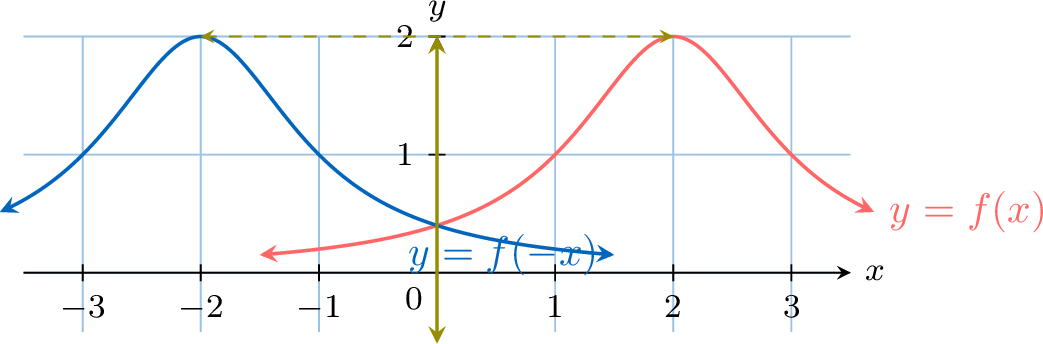
Example
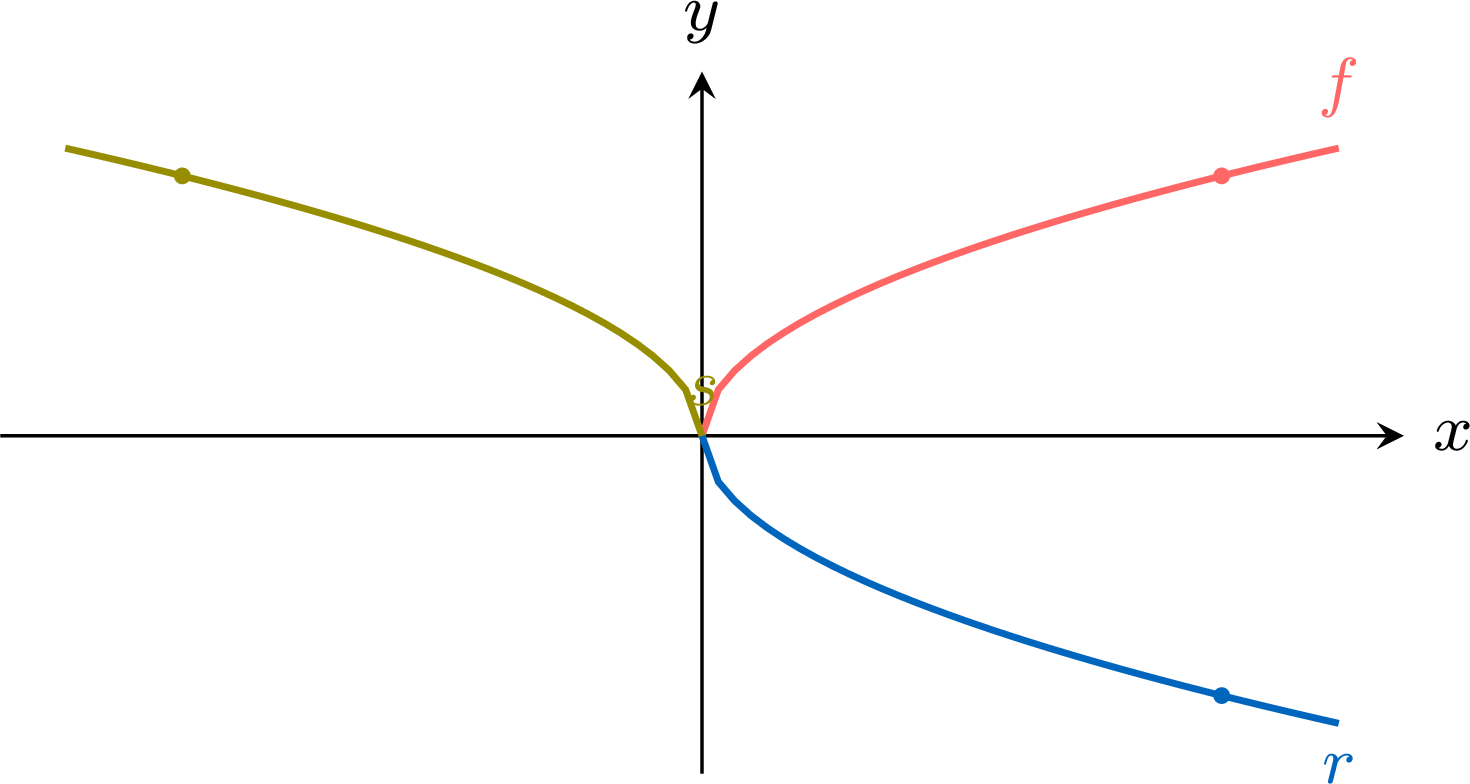
From the graph of \(f(x) = \sqrt{x}\), plot \(r(x) = -f(x)\) and \(s(x) = f(-x)\). - \(r(x) = -\sqrt{x}\): every output changes sign — a reflection in the \(x\)-axis. The curve flips below the axis; the point \((4, 2)\) moves to \((4, -2)\).
- \(s(x) = \sqrt{-x}\): every input changes sign — a reflection in the \(y\)-axis. The curve flips to the left half-plane (defined for \(x \le 0\)); the point \((4, 2)\) moves to \((-4, 2)\).
Skills to practice
- Reflecting Graphs
II
Composite Transformations
II.1
Combining Transformations
Recappreviously studied — click to reread
When multiple transformations are applied to a function, the order in which they are performed is crucial. The standard form for a transformed function is:$$ g(x) = a \cdot f(b(x-c)) + d $$ To graph this function from the parent function \(f(x)\), apply the transformations in the following order:
Method — Order of Transformations
- Horizontal Transformations (inside the brackets):
- Apply the horizontal stretch/compression by the factor \(\frac{1}{|b|}\) (\(b \neq 0\)), followed by a reflection in the \(y\)-axis if \(b < 0\).
- Apply the horizontal translation (shift) by \(c\) units.
- Vertical Transformations (outside the brackets):
- Apply the vertical stretch/compression by the factor \(|a|\), followed by a reflection in the \(x\)-axis if \(a < 0\).
- Apply the vertical translation (shift) by \(d\) units.
Example
Describe the sequence of transformations that maps the graph of \(f(x)=\sqrt{x}\) onto the graph of \(g(x) = 3\sqrt{-x+2} - 4\).
First, we rewrite the function \(g(x)\) in the standard form \(a \cdot f(b(x-c)) + d\):$$ g(x) = 3\sqrt{-(x-2)} - 4 $$ Comparing this to \(f(x)=\sqrt{x}\), we have \(a=3\), \(b=-1\), \(c=2\), and \(d=-4\). The transformations are applied as follows: 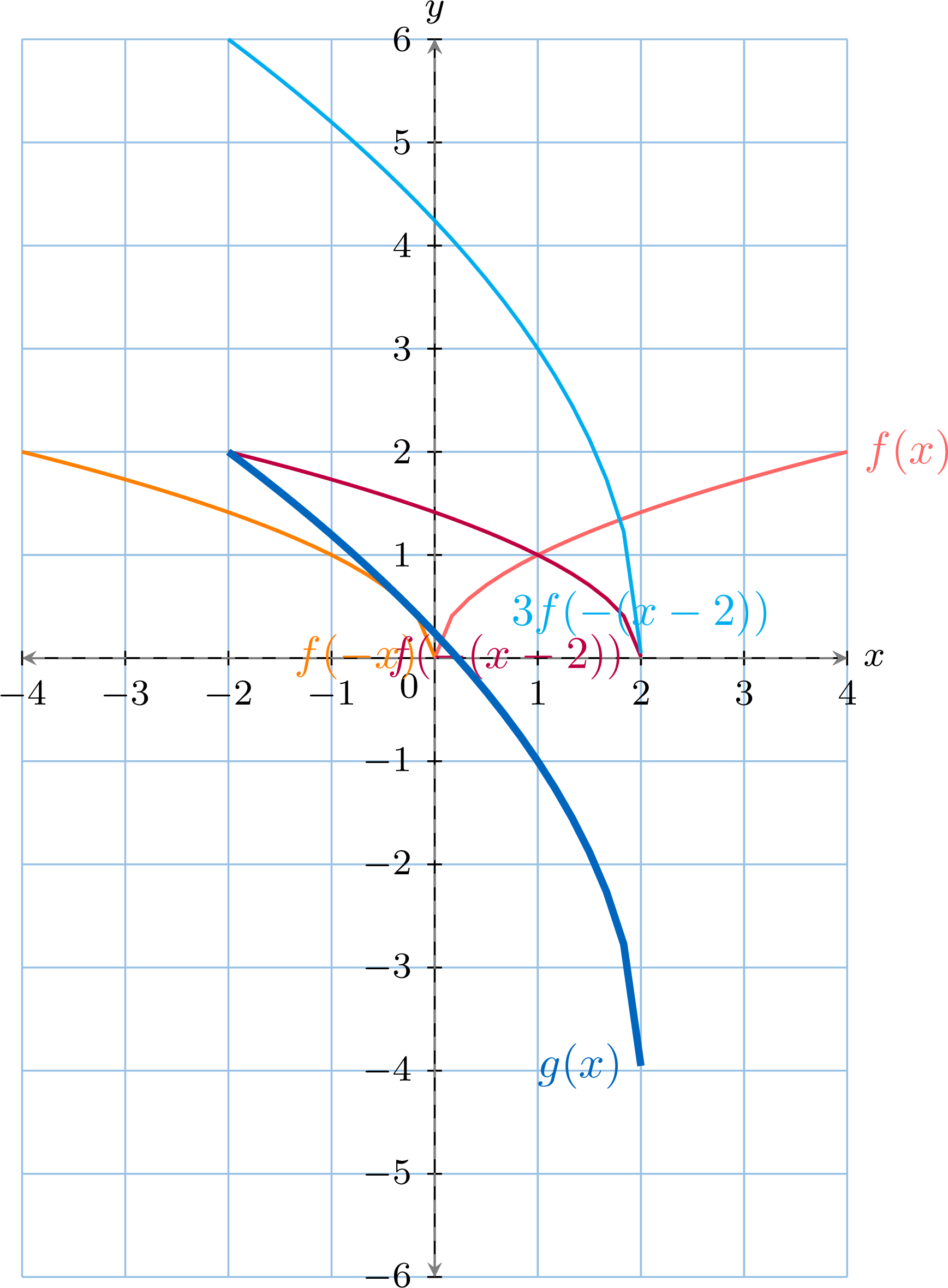
- Horizontal Transformations on \(f(x)=\sqrt{x}\):
- Reflection: Since \(b=-1\), reflect the graph in the y-axis (\(y = \sqrt{-x}\)).
- Translation: Since \(c=2\), translate the graph 2 units to the right (\(y = \sqrt{-(x-2)}\)).
- Vertical Transformations on the result:
- Stretch: Since \(a=3\), stretch the graph vertically by a factor of 3 (\(y = 3\sqrt{-(x-2)}\)).
- Translation: Since \(d=-4\), translate the graph 4 units down (\(y = 3\sqrt{-(x-2)} - 4\)).
Skills to practice
- Sketching Combined Transformations
- Finding Equations from a Sequence of Transformations
II.2
Rational Functions as Images of \(y \equal \frac{1}{x}\)
Example
Describe a sequence of transformations that maps the graph of \(y = \dfrac{1}{x}\) onto the graph of \(y = \dfrac{2x + 1}{x - 1}\), and deduce the asymptotes of the second graph.
Write the numerator around the denominator: \(2x + 1 = 2(x - 1) + 3\). With \(f(x) = \dfrac{1}{x}\), for \(x \neq 1\): $$\begin{aligned}[t] \frac{2x + 1}{x - 1} &= \frac{2(x - 1) + 3}{x - 1} \\
&= 2 + \frac{3}{x - 1} && \text{(split the fraction)} \\
&= 3f(x - 1) + 2. \end{aligned}$$ This is the standard form \(a \cdot f(b(x - c)) + d\) with \(a = 3\), \(b = 1\), \(c = 1\) and \(d = 2\). In the order of transformations: 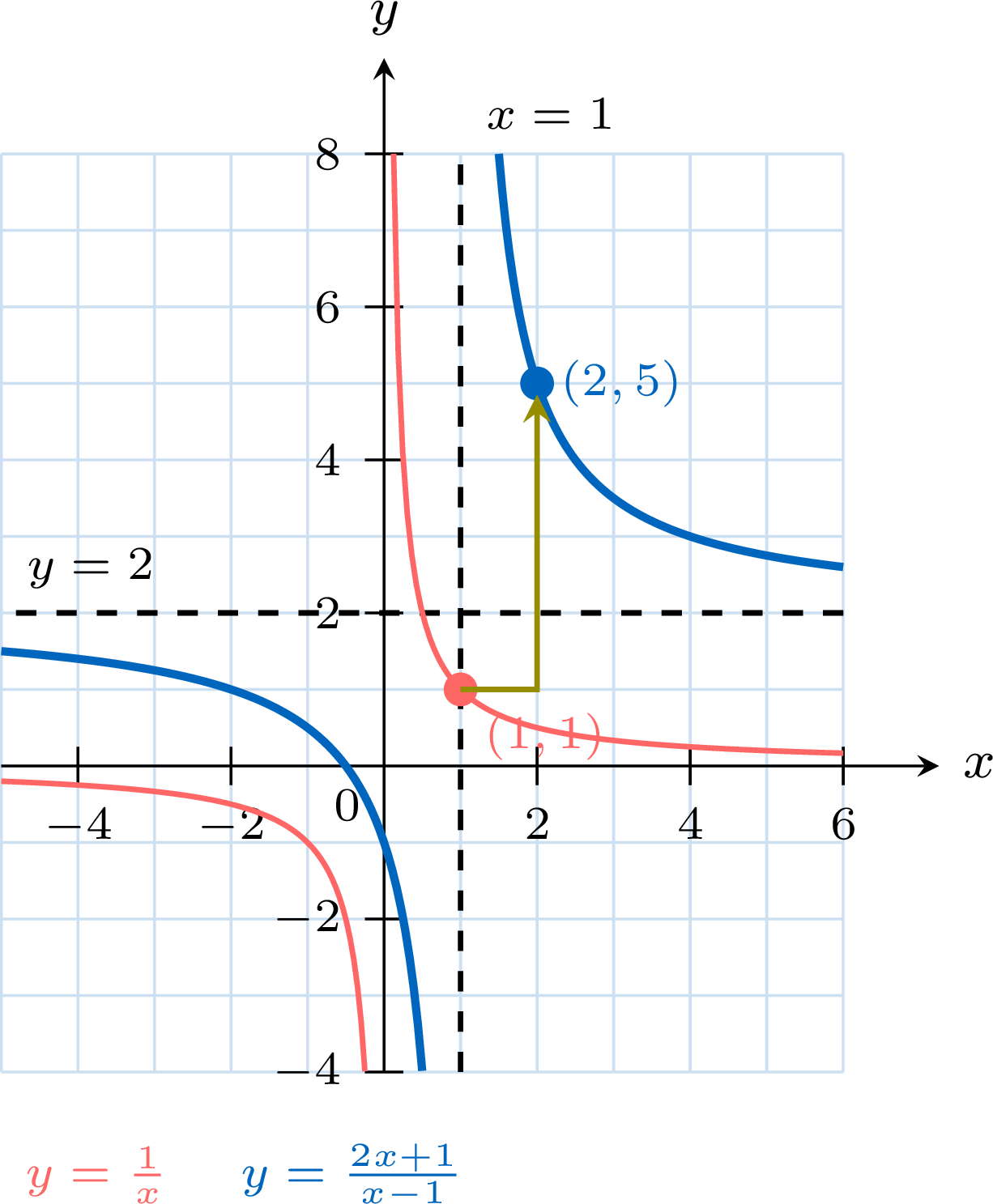
- translate \(1\) unit to the right: \(y = \dfrac{1}{x - 1}\);
- stretch vertically with scale factor \(3\): \(y = \dfrac{3}{x - 1}\);
- translate \(2\) units up: \(y = \dfrac{3}{x - 1} + 2\).
Skills to practice
- Relating Rational Functions to \(y \equal \frac{1}{x}\)
III
Going further
Skills to practice
- Reasoning and Solving Problems
Jump to section