International Baccalaureate · DP 2: Applications and Interpretation SL
Revision: Number, Algebra and Finance
I
Toolbox: Arithmetic Series
Recappreviously studied — click to reread
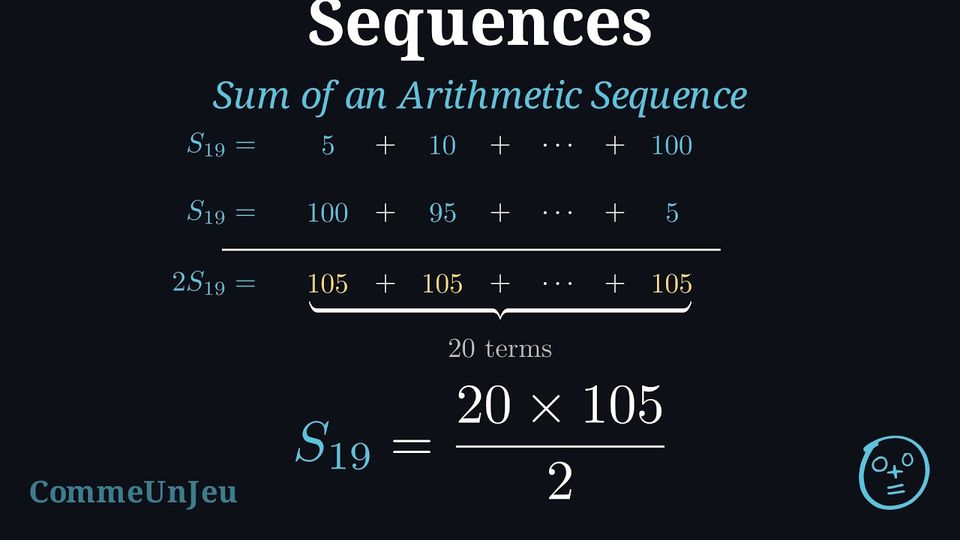
Proposition — Sum of an Arithmetic Sequence
The sum of the first terms of an arithmetic sequence is given by the formula:$$S_n = \text{Number of terms} \times \frac{(\text{First term} + \text{Last term})}{2}$$ - If a sequence starts at \(u_0\) and ends at \(u_n\), there are \(\boldsymbol{n+1}\) terms. The formula is:$$S_n = \frac{n+1}{2}(u_0 + u_n)$$
- If a sequence starts at \(u_1\) and ends at \(u_n\), there are \(\boldsymbol{n}\) terms. The formula is:$$S_n = \frac{n}{2}(u_1 + u_n)$$
Example
Compute the sum \(1 + 2 + 3 + \cdots + 100\).
The terms \(1, 2, 3, \ldots, 100\) form an arithmetic sequence starting at \(u_1 = 1\) and ending at \(u_{100} = 100\), so there are \(100\) terms: $$\begin{aligned}[t] 1 + 2 + \cdots + 100 &= \frac{100}{2}\,(1 + 100) && \text{(} S_n = \tfrac{n}{2}(u_1 + u_n)\text{)} \\
&= 50 \times 101 && \text{(simplify } \tfrac{100}{2}\text{)} \\
&= 5\,050. \end{aligned}$$
Proposition — Sum from the First Term and the Common Difference
Let \((u_n)\) be an arithmetic sequence with common difference \(d\). The sum of its first terms can also be written with the first term and the common difference only, without computing the last term: - If the sequence starts at \(u_1\), the sum of its first \(\boldsymbol{n}\) terms is:$$S_n = \frac{n}{2}\big(2u_1 + (n-1)d\big)$$
- If the sequence starts at \(u_0\), the sum of its first \(\boldsymbol{n+1}\) terms is:$$S_n = \frac{n+1}{2}\big(2u_0 + nd\big)$$
Example
An arithmetic sequence has first term \(u_1 = 3\) and common difference \(d = 4\). - Compute the sum \(S_{12}\) of its first \(12\) terms.
- How many terms, starting from \(u_1\), must be added for the sum to equal \(210\)?
- The last term is not needed. With \(u_1 = 3\), \(d = 4\) and \(n = 12\): $$\begin{aligned}[t] S_{12} &= \frac{12}{2}\big(2u_1 + 11d\big) && \text{(} S_n = \tfrac{n}{2}(2u_1 + (n-1)d)\text{)} \\ &= 6 \times (2 \times 3 + 11 \times 4) \\ &= 6 \times 50 \\ &= 300. \end{aligned}$$
- Here the number of terms \(n\) is the unknown. First, \(S_n\) in terms of \(n\): $$\begin{aligned}[t] S_n &= \frac{n}{2}\big(2 \times 3 + (n-1) \times 4\big) && \text{(} S_n = \tfrac{n}{2}(2u_1 + (n-1)d)\text{)} \\
&= \frac{n}{2}\,(4n + 2) && \text{(expand)} \\
&= 2n^2 + n. \end{aligned}$$ So we look for the number of terms \(n\) such that \(2n^2 + n = 210\). The terms \(3, 7, 11, \ldots\) are positive, so each added term makes the sum larger: \(S_n\) increases with \(n\). A table of values gives
\(n\) \(8\) \(9\) \(10\) \(11\) \(S_n = 2n^2 + n\) \(136\) \(171\) \(210\) \(253\)
Check: \(S_{10} = \frac{10}{2}(2 \times 3 + 9 \times 4) = 5 \times 42 = 210\).
Skills to practice
- Calculating an Arithmetic Series
II
Toolbox: Upper and Lower Bounds
Recappreviously studied — click to reread
Definition — Lower and Upper Bounds
For a rounded value: - The Lower Bound (LB) is the smallest possible value.
- The Upper Bound (UB) is the value that the possible values never reach: every possible value is strictly below it, so we write “\(<\)” for the upper bound. The upper bound itself is not a possible value, but it is the number used in calculations.
Example
The length of a book is given as \(L = 12\) cm, rounded to the nearest cm (\(u=1\)). - Calculate the lower bound and the upper bound of the length.
- Write the inequality representing the possible values for the true length.
- Bounds:
- Lower bound: \(12 - 0.5 = 11.5\) cm.
- Upper bound: \(12 + 0.5 = 12.5\) cm.
- Inequality: Therefore: \(11.5 \le L < 12.5\).
Method — Bounds of a Calculation
When performing calculations with rounded values (area, perimeter, speed, \(\dots\)), errors propagate.Let \(A\) and \(B\) be two positive quantities with bounds \(A\in[A_{\min},A_{\max})\) and \(B\in[B_{\min},B_{\max})\) (with \(B_{\min}>0\) if dividing by \(B\)).
| Operation | Upper bound | Lower bound |
| \(A + B\) | \(A_{\max} + B_{\max}\) | \(A_{\min} + B_{\min}\) |
| \(A - B\) | \(A_{\max} - B_{\min}\) | \(A_{\min} - B_{\max}\) |
| \(A \times B\) | \(A_{\max} \times B_{\max}\) | \(A_{\min} \times B_{\min}\) |
| \(A \div B\) | \(A_{\max} \div B_{\min}\) | \(A_{\min} \div B_{\max}\) |
Example
A rectangle has length \(l = 10\) cm and width \(w = 5\) cm, both measured to the nearest cm. Calculate the upper and lower bounds of the area. - Step 1: Determine the bounds.
Since the measurements are to the nearest 1 cm, the accuracy is \(\pm 0.5\) cm.- Length \(l\): Lower bound \(= 9.5\), Upper bound \(= 10.5\).
- Width \(w\): Lower bound \(= 4.5\), Upper bound \(= 5.5\).
- Step 2: Calculate the areas.
- Upper bound of the area (using the upper bounds of the sides): $$ A_{\max} = 10.5 \times 5.5 = 57.75 \text{ cm}^2 $$
- Lower bound of the area (using the lower bounds of the sides): $$ A_{\min} = 9.5 \times 4.5 = 42.75 \text{ cm}^2 $$
Skills to practice
- Finding Upper and Lower Bounds
III
Exam-Style Questions
Skills to practice
- Working with Technology: Number, Algebra and Finance
- Quiz
Jump to section