International Baccalaureate · DP 2: Applications and Interpretation SL
Revision: Geometry and Trigonometry
I
Toolbox: Arcs and Sectors in Degrees
Recappreviously studied — click to reread
Method — Finding the Length of an Arc
The length of an arc is a fraction of the full circumference. - Find the fraction of the circle. This is the arc’s central angle (in degrees) divided by \(360^\circ\): $$ \text{Fraction} = \frac{\text{central angle } (\theta)}{360^\circ}. $$
- Multiply the fraction by the full circumference. The circumference of a circle with radius \(r\) is \(C = 2 \pi r\): $$ \text{Arc Length} = \text{Fraction} \times (2 \pi r). $$
Proposition — Area of a Sector
The area of a sector of radius \(r\) and angle \(\theta\) in degrees is the fraction \(\dfrac{\theta}{360^\circ}\) of the area of the disc: \(A = \dfrac{\theta}{360^\circ} \times \pi r^2\). 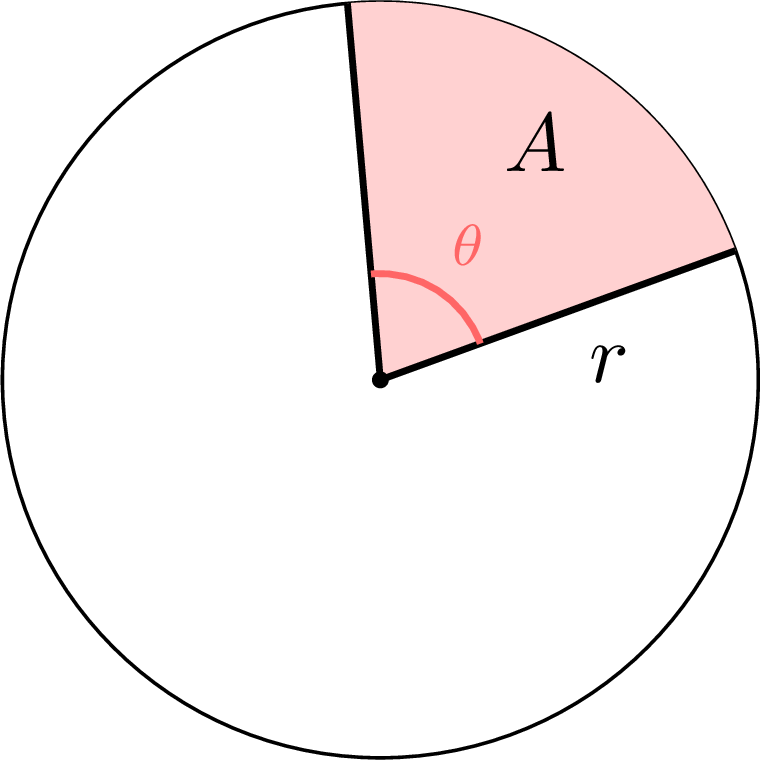
Example
Find the area of a sector of radius \(6\) cm and angle \(50^\circ\), exactly and to \(0.1 \text{ cm}^2\).
$$\begin{aligned}[t]A &= \frac{\theta}{360^\circ} \times \pi r^2 && \text{(area of a sector)}\\
&= \frac{50^\circ}{360^\circ} \times \pi \times 6^2 && (\theta = 50^\circ,\ r = 6)\\
&= \frac{50 \times 36}{360}\,\pi && \text{(grouping the numbers)}\\
&= 5\pi \text{ cm}^2 && (1800 \div 360 = 5)\\
&\approx 15.7 \text{ cm}^2.\end{aligned}$$
Skills to practice
- Finding an Angle or a Radius from an Arc or a Sector
II
Toolbox: North and East Components
Recappreviously studied — click to reread
Method — Finding the North and East Components of a Journey
Unless it runs due North, East, South or West, a journey of length \(d\) on a bearing \(\theta\) is the hypotenuse of a right-angled triangle whose two other sides are its North–South part and its East–West part. - Draw the North–South line at the starting point, the journey, and the East–West segment from the end of the journey to the North–South line: these three segments form the right-angled triangle.
- Find the acute angle \(\alpha\) between the journey and the North–South line: \(\alpha = \theta\) for a bearing between \(000^\circ\) and \(090^\circ\), \(\alpha = 180^\circ - \theta\) between \(090^\circ\) and \(180^\circ\), \(\alpha = \theta - 180^\circ\) between \(180^\circ\) and \(270^\circ\), \(\alpha = 360^\circ - \theta\) between \(270^\circ\) and \(360^\circ\).
- Compute the two parts in the right-angled triangle: the North–South part is \(d\cos\alpha\) (the side adjacent to \(\alpha\)), the East–West part is \(d\sin\alpha\) (the side opposite \(\alpha\)).
- State the directions: north for a bearing below \(090^\circ\) or above \(270^\circ\), south for a bearing between \(090^\circ\) and \(270^\circ\); east for a bearing between \(000^\circ\) and \(180^\circ\), west for a bearing between \(180^\circ\) and \(360^\circ\).
Example
A boat sails \(15\) km from a harbour \(H\) on a bearing of \(125^\circ\). How far south and how far east of \(H\) is it (to \(0.1\) km)? 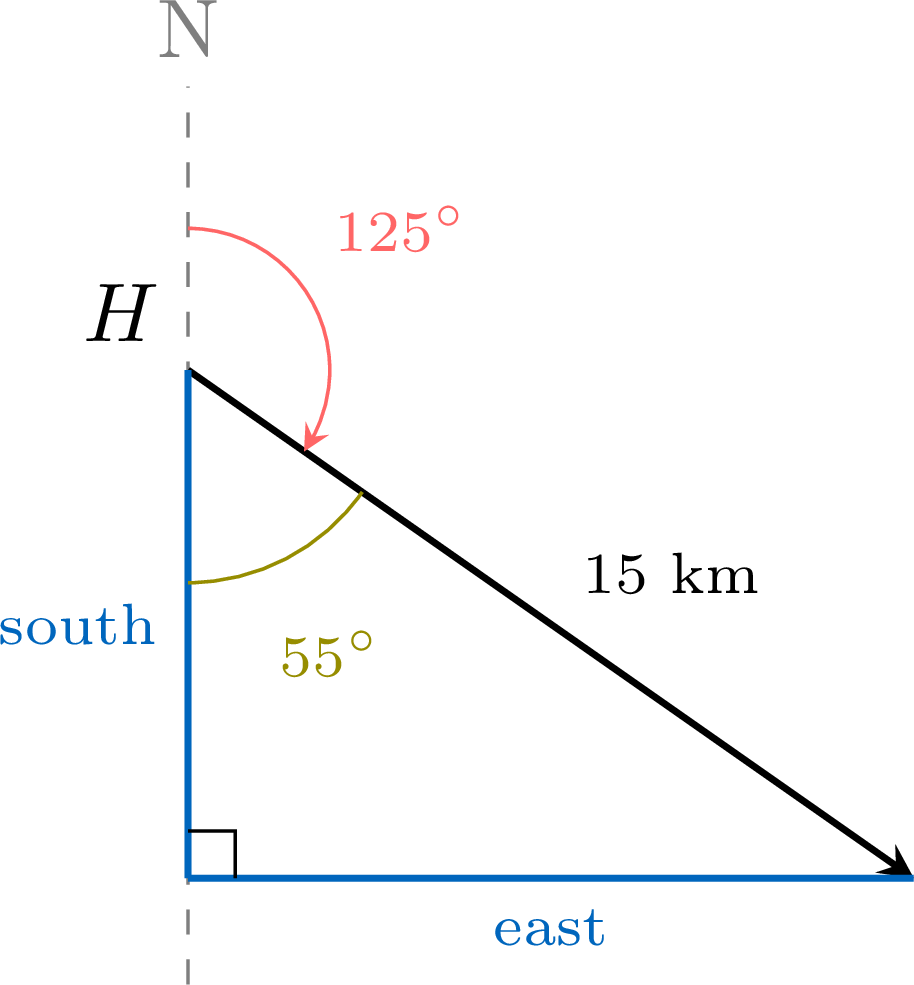
Skills to practice
- Finding North and East Components
III
Exam-Style Questions
Skills to practice
- Working with Technology: Geometry and Trigonometry
Jump to section