International Baccalaureate · DP 2: Analysis and Approaches SL
Introduction to Integration
I
The Definite Integral as an Area
I.1
Approximating Area with Rectangles
The measurement of area has been fundamental to science and society since antiquity. In ancient Egypt, surveyors used knotted ropes to construct right angles, allowing them to measure and restore the boundaries of rectangular fields washed away by the annual floods of the Nile. While finding the area of shapes with straight sides is straightforward, calculus provides a revolutionary tool for finding the area of regions bounded by curves. 
The aim is a method to find the exact area, \(\mathcal{A}\), of the region bounded by the graph of a non-negative function \(y=f(x)\), the x-axis, and the vertical lines \(x=a\) and \(x=b\). This area is denoted by the definite integral: 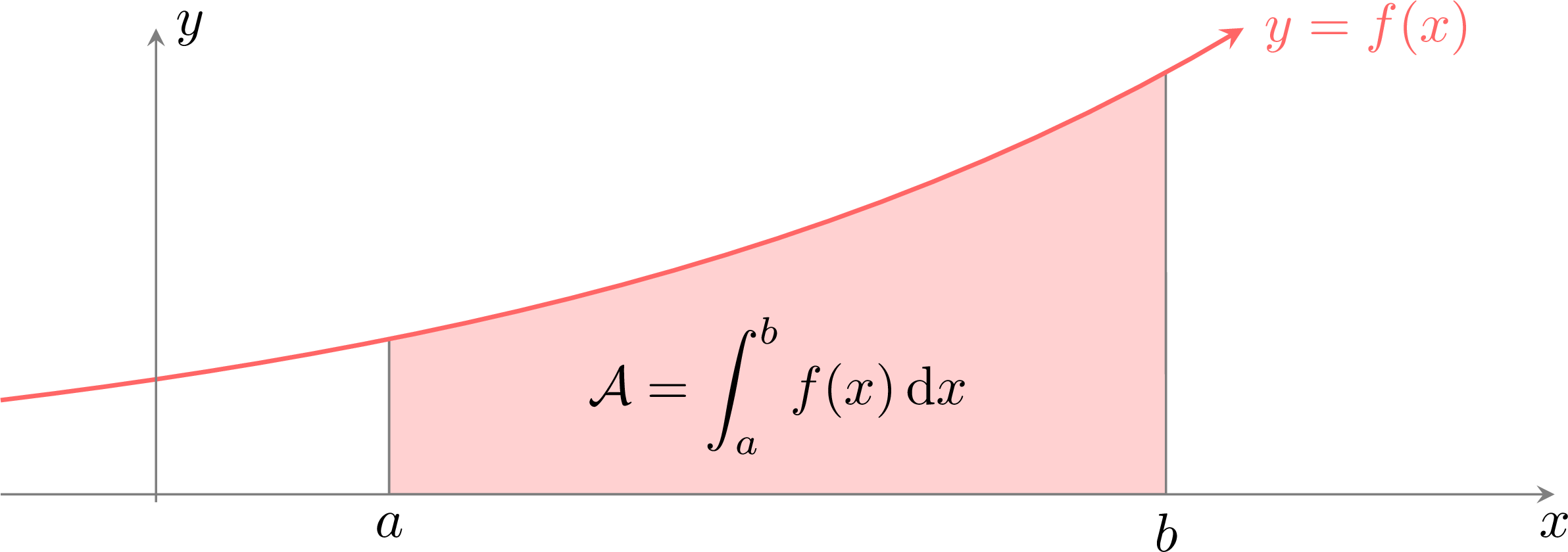
Method — Approximating Area with Riemann Sums
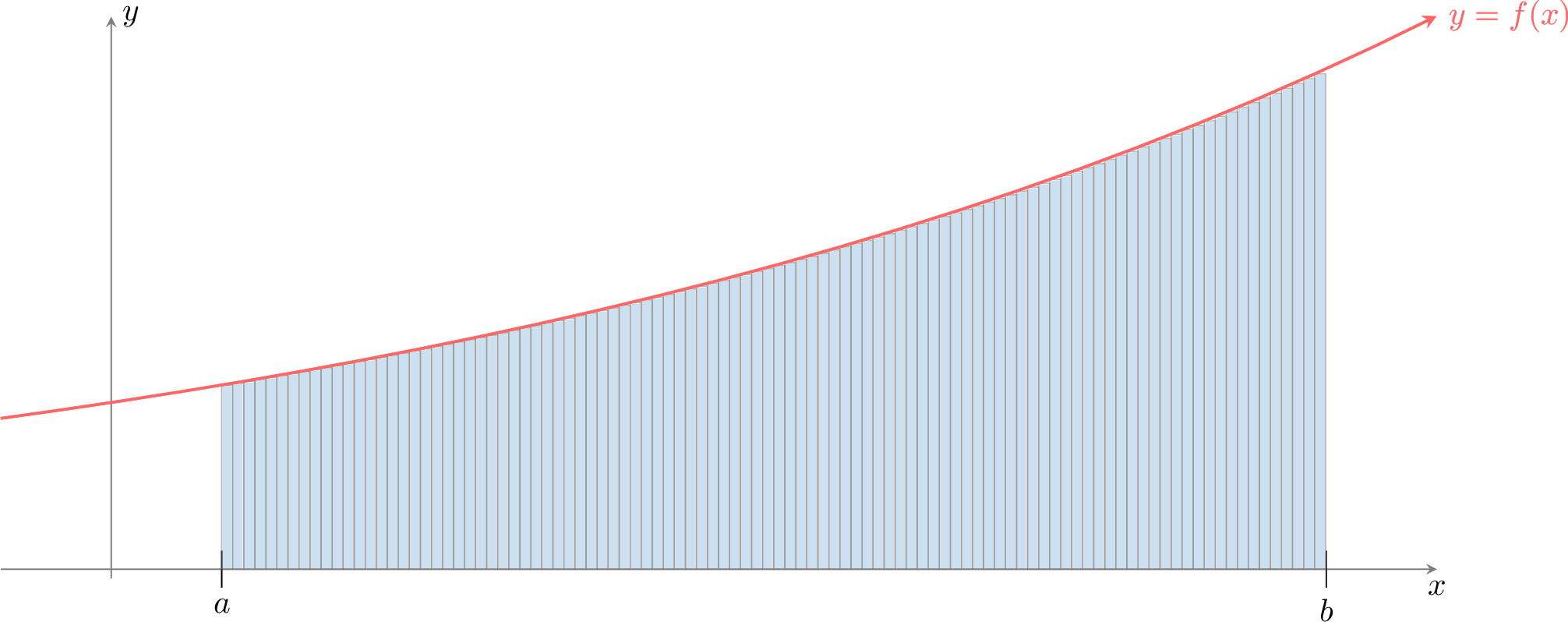
We aim to measure the shaded area, denoted \(\displaystyle\int_a^b f(x)\,\mathrm{d}x\), under the curve of a continuous non-negative function \(y=f(x)\). 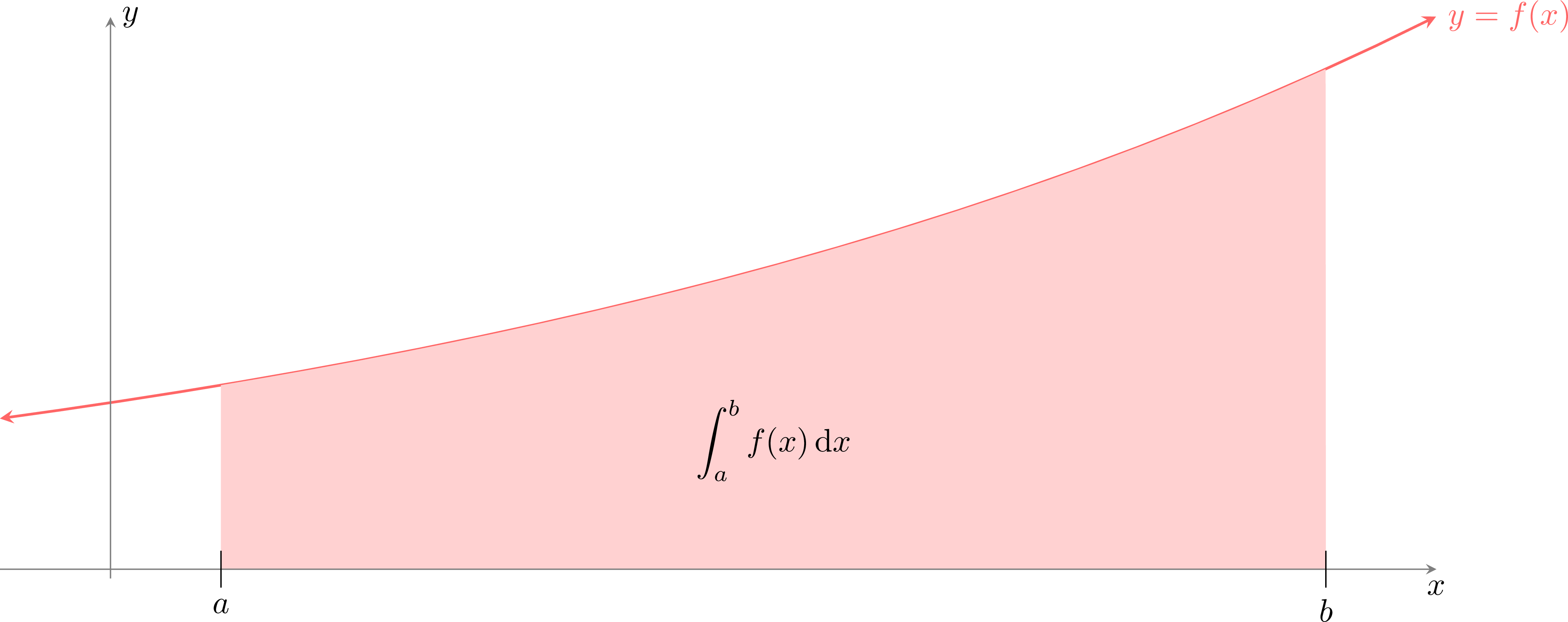
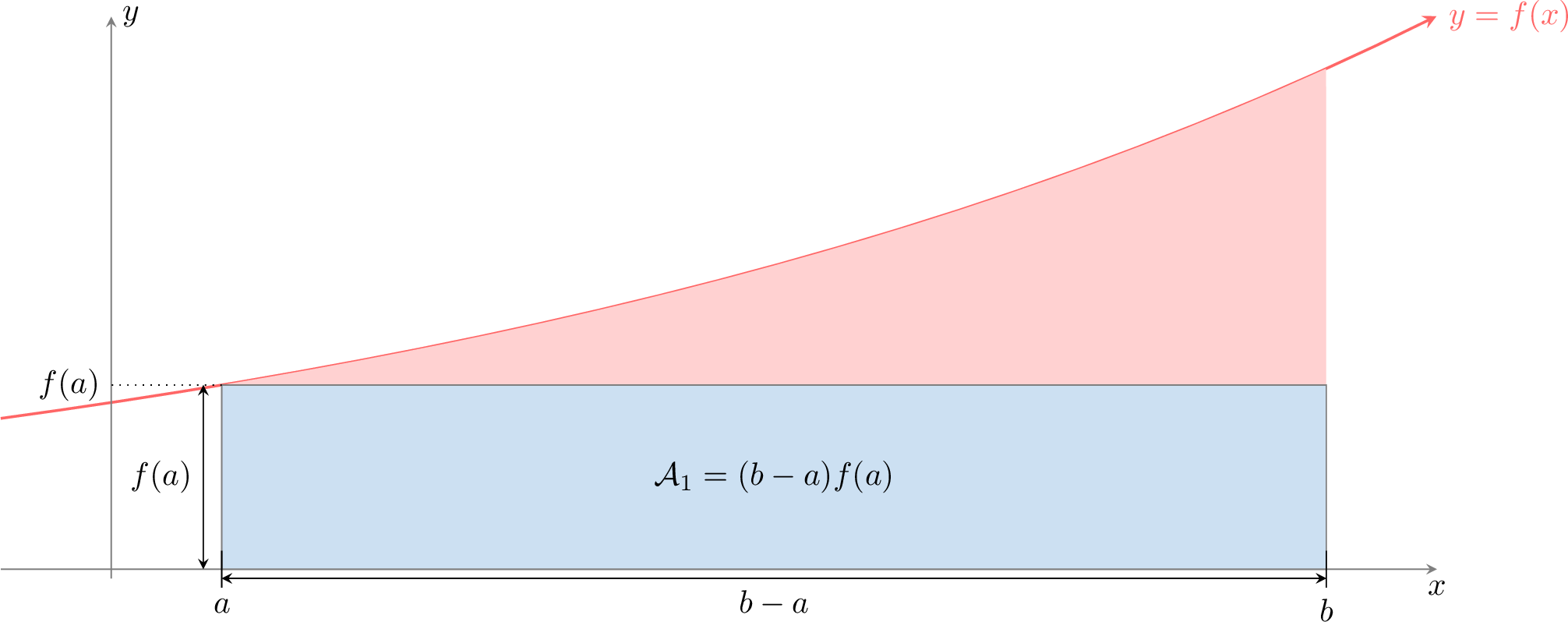
- Approximation with 1 rectangle: We can make a first, rough approximation by filling the area with a single rectangle of width \((b-a)\) and height \(f(a)\) (the value of the function at the left endpoint).
- Approximation with 4 rectangles: To improve the approximation, we divide the interval \([a,b]\) into 4 equal subintervals, each of width \(\frac{b-a}{4}\). We construct a rectangle on each subinterval, using the function's value at the left endpoint for the height.
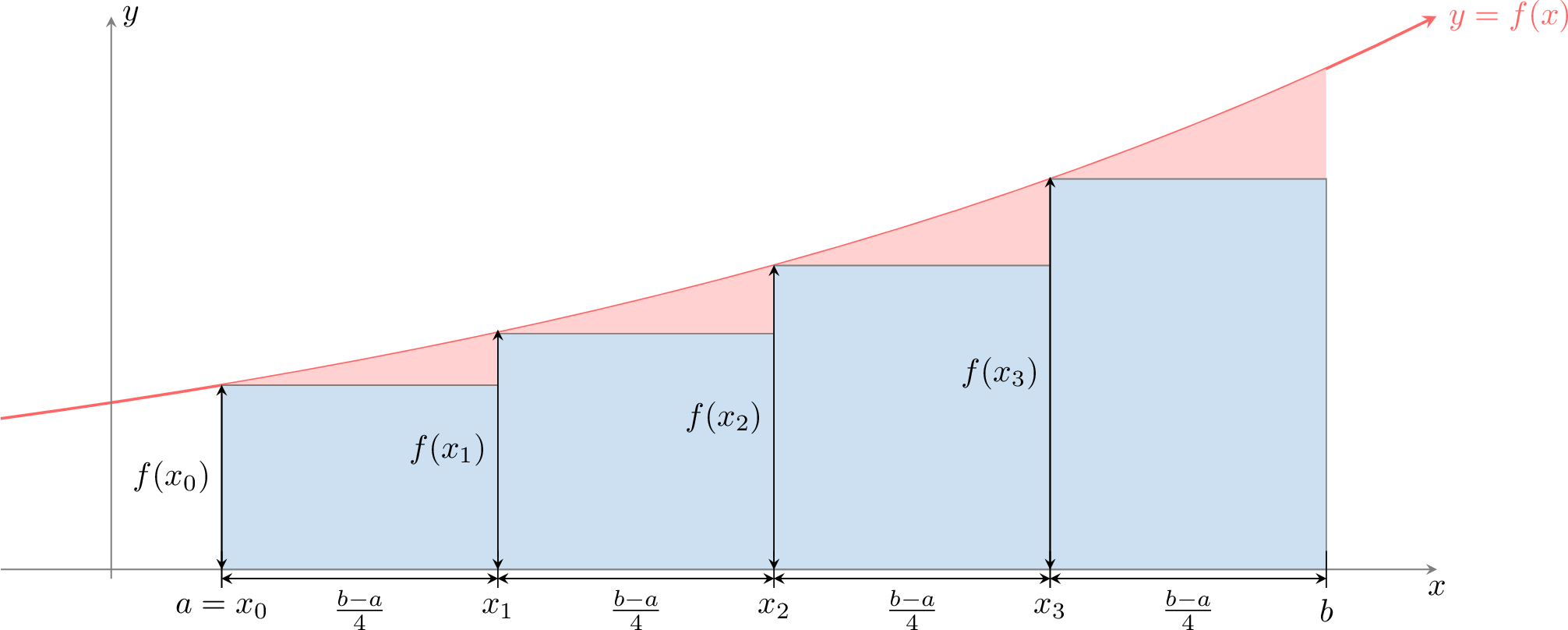
- Approximation with \(n\) rectangles: We can generalise this by dividing the interval into \(n\) equal subintervals, each of width \(\Delta x = \frac{b-a}{n}\). Let \(x_i=a+i\Delta x\) for \(i=0,1,\dots,n-1\). The sum of the areas of the \(n\) rectangles is: $$ S_n = \sum_{i=0}^{n-1} f(x_i) \Delta x. $$ As we increase the number of rectangles (\(n \to \infty\)), the width of each rectangle becomes infinitesimally small, and the sum of their areas becomes a perfect match for the area under the curve: $$\displaystyle\int_a^b f(x)\,\mathrm{d}x = \lim_{n\to\infty} S_n.$$
Skills to practice
- Approximating Area with Rectangles
I.2
Definition of the Definite Integral
Definition — Definite Integral
The definite integral of a continuous function \(f\) from \(a\) to \(b\) is the limit of the Riemann sum as the number of subintervals approaches infinity. It is denoted by: $$ \int_a^b f(x)\,\mathrm{d}x = \lim_{n \to \infty} \sum_{i=0}^{n-1} f(x_i) \Delta x $$ where the interval \([a,b]\) is divided into \(n\) subintervals of equal width \(\Delta x = \dfrac{b-a}{n}\) and \(x_i = a + i\Delta x\). - \(a\) and \(b\) are the limits of integration.
- \(f(x)\) is the integrand.
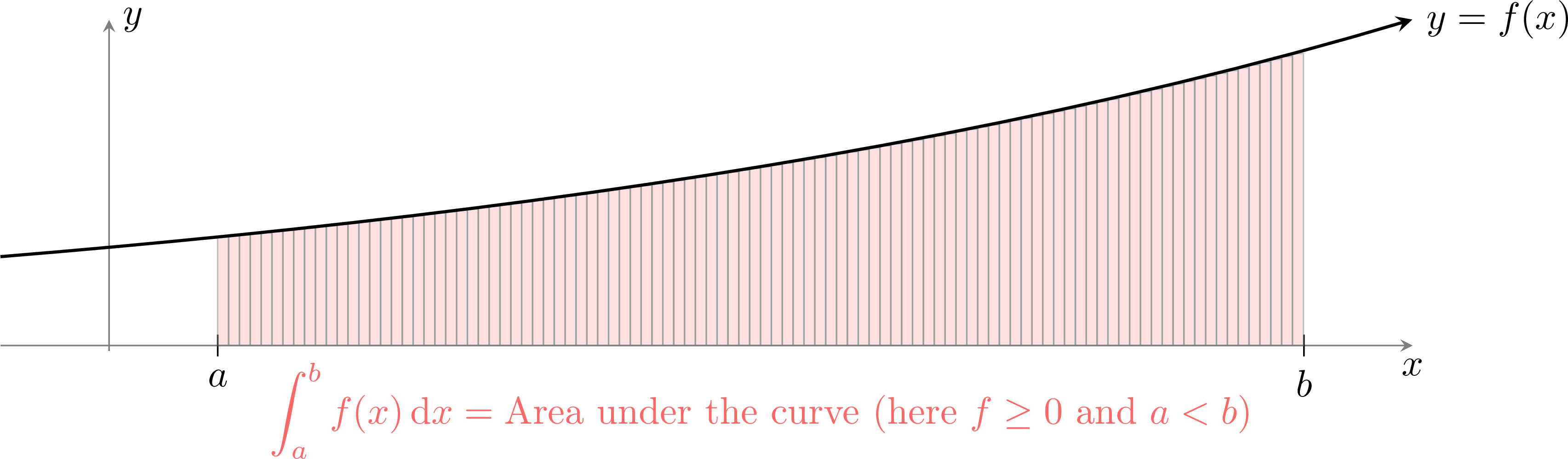
This notation, introduced by Leibniz, captures the idea of summing (\( \int \) is an elongated 'S' for summa) the areas of infinitely many rectangles of height \(f(x)\) and infinitesimal width \(\mathrm{d}x\). 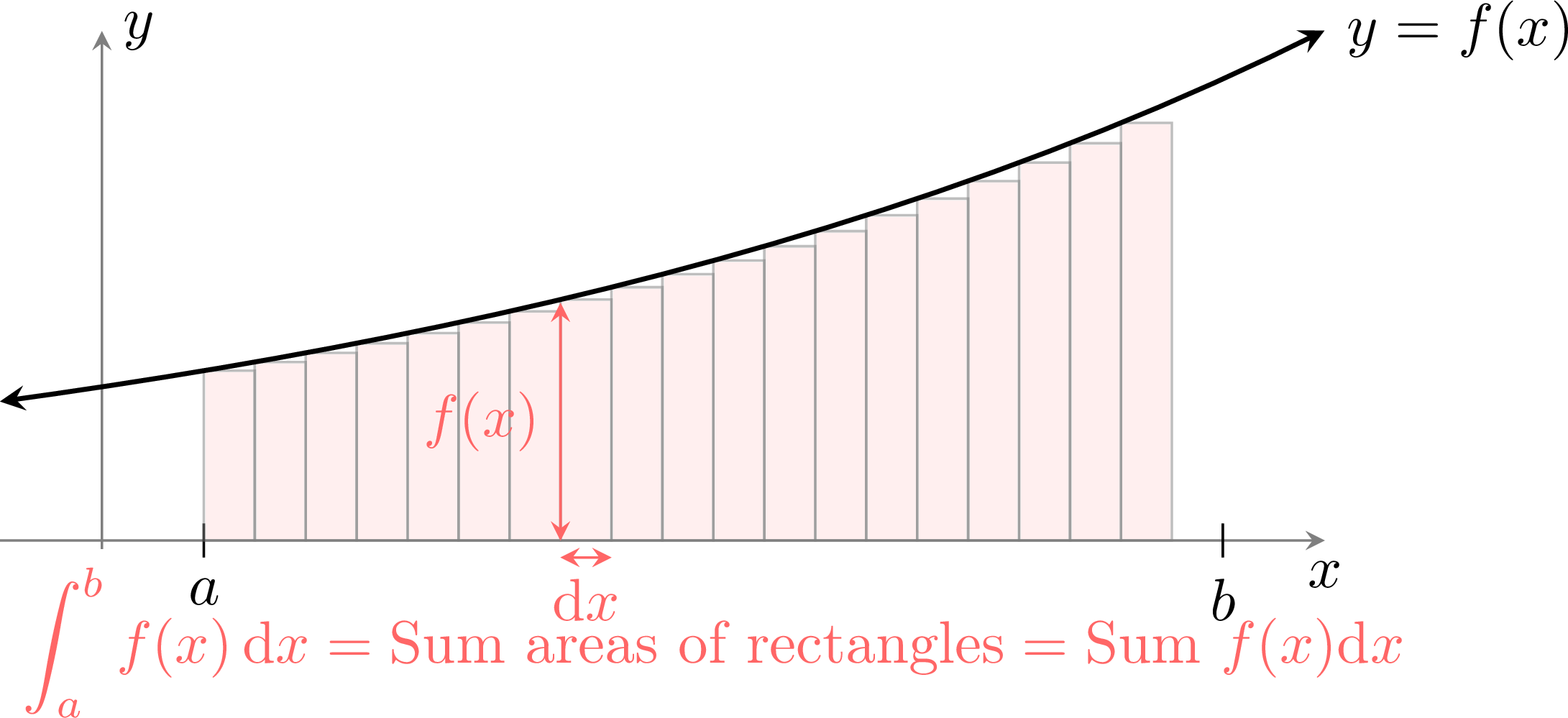
Definition — Signed Area
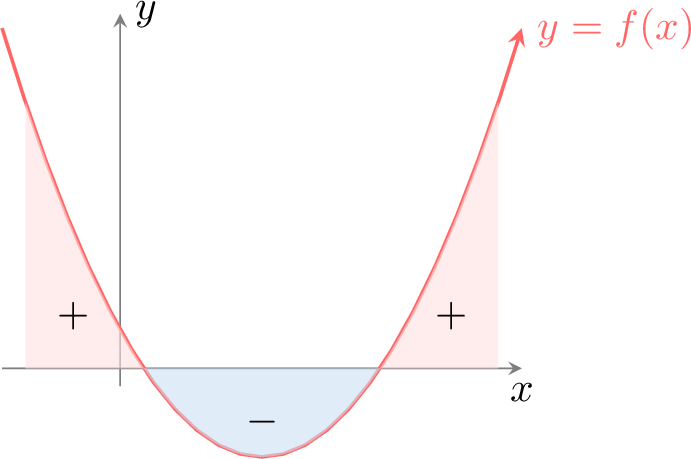
The definite integral calculates the signed area. - Area above the x-axis is counted as positive.
- Area below the x-axis is counted as negative.
Example
Determine the integral \(\displaystyle\int_{-1}^{2} 1\,\mathrm{d}x\) by interpreting it as an area.
The integral represents the area under the constant function \(f(x)=1\) from \(x=-1\) to \(x=2\). This forms a rectangle with width \(2 - (-1) = 3\) and height \(1\). 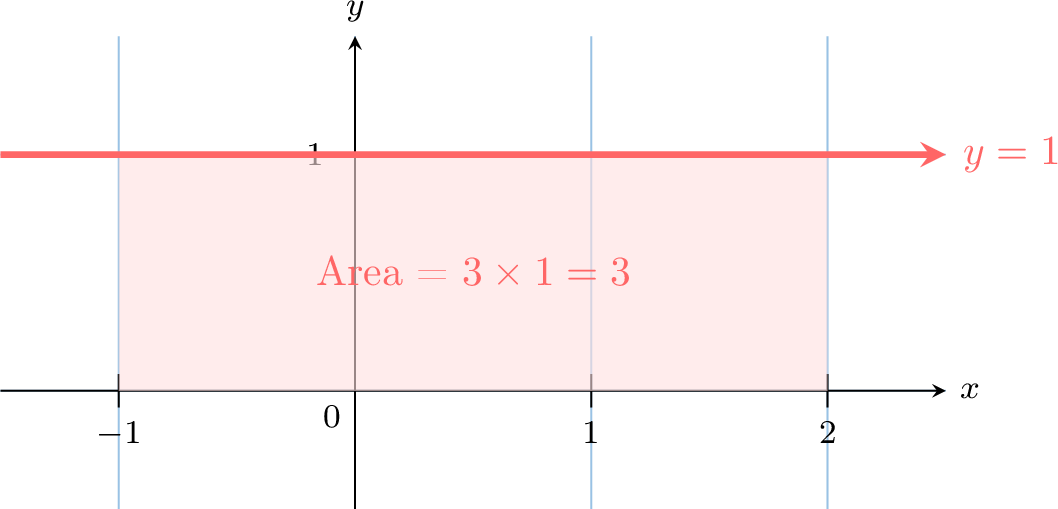
Therefore, \(\displaystyle\int_{-1}^{2}1\,\mathrm{d}x= 3.\)
Skills to practice
- Identifying the Integral That Gives an Area
- Reading the Sign of an Integral
- Evaluating Integrals with Area Formulas
I.3
Properties of the Definite Integral
Proposition — Properties of Integration
Let \(f\) and \(g\) be continuous on an interval \(I\), \(a\), \(b\), \(c\) three real numbers in \(I\), and \(k\) a constant. - Zero-Width Interval: $$\displaystyle\int_a^a f(x) \;\mathrm{d}x= 0.$$
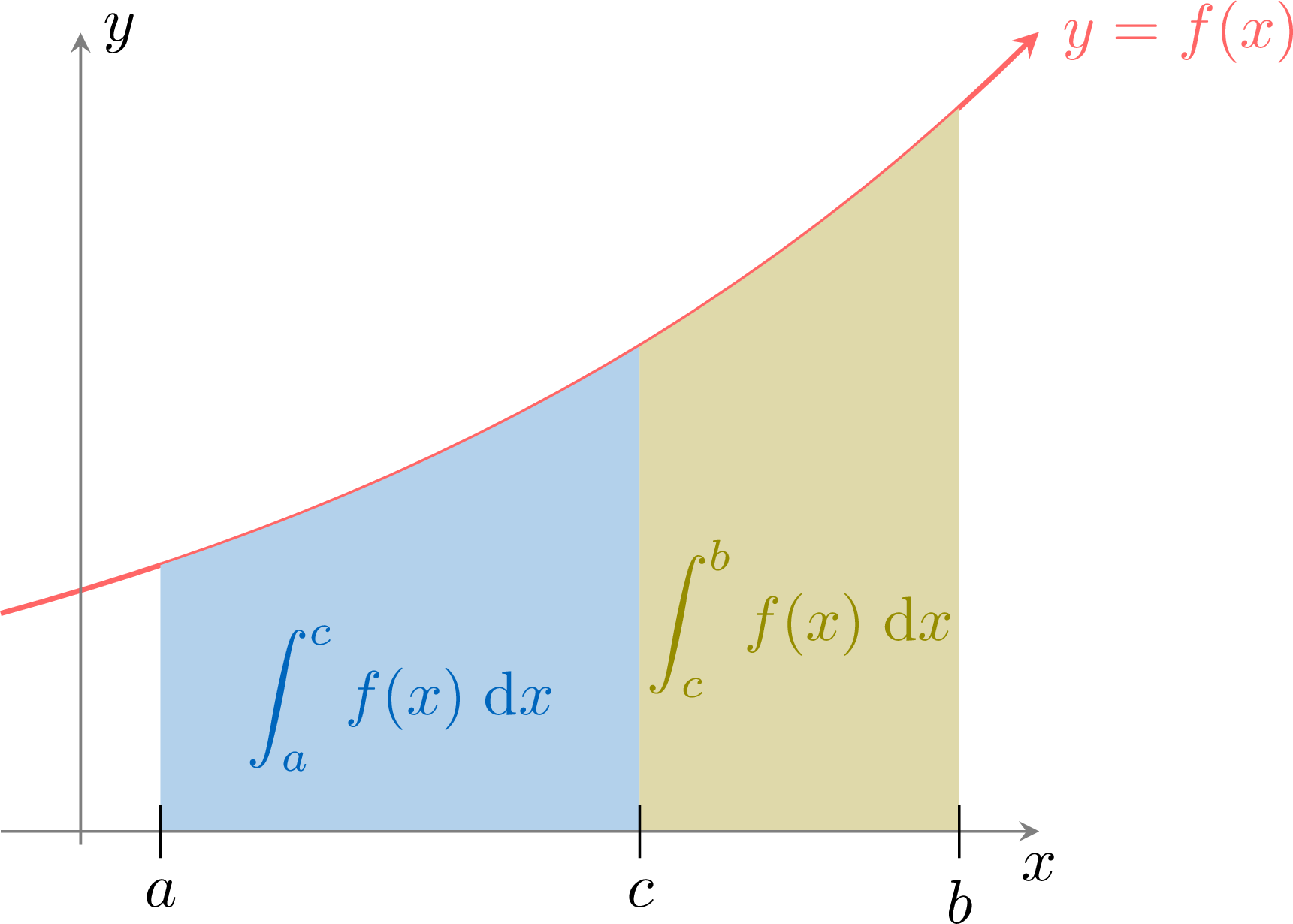
- Additivity of Intervals: For any \(c\) in \(I\) (the figure shows \(c\) between \(a\) and \(b\)): $$\displaystyle\int_a^b f(x)\;\mathrm{d}x = \int_a^c f(x) \; \mathrm{d}x + \int_c^b f(x)\;\mathrm{d}x$$
- Linearity: $$\displaystyle\int_a^b (f(x)+g(x)) \; \mathrm{d}x= \int_a^b f(x) \; \mathrm{d}x+ \int_a^b g(x) \; \mathrm{d}x$$ $$\displaystyle\int_a^b k f(x) \; \mathrm{d}x= k \int_a^b f(x) \; \mathrm{d}x.$$
- Reversing the Bounds: Exchanging the two bounds changes the sign of the integral: $$\displaystyle\int_b^a f(x) \; \mathrm{d}x= -\int_a^b f(x) \; \mathrm{d}x.$$
Skills to practice
- Applying the Properties of Integrals
II
Antiderivatives and the Fundamental Theorem
II.1
Antiderivatives and Initial Conditions
So far, we have defined the definite integral as the limit of a sum—a geometric concept of area. Separately, differentiation is a process of finding rates of change. The Fundamental Theorem of Calculus provides a profound and powerful link between these two seemingly unrelated ideas: integration and differentiation are inverse processes of each other.
Definition — Antiderivative
A function \(F\) is an antiderivative of a function \(f\) if \(F'(x) = f(x)\). The process of finding an antiderivative is called antidifferentiation or indefinite integration. 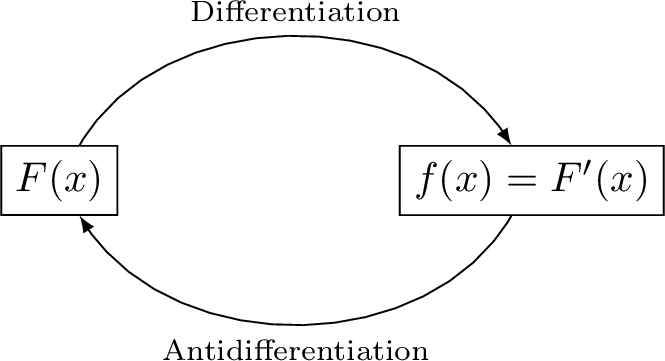
Since the derivative of a constant is zero, no function has a unique antiderivative. For example, if \(F(x) = x^2\) is an antiderivative of \(f(x)=2x\), then \(G(x)=x^2+5\) is also an antiderivative, since \(G'(x) = 2x+0 = 2x\). All antiderivatives of a function differ only by a constant.
Proposition — Existence
Every continuous function on an interval \(I\) admits antiderivatives on \(I\) (a function continuous on an interval is a function whose graph can be drawn without lifting the pencil; all the functions studied here are continuous on each interval on which they are defined). This result is accepted here without proof: its proof uses integral calculus. Proposition — General Form
If \(F\) is an antiderivative of \(f\) on an interval \(I\), then any other antiderivative \(G\) of \(f\) on \(I\) is defined by:$$ \textcolor{colorprop}{G(x) = F(x) + C} \quad \text{where } C \in \mathbb{R} \text{ is a constant.} $$
Let \(F\) be a fixed antiderivative of \(f\) on the interval \(I\).
- Analysis: Let \(G\) be any antiderivative of \(f\) on \(I\).
By definition, \(G'(x) = f(x)\) and \(F'(x) = f(x)\).
Consider the function \(H = G - F\). Its derivative is: $$ H'(x) = G'(x) - F'(x) = f(x) - f(x) = 0 $$ Since the derivative of \(H\) is zero on the interval \(I\), then \(H\) must be a constant function.
Therefore, there exists a constant \(C \in \mathbb{R}\) such that \(G(x) - F(x) = C\), which gives \(G(x) = F(x) + C\). - Synthesis: Conversely, let \(G\) be a function defined by \(G(x) = F(x) + C\) for some constant \(C \in \mathbb{R}\).
Then \(G\) is differentiable on \(I\) and \(G'(x) = F'(x) + 0 = f(x)\).
Thus, \(G\) is indeed an antiderivative of \(f\) on \(I\).
A Kinematic Reading
Two antiderivatives of the same function on an interval differ by a constant. Behind this result lies a fact accepted here without proof: a function whose derivative is zero at every point of an interval is constant on that interval. Motion makes it natural.
- Let \(x(t)\) be the position, at time \(t\), of a body moving along an axis: its velocity is \(x'(t)\). If the velocity is zero at every instant of a time interval, the body does not move during that interval: its position is constant.
- Let \(F\) and \(G\) be two antiderivatives of the same function \(f\) on an interval \(I\). They behave like the positions of two bodies moving along the same axis with the same velocity \(f(t)\) at every instant: the gap \(G(t) - F(t)\) has derivative \(f(t) - f(t) = 0\), so it does not change. There is a constant \(C\) such that \(G = F + C\) on \(I\).
Definition — Indefinite Integral
The family of all antiderivatives of a function \(f\) is called the indefinite integral of \(f\). It is denoted by: $$ \int f(x)\,\mathrm{d}x = F(x)+C $$ where \(F\) is any particular antiderivative of \(f\) and \(C\) is an arbitrary constant called the constant of integration. Proposition — Initial Condition
Let \(f\) be continuous on \(I\) and let \(x_0 \in I\) and \(y_0 \in \mathbb{R}\).Then there exists a unique antiderivative \(F\) of \(f\) on \(I\) such that \(F(x_0) = y_0\).
Let \(G\) be any antiderivative of \(f\) on \(I\).
According to the General Form proposition, any antiderivative \(F\) of \(f\) must be of the form \(F(x) = G(x) + C\) for some constant \(C \in \mathbb{R}\).
The condition \(F(x_0) = y_0\) is therefore equivalent to:$$ G(x_0) + C = y_0 \iff C = y_0 - G(x_0) $$ Since \(y_0\) and \(G(x_0)\) are fixed real numbers, this equation has a unique solution for the constant \(C\).
Consequently, there exists one and only one antiderivative \(F\) satisfying the initial condition.
Example — Physics Application: The Falling Apple
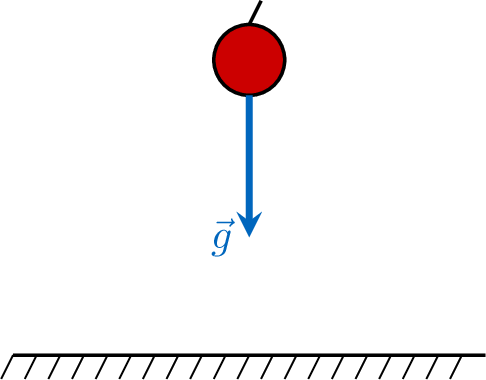
Consider an apple falling from a tree. Let \(v(t)\) be its velocity at time \(t\), measured along a vertical axis pointing upward; air resistance is neglected. According to Newton's second law, the derivative of the velocity is then the constant acceleration due to gravity:$$ v'(t) = -g \quad (\text{where } g \approx 9.8 \text{ m/s}^2) $$ The velocity function \(v\) is an antiderivative of the constant function \(f(t) = -g\). - Determine the general form of the velocity \(v(t)\).
- If the apple starts from rest at \(t=0\), we have the initial condition \(v(0) = 0\). Find the unique velocity function.
- The general antiderivatives of \(-g\) are of the form \(v(t) = -gt + C\).
- Using the initial condition: \(v(0) = -g(0) + C = 0 \implies C = 0\).
The unique solution is \(v(t) = -gt\).
Skills to practice
- Checking an Antiderivative by Differentiating
- Understanding Antiderivatives
- Guessing and Checking an Antiderivative
- Proving That a Function Is an Antiderivative
II.2
Finding Antiderivatives
The process of finding antiderivatives relies on reversing the rules of differentiation. Just as we have a table of derivatives for common functions, we can create a corresponding table of antiderivatives.
Proposition — Antiderivatives of Common Functions
$$\begin{array}{|c|c|}\hline \textbf{Function }f(x) & \textbf{An Antiderivative }F(x) \\
\hline k \text{ (a constant)} & k x\\
\hline x^{n}, n \neq-1 & \dfrac{x^{n+1}}{n+1} \\
\hline e^{x} & e^{x} \\
\hline \frac{1}{x} & \ln|x| \\
\hline \cos(x) & \sin(x) \\
\hline \sin(x) & -\cos(x) \\
\hline\end{array}$$ Each line holds on every interval where \(f\) is defined: for \(\dfrac{1}{x}\), and for \(x^n\) with \(n < 0\), on an interval that does not contain \(0\), \((-\infty, 0)\) or \((0, +\infty)\).
This table is obtained by reading the table of standard derivatives in reverse.
Example
Find an antiderivative of \(f(x)=\frac{1}{x^2}\) on the interval \((0, +\infty)\).
First, we rewrite the function using a negative exponent: \(f(x)=x^{-2}\).
An antiderivative of the power function \(f(x)=x^n\) (for \(n\neq -1\)) is \(F(x)=\dfrac{x^{n+1}}{n+1}\). With \(n=-2\), we have $$\begin{aligned} F(x) &= \frac{x^{-2+1}}{-2+1} \\ &= \frac{x^{-1}}{-1} \\ &= -\frac{1}{x}\end{aligned}$$
An antiderivative of the power function \(f(x)=x^n\) (for \(n\neq -1\)) is \(F(x)=\dfrac{x^{n+1}}{n+1}\). With \(n=-2\), we have $$\begin{aligned} F(x) &= \frac{x^{-2+1}}{-2+1} \\ &= \frac{x^{-1}}{-1} \\ &= -\frac{1}{x}\end{aligned}$$
Proposition — Linearity of Integration
Let \(u\) and \(v\) be two functions with antiderivatives \(U\) and \(V\), and let \(k\) be a constant. - An antiderivative of \(u+v\) is \(U+V\).
- An antiderivative of \(ku\) is \(kU\).
Example
Find an antiderivative of \(f(x)=2x+3\).
We use the linearity property to find the antiderivative of each term separately.
- An antiderivative of \(2x\) is \(2 \cdot \dfrac{x^2}{2} = x^2\).
- An antiderivative of \(3\) is \(3x\).
Skills to practice
- Finding Antiderivatives of Basic Functions
- Applying the Linearity of Integration
- Finding a Function from Its Derivative and One Value
- Determining the Antiderivative That Satisfies a Condition
II.3
Antiderivatives of Composite Functions
Proposition — Antiderivatives of \(x \mapsto f(ax + b)\)
Let \(f\) be a function with an antiderivative \(F\) on an interval \(I\), and \(a\), \(b\) real numbers with \(a \neq 0\). On every interval on which \(ax + b\) stays in \(I\), $$\textcolor{colorprop}{x \mapsto \frac{1}{a}\,F(ax + b) \text{ is an antiderivative of } x \mapsto f(ax + b).}$$
The derivative of \(x \mapsto g(ax + b)\) is \(x \mapsto a\,g'(ax + b)\). With \(g = F\) and \(F' = f\): $$\begin{aligned}\left(\frac{1}{a}\,F(ax + b)\right)' &= \frac{1}{a} \times a\,F'(ax + b) &&\text{(derivative of } x \mapsto g(ax + b)\text{)}\\
&= f(ax + b). &&\text{(} F' = f\text{)}\end{aligned}$$ The factor \(\dfrac{1}{a}\) compensates the factor \(a\) that differentiation brings out.
Example
Determine an antiderivative of each function on the given interval. - \(f_1(x) = (2x - 1)^4\) on \(\mathbb{R}\).
- \(f_2(x) = \cos\left(3x + \dfrac{\pi}{4}\right)\) on \(\mathbb{R}\).
- \(f_3(x) = e^{-2x}\) on \(\mathbb{R}\).
- \(f_4(x) = \dfrac{1}{(2x + 1)^2}\) on \(\left(-\dfrac{1}{2}, +\infty\right)\).
Each time, name \(f\), an antiderivative \(F\) of \(f\), and \(a\); then \(x \mapsto \frac{1}{a}F(ax + b)\) answers.
- \(f(X) = X^4\), \(F(X) = \dfrac{X^5}{5}\), \(a = 2\): \(F_1(x) = \dfrac{1}{2} \times \dfrac{(2x - 1)^5}{5} = \dfrac{(2x - 1)^5}{10}\).
- \(f = \cos\), \(F = \sin\), \(a = 3\): \(F_2(x) = \dfrac{1}{3}\sin\left(3x + \dfrac{\pi}{4}\right)\).
- \(f = \exp\), \(F = \exp\), \(a = -2\): \(F_3(x) = -\dfrac{1}{2}\,e^{-2x}\).
- \(f(X) = \dfrac{1}{X^2}\), \(F(X) = -\dfrac{1}{X}\) on \((0, +\infty)\), \(a = 2\), and \(2x + 1 \gt 0\) for \(x \gt -\frac{1}{2}\): \(F_4(x) = \dfrac{1}{2} \times \left(-\dfrac{1}{2x + 1}\right) = -\dfrac{1}{2(2x + 1)}\).
Proposition — Antiderivatives of Composite Functions (Reverse Chain Rule)
Let \(u\) be a differentiable function of \(x\). $$\begin{array}{|c|c|}\hline \textbf{Function }f(x) & \textbf{An Antiderivative }F(x) \\
\hline u'(x) [u(x)]^n, \quad n \neq -1 & \dfrac{[u(x)]^{n+1}}{n+1} \\
\hline \dfrac{u'(x)}{u(x)} & \ln|u(x)| \\
\hline u'(x)e^{u(x)} & e^{u(x)} \\
\hline\end{array}$$ Each line holds on every interval where the expressions are defined: for \(\dfrac{u'(x)}{u(x)}\), and for \(n < 0\), on an interval where \(u(x) \neq 0\). Example
Find an antiderivative of \(f(x)=\frac{2x}{x^2+1}\).
The function \(f(x)\) is of the form \(\dfrac{u'(x)}{u(x)}\).
Let \(u(x) = x^2+1\). Then its derivative is \(u'(x) = 2x\).
So, we can write \(f(x) = \dfrac{u'(x)}{u(x)}\).
From the table, an antiderivative is \(F(x) = \ln|u(x)|\).
Substituting back, we get \(F(x) = \ln|x^2+1|\). Since \(x^2+1\) is always positive, we can remove the absolute value bars: $$ F(x) = \ln(x^2+1) $$
Skills to practice
- Finding Antiderivatives of \(f(ax + b)\)
- Applying the Reverse Chain Rule
- Finding Antiderivatives of Composites with a Condition
II.4
The Fundamental Theorem of Calculus
Theorem — Fundamental Theorem of Calculus
If \(f\) is a continuous function on the interval \([a,b]\) and \(F\) is any antiderivative of \(f\), then: $$ \int_a^b f(x)\,\mathrm{d}x = F(b) - F(a) $$ This result is often written using the notation \(\left[ F(x) \right]_a^b = F(b)-F(a)\).
The theorem states that integration and differentiation are inverse processes. We can understand this by examining the “area function”.
- Defining the Area Function: We define a function, \(A(x)\), as the area under the curve \(y=f(t)\) from a fixed starting point \(a\) to a variable endpoint \(x\): $$ A(x) = \int_a^x f(t) \, \mathrm{d}t. $$ Our goal is to show that the derivative of this area function, \(A'(x)\), is simply the original function \(f(x)\).
- The Area of a Thin Strip: By its definition, the area of a thin vertical strip between \(x\) and \(x+h\) is the difference between the total area up to \(x+h\) and the total area up to \(x\): $$ \text{Area of strip} = A(x+h) - A(x). $$
- Approximating the Area of the Strip: As shown in the diagram, if the width \(h\) is very small, this thin strip is almost a perfect rectangle.
- The width of the rectangle is \(h\).
- The height of the rectangle is approximately \(f(x)\).
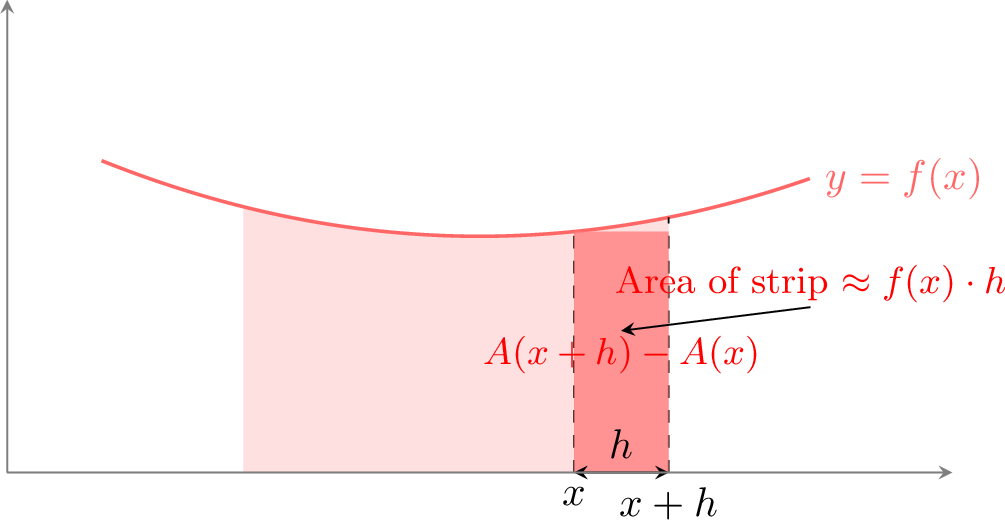
- Connecting to the Derivative: We now have two expressions for the area of the strip: $$ A(x+h) - A(x) \approx f(x) \cdot h. $$ Dividing both sides by \(h\), we get the difference quotient for the function \(A(x)\): $$ \frac{A(x+h) - A(x)}{h} \approx f(x). $$
- Taking the Limit: This approximation becomes a perfect equality as the width of the strip, \(h\), approaches zero. Taking the limit of both sides: $$ \lim_{h\to 0}\frac{A(x+h)-A(x)}{h} = f(x). $$ The expression on the left is, by definition, the derivative of the area function, \(A'(x)\): $$ A'(x) = f(x). $$
- Finding the Formula: Let \(F(x)\) be any antiderivative of \(f(x)\). Since all antiderivatives of a function differ only by a constant, we know that: $$ A(x) = F(x) + C $$ for some constant \(C\). To find \(C\), we can evaluate this at \(x=a\): $$ A(a) = \int_a^a f(t)\,\mathrm{d}t = 0 $$ so $$ F(a) + C = 0 \implies C = -F(a). $$ Thus the area function is \(A(x) = F(x) - F(a)\).
To find the total area up to \(x=b\), we simply evaluate \(A(b)\): $$ \int_a^b f(x)\,\mathrm{d}x = A(b) = F(b) - F(a). $$
Remark
This theorem is fundamental because it connects the geometric concept of area (the definite integral) with the algebraic process of antidifferentiation. It gives us a powerful method to calculate exact areas without using the limit of a Riemann sum.
Example
Find \(\displaystyle \int_0^2 x^2 \mathrm{d}x\). - Find an antiderivative: An antiderivative of \(f(x)=x^2\) is \(F(x) = \dfrac{x^3}{3}\).
- Apply the Fundamental Theorem: $$\begin{aligned}\displaystyle \int_0^2 x^2 \mathrm{d}x &= \left[ \frac{x^3}{3} \right]_0^2\\ &= F(2) - F(0) \\ &=\frac{2^3}{3} -\frac{0^3}{3}\\ &=\frac{8}{3} - 0 = \frac{8}{3} \end{aligned}$$
Theorem — The Area Function Is an Antiderivative
Let \(f\) be continuous on an interval \(I\), and let \(a \in I\). The function \(F_a\) defined on \(I\) by $$ F_a(x) = \int_a^x f(t)\,\mathrm{d}t $$ is the antiderivative of \(f\) that vanishes at \(a\): \(F_a'=f\) and \(F_a(a)=0\). In particular, every function that is continuous on an interval admits antiderivatives. Skills to practice
- Evaluating Definite Integrals and Areas
- Evaluating Integrals with the Table and with a Variable Bound
- Proving the Properties of the Integral
III
Going further
Skills to practice
- Solving Problems without Technology
- Solving Problems with Technology
- Quiz
Jump to section