International Baccalaureate · DP 1: Applications and Interpretation SL
Points in Space
I
Locating Points in Space
I.1
Coordinates in Space
Recappreviously studied — click to reread
On the map of a bay, a grid locates every point of the sea surface by two numbers: the origin \(O\) is a buoy, the first axis points east, the second north, and the unit is the metre. A seagull flies \(12\) m above the point \((20, 40)\) of the map, a boat floats at the point \((40, 10)\), and a diver swims \(8\) m under the surface, right below the point \((10, 20)\). How many numbers are needed to say exactly where the seagull, the boat and the diver are? What does the last number measure, and what is special about the diver's numbers?
Three numbers. The first two locate the point of the map right below or right above the object; the third is its height above the sea surface, measured on a vertical axis through \(O\): $$\text{seagull } G(20, 40, 12), \qquad \text{boat } B(40, 10, 0), \qquad \text{diver } D(10, 20, -8).$$ The boat is on the surface: its height is \(0\). The diver is under the surface: its third number is negative, \(-8\). 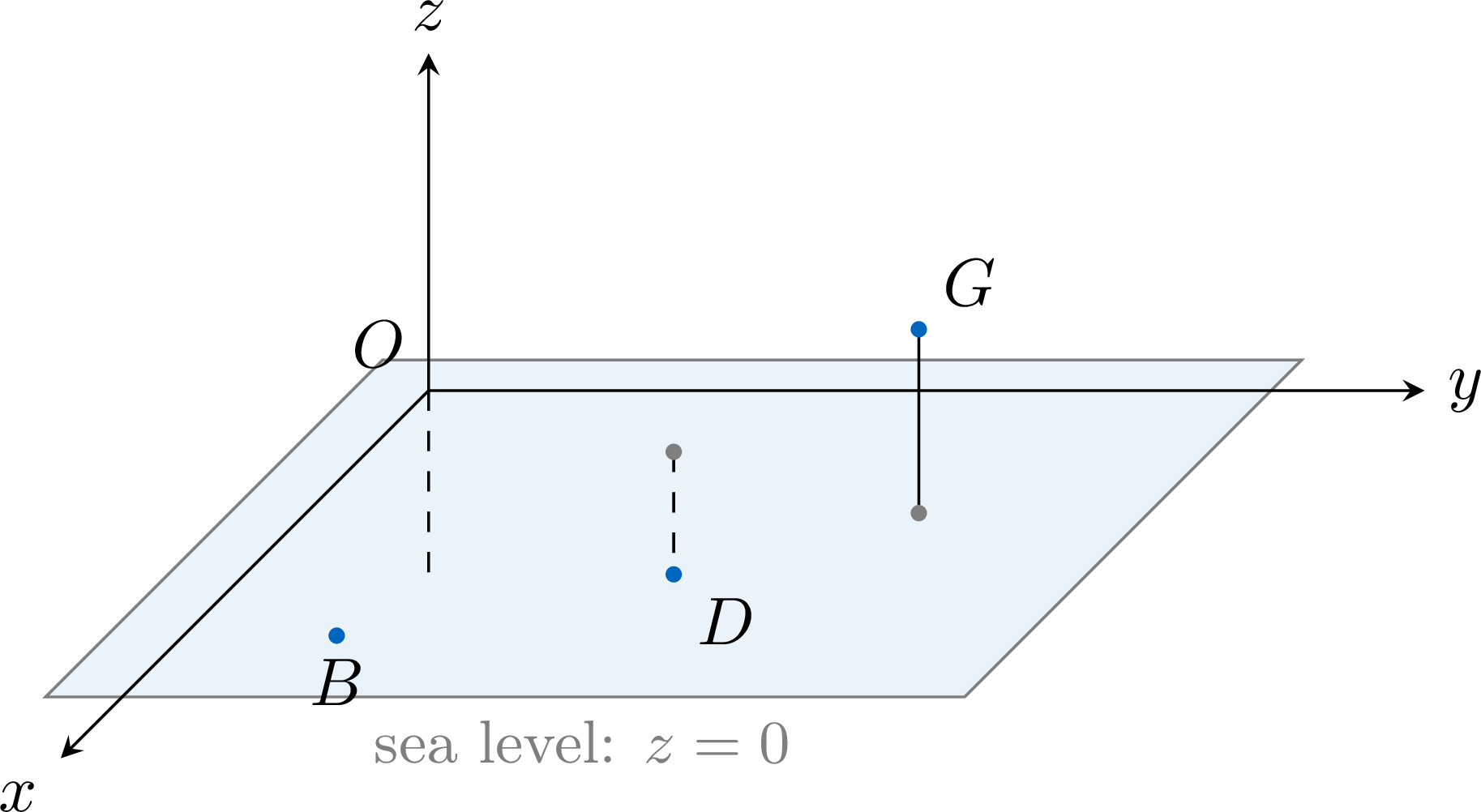
Definition — Coordinate System in Space
A coordinate system in space is made of a point \(O\), the origin, and three number lines through \(O\), perpendicular in pairs and graduated with the same unit (such a system is called orthonormal): the \(x\)-axis, the \(y\)-axis and the \(z\)-axis. Every point \(P\) of space is located by an ordered triple of numbers, its coordinates, written \(P(x, y, z)\): starting from \(O\), move \(x\) units along the \(x\)-axis, then \(y\) units parallel to the \(y\)-axis, then \(z\) units parallel to the \(z\)-axis — in the direction of the arrow for a positive number, in the opposite direction for a negative one. The number \(x\) is the \(x\)-coordinate of \(P\), \(y\) its \(y\)-coordinate and \(z\) its \(z\)-coordinate: the signed height of \(P\) relative to the plane of the \(x\)- and \(y\)-axes, positive above this plane and negative below it. The origin is \(O(0, 0, 0)\). 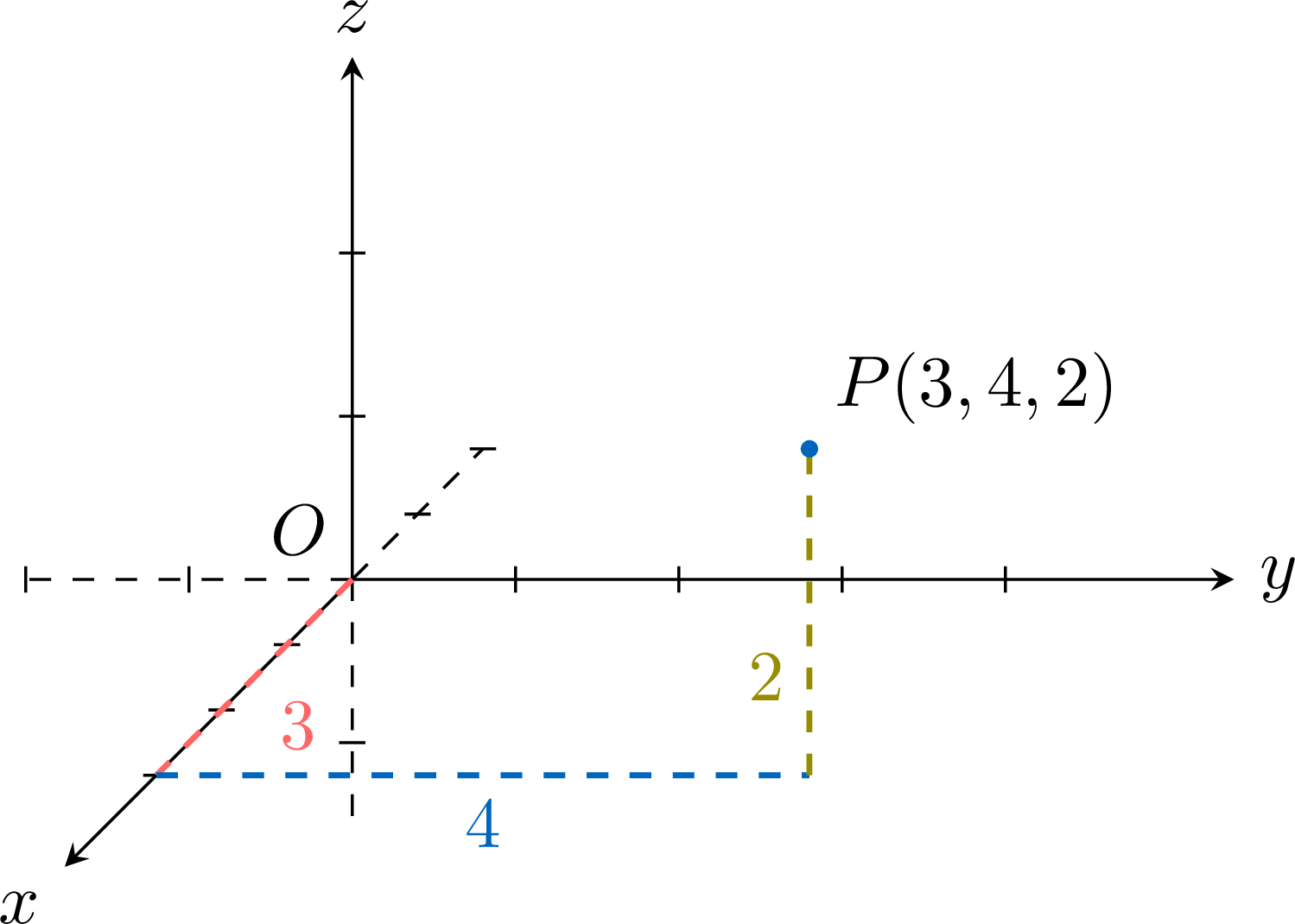
Definition — Right-Handed Coordinate System
By convention, the axes of a coordinate system in space are placed right-handed: when the thumb of the right hand points along the \(x\)-axis and the index finger along the \(y\)-axis, the middle finger, held at right angles to both, points along the \(z\)-axis — each finger in the direction of the arrow. Seen from above, from a point of the \(z\)-axis with \(z > 0\), the quarter turn that takes the \(x\)-axis onto the \(y\)-axis is then anticlockwise. With the middle finger pointing the other way, the system would be left-handed: the convention excludes it. 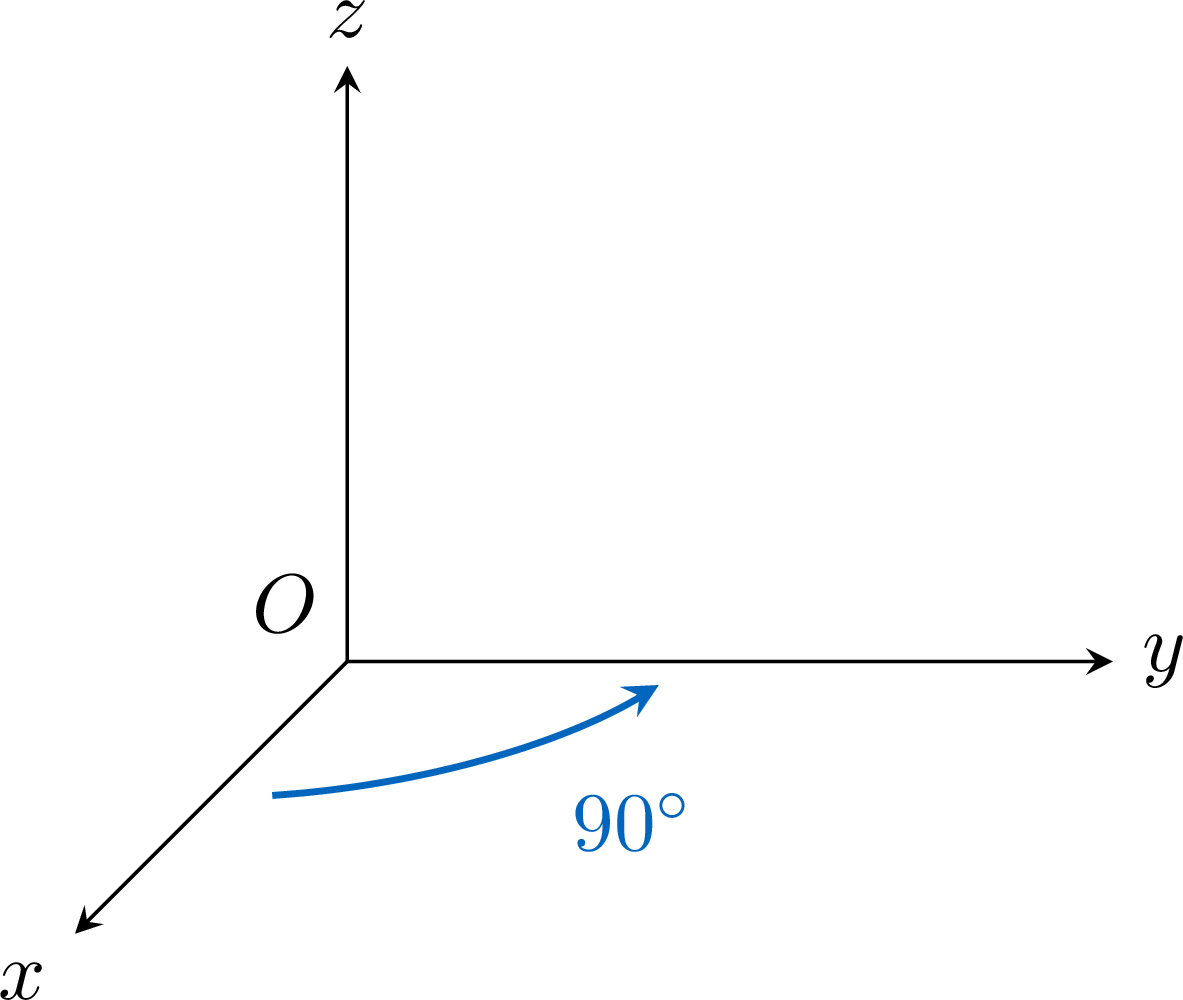
Definition — Coordinate Planes
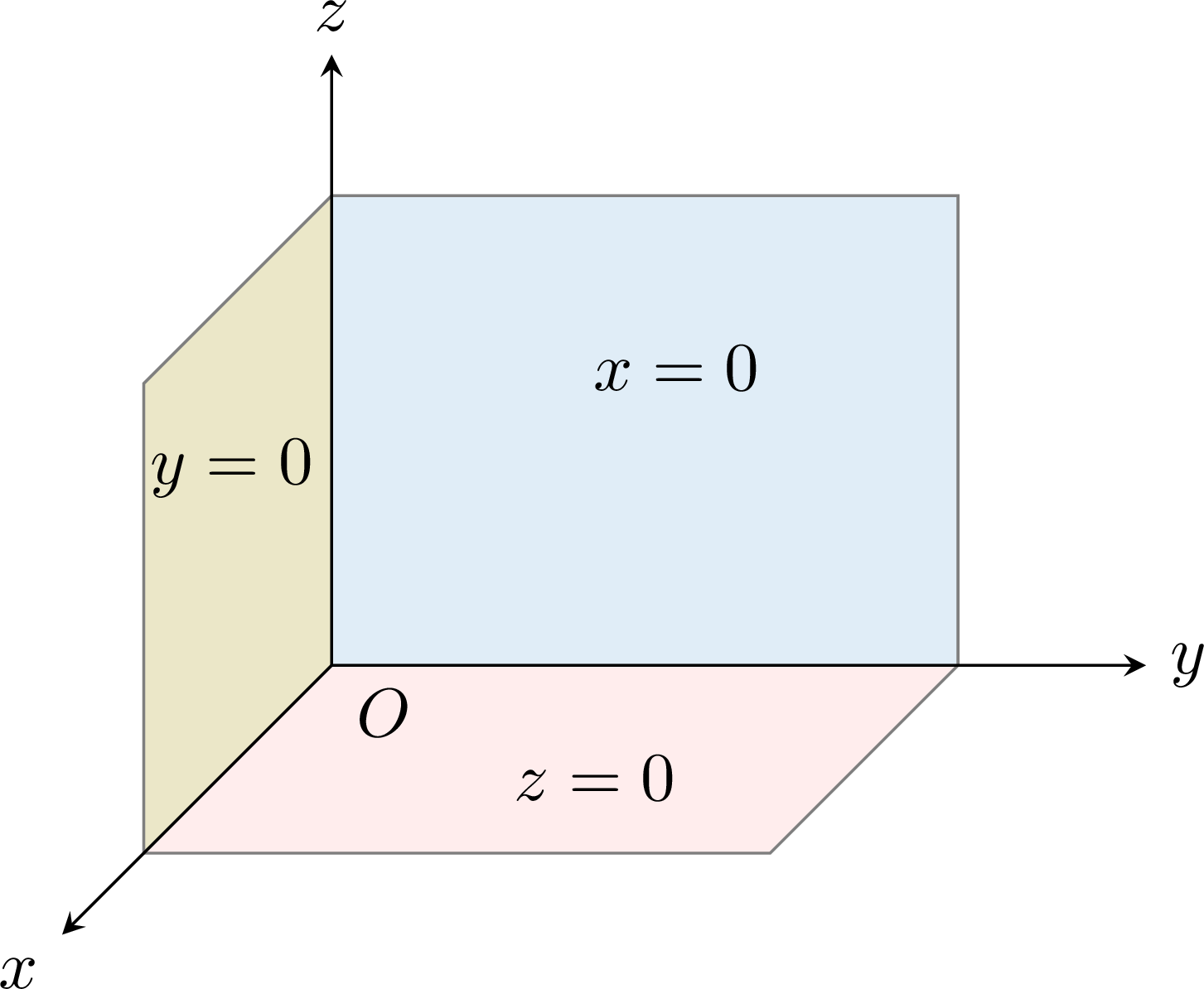
The axes, taken two at a time, span the three coordinate planes: - the \(xy\)-plane, which contains the \(x\)- and \(y\)-axes: its points are those with \(z = 0\);
- the \(xz\)-plane: the points with \(y = 0\);
- the \(yz\)-plane: the points with \(x = 0\).
Method — Plotting a Point in Space
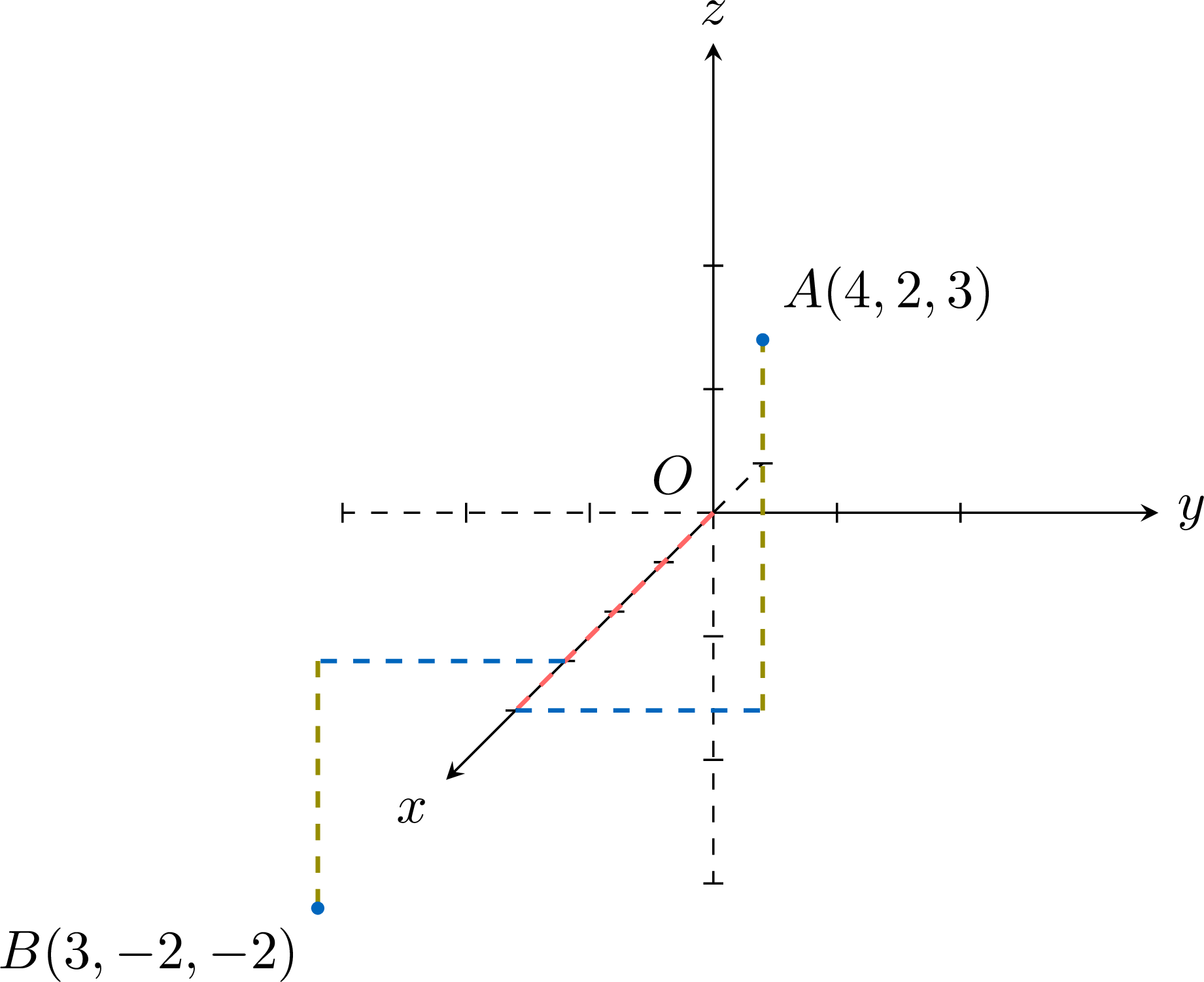
The axes are drawn in perspective: the \(y\)-axis horizontal, the \(z\)-axis vertical, and the \(x\)-axis, which points towards the reader, slanting down to the left with its unit shortened. To plot the point \(P(x, y, z)\): - from \(O\), move \(x\) units along the \(x\)-axis — towards the reader when \(x > 0\);
- then \(y\) units parallel to the \(y\)-axis — to the right when \(y > 0\);
- then \(z\) units vertically — up when \(z > 0\), down when \(z < 0\).
Example
Plot the points \(A(4, 2, 3)\) and \(B(3, -2, -2)\) on a perspective drawing of the axes. - \(A(4, 2, 3)\): \(4\) units towards the reader along the \(x\)-axis, then \(2\) units to the right, then \(3\) units up.
- \(B(3, -2, -2)\): \(3\) units towards the reader, then \(2\) units to the left, since \(y = -2\), then \(2\) units down, since \(z = -2\): the point \(B\) lies below the \(xy\)-plane.
Example
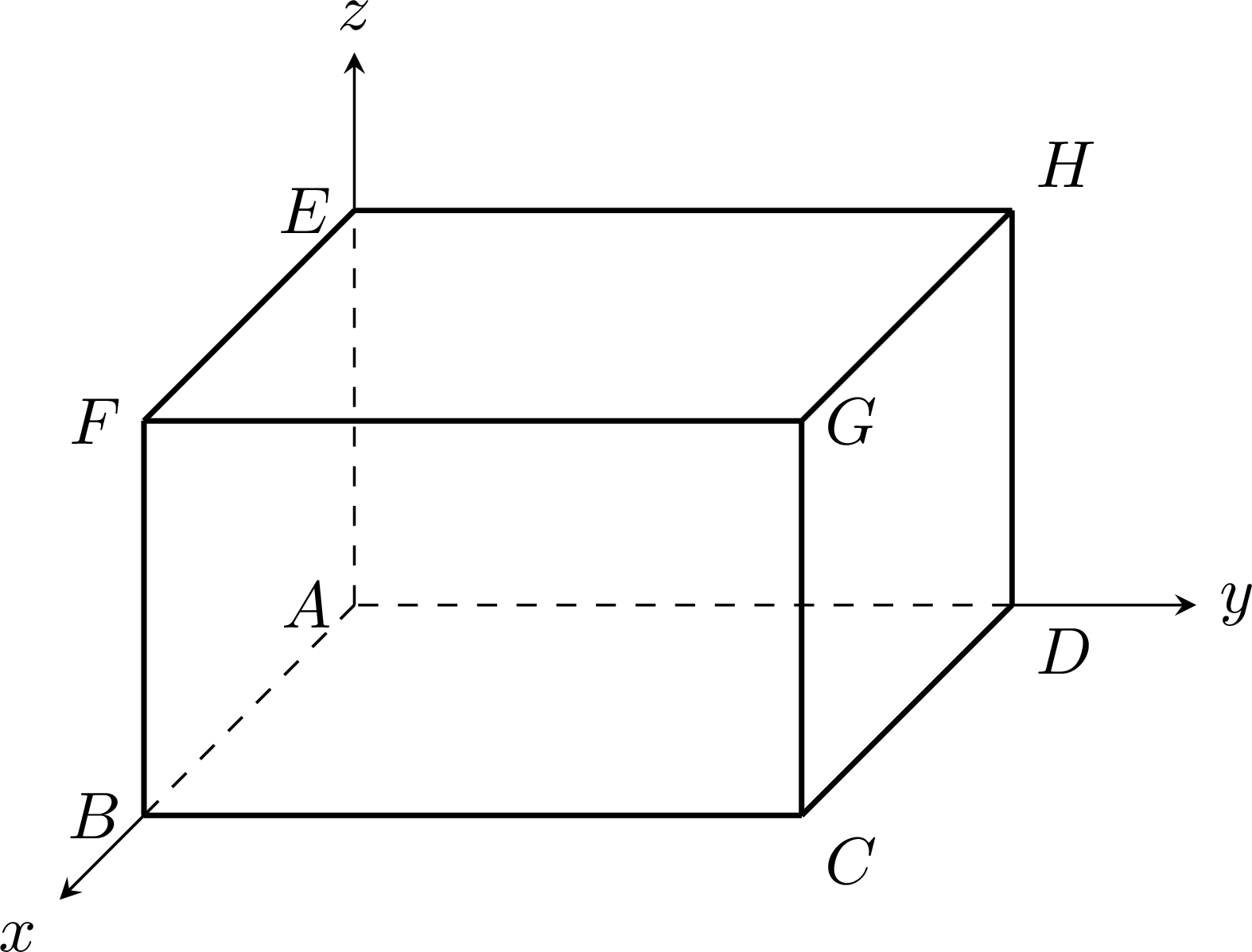
- The cuboid \(ABCDEFGH\) has its vertex \(A\) at the origin and its edges \(\Segment{AB}\), \(\Segment{AD}\) and \(\Segment{AE}\) along the axes, with \(AB = 4\), \(AD = 5\) and \(AE = 3\). Give the coordinates of its eight vertices.
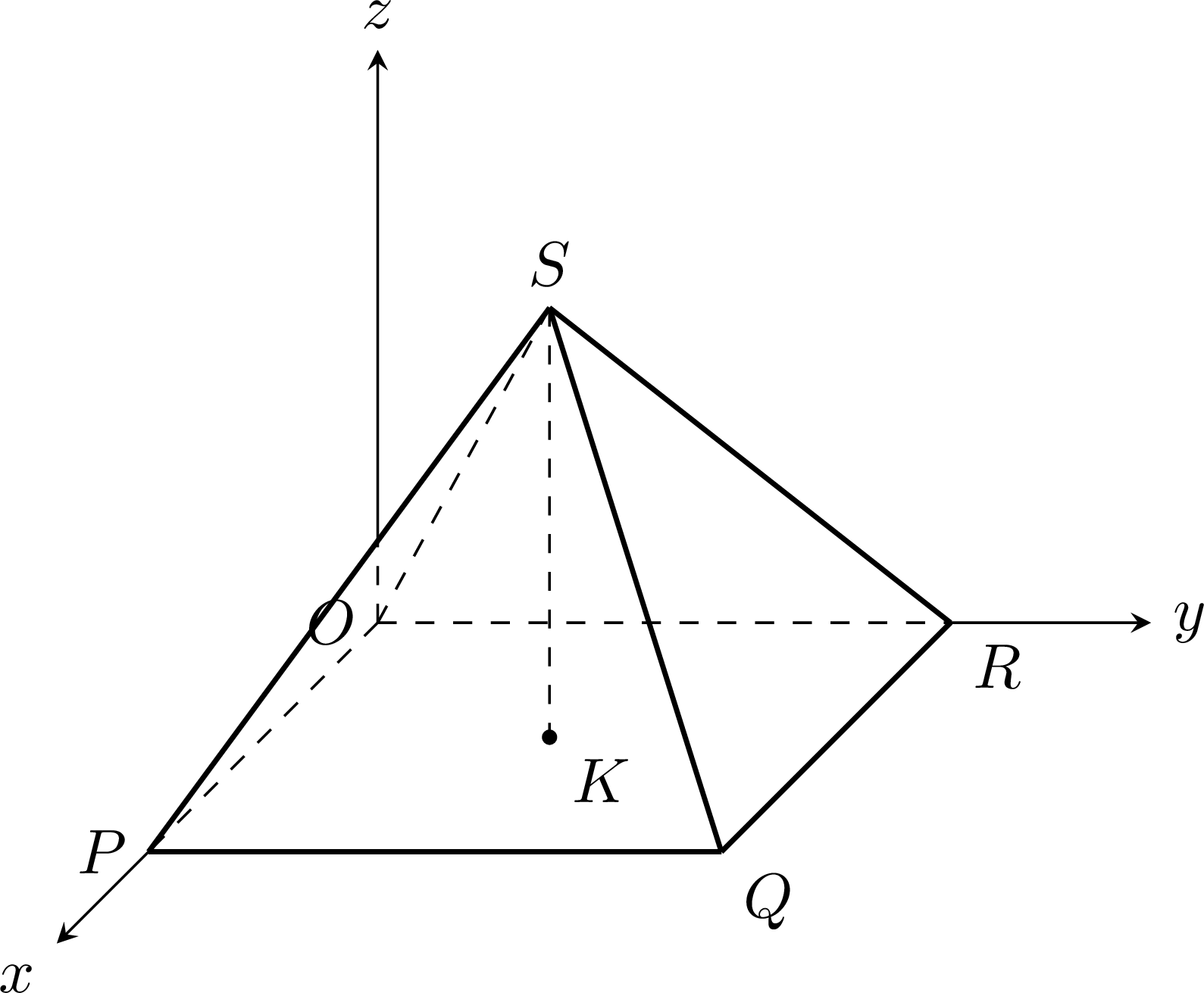
- The pyramid \(SOPQR\) has a square base \(OPQR\) of side \(4\) in the \(xy\)-plane, with \(O\) at the origin, \(P\) on the \(x\)-axis and \(R\) on the \(y\)-axis; its apex \(S\) is \(3\) units above the centre \(K\) of the base. Give the coordinates of \(P\), \(Q\), \(R\), \(K\) and \(S\).
- \(A\) is the origin: \(A(0, 0, 0)\). The vertices \(B\), \(D\) and \(E\) lie on the axes, at the distances \(AB = 4\), \(AD = 5\) and \(AE = 3\) from \(A\): \(B(4, 0, 0)\), \(D(0, 5, 0)\), \(E(0, 0, 3)\). The vertex \(C\) is reached by moving \(4\) units along the \(x\)-axis, then \(5\) units parallel to the \(y\)-axis: \(C(4, 5, 0)\). The top face \(EFGH\) lies right above the base, with \(z\)-coordinate \(3\): \(F(4, 0, 3)\), \(G(4, 5, 3)\), \(H(0, 5, 3)\).
- \(P(4, 0, 0)\), \(Q(4, 4, 0)\) and \(R(0, 4, 0)\). The centre of the square is halfway along each side of length \(4\): \(K(2, 2, 0)\). The apex is right above \(K\), \(3\) units up: \(S(2, 2, 3)\).
Skills to practice
- Locating Points on the Axes and in the Planes
- Reading Coordinates in a Solid
- Plotting and Locating Points in Space
II
Distance and Midpoint in Space
II.1
Distance Between Two Points
Recappreviously studied — click to reread
On the map of a bay, the origin \(O\) is a buoy at sea level, the first axis points east, the second north, the third up, and the unit is the metre. A seagull is at \(G(20, 40, 12)\) and a diver at \(D(10, 20, -8)\). How far is the seagull from the diver? Why is the distance between the points \((20, 40)\) and \((10, 20)\) of the map not the answer?
The map distance ignores the difference of heights, \(12 - (-8) = 20\) m. Two right-angled triangles give the true distance. From \(D\), move \(10\) m east to \(E(20, 20, -8)\), then \(20\) m north to \(C(20, 40, -8)\), right below \(G\) at the diver's depth. 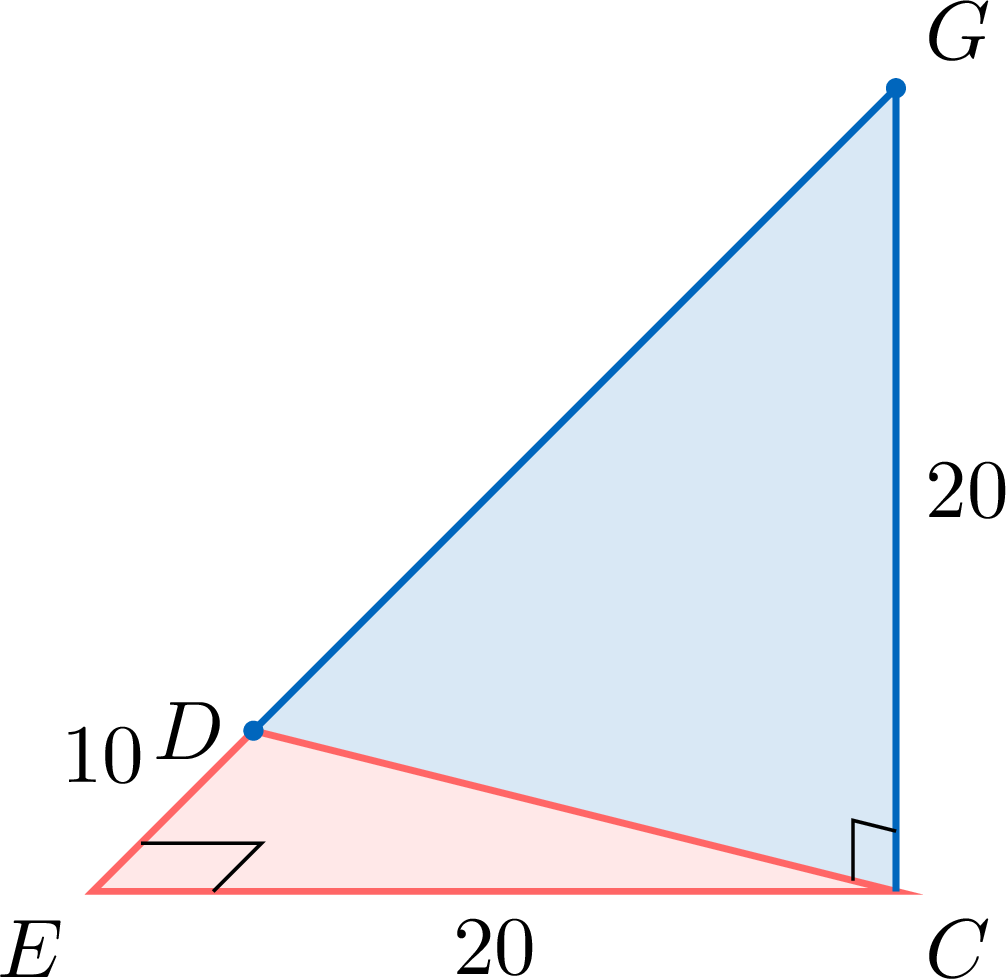
The triangle \(DEC\) is horizontal and right-angled at \(E\), since east and north are perpendicular; the triangle \(DCG\) is vertical and right-angled at \(C\), since \(\Segment{CG}\) is vertical and \(\Segment{DC}\) horizontal: $$\begin{aligned}[t] DC^2 &= DE^2 + EC^2 && \text{(Pythagoras' theorem in } DEC\text{)}\\
&= 10^2 + 20^2 \\
&= 500,\\
DG^2 &= DC^2 + CG^2 && \text{(Pythagoras' theorem in } DCG\text{)}\\
&= 500 + 20^2 \\
&= 900. \end{aligned}$$ So \(DG = \sqrt{900} = 30\) m, while the map distance is only \(\sqrt{500} \approx 22.4\) m.
Proposition — Distance Between Two Points
In an orthonormal coordinate system in space, the distance between the points \(A(x_A, y_A, z_A)\) and \(B(x_B, y_B, z_B)\) is $$AB = \sqrt{(x_B - x_A)^2 + (y_B - y_A)^2 + (z_B - z_A)^2}.$$
We apply Pythagoras' theorem twice: first in a horizontal right-angled triangle, then in a vertical one. Let \(D(x_B, y_A, z_A)\) and \(C(x_B, y_B, z_A)\): from \(A\), the point \(D\) is reached parallel to the \(x\)-axis, then \(C\) parallel to the \(y\)-axis, and \(B\) is right above or right below \(C\). 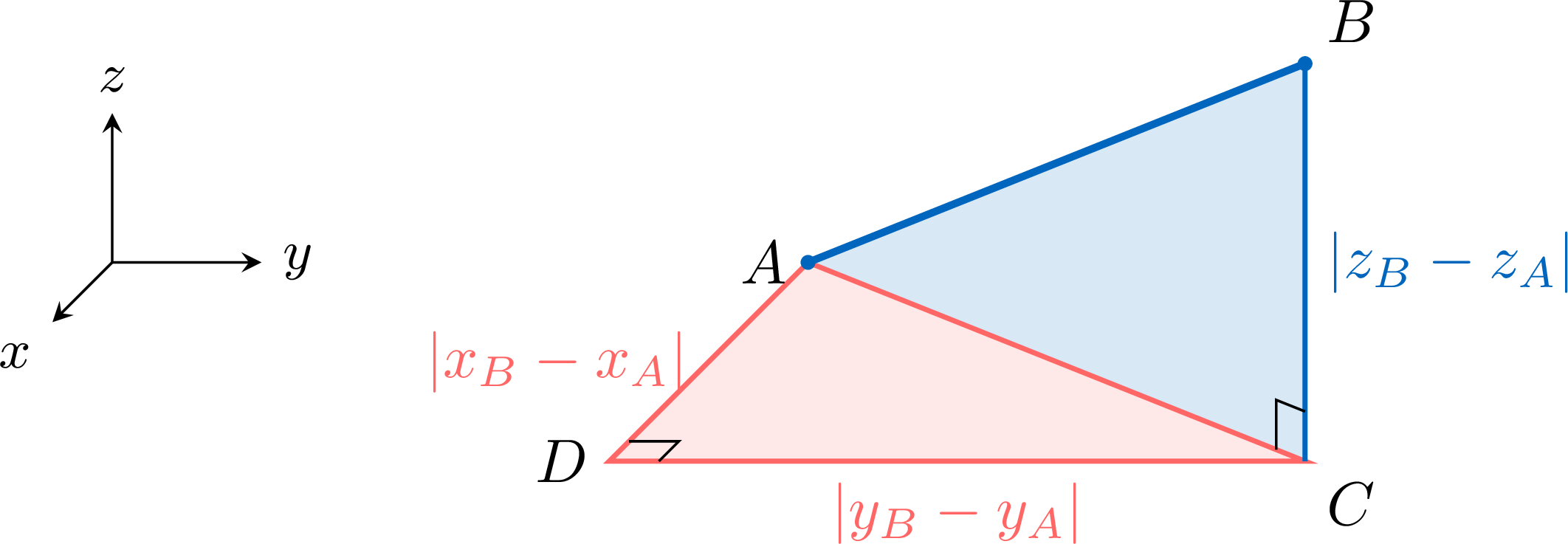
- The horizontal triangle \(ADC\). The segment \(\Segment{AD}\) is parallel to the \(x\)-axis and \(\Segment{DC}\) to the \(y\)-axis. These axes are perpendicular, so \(ADC\) is right-angled at \(D\), with \(AD = |x_B - x_A|\) and \(DC = |y_B - y_A|\).
- The vertical triangle \(ACB\). The segment \(\Segment{CB}\) is parallel to the \(z\)-axis, which is perpendicular to the \(xy\)-plane; the points \(A\) and \(C\) have the same \(z\)-coordinate \(z_A\), so \(\Line{AC}\) is horizontal. Hence \(ACB\) is right-angled at \(C\), with \(CB = |z_B - z_A|\).
Method — Calculating a Distance in Space
To calculate the distance \(AB\): - write the three differences of coordinates \(x_B - x_A\), \(y_B - y_A\) and \(z_B - z_A\) — the order of the two points does not matter, since \((x_A - x_B)^2 = (x_B - x_A)^2\);
- square them and add;
- take the square root, and give the exact value, with the square root simplified, before any rounding.
Example
Let \(A(2, -1, 5)\) and \(B(5, 3, -7)\). Calculate the distances \(AB\) and \(OA\), where \(O\) is the origin; give exact values.
$$\begin{aligned}[t] AB &= \sqrt{(x_B - x_A)^2 + (y_B - y_A)^2 + (z_B - z_A)^2} && \text{(distance formula)}\\
&= \sqrt{(5 - 2)^2 + (3 - (-1))^2 + (-7 - 5)^2} && \text{(coordinates of } A \text{ and } B\text{)}\\
&= \sqrt{3^2 + 4^2 + (-12)^2} \\
&= \sqrt{9 + 16 + 144} \\
&= \sqrt{169} \\
&= 13, \end{aligned}$$ $$\begin{aligned}[t] OA &= \sqrt{(2 - 0)^2 + (-1 - 0)^2 + (5 - 0)^2} && \text{(distance formula)}\\
&= \sqrt{4 + 1 + 25} \\
&= \sqrt{30}. \end{aligned}$$ The number \(30 = 2 \times 3 \times 5\) has no square factor other than \(1\): \(\sqrt{30}\) does not simplify.
Skills to practice
- Calculating a Distance in Space
- Using the Distance Formula
II.2
Midpoint of a Segment
Recappreviously studied — click to reread
The origin \(O\) is a buoy at sea level; the first axis points east, the second north, the third up, and the unit is the metre. A boat floats at \(B(40, 10, 0)\). Its anchor rests on the sea bed at \(A(30, 0, -30)\), and the anchor chain is taut, in a straight line from \(B\) to \(A\). A float is fixed at the middle \(M\) of the chain. Guess the coordinates of \(M\), then check the guess with distances.
Halfway from \(B\) to \(A\), each coordinate has changed by half as much: the guess is \(M(35, 5, -15)\), each coordinate being the mean of those of \(B\) and \(A\). 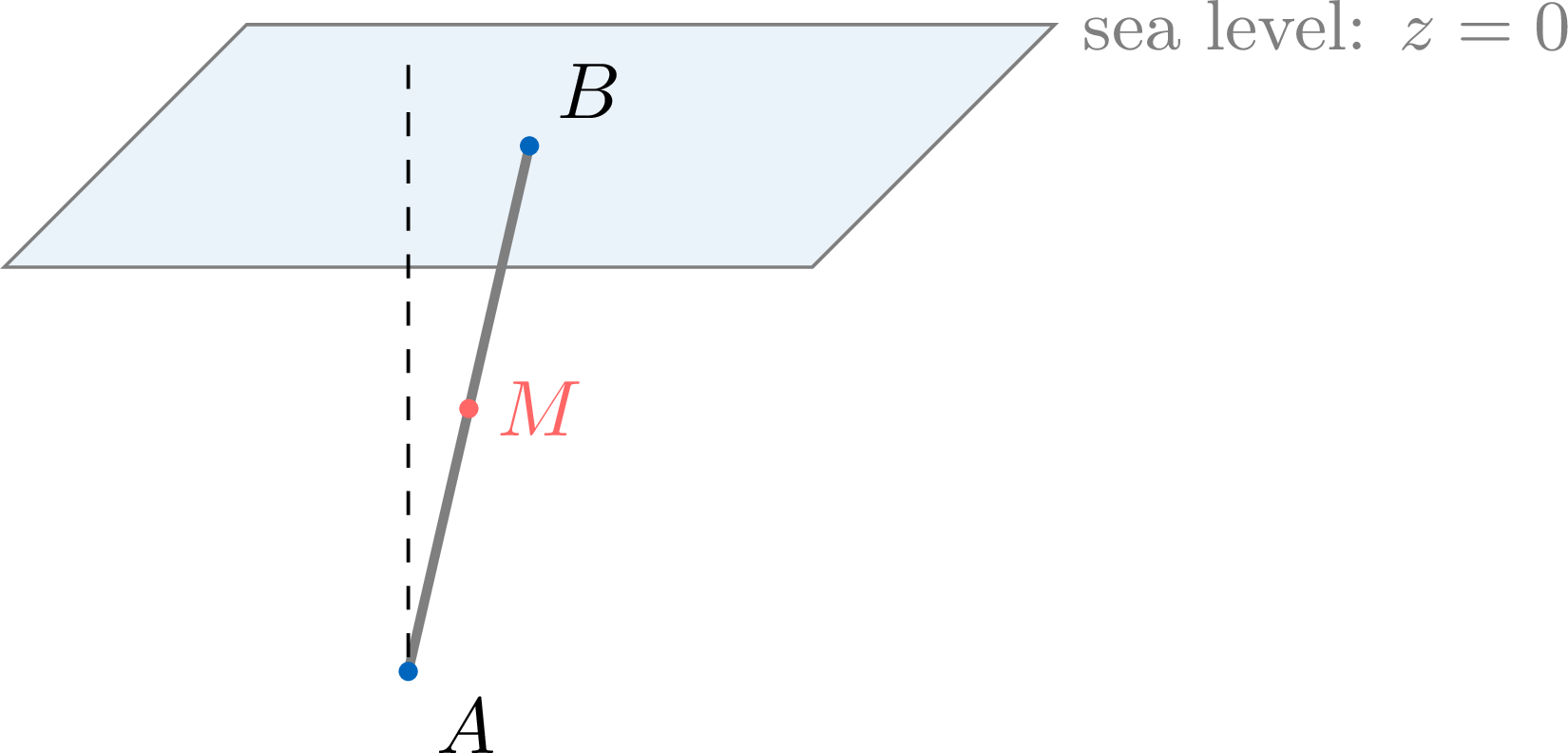
Check with the distance formula: $$BA = \sqrt{(-10)^2 + (-10)^2 + (-30)^2} = \sqrt{1100} = 10\sqrt{11},$$ $$BM = \sqrt{(-5)^2 + (-5)^2 + (-15)^2} = \sqrt{275} = 5\sqrt{11}, \qquad MA = \sqrt{(-5)^2 + (-5)^2 + (-15)^2} = 5\sqrt{11}.$$ So \(BM + MA = BA\): the point \(M\) lies on the chain; and \(BM = MA\): it is its middle. The float is at \(M(35, 5, -15)\), \(15\) m under the surface.
Proposition — Coordinates of the Midpoint
In an orthonormal coordinate system in space, the midpoint \(M\) of the segment \(\Segment{AB}\), with \(A(x_A, y_A, z_A)\) and \(B(x_B, y_B, z_B)\), has coordinates $$M\left(\frac{x_A + x_B}{2}, \frac{y_A + y_B}{2}, \frac{z_A + z_B}{2}\right):$$ each coordinate of the midpoint is the mean of the corresponding coordinates of the endpoints.
Let \(M\) be the point with these coordinates. For the first coordinate, $$x_M - x_A = \frac{x_A + x_B}{2} - x_A = \frac{x_B - x_A}{2} \quad\text{and}\quad x_B - x_M = x_B - \frac{x_A + x_B}{2} = \frac{x_B - x_A}{2},$$ and the same computation holds for the second and third coordinates. The distance formula then gives $$\begin{aligned}[t] AM &= \sqrt{\left(\frac{x_B - x_A}{2}\right)^2 + \left(\frac{y_B - y_A}{2}\right)^2 + \left(\frac{z_B - z_A}{2}\right)^2} && \text{(distance formula)}\\
&= \frac{1}{2}\sqrt{(x_B - x_A)^2 + (y_B - y_A)^2 + (z_B - z_A)^2} && \text{(factor } \tfrac{1}{4} = \left(\tfrac{1}{2}\right)^2\text{)}\\
&= \frac{AB}{2}, && \text{(distance formula)} \end{aligned}$$ and in the same way \(MB = \dfrac{AB}{2}\). Hence \(AM + MB = AB\). The three points \(A\), \(M\) and \(B\) lie in one plane, and by the triangle inequality, \(AM + MB = AB\) happens only when the triangle \(AMB\) is flat, with \(M\) on the segment \(\Segment{AB}\). So \(M\) is a point of \(\Segment{AB}\) with \(AM = MB\): it is the midpoint of \(\Segment{AB}\).
Example
Calculate the coordinates of the midpoint \(M\) of \(\Segment{AB}\), with \(A(2, -1, 5)\) and \(B(5, 3, -7)\).
By the midpoint formula, each coordinate of \(M\) is the mean of those of \(A\) and \(B\): $$\begin{aligned}[t] x_M &= \frac{x_A + x_B}{2} = \frac{2 + 5}{2} = 3.5,\\
y_M &= \frac{y_A + y_B}{2} = \frac{-1 + 3}{2} = 1,\\
z_M &= \frac{z_A + z_B}{2} = \frac{5 + (-7)}{2} = -1. \end{aligned}$$ So \(M(3.5, 1, -1)\).
Example
The point \(M(1, -2, 4)\) is the midpoint of \(\Segment{AB}\), and \(A(3, 1, 7)\). Calculate the coordinates of \(B\).
Each coordinate of \(M\) is a mean: \(x_M = \dfrac{x_A + x_B}{2}\) gives \(x_B = 2x_M - x_A\), and likewise for \(y\) and \(z\): $$\begin{aligned}[t] x_B &= 2x_M - x_A = 2 \times 1 - 3 = -1,\\
y_B &= 2y_M - y_A = 2 \times (-2) - 1 = -5,\\
z_B &= 2z_M - z_A = 2 \times 4 - 7 = 1. \end{aligned}$$ So \(B(-1, -5, 1)\). Check: \(\dfrac{3 + (-1)}{2} = 1\), \(\dfrac{1 + (-5)}{2} = -2\) and \(\dfrac{7 + 1}{2} = 4\) are the coordinates of \(M\).
Skills to practice
- Calculating the Coordinates of a Midpoint
- Finding an Endpoint from the Midpoint
- Using Midpoints
III
Solids in Coordinates
III.1
Lengths and Angles in Solids
Recappreviously studied — click to reread
A closed umbrella is \(75\) cm long. It has to travel in a box shaped like a cuboid, \(60\) cm long, \(20\) cm wide and \(40\) cm high: every edge of the box is shorter than the umbrella. Can the umbrella fit in the box, lying in a straight line?
Place the axes along the three edges from a corner \(A\) of the box, the unit being the centimetre: \(x\) along the width, \(y\) along the length, \(z\) along the height. 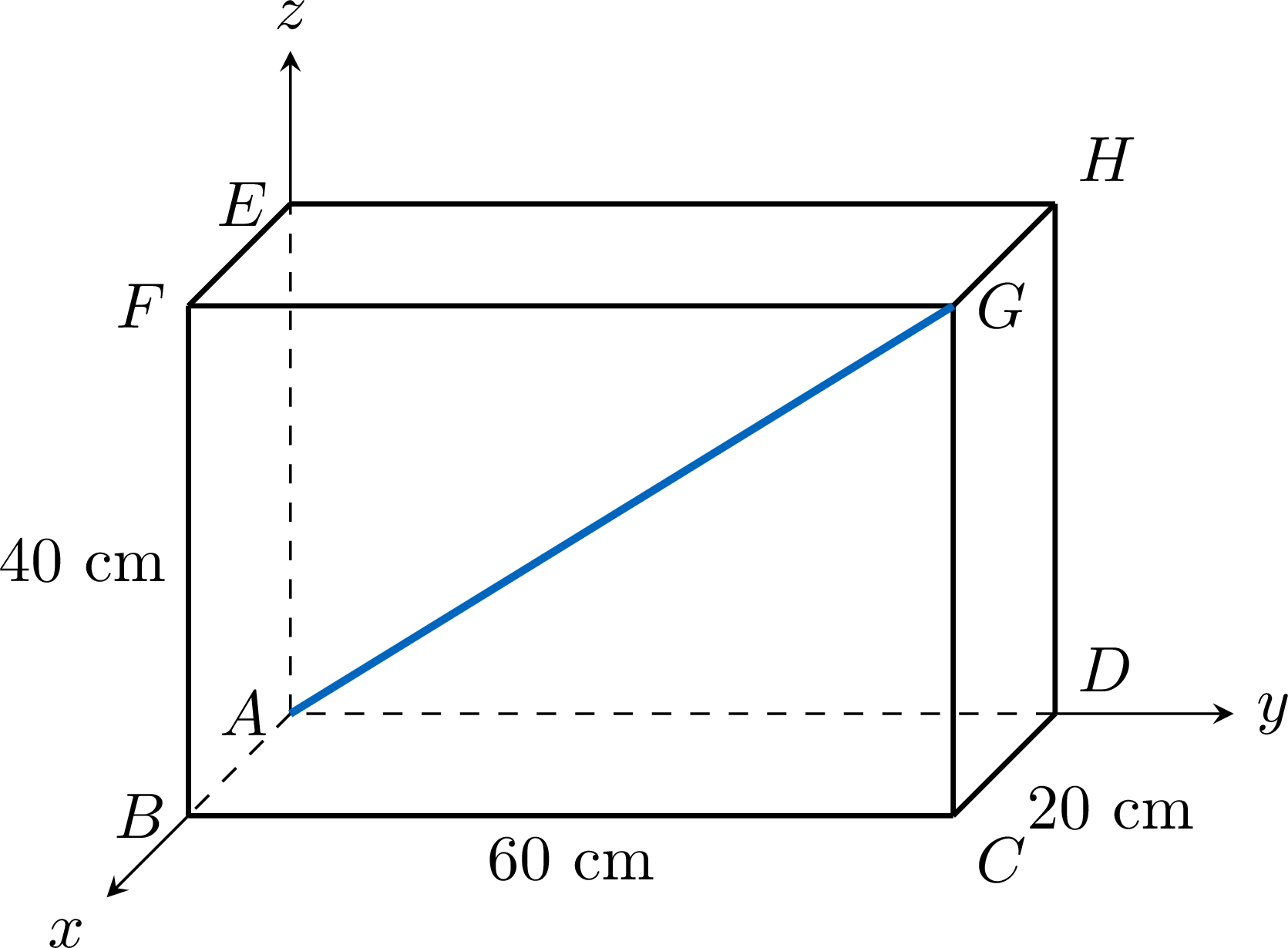
Two points of the box have coordinates that differ by at most \(20\), \(60\) and \(40\) in absolute value, so, by the distance formula, they are at most \(\sqrt{20^2 + 60^2 + 40^2}\) apart: the longest segment inside the box joins \(A\) to the opposite vertex \(G(20, 60, 40)\). $$\begin{aligned}[t] AG &= \sqrt{(20 - 0)^2 + (60 - 0)^2 + (40 - 0)^2} && \text{(distance formula)}\\
&= \sqrt{400 + 3600 + 1600} \\
&= \sqrt{5600} \\
&\approx 74.8 \text{ cm}. \end{aligned}$$ Since \(74.8 < 75\), the umbrella does not fit: about \(2\) mm is missing.
Definition — Face Diagonal and Space Diagonal
In a cuboid, a face diagonal joins two opposite vertices of a face, and a space diagonal joins two vertices that lie on no common face. In the cuboid \(ABCDEFGH\), \(\Segment{AC}\) is a diagonal of the face \(ABCD\) and \(\Segment{AG}\) is a space diagonal; the four space diagonals are \(\Segment{AG}\), \(\Segment{BH}\), \(\Segment{CE}\) and \(\Segment{DF}\). 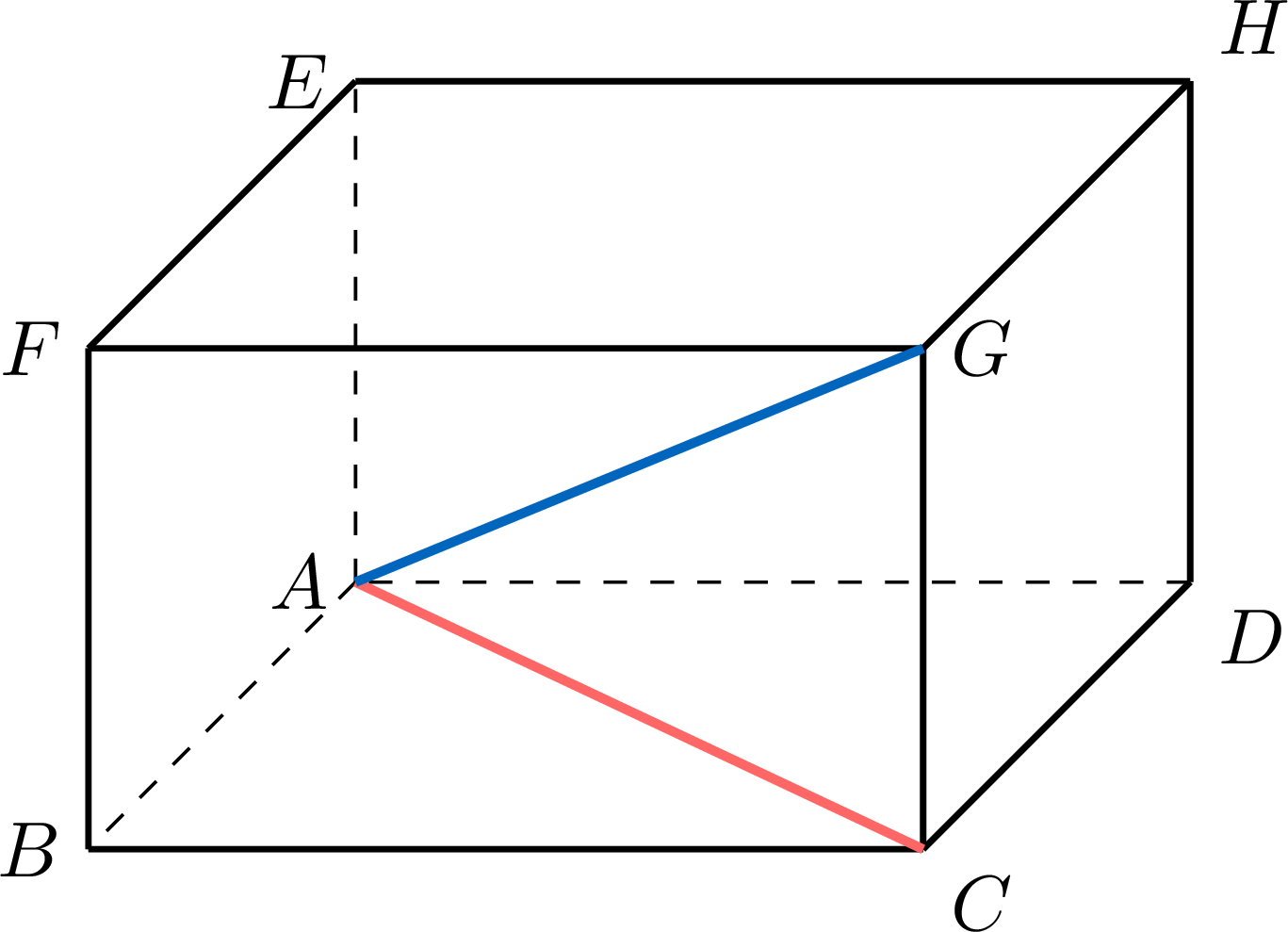
Proposition — Space Diagonals of a Cuboid
In a cuboid whose three edges from one vertex measure \(a\), \(b\) and \(c\), the four space diagonals have the same length $$d = \sqrt{a^2 + b^2 + c^2}$$ and the same midpoint, the centre of the cuboid. In a cube of edge \(a\), the space diagonals measure \(a\sqrt{3}\).
Place the cuboid \(ABCDEFGH\) with \(A\) at the origin and \(\Segment{AB}\), \(\Segment{AD}\), \(\Segment{AE}\) along the axes: \(A(0, 0, 0)\), \(B(a, 0, 0)\), \(C(a, b, 0)\), \(D(0, b, 0)\), \(E(0, 0, c)\), \(F(a, 0, c)\), \(G(a, b, c)\) and \(H(0, b, c)\). 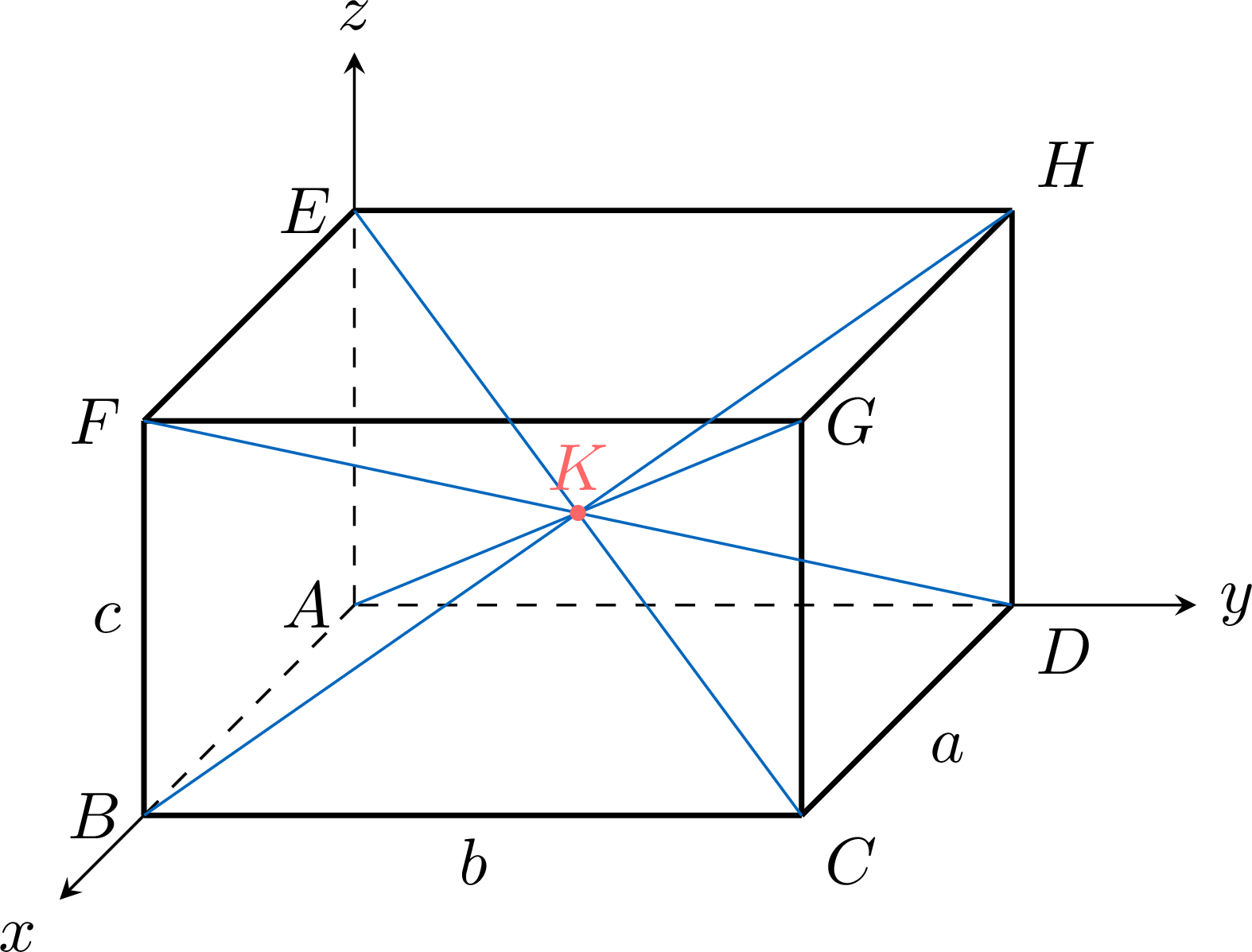
$$\begin{aligned}[t] AG &= \sqrt{(a - 0)^2 + (b - 0)^2 + (c - 0)^2} && \text{(distance formula)}\\
&= \sqrt{a^2 + b^2 + c^2},\\
BH &= \sqrt{(0 - a)^2 + (b - 0)^2 + (c - 0)^2} && \text{(distance formula)}\\
&= \sqrt{a^2 + b^2 + c^2}. && \text{(} (-a)^2 = a^2 \text{)} \end{aligned}$$ The endpoints of \(\Segment{CE}\) and of \(\Segment{DF}\) also differ by \(a\), \(b\) and \(c\) in absolute value — for instance \(C(a, b, 0)\) and \(E(0, 0, c)\) — so \(CE = DF = \sqrt{a^2 + b^2 + c^2}\) as well. By the midpoint formula, the midpoint of \(\Segment{AG}\) is \(\left(\frac{0 + a}{2}, \frac{0 + b}{2}, \frac{0 + c}{2}\right) = \left(\frac{a}{2}, \frac{b}{2}, \frac{c}{2}\right)\), and that of \(\Segment{BH}\) is \(\left(\frac{a + 0}{2}, \frac{0 + b}{2}, \frac{0 + c}{2}\right)\), the same point \(K\); the same holds for \(\Segment{CE}\) and \(\Segment{DF}\). For a cube, \(a = b = c\) and \(d = \sqrt{3a^2} = a\sqrt{3}\).
Method — Finding the Angle Between Two Intersecting Lines
Two lines of space that meet at a point \(A\) lie in one plane: the angle between them is an angle of a triangle. To find it: - choose a triangle: take one more point on each line, \(B\) and \(C\); the angle sought is \(\Angle{BAC}\);
- compute the three sides \(AB\), \(AC\) and \(BC\), with the distance formula or with Pythagoras' theorem in a face;
- choose the tool: if the triangle is right-angled — the converse of Pythagoras' theorem decides — use a trigonometric ratio at \(A\); otherwise, the law of cosines, met with non-right-angled triangles, gives the angle.
Example
The cuboid \(ABCDEFGH\) has \(A\) at the origin, \(B(4, 0, 0)\), \(D(0, 3, 0)\) and \(E(0, 0, 2)\). Calculate the angle between the space diagonal \(\Segment{AG}\) and the edge \(\Segment{AE}\), to the nearest tenth of a degree.
The vertex opposite \(A\) is \(G(4, 3, 2)\). The angle sought is \(\theta = \Angle{GAE}\), in the triangle \(AEG\). 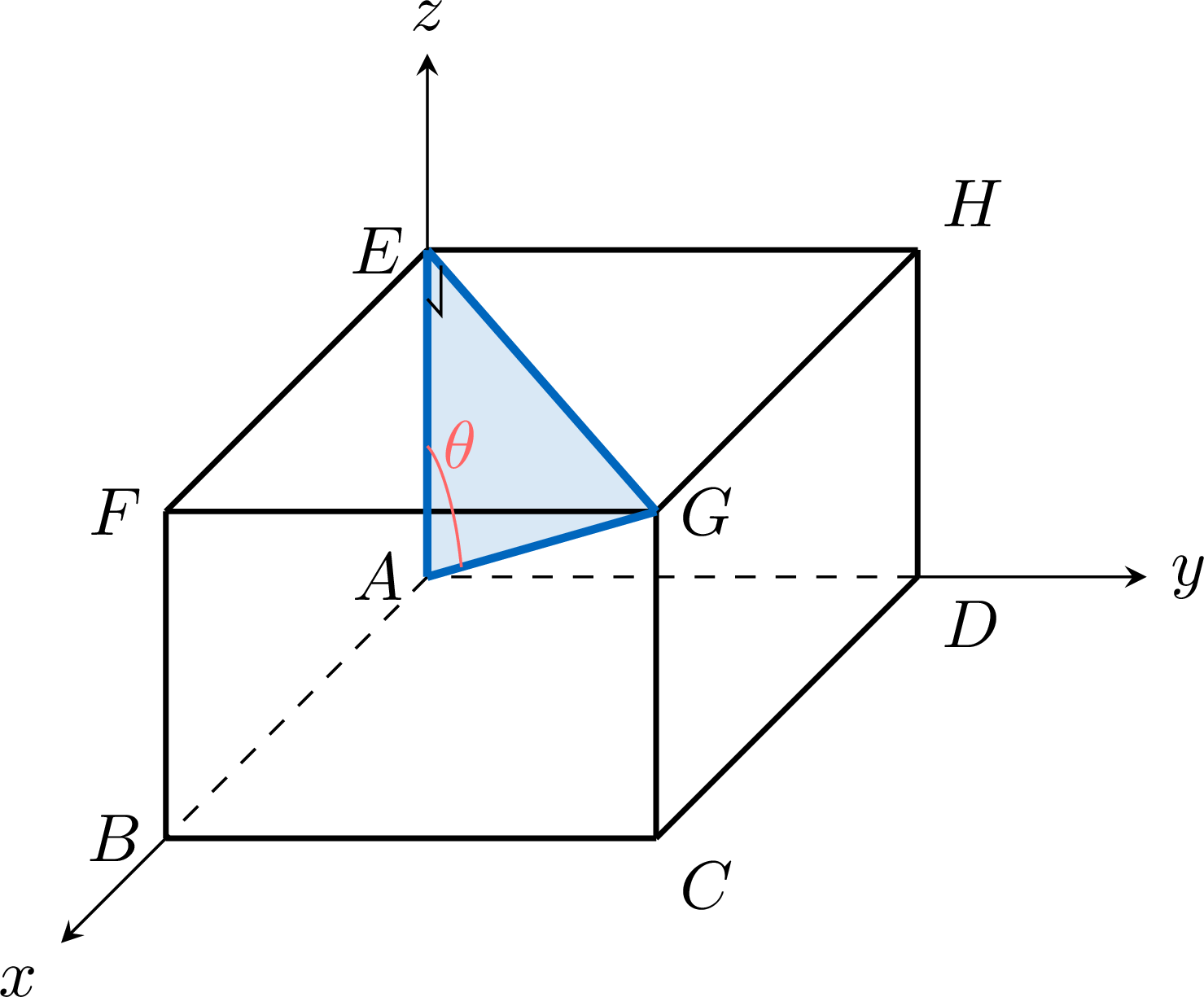
Its sides: \(AE = 2\), \(EG = \sqrt{(4-0)^2 + (3-0)^2 + (2-2)^2} = \sqrt{25} = 5\) and \(AG = \sqrt{4^2 + 3^2 + 2^2} = \sqrt{29}\). Since \(AE^2 + EG^2 = 4 + 25 = 29 = AG^2\), the triangle \(AEG\) is right-angled at \(E\), by the converse of Pythagoras' theorem. The side \(\Segment{AE}\) is adjacent to \(\theta\) and \(\Segment{AG}\) is the hypotenuse: $$\begin{aligned}[t] \cos\theta &= \frac{AE}{AG} && \text{(adjacent over hypotenuse)}\\
&= \frac{2}{\sqrt{29}}, \end{aligned}$$ so \(\theta = \cos^{-1}\left(\dfrac{2}{\sqrt{29}}\right) \approx 68.2^\circ\).
Definition — Angle Between a Line and a Plane
Let \(\mathcal{P}\) be a plane and \(P\) a point outside it. The orthogonal projection of \(P\) on \(\mathcal{P}\) is the point \(P'\) of \(\mathcal{P}\) such that the line \(\Line{PP'}\) is perpendicular to \(\mathcal{P}\): the foot of the perpendicular dropped from \(P\). Let a line \(L\) meet \(\mathcal{P}\) at a point \(Q\), and let \(P'\) be the projection of a point \(P\) of \(L\) outside \(\mathcal{P}\). The angle between the line \(L\) and the plane \(\mathcal{P}\) is the angle \(\theta = \Angle{PQP'}\) between \(L\) and its projection \(\Line{QP'}\). It lies between \(0^\circ\) and \(90^\circ\). When \(L\) is perpendicular to \(\mathcal{P}\), the projection of \(P\) is \(Q\) itself and the angle is taken equal to \(90^\circ\); when \(L\) lies in \(\mathcal{P}\) or is parallel to it, the angle is taken equal to \(0^\circ\). 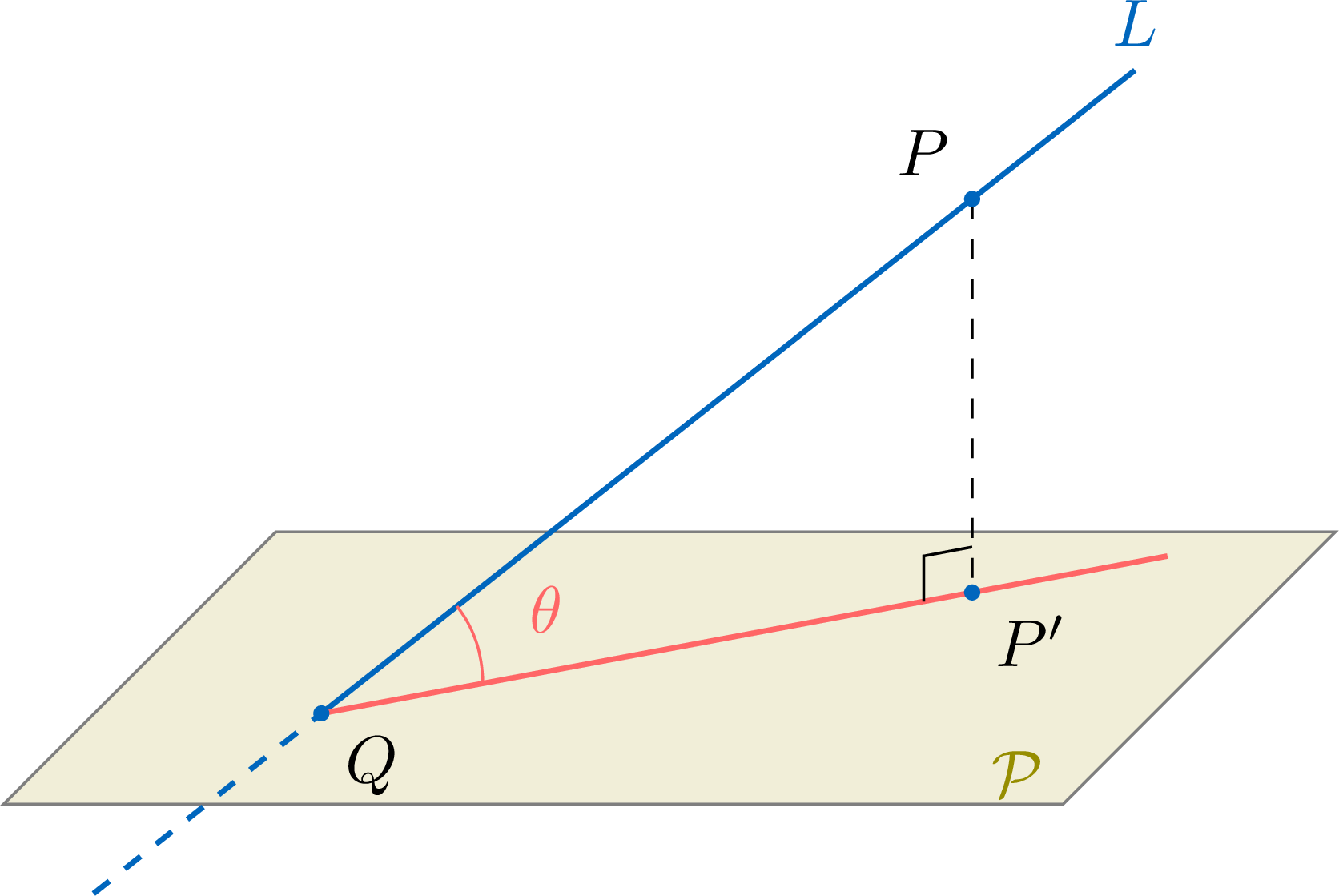
Method — Finding the Angle Between a Line and a Plane
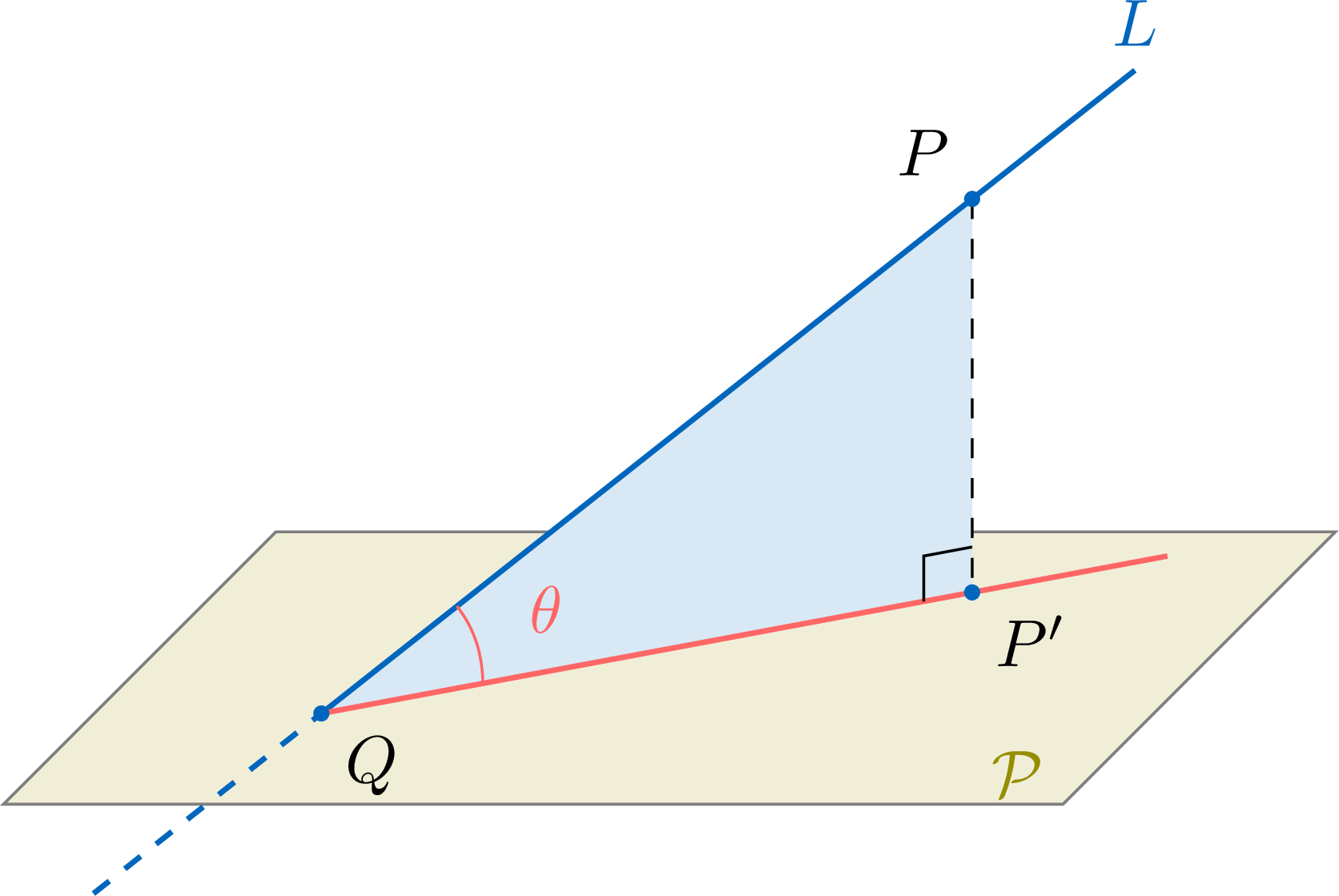
To find the angle \(\theta\) between a line \(\Line{QP}\) and a plane \(\mathcal{P}\) that it meets at \(Q\) — the line being not perpendicular to the plane, otherwise \(\theta = 90^\circ\): - project \(P\) on the plane: choose a point \(P\) of the line outside the plane and drop the perpendicular from \(P\) to the plane; its foot \(P'\) is the projection of \(P\), and the line \(\Line{QP'}\) is the projection of the line on the plane. With coordinates, on the \(xy\)-plane, the projection of \(P(x, y, z)\) is \(P'(x, y, 0)\), right below or right above \(P\); on a plane parallel to a coordinate plane — a face of a cuboid placed along the axes, for instance — the coordinate that is constant on the plane takes its value, the other two are kept;
- draw the right-angled triangle \(QP'P\), formed by the segment \(\Segment{QP}\) of the line, its projection \(\Segment{QP'}\) and the perpendicular \(\Segment{PP'}\), right-angled at \(P'\);
- compute two of its sides and use a trigonometric ratio at \(Q\) (SOH-CAH-TOA), for instance \(\tan\theta = \dfrac{PP'}{QP'}\): the result is the acute angle \(\theta\) between the line and its projection.
Example
The pyramid \(SABCD\) has a square base \(ABCD\) in the \(xy\)-plane, with \(A(0, 0, 0)\), \(B(6, 0, 0)\), \(C(6, 6, 0)\) and \(D(0, 6, 0)\), and its apex is \(S(3, 3, 4)\). Calculate the angle between the edge \(\Segment{SC}\) and the base, to the nearest tenth of a degree.
The edge meets the base at \(C\). The projection of \(S(3, 3, 4)\) on the base, the \(xy\)-plane, is \(K(3, 3, 0)\), the centre of the square. The angle sought is \(\theta = \Angle{SCK}\), in the triangle \(CKS\) right-angled at \(K\). 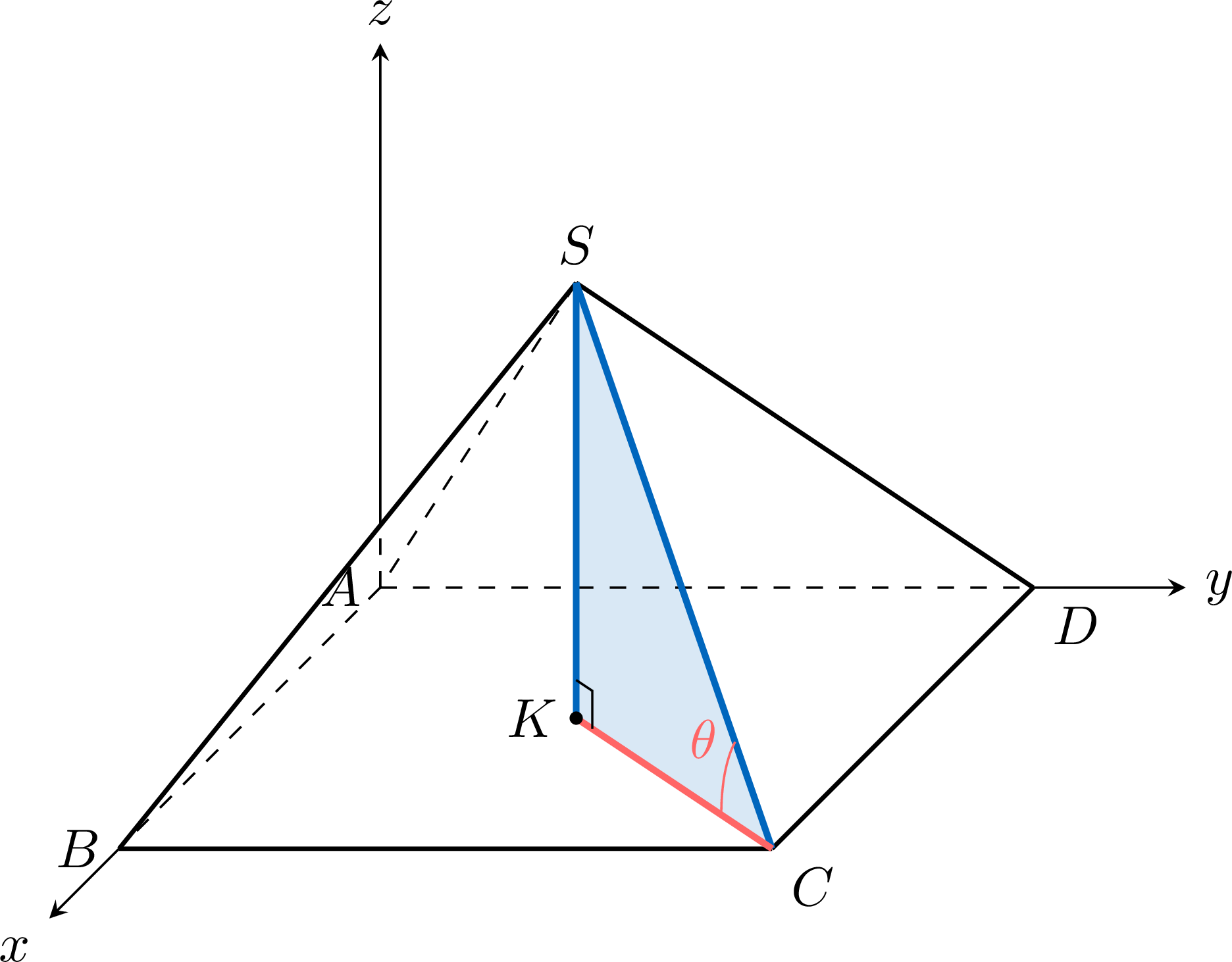
Its sides: \(SK = 4\) and \(CK = \sqrt{(3 - 6)^2 + (3 - 6)^2 + 0^2} = \sqrt{18} = 3\sqrt{2}\). The side \(\Segment{SK}\) is opposite \(\theta\) and \(\Segment{CK}\) adjacent: $$\begin{aligned}[t] \tan\theta &= \frac{SK}{CK} && \text{(opposite over adjacent)}\\
&= \frac{4}{3\sqrt{2}}, \end{aligned}$$ so \(\theta = \tan^{-1}\left(\dfrac{4}{3\sqrt{2}}\right) \approx 43.3^\circ\).
Skills to practice
- Calculating the Length of a Space Diagonal
- Finding the Angle Between Two Intersecting Lines
- Finding the Angle Between a Line and a Plane
IV
Going further
Skills to practice
- Reasoning and Problem-Solving
- Solving Problems in Space
- Quiz
Jump to section