International Baccalaureate · DP 1: Analysis and Approaches SL
Measurement
I
Circles, Arcs and Sectors
I.1
Arcs and Sectors
Recappreviously studied — click to reread
Definition — Arc of a Circle
An arc is a part of a circle between two of its points; its central angle \(\theta\) (theta) measures it. 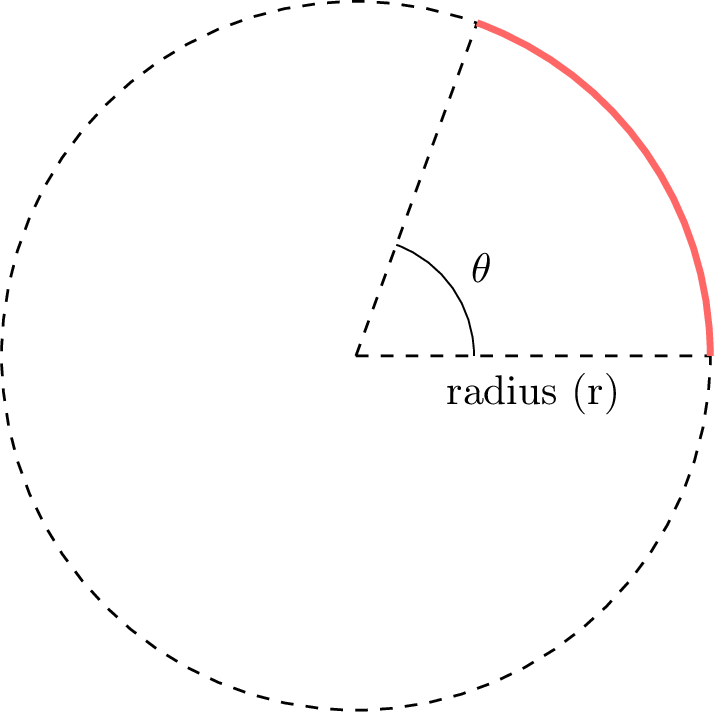
Definition — Sector
Two points \(A\) and \(B\) of a circle with centre \(O\) cut it into two arcs, the minor arc and the major arc (two equal semicircles when \(AB\) is a diameter), and the radii \(OA\) and \(OB\) cut the disc into two parts. Each part, bounded by the two radii and one of the arcs, is a sector; its angle is the central angle that sweeps its arc. When \(\theta = \Angle{AOB}\) is less than \(180^\circ\), the sector of angle \(\theta\) is the minor sector and the other one, of angle \(360^\circ - \theta\), is the major sector. When the two radii are opposite, the two sectors are half-discs, of angle \(180^\circ\). 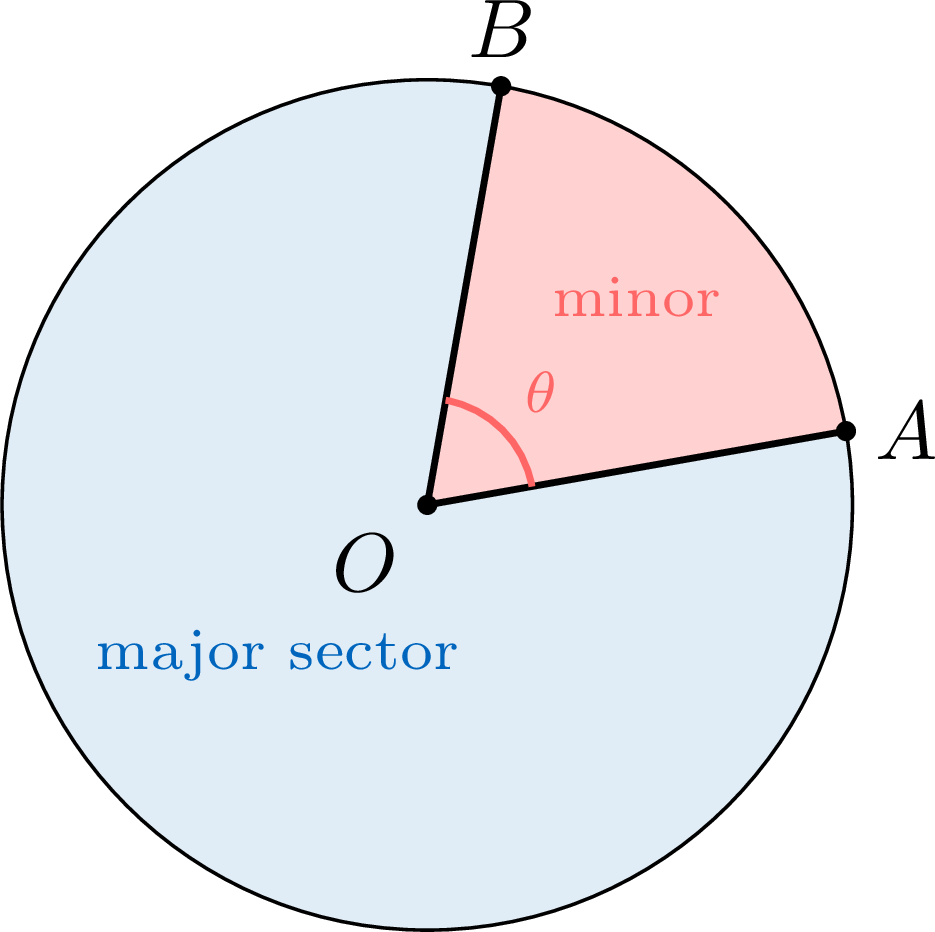
Method — Finding the Length of an Arc
The length of an arc is a fraction of the full circumference. - Find the fraction of the circle. This is the arc’s central angle (in degrees) divided by \(360^\circ\): $$ \text{Fraction} = \frac{\text{central angle } (\theta)}{360^\circ}. $$
- Multiply the fraction by the full circumference. The circumference of a circle with radius \(r\) is \(C = 2 \pi r\): $$ \text{Arc Length} = \text{Fraction} \times (2 \pi r). $$
Method — Finding the Perimeter of a Sector
The boundary of a sector is made of two radii and one arc. For a sector of radius \(r\) and angle \(\theta\) in degrees, with \(0^\circ < \theta < 360^\circ\): $$P = 2r + \ell = 2r + \frac{\theta}{360^\circ} \times 2\pi r.$$ For a major sector, use its own angle, \(360^\circ - \theta\). Example
A sector has radius \(10\) cm and angle \(108^\circ\). Find the exact length of its arc, then its perimeter, exactly and to the nearest millimetre.
$$\begin{aligned}[t]\ell &= \frac{\theta}{360^\circ} \times 2\pi r && \text{(length of an arc)}\\
&= \frac{108^\circ}{360^\circ} \times 2\pi \times 10 && (\theta = 108^\circ,\ r = 10)\\
&= \frac{3}{10} \times 20\pi && \left(\tfrac{108}{360} = \tfrac{3}{10}\right)\\
&= 6\pi \text{ cm,}\end{aligned}$$ $$\begin{aligned}[t]P &= 2r + \ell && \text{(two radii and the arc)}\\
&= 20 + 6\pi \text{ cm}\\
&\approx 38.8 \text{ cm.}\end{aligned}$$ Check: \(108^\circ\) is a little less than \(120^\circ\), a third of the turn, and \(6\pi \approx 18.8\) is indeed a little less than a third of the circumference, \(20\pi \approx 62.8\).
Method — Finding the Angle or the Radius from an Arc
When the length \(\ell\) of an arc is known: - write the formula \(\ell = \dfrac{\theta}{360^\circ} \times 2\pi r\);
- replace the two known quantities by their values;
- solve the equation for the unknown one.
Example
- An arc of a circle of radius \(12\) cm measures \(5\pi\) cm. Find its central angle.
- An arc with central angle \(70^\circ\) measures \(11\) cm. Find the radius of the circle, to the nearest millimetre.
- $$\begin{aligned}[t]\frac{\theta}{360^\circ} \times 2\pi \times 12 &= 5\pi && \text{(length of an arc)}\\ \frac{\theta}{360^\circ} \times 24\pi &= 5\pi\\ \frac{\theta}{360^\circ} &= \frac{5}{24} && \text{(dividing by } 24\pi\text{)}\\ \theta &= 75^\circ. && \text{(multiplying by } 360^\circ\text{)}\end{aligned}$$
- $$\begin{aligned}[t]\frac{70^\circ}{360^\circ} \times 2\pi r &= 11 && \text{(length of an arc)}\\ r &= \frac{11 \times 360}{70 \times 2\pi} && \text{(solving for } r\text{)}\\ &\approx 9.0 \text{ cm.}\end{aligned}$$ Check: \(\dfrac{70}{360} \times 2\pi \times 9.0 \approx 11.0\).
Skills to practice
- Finding Exact Arc Lengths and Perimeters
- Finding an Angle or a Radius from an Arc
I.2
Area of a Sector
Recappreviously studied — click to reread
A garden sprinkler stands at a point \(O\) of a lawn. It sweeps back and forth through an angle of \(120^\circ\) and throws water up to \(9\) m away. The watered region is bounded by two straight edges of \(9\) m and a curved edge. 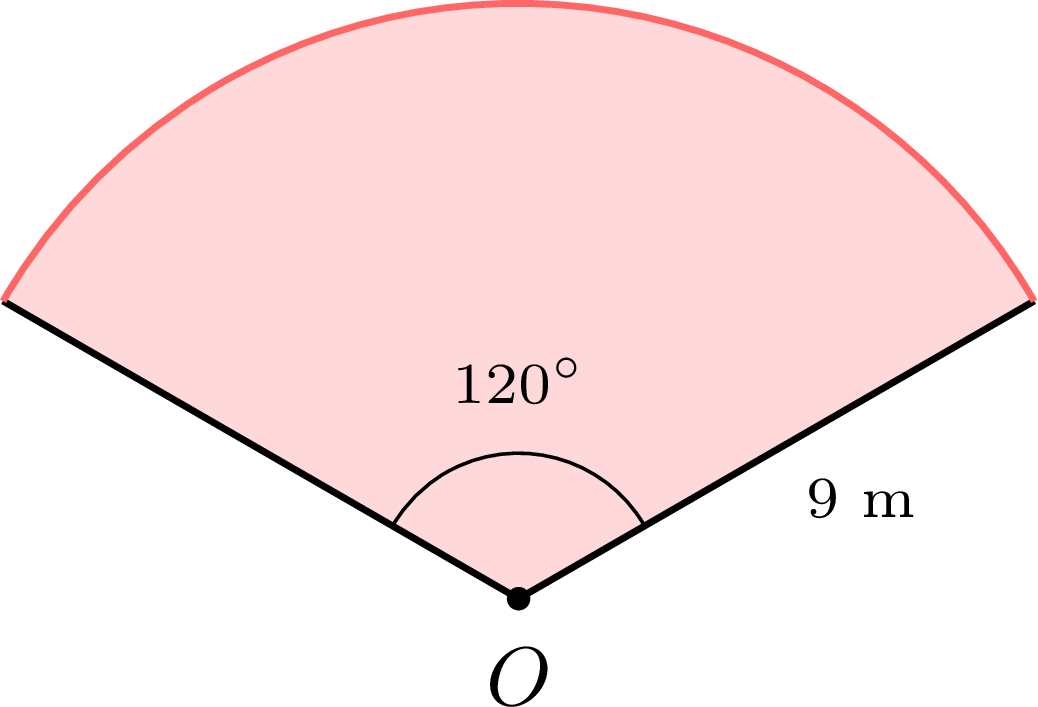
How long is the curved edge, and what area of lawn is watered? The watered region is a fraction of a disc of radius \(9\) m — which fraction?
A full turn is \(360^\circ\), and \(\dfrac{120^\circ}{360^\circ} = \dfrac{1}{3}\): the watered region is one third of the disc of radius \(9\) m, and its curved edge is one third of the circle. $$\begin{aligned}[t]\text{curved edge} &= \frac{1}{3} \times 2\pi \times 9 && \text{(a third of the circumference)}\\
&= 6\pi \approx 18.8 \text{ m,}\end{aligned}$$ $$\begin{aligned}[t]\text{watered area} &= \frac{1}{3} \times \pi \times 9^2 && \text{(a third of the disc)}\\
&= 27\pi \approx 84.8 \text{ m}^2.\end{aligned}$$ The same fraction of the full turn, \(\dfrac{\theta}{360^\circ}\), gives both the arc and the area.
Proposition — Area of a Circle
The area of a circle means the area of the disc it encloses. It is found by multiplying \(\pi\) by the radius squared: $$\text{Area of a circle} = \pi \times \text{radius} \times \text{radius} $$ $$A = \pi r \times r = \pi r^2$$ 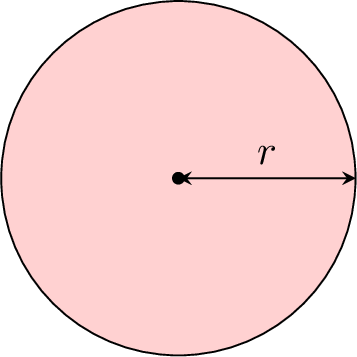
Proposition — Area of a Sector
The area of a sector of radius \(r\) and angle \(\theta\) in degrees is the fraction \(\dfrac{\theta}{360^\circ}\) of the area of the disc: \(A = \dfrac{\theta}{360^\circ} \times \pi r^2\). 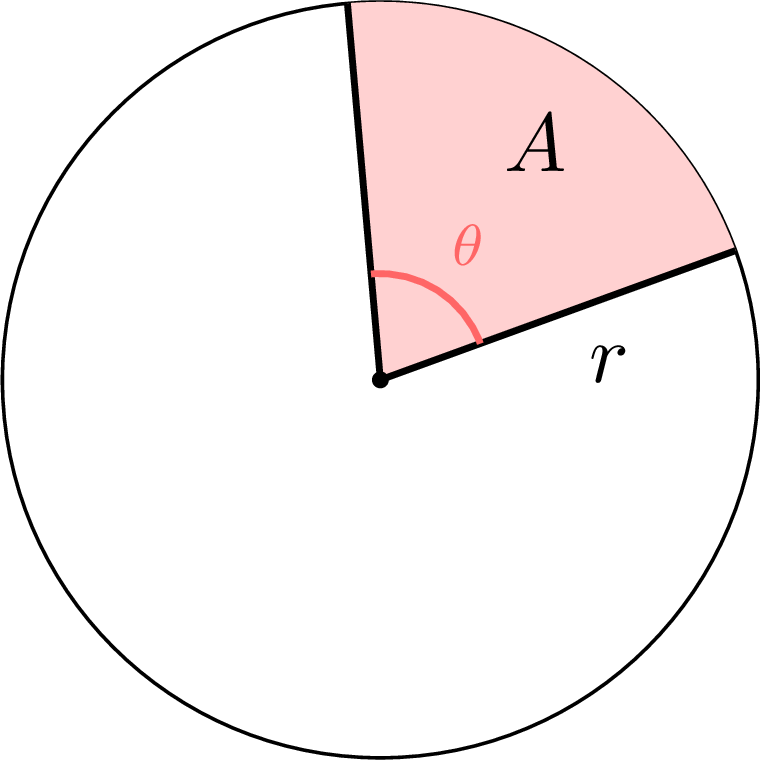
Two sectors of the same disc with equal angles have equal areas: a rotation about the centre carries one onto the other. Cut the disc into \(360\) sectors of \(1^\circ\): they all have the same area, the area of the disc shared out equally, \(\dfrac{\pi r^2}{360}\). A sector whose angle is a whole number of degrees, \(\theta = n^\circ\), is made of \(n\) of them: $$\begin{aligned}[t]A &= n \times \frac{\pi r^2}{360} && (n \text{ sectors of } 1^\circ)\\
&= \frac{n^\circ}{360^\circ} \times \pi r^2 = \frac{\theta}{360^\circ} \times \pi r^2.\end{aligned}$$ Cutting the disc into smaller equal sectors — tenths, hundredths of a degree — gives the same formula for the angles measured in tenths, in hundredths of a degree. Any other angle lies between two such angles as close to each other as we wish, and its sector lies between their two sectors: its area is squeezed between two values of the formula that are as close as we wish, so it obeys the formula too. The area of a sector is proportional to its angle. Check: \(\theta = 90^\circ\) gives \(\dfrac{1}{4}\pi r^2\), the quarter disc, and \(\theta = 360^\circ\) the whole disc.
Example
Find the area of a sector of radius \(6\) cm and angle \(50^\circ\), exactly and to \(0.1 \text{ cm}^2\).
$$\begin{aligned}[t]A &= \frac{\theta}{360^\circ} \times \pi r^2 && \text{(area of a sector)}\\
&= \frac{50^\circ}{360^\circ} \times \pi \times 6^2 && (\theta = 50^\circ,\ r = 6)\\
&= \frac{50 \times 36}{360}\,\pi && \text{(grouping the numbers)}\\
&= 5\pi \text{ cm}^2 && (1800 \div 360 = 5)\\
&\approx 15.7 \text{ cm}^2.\end{aligned}$$
Example
Two radii of a disc of radius \(4\) cm make an angle of \(45^\circ\). Find the exact area of the major sector, then check the result with the minor sector.
The major sector has angle \(360^\circ - 45^\circ = 315^\circ\): $$\begin{aligned}[t]A &= \frac{315^\circ}{360^\circ} \times \pi \times 4^2 && \text{(area of a sector)}\\
&= \frac{7}{8} \times 16\pi && \left(\tfrac{315}{360} = \tfrac{7}{8}\right)\\
&= 14\pi \approx 44.0 \text{ cm}^2.\end{aligned}$$ Check: the minor sector has area \(\dfrac{45^\circ}{360^\circ} \times 16\pi = 2\pi\), and \(14\pi + 2\pi = 16\pi\), the area of the whole disc.
Method — Finding the Angle or the Radius from the Area
When the area \(A\) of a sector is known: - write the formula \(A = \dfrac{\theta}{360^\circ} \times \pi r^2\);
- replace the two known quantities by their values;
- solve for the unknown one. For the radius, solve first for \(r^2\), then take the square root, since \(r > 0\).
Example
- A sector of radius \(8\) cm has area \(30 \text{ cm}^2\). Find its angle, to \(0.1^\circ\).
- A sector of angle \(120^\circ\) has area \(12\pi \text{ cm}^2\). Find its radius.
- $$\begin{aligned}[t]\frac{\theta}{360^\circ} \times \pi \times 8^2 &= 30 && \text{(area of a sector)}\\ \theta &= \frac{30 \times 360^\circ}{64\pi} && \text{(solving for } \theta\text{)}\\ &\approx 53.7^\circ.\end{aligned}$$
- $$\begin{aligned}[t]\frac{120^\circ}{360^\circ} \times \pi r^2 &= 12\pi && \text{(area of a sector)}\\ \frac{1}{3}\,\pi r^2 &= 12\pi && \left(\tfrac{120}{360} = \tfrac{1}{3}\right)\\ r^2 &= 36 && \text{(multiplying by } \tfrac{3}{\pi}\text{)}\\ r &= 6 \text{ cm.} && (r > 0)\end{aligned}$$
Skills to practice
- Finding the Exact Area of a Sector without Technology
- Finding an Angle or a Radius from an Area
- Justifying Sector Area Calculations
I.3
Segments of a Circle
Recappreviously studied — click to reread
Definition — Chord
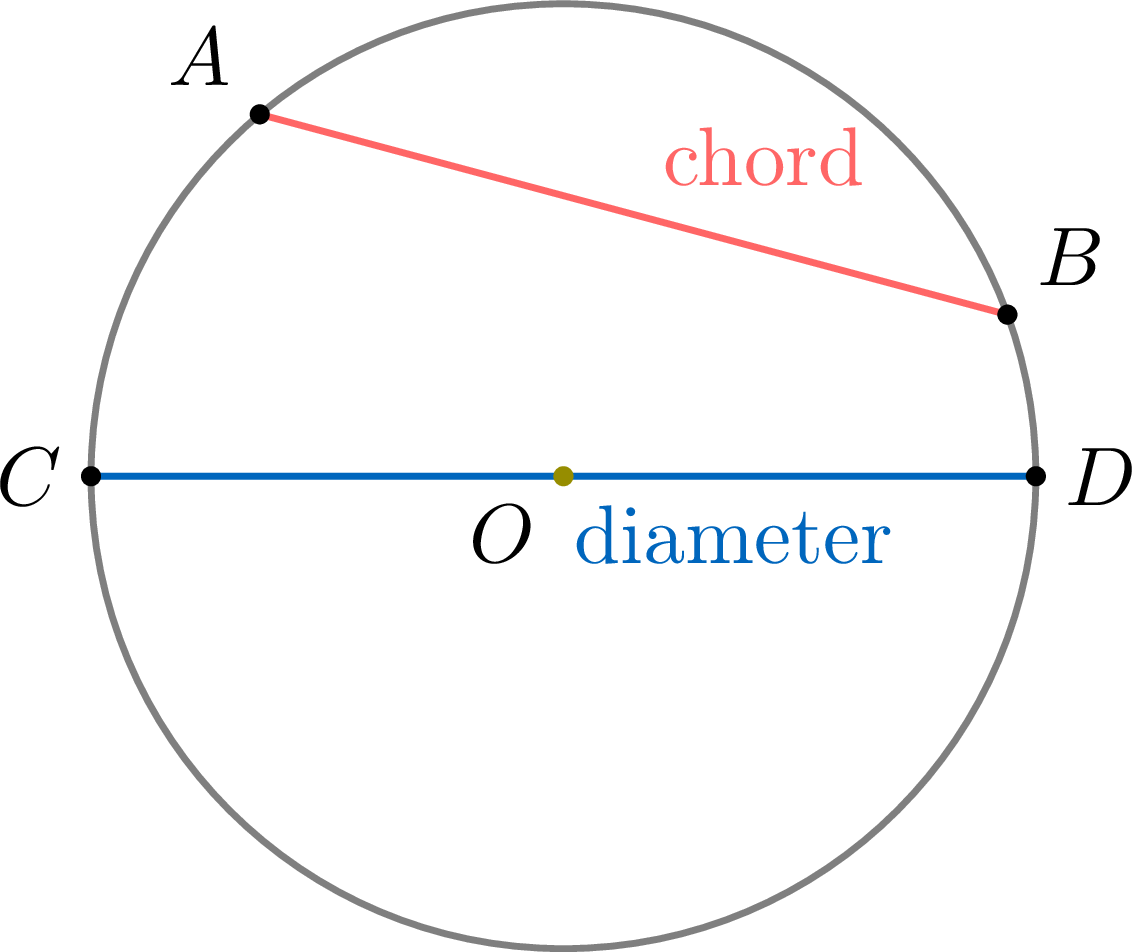
A chord is a line segment whose two endpoints are on the circle.Every chord that passes through the centre is a diameter: a diameter is the longest chord of the circle.
Definition — Segment of a Disc
A chord \(\Segment{AB}\) cuts a disc into two parts, each bounded by the chord and by one of the two arcs \(AB\): they are the two segments of the disc. The minor segment lies on the side of the minor arc, the major segment on the side of the major arc. When the chord is a diameter, the two segments are two equal half-discs: neither is minor nor major. A segment of a disc is not to be confused with the line segment \(\Segment{AB}\), which is its chord. 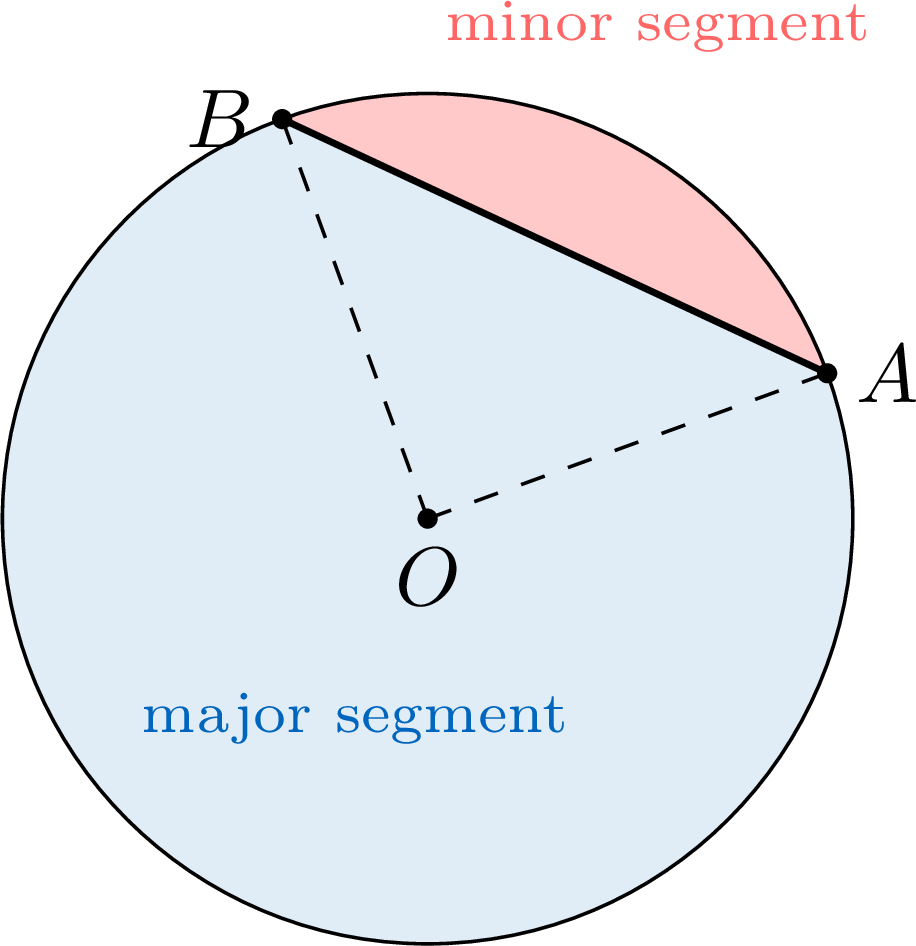
Method — Finding the Area of a Segment
Let \(\Segment{AB}\) be a chord of a circle with centre \(O\) and radius \(r\), with \(\theta = \Angle{AOB}\) less than \(180^\circ\). The sector \(OAB\) is made of the triangle \(OAB\) and of the minor segment, so the minor segment is the sector minus the triangle: $$\begin{aligned}\text{minor segment} &= \text{sector } OAB - \text{triangle } OAB,\\
\text{major segment} &= \text{disc} - \text{minor segment}.\end{aligned}$$ The triangle \(OAB\) is isosceles, \(OA = OB = r\): its area is \(\dfrac{1}{2} \times AB \times h\), where \(h\) is the distance from \(O\) to the chord. 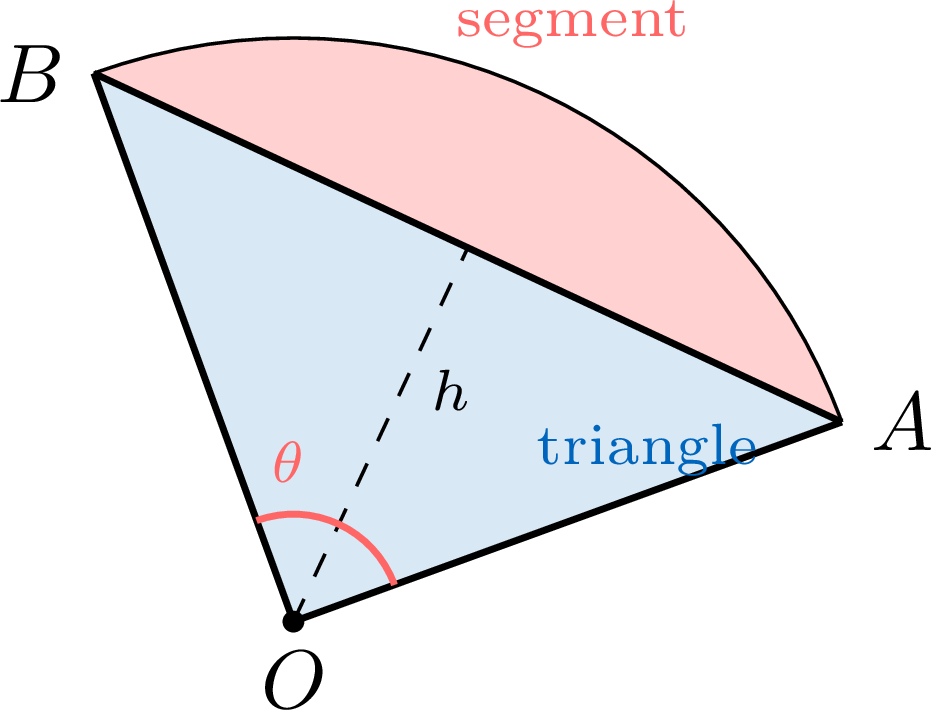
Example
A chord \(\Segment{AB}\) of a circle with centre \(O\) and radius \(6\) cm is such that \(\Angle{AOB} = 90^\circ\). Find the area of the minor segment, exactly and to \(0.1 \text{ cm}^2\), then the area of the major segment.
The triangle \(OAB\) is right-angled at \(O\), with legs \(OA = OB = 6\): its area is \(\dfrac{1}{2} \times 6 \times 6 = 18\). $$\begin{aligned}[t]\text{minor segment} &= \text{sector } OAB - \text{triangle } OAB && \text{(area of a segment)}\\
&= \frac{90^\circ}{360^\circ} \times \pi \times 6^2 - 18 && \text{(area of a sector)}\\
&= 9\pi - 18 \approx 10.3 \text{ cm}^2,\end{aligned}$$ $$\begin{aligned}[t]\text{major segment} &= \text{disc} - \text{minor segment}\\
&= 36\pi - (9\pi - 18)\\
&= 27\pi + 18 \approx 102.8 \text{ cm}^2.\end{aligned}$$
Example
A chord \(\Segment{AB}\) of a circle with centre \(O\) and radius \(4\) cm is such that \(\Angle{AOB} = 60^\circ\). Show that the triangle \(OAB\) is equilateral, then find the area of the minor segment, exactly and to \(0.1 \text{ cm}^2\).
The triangle \(OAB\) is isosceles, \(OA = OB = 4\), so its base angles are equal: each measures \(\dfrac{180^\circ - 60^\circ}{2} = 60^\circ\). Its three angles measure \(60^\circ\): it is equilateral, with side \(4\). Its height from \(O\) falls at the midpoint \(H\) of \(\Segment{AB}\), so \(AH = 2\) and: $$\begin{aligned}[t]OH^2 &= OA^2 - AH^2 && \text{(Pythagoras' theorem in } OHA\text{)}\\
&= 16 - 4 = 12,\\
OH &= \sqrt{12} = 2\sqrt{3}.\end{aligned}$$ The triangle has area \(\dfrac{1}{2} \times 4 \times 2\sqrt{3} = 4\sqrt{3}\), and the sector \(\dfrac{60^\circ}{360^\circ} \times \pi \times 4^2 = \dfrac{8\pi}{3}\): $$\text{minor segment} = \frac{8\pi}{3} - 4\sqrt{3} \approx 1.4 \text{ cm}^2.$$
Skills to practice
- Finding the Area of a Segment
- Justifying a Segment Calculation
I.4
Composite Figures with Sectors
Recappreviously studied — click to reread
Method — Area and Perimeter of a Figure with Circular Parts
- Name the pieces: rectangles, triangles, sectors, segments — each sector with its radius and its angle.
- Area: add the areas of the pieces that make up the figure, or subtract, from a larger shape, the pieces cut out of it.
- Perimeter: follow the outline only — every arc and every straight edge of the boundary, once each; the lines drawn inside the figure do not count.
Example
From a square tile \(ABCD\) of side \(10\) cm, the quarter disc with centre \(A\) and radius \(10\) cm is cut out. Find the area and the perimeter of the piece that remains, exactly and to \(0.1\). 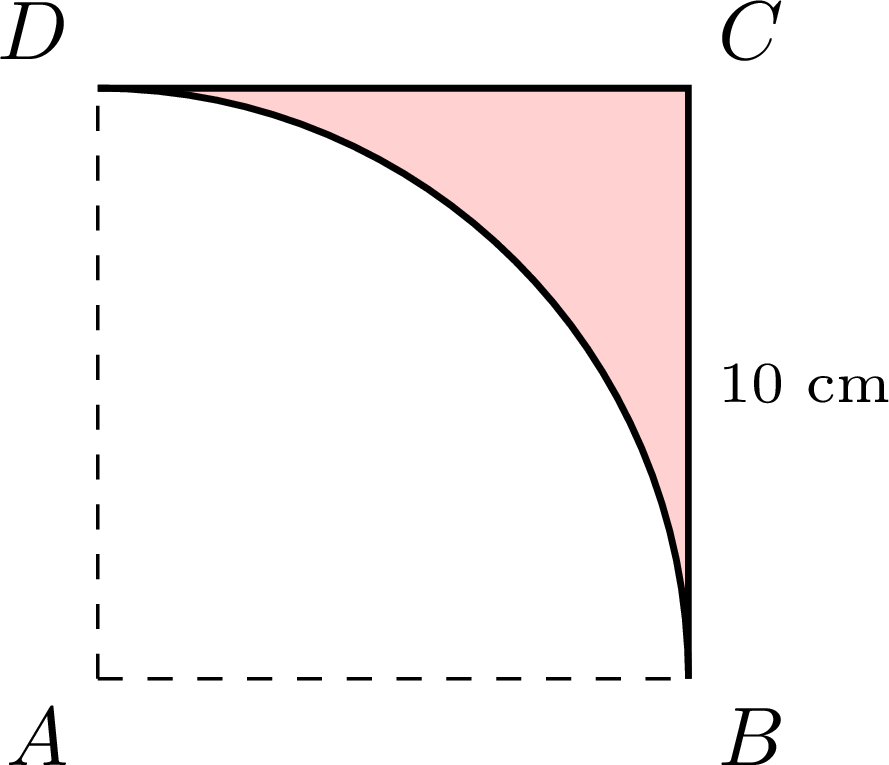
The quarter disc is a sector of angle \(90^\circ\) and radius \(10\) cm, cut out of the square. $$\begin{aligned}[t]\text{area} &= \text{square} - \text{quarter disc} && \text{(the piece cut out)}\\
&= 10^2 - \frac{90^\circ}{360^\circ} \times \pi \times 10^2 && \text{(area of a sector)}\\
&= 100 - 25\pi \approx 21.5 \text{ cm}^2.\end{aligned}$$ The outline of the piece is made of the sides \(\Segment{BC}\) and \(\Segment{CD}\) and of the arc \(BD\): $$\begin{aligned}[t]\text{perimeter} &= 10 + 10 + \frac{90^\circ}{360^\circ} \times 2\pi \times 10 && \text{(two sides and the arc)}\\
&= 20 + 5\pi \approx 35.7 \text{ cm.}\end{aligned}$$ The sides \(\Segment{AB}\) and \(\Segment{AD}\) are not part of the outline: they went away with the quarter disc.
Example
A windscreen wiper turns about a point \(O\) through \(110^\circ\). Its blade covers the part of the arm between \(20\) cm and \(65\) cm from \(O\). What area of windscreen does the blade wipe, to the nearest \(\text{cm}^2\)? 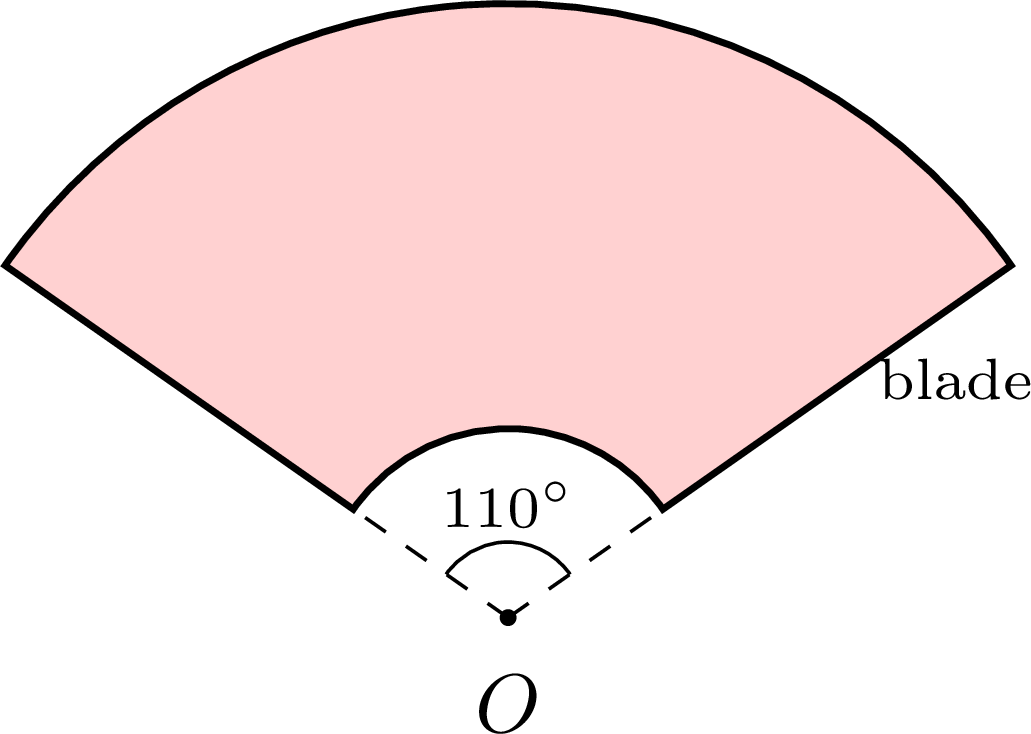
The wiped region is the sector of radius \(65\) cm from which the sector of radius \(20\) cm, with the same angle, is removed: $$\begin{aligned}[t]A &= \text{sector of radius } 65 - \text{sector of radius } 20\\
&= \frac{110^\circ}{360^\circ} \times \pi \times 65^2 - \frac{110^\circ}{360^\circ} \times \pi \times 20^2 && \text{(area of a sector)}\\
&= \frac{110^\circ}{360^\circ} \times \pi \times (65^2 - 20^2) && \text{(common factor)}\\
&= \frac{110 \times 3825}{360}\,\pi\\
&\approx 3672 \text{ cm}^2.\end{aligned}$$
Skills to practice
- Finding Areas and Perimeters of Composite Figures
- Justifying Composite Figure Calculations
II
Volume
II.1
Volumes of Solids with Uniform Cross-Section
Recappreviously studied — click to reread
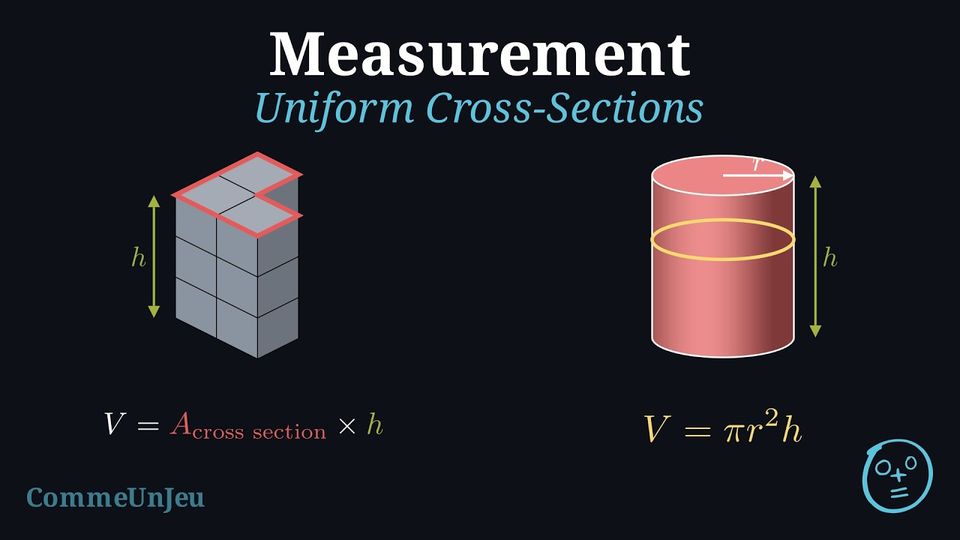
Proposition — Volume of a Solid of Uniform Cross-Section
$$\text{Volume} = \textcolor{colordef}{\text{area of the cross-section}} \times \textcolor{olive}{\text{length}}$$ The length is the distance between the two ends, measured perpendicular to them; for a solid standing on an end, it is its height. Proposition — Volume of a Cylinder
$$\begin{aligned}V &= \pi r^2 h\end{aligned}$$ 
A cylinder has a uniform cross-section.
- Area of base = Area of
 = Area of a disc = \(\pi r^2\)
- height = \(h\)
- $$ \begin{aligned}[t] V &= \text{area of base} \times \text{height} \\ &= \pi r^2 \times h \end{aligned} $$
Skills to practice
- Finding Volumes of Prisms and Cylinders
II.2
Volumes of Tapered Solids and Spheres
Recappreviously studied — click to reread
Proposition — Volume of a Pyramid or Cone
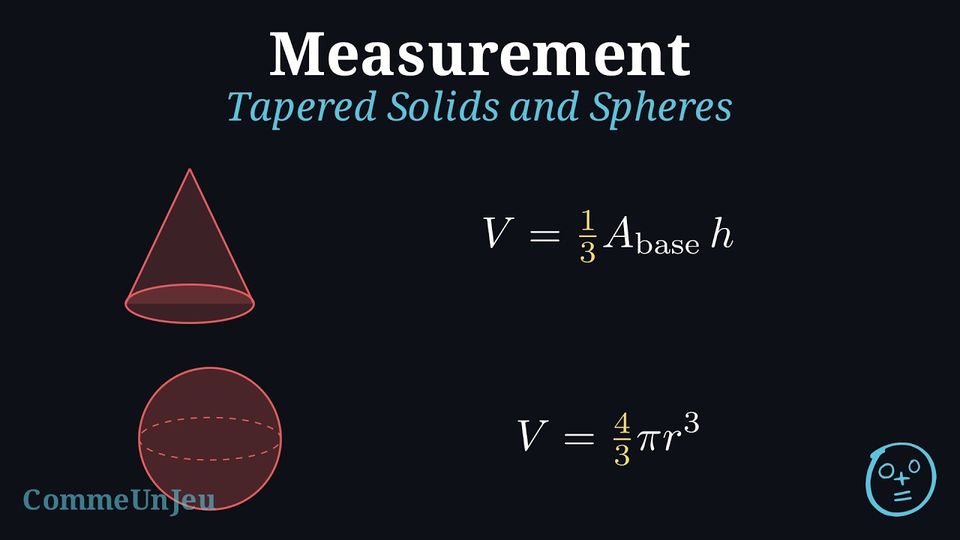
The volume of a pyramid or a cone (a solid that tapers from its base to a single point, its apex) is one-third of the area of its base multiplied by its perpendicular height.$$ V = \frac{1}{3} \times A_{\text{base}} \times h $$ 

Example
Find the volume of the cone, exactly and to \(0.01\) cm\(^3\). 
- Find the area of the circular base: $$ \begin{aligned} A_{\text{base}} &= \pi r^2 \\ &= \pi (3)^2 \\ &= 9\pi \, \text{cm}^2 \end{aligned} $$
- Calculate the volume of the cone: $$ \begin{aligned} V &= \frac{1}{3} \times A_{\text{base}} \times h \\ &= \frac{1}{3} \times 9\pi \times 7 \\ &= 21\pi \, \text{cm}^3 \\ &\approx 65.97 \, \text{cm}^3 \end{aligned} $$
Proposition — Volume of a Sphere
The volume of a sphere with radius \(r\) is given by the formula:$$ V = \frac{4}{3} \pi r^3 $$ 
Example
Find the volume of the sphere, exactly and to \(0.01\) m\(^3\). 
$$ \begin{aligned} V &= \frac{4}{3} \pi r^3 \\
&= \frac{4}{3} \pi (4)^3 \\
&= \frac{4}{3} \pi (64) \\
&= \frac{256}{3}\pi \, \text{m}^3 \\
&\approx 268.08 \, \text{m}^3 \end{aligned} $$
Proposition — Volume of a Hemisphere
A plane through the centre of a sphere cuts it into two identical halves, each called a hemisphere. The volume of a hemisphere of radius \(r\) is half the volume of the sphere: $$V = \frac{2}{3}\pi r^3.$$ 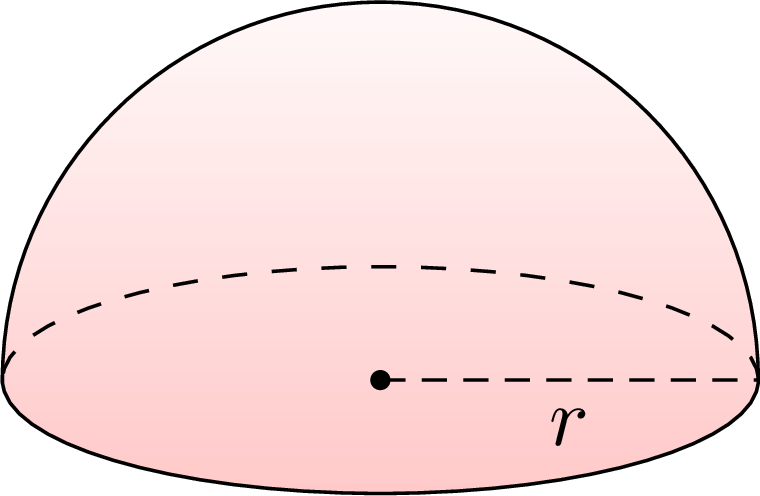
The two halves are identical, so each one has half the volume of the sphere of radius \(r\): $$\begin{aligned}[t]V &= \frac{1}{2} \times \frac{4}{3}\pi r^3 && \text{(half the volume of a sphere)}\\
&= \frac{2}{3}\pi r^3.\end{aligned}$$
Method — Finding the Volume of a Composite Solid
A composite solid is made of several solids whose volume formulas are known: prisms, cylinders, pyramids, cones, spheres, hemispheres. To find its volume: - Split the solid into these parts, and read the dimensions of each part on the figure: a radius shared by two parts is the same length.
- Write the volume of each part with its formula, keeping exact values (in terms of \(\pi\)).
- Add the volumes of the parts; subtract the volume of a part that has been removed, such as a hole.
- Round only once, at the end.
Example
A spinning top is made of a hemisphere of radius \(3\) cm and a cone with the same base and a height of \(4\) cm, glued base to base. Find the volume of the top, exactly and to \(0.1\) cm\(^3\). 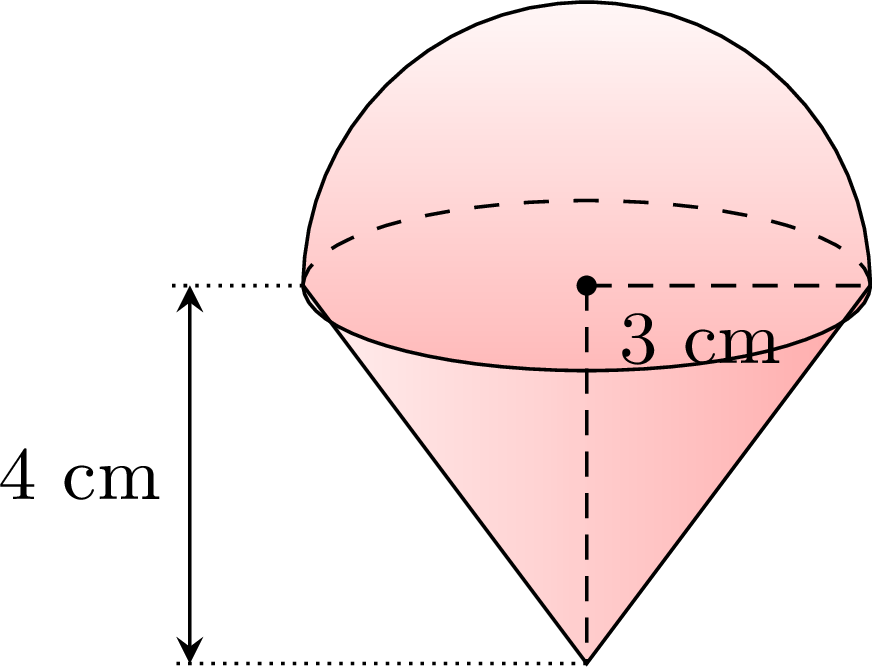
The top is made of two parts, a cone of height \(h = 4\) cm and a hemisphere, which share the radius \(r = 3\) cm: $$\begin{aligned}[t]V &= V_{\text{cone}} + V_{\text{hemisphere}} && \text{(sum of the two parts)}\\
&= \frac{1}{3}\pi r^2 h + \frac{2}{3}\pi r^3 && \text{(volume of a cone, of a hemisphere)}\\
&= \frac{1}{3}\pi \times 3^2 \times 4 + \frac{2}{3}\pi \times 3^3\\
&= 12\pi + 18\pi\\
&= \textcolor{colorprop}{30\pi} \approx \textcolor{colorprop}{94.2} \text{ cm}^3.\end{aligned}$$
Example
- A sphere has a volume of \(500\) cm\(^3\). Find its radius, to \(0.01\) cm.
- A cone of base radius \(4\) cm has a volume of \(200\) cm\(^3\). Find its height, to \(0.01\) cm.
The volume formula links the unknown length to the volume. The formula is written first, the unknown length is isolated, and only then are the letters replaced by the numbers.
- $$\begin{aligned}[t]V &= \frac{4}{3}\pi r^3 && \text{(volume of a sphere)}\\ r^3 &= \frac{3V}{4\pi} && \text{(multiplying by } 3 \text{, dividing by } 4\pi\text{)}\\ &= \frac{3 \times 500}{4\pi} = \frac{375}{\pi}\\ r &= \sqrt[3]{\frac{375}{\pi}}\\ &\approx \textcolor{colorprop}{4.92} \text{ cm.}\end{aligned}$$ Check: \(\dfrac{4}{3}\pi \times 4.92^3 \approx 499\), close to \(500\) since the radius is rounded.
- $$\begin{aligned}[t]V &= \frac{1}{3}\pi r^2 h && \text{(volume of a cone)}\\ h &= \frac{3V}{\pi r^2} && \text{(multiplying by } 3 \text{, dividing by } \pi r^2\text{)}\\ &= \frac{3 \times 200}{\pi \times 4^2} = \frac{600}{16\pi}\\ &\approx \textcolor{colorprop}{11.94} \text{ cm.}\end{aligned}$$
Definition — Litre
A litre is a unit used to measure the capacity of liquids (how much a container holds). - 1 litre is the volume of a cube that measures \(10 \,\text{cm}\) on each side. This cube holds \(10 \times 10 \times 10 = 1\,000\) cubes of \(1 \,\text{cm}^3\), so $$ 1 \,\text{L} = 1\,000 \,\text{cm}^3 \quad\text{and}\quad 1\,000 \,\text{L} = 1 \,\text{m}^3 $$
- Its symbol is L (a capital “L”).
- A smaller unit, the millilitre (mL), is used for small volumes: $$ 1 \,\text{L} = 1\,000 \,\text{mL} \quad\text{and}\quad 1 \,\text{mL} = 1 \,\text{cm}^3 $$
- A larger unit, the kilolitre (kL), is used for very large capacities, like a swimming pool: $$ 1 \,\text{kL} = 1\,000 \,\text{L} = 1 \,\text{m}^3 $$
Skills to practice
- Calculating Exact Volumes of Pyramids and Cones without Technology
- Calculating Volumes of Pyramids, Cones and Spheres
- Calculating Volumes of Hemispheres and Composite Solids
- Finding a Length from a Volume
- Justifying Volume Calculations
III
Surface Area
III.1
Surface Area of Solids
Recappreviously studied — click to reread
Definition — Surface Area
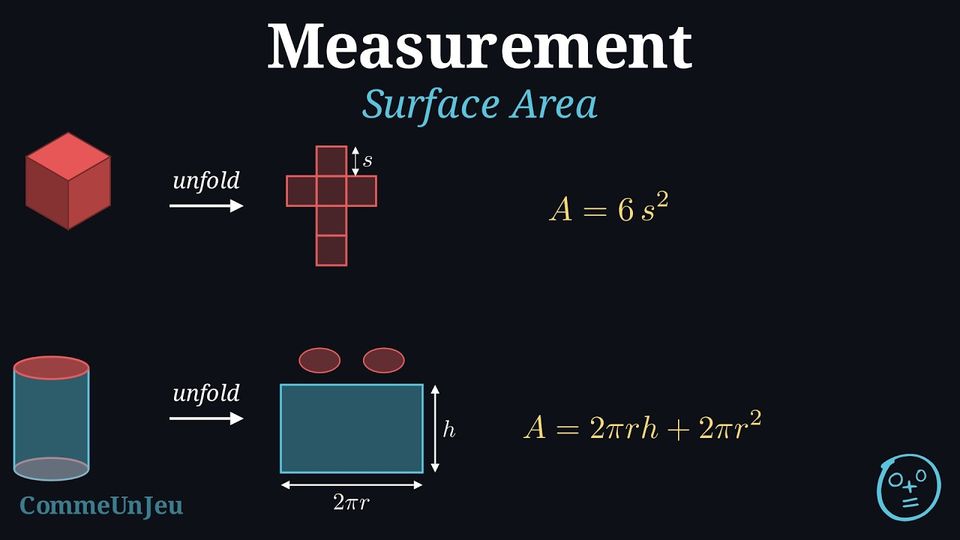
The surface area of a 3D shape is the total area of all the surfaces that bound it, flat faces and curved surfaces. It is measured in square units (cm\(^2\), m\(^2\), \(\dots\)). Proposition — Surface Area of Polyhedra
The surface area of a three-dimensional figure with plane faces is the sum of the areas of the faces. Method — Unfolding a Solid into Its Net
When a solid with plane faces is unfolded into its net, its surface area is the area of the net. 
Method — Using Pythagoras' Theorem in a Solid
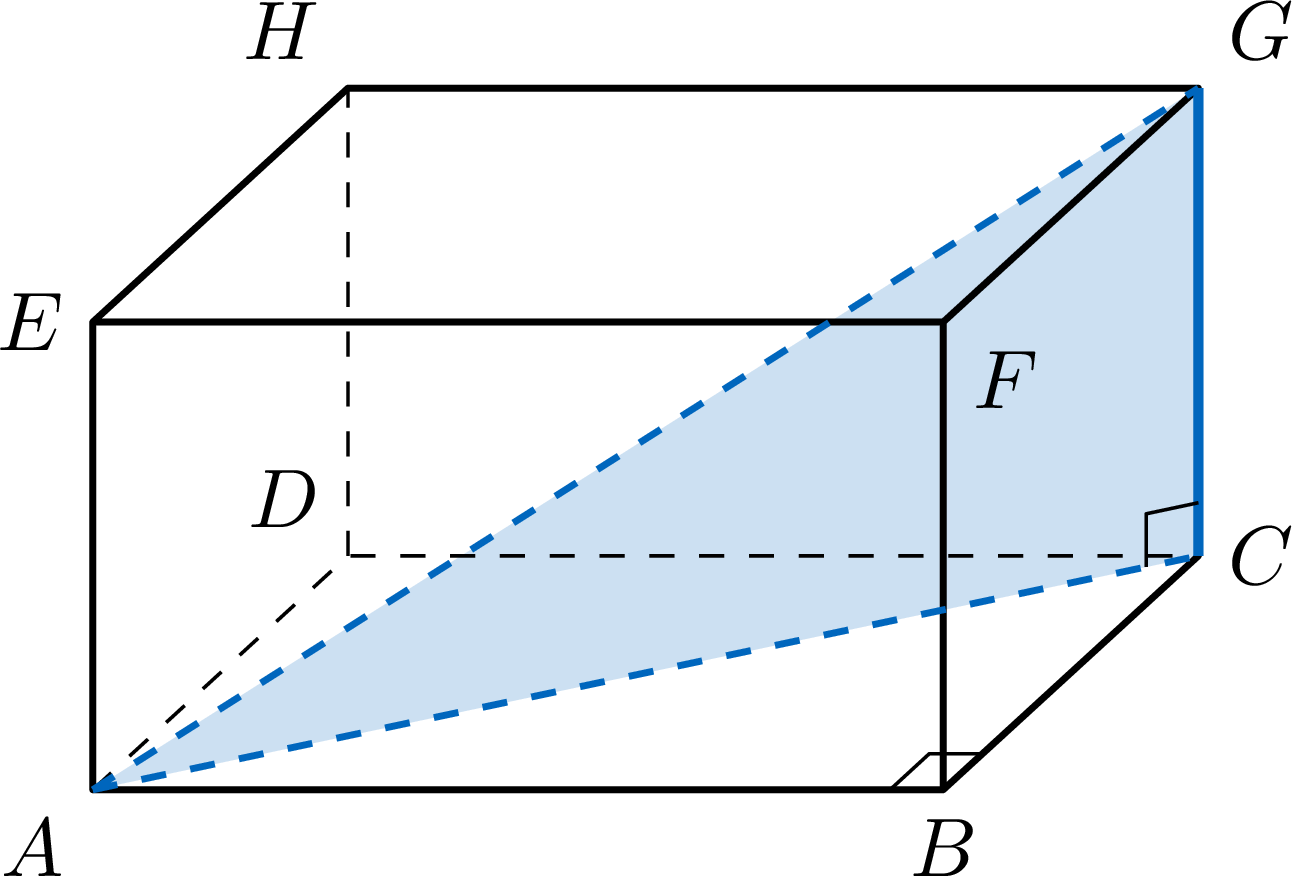
In a solid, a length that cannot be measured directly — a diagonal through a box, the height of a pyramid — is often a side of a right-angled triangle hidden inside the solid. - Find a right-angled triangle that contains the unknown length. The right angle comes from an edge perpendicular to a face — such an edge is perpendicular to every line of that face through its foot, a property of space accepted here without proof; in a cuboid, every edge is perpendicular to the two faces at its ends — or from the height of a pyramid or a cone, perpendicular to its base.
- If another side of that triangle is unknown, compute it first in a second right-angled triangle, often drawn on a face: the theorem is then used twice.
- Write the theorem for each triangle, keep the exact values (squares or radicals), and round only at the end.
Example
A pyramid \(SABCD\) has a square base \(ABCD\) of side \(8\) cm and four lateral edges of \(10\) cm; its apex \(S\) is directly above the centre \(O\) of the square. Find its height \(SO\), exactly and to \(0.1\) cm. 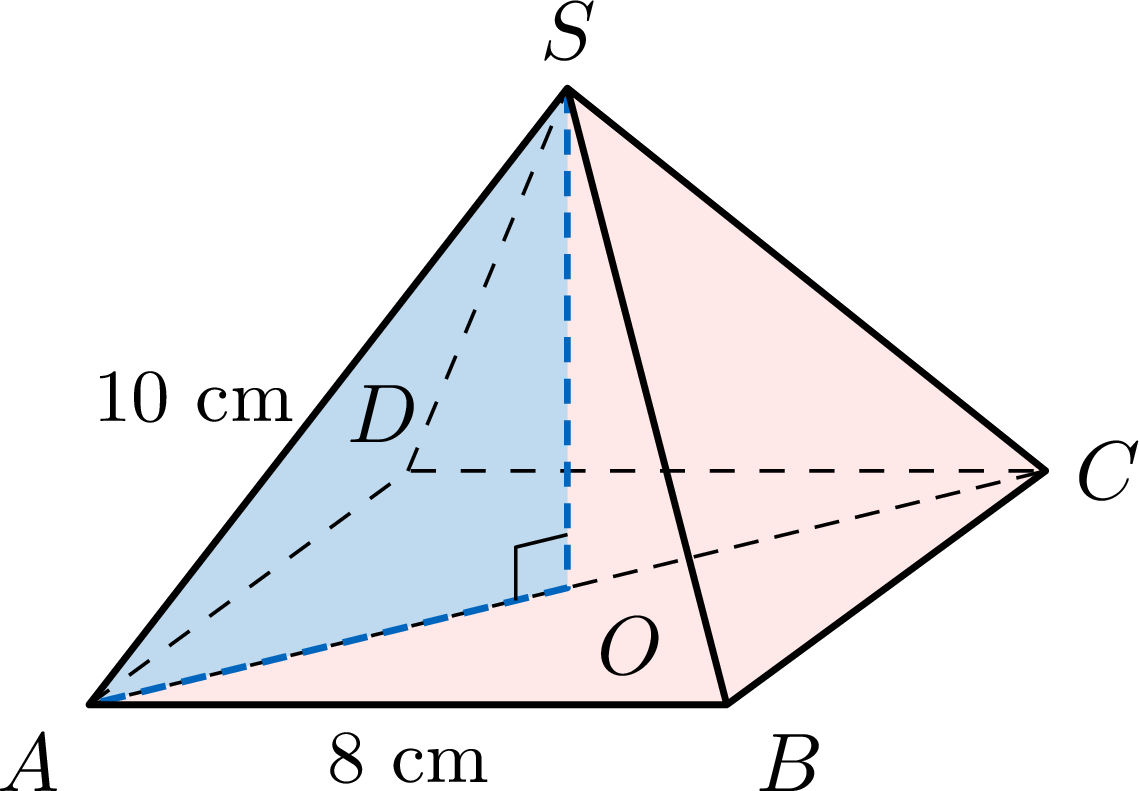
- The half-diagonal \(OA\). The square has a right angle at \(B\), so in the triangle \(ABC\): $$\begin{aligned}[t] AC^2 &= AB^2 + BC^2 && \text{(Pythagoras' theorem, right angle at } B\text{)}\\ &= 8^2 + 8^2 = 128, \end{aligned}$$ so \(AC = \sqrt{128} = 8\sqrt{2}\) cm and \(OA = 4\sqrt{2}\) cm, since \(O\) is the midpoint of the diagonal.
- The height \(SO\). The height \(\Segment{SO}\) is perpendicular to the base, so the triangle \(SOA\) has a right angle at \(O\): $$\begin{aligned}[t] SO^2 &= SA^2 - OA^2 && \text{(Pythagoras' theorem, right angle at } O\text{)}\\ &= 10^2 - \left(4\sqrt{2}\right)^2 = 100 - 32 = 68, \end{aligned}$$ so \(SO = \sqrt{68} = \textcolor{colorprop}{2\sqrt{17}} \text{ cm} \approx \textcolor{colorprop}{8.2}\) cm, rounded only now: \(OA = 4\sqrt{2}\) was kept exact.
Proposition — Surface Area of Solids with Curved Surfaces
| Name | Solid | Surface area |
| Right cylinder |  | \(\begin{aligned} A=& \text { curved surface } +2 \text { circular ends } \\=&2 \pi r h+2 \pi r^{2} \end{aligned}\) |
| Right cone |  | \(\begin{aligned} A &=\text { curved surface } +\text { circular base } \\&= \pi r s+\pi r^{2} \end{aligned}\) |
| Sphere |  | \(A=4\pi r^2\) |
- Curved surface area of the cylinder.
When the cylinder is unrolled, its curved surface becomes a rectangle of height \(h\) and length equal to the circumference of the base, \(2\pi r\):

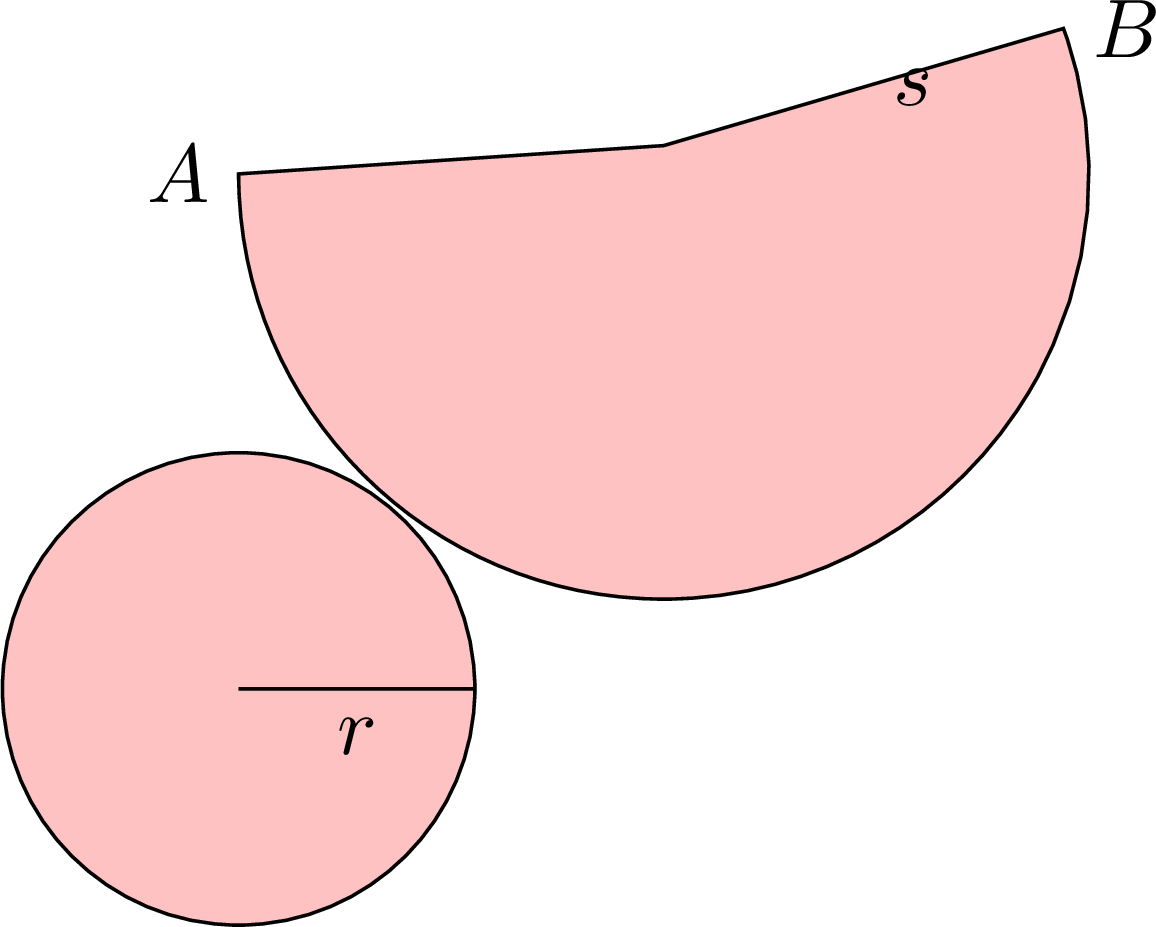
- Curved surface area of the cone.
When the curved surface of the cone is unrolled, it becomes a sector of the disc of radius \(s\) (the slant height):
Example
Find the surface area of the cylinder: 
$$ \begin{aligned} A &= 2\pi r h + 2\pi r^2 \\
&= 2\pi(2)(5) + 2\pi(2)^2 \\
&= 20\pi + 8\pi \\
&= 28\pi \, \text{m}^2 \end{aligned} $$
Proposition — Surface Area of a Hemisphere
The curved surface of a hemisphere of radius \(r\) is half the sphere: its area is \(2\pi r^2\). A solid hemisphere is also bounded by a flat disc of radius \(r\), so its total surface area is $$A = 2\pi r^2 + \pi r^2 = 3\pi r^2.$$ 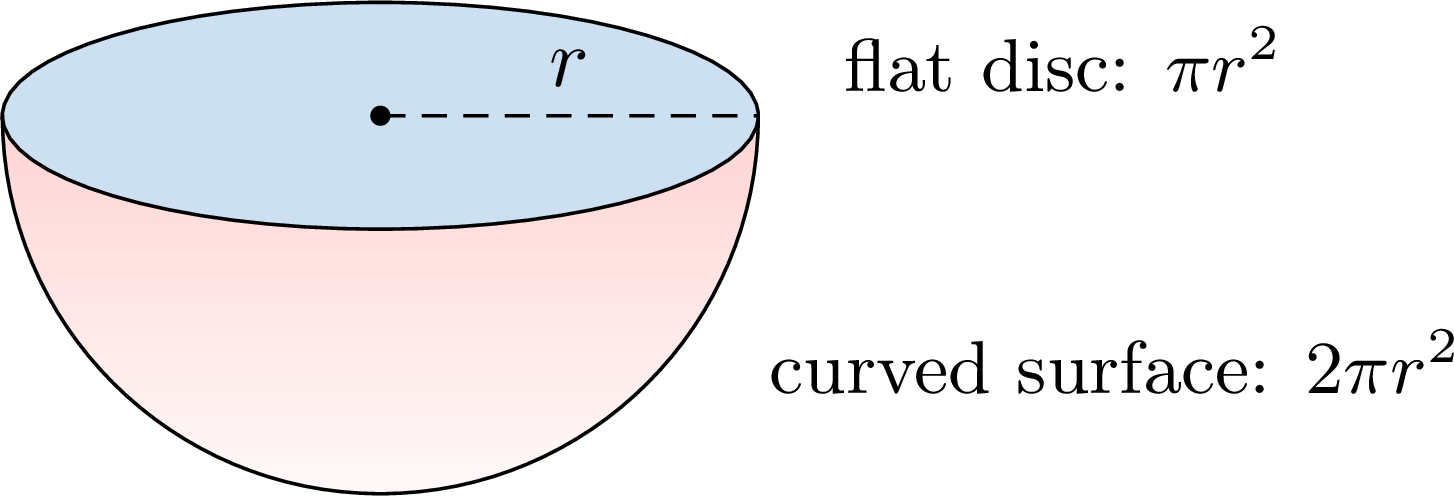
The plane through the centre cuts the sphere into two identical halves, so the curved surface has half the area of the sphere; the flat face is a disc of radius \(r\): $$\begin{aligned}[t]A &= \frac{1}{2} \times 4\pi r^2 + \pi r^2 && \text{(half a sphere, plus a disc)}\\
&= 2\pi r^2 + \pi r^2\\
&= 3\pi r^2.\end{aligned}$$
Method — Finding the Surface Area of a Composite or Hollow Solid
- List the surfaces that are really on the outside of the solid; for a hollow object with a thin wall, such as a bowl or a pipe, it is usually this outer surface that is asked, and the inner surface counts only when the question says so. Where two parts are glued together, the joining face is inside the solid and is not counted; an open (hollow) end has no surface.
- Find the area of each outside surface with its formula: the curved surface of a cylinder \(2\pi r h\), of a cone \(\pi r s\), where \(s\) is the slant height (given, or found from the height with Pythagoras' theorem), of a hemisphere \(2\pi r^2\), and the flat faces as plane figures.
- Add these areas, and round only once, at the end.
Example
A bowl is an open hemisphere of radius \(9\) cm, with a wall thin enough to be ignored: it has no lid. Find the area of its outer surface, exactly and to \(0.1\) cm\(^2\), and compare it with the surface area of a solid hemisphere of the same radius. 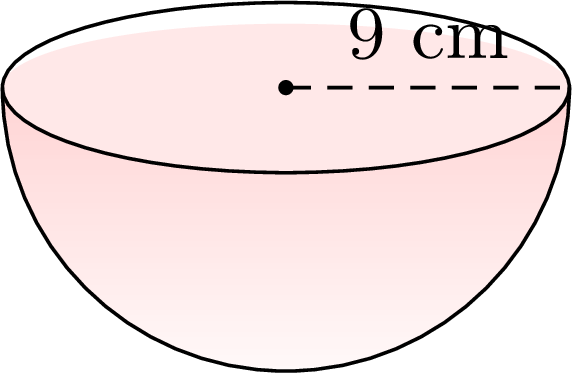
The bowl is open: its outer surface is the curved surface alone, with \(r = 9\) cm: $$\begin{aligned}[t]A_{\text{bowl}} &= 2\pi r^2 && \text{(curved surface of a hemisphere)}\\
&= 2\pi \times 9^2\\
&= \textcolor{colorprop}{162\pi} \approx \textcolor{colorprop}{508.9} \text{ cm}^2.\end{aligned}$$ A solid hemisphere of the same radius also has its flat disc: \(A = 3\pi r^2 = 243\pi \approx 763.4\) cm\(^2\). The difference, \(81\pi \approx 254.5\) cm\(^2\), is exactly the area \(\pi \times 9^2\) of the missing disc.
Example
A spinning top is made of a hemisphere of radius \(3\) cm and a cone with the same base and a height of \(4\) cm, glued base to base. Find the surface area of the top, exactly and to \(0.1\) cm\(^2\). 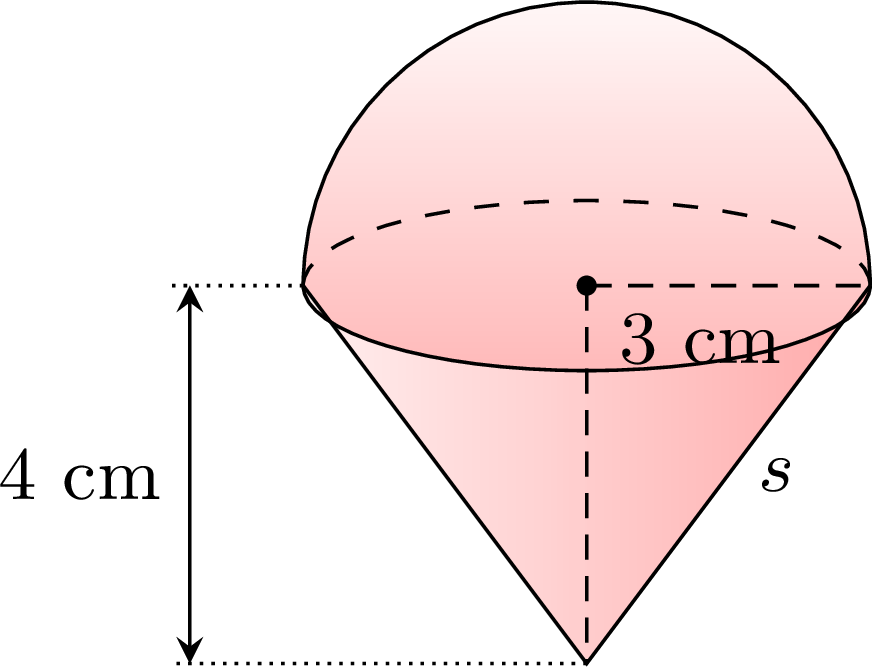
The disc where the two parts are glued is inside the top: it is not counted. The outside surfaces are the curved surface of the cone and that of the hemisphere, with \(r = 3\) cm. The slant height \(s\) of the cone comes first: $$\begin{aligned}[t]s^2 &= r^2 + h^2 && \text{(Pythagoras' theorem)}\\
&= 3^2 + 4^2\\
&= 25,\end{aligned}$$ so \(s = 5\) cm, a length being positive. Then $$\begin{aligned}[t]A &= \pi r s + 2\pi r^2 && \text{(curved surfaces of the cone and of the hemisphere)}\\
&= \pi \times 3 \times 5 + 2\pi \times 3^2\\
&= 15\pi + 18\pi\\
&= \textcolor{colorprop}{33\pi} \approx \textcolor{colorprop}{103.7} \text{ cm}^2.\end{aligned}$$ Adding the joining disc would count \(9\pi\) cm\(^2\) that nobody can touch or paint.
Skills to practice
- Finding Surface Areas of Prisms and Pyramids
- Finding Surface Areas of Cylinders, Cones and Spheres
- Finding Surface Areas of Hemispheres and Composite Solids
- Justifying Surface Area Calculations
IV
Going further
Skills to practice
- Solving Problems on Arcs and Sectors
- Solving Problems on Surface Area and Volume
- Solving Exam-Style Problems on Measurement
- Quiz
Jump to section