International Baccalaureate · DP 1: Analysis and Approaches HL
Complex Numbers: Algebraic Form
I
Complex Numbers
I.1
The Number \(i\) and the Set of Complex Numbers
In 1572, the Italian engineer Rafael Bombelli studied the equation $$x^3 = 15x + 4.$$
- Check that \(x = 4\) is a solution.
- Cardano's formula, the great discovery of his century, gives a solution of this equation as $$x = \sqrt[3]{2+\sqrt{-121}} + \sqrt[3]{2-\sqrt{-121}}.$$ The symbol \(\sqrt{-121}\) (Cardano's historical notation, which we will soon abandon) names an impossible number: no real number has a negative square. Yet the equation does have the perfectly real solution \(4\). Bombelli's idea: dare to compute with an “impossible” number \(i\) satisfying \(i^2 = -1\), writing \(\sqrt{-121} = 11i\), and see whether the formula secretly says \(4\).
- Admitting the usual rules of algebra together with \(i^2=-1\), expand \((2+i)^3\). What do you notice? Conclude what value the formula produces when its two cube roots are chosen as \(2+i\) and \(2-i\), which differ only in the sign in front of \(i\), as the formula requires.
Definition — The Imaginary Unit \(i\)
The imaginary unit, denoted by \(i\), is defined as a number such that: $$\textcolor{colordef}{i^2 = -1}$$
Why We Write \(i^2 \equal -1\) and Never \(i \equal \sqrt{-1}\)
The temptation is great to write \(i = \sqrt{-1}\). The following chain of equalities shows why this chapter does not use this notation: $$1 = \sqrt{1} = \sqrt{(-1)\times(-1)} = \sqrt{-1}\times\sqrt{-1} = i \times i = i^2 = -1.$$ Every step looks legal, yet the conclusion \(1 = -1\) is absurd. The faulty step is the third one: the law \(\sqrt{a}\times\sqrt{b} = \sqrt{ab}\) holds only for \(a, b \ge 0\) — exactly the hypothesis that comes with it for square roots. The symbol \(\sqrt{\ }\) keeps its meaning only for non-negative real numbers.
- We define \(i\) by the property \(\textcolor{colordef}{i^2 = -1}\), and we never apply the laws of \(\sqrt{\ }\) to negative numbers.
- Moreover, \(-1\) has two square roots in the complex numbers, \(i\) and \(-i\), and nothing distinguishes one from the other: a symbol \(\sqrt{-1}\) would pretend to choose between two indistinguishable numbers.
Definition — Complex Number and Algebraic Form
A complex number is a number of the form \(z = a + bi\), where \(a\) and \(b\) are real numbers and \(i\) is the imaginary unit. This way of writing \(z\) is called its algebraic form. The set of all complex numbers is denoted by \(\C\).
Note
- \(i\) cannot be a real number, since no real number squared is equal to \(-1\).
- A real number \(a\) is a complex number where \(b=0\), written as \(a = a+0i\). Thus \(\R \subset \C\).
- A number where \(a=0\), such as \(bi\), is called a purely imaginary number.
Definition — Real and Imaginary Parts
For a complex number \(z = a + bi\) (with \(a,b \in \R\)): - \(a\) is the real part of \(z\), denoted \(\Re(z)\).
- \(b\) is the imaginary part of \(z\), denoted \(\Im(z)\).
Example
For \(z = 2+3i\): - \(\Re(2+3i)=2\)
- \(\Im(2+3i)=3\)
Definition — Complex Conjugate
The complex conjugate of \(z = a + bi\) (with \(a,b\in\R\)) is \(\conjugate{z} = a - bi\). The complex conjugate of \(z\) is often denoted as \(\conjugate{z}\) or \(z^{*}\). Example
The complex conjugate of \(2+3i\) is \(\conjugate{2+3i} = 2-3i\). Skills to practice
- Recognising the Real and Imaginary Parts
- Classifying Complex Numbers
- Identifying Real and Imaginary Parts
- Finding the Conjugate of a Complex Number
II
Operations with Complex Numbers
II.1
Calculating with Complex Numbers
The arithmetic of complex numbers follows the standard rules of algebra, together with the key relation \(i^2=-1\).
Definition — Algebraic Operations
Let \(z = a+bi\) and \(w = c+di\), where \(a,b,c,d \in \R\). - Addition: $$\begin{aligned}[t] z + w &= (a+bi) + (c+di) \\ &= (a+c)+(b+d)i. \end{aligned}$$
- Subtraction: $$\begin{aligned}[t] z - w &= (a+bi) - (c+di) \\ &= (a-c)+(b-d)i. \end{aligned}$$
- Multiplication: $$\begin{aligned}[t] z \times w &= (a+bi)(c+di) \\ &= ac + adi + bci + bdi^2 \\ &= ac + adi + bci - bd && \text{(\(i^2 = -1\))}\\ &= (ac-bd)+ (ad+bc)i. \end{aligned}$$
- Division (with \(w \neq 0\), so that \(c^2+d^2 \neq 0\) since \(c\) and \(d\) are not both zero): $$\begin{aligned}[t] \dfrac{z}{w} &= \frac{a+bi}{c+di} \\ &= \left(\frac{a+bi}{c+di}\right)\left(\frac{c-di}{c-di}\right) && \text{(multiply by 1)}\\ &= \frac{(a+bi)(c-di)}{(c+di)(c-di)} \\ &= \frac{ac-adi+bci-bdi^2}{c^2-(di)^2} && \text{(expand)}\\ &= \frac{ac-adi+bci+bd}{c^2+d^2} && \text{(\(i^2 = -1\))}\\ &= \frac{(ac+bd) + (bc-ad)i}{c^2+d^2}. \end{aligned}$$
Example
Write \((2+3i)(4-i)\) in the form \(a+bi\).
$$\begin{aligned}[t] (2+3i)(4-i) &= 8 - 2i + 12i - 3i^2 && \text{(expand)}\\
&= 8 + 10i - 3i^2 && \text{(collect like terms)}\\
&= 8 + 10i - 3 \times (-1) && \text{(\(i^2 = -1\))}\\
&= 11 + 10i. \end{aligned}$$
Proposition — Inverse of a Nonzero Complex Number and Zero Product
Let \(z = a + bi\) with \(a, b \in \R\) and \(z \neq 0\) (so that \(a^2 + b^2 \neq 0\)). Then \(z\) has an inverse, the complex number \(\dfrac{1}{z}\) such that \(z \times \dfrac{1}{z} = 1\), and $$\textcolor{colorprop}{\frac{1}{z} = \frac{a - bi}{a^2 + b^2} = \frac{a}{a^2+b^2} - \frac{b}{a^2+b^2}\,i.}$$ Zero product. For all complex numbers \(z\) and \(w\): $$zw = 0 \;\Leftrightarrow\; z = 0 \text{ or } w = 0.$$
The inverse. Since \(a\) and \(b\) are not both zero, \(a^2 + b^2 > 0\). Moreover $$\begin{aligned}[t] (a + bi)(a - bi) &= a^2 - (bi)^2 && \text{(\((x+y)(x-y) = x^2 - y^2\))}\\
&= a^2 - b^2 i^2 && \text{(power of a product)}\\
&= a^2 + b^2. && \text{(\(i^2 = -1\))} \end{aligned}$$ Dividing by the nonzero real number \(a^2 + b^2\) gives \(z \times \dfrac{a - bi}{a^2+b^2} = 1\): the number \(\dfrac{a - bi}{a^2+b^2}\) is an inverse of \(z\). It is the only one: if \(z z' = 1\) and \(z z'' = 1\), then \(z' = z'(z z'') = (z' z) z'' = z''\).
Zero product. If \(z = 0\) or \(w = 0\), then \(zw = 0\), by the usual rules of algebra. Conversely, suppose \(zw = 0\) and \(z \neq 0\). Multiplying both sides by \(\dfrac{1}{z}\): $$\frac{1}{z}(zw) = \frac{1}{z} \times 0 = 0 \quad \text{and} \quad \frac{1}{z}(zw) = \left(\frac{1}{z} z\right) w = w,$$ so \(w = 0\).
Zero product. If \(z = 0\) or \(w = 0\), then \(zw = 0\), by the usual rules of algebra. Conversely, suppose \(zw = 0\) and \(z \neq 0\). Multiplying both sides by \(\dfrac{1}{z}\): $$\frac{1}{z}(zw) = \frac{1}{z} \times 0 = 0 \quad \text{and} \quad \frac{1}{z}(zw) = \left(\frac{1}{z} z\right) w = w,$$ so \(w = 0\).
Example
Write \(\dfrac{1}{2+3i}\) and \(\dfrac{1}{2i}\) in algebraic form.
For \(z = 2 + 3i\), \(a = 2\) and \(b = 3\), so \(a^2 + b^2 = 4 + 9 = 13\): $$\begin{aligned}[t] \frac{1}{2+3i} &= \frac{2 - 3i}{13} && \text{(inverse of \(a + bi\))}\\
&= \frac{2}{13} - \frac{3}{13}\,i. \end{aligned}$$ For \(z = 2i = 0 + 2i\), \(a = 0\) and \(b = 2\), so \(a^2 + b^2 = 4\): $$\begin{aligned}[t] \frac{1}{2i} &= \frac{0 - 2i}{4} && \text{(inverse of \(a + bi\))}\\
&= -\frac{1}{2}\,i. \end{aligned}$$ Check: \((2+3i)\left(\frac{2}{13} - \frac{3}{13}i\right) = \frac{4 + 9}{13} + \frac{-6 + 6}{13}\,i = 1\), and \(2i \times \left(-\frac{1}{2}i\right) = -i^2 = 1\).
Method — Dividing by a Complex Number
To write a quotient \(\dfrac{z}{w}\) (with \(w \neq 0\)) in algebraic form, multiply the numerator and the denominator by the conjugate of the denominator (for \(w = c + di\), the number \(c - di\)): the denominator becomes the real number \(w\conjugate{w} = c^2 + d^2\). This is the same technique used to rationalize a binomial denominator such as \(3+\sqrt{5}\), and the same computation as the inverse \(\dfrac{1}{w} = \dfrac{c - di}{c^2 + d^2}\), since \(\dfrac{z}{w} = z \times \dfrac{1}{w}\). Example
Write \(\dfrac{3+2i}{1-2i}\) in the form \(a+bi\).
$$\begin{aligned}[t] \frac{3+2i}{1-2i} &= \frac{(3+2i)}{(1-2i)} \times \frac{(1+2i)}{(1+2i)} && \text{(multiply by 1)}\\
&= \frac{3 + 6i + 2i + 4i^2}{1^2 - (2i)^2} && \text{(expand; \((x-y)(x+y) = x^2 - y^2\))}\\
&= \frac{-1 + 8i}{1 + 4} && \text{(\(i^2 = -1\))}\\
&= -\frac{1}{5} + \frac{8}{5}i. \end{aligned}$$
Proposition — Powers of \(i\)
The powers of \(i\) repeat in a cycle of length \(4\): $$\textcolor{colorprop}{i^0 = 1, \quad i^1 = i, \quad i^2 = -1, \quad i^3 = -i, \quad i^4 = 1, \;\dots}$$ For any natural number \(n\), the value of \(i^n\) depends only on the remainder of the Euclidean division of \(n\) by \(4\): writing \(n = 4q + r\) with \(q\) the quotient and \(r \in \{0, 1, 2, 3\}\) the remainder, $$i^n = i^{4q+r} = \left(i^4\right)^q \times i^r = 1^q \times i^r = i^r.$$ Example
Compute \(i^{2026}\).
$$\begin{aligned}[t] i^{2026} &= i^{4 \times 506 + 2} && \text{(\(2026 = 4 \times 506 + 2\))}\\
&= \left(i^4\right)^{506} \times i^2 && \text{(\(x^{m+n} = x^m x^n\))}\\
&= 1^{506} \times (-1) && \text{(\(i^4 = 1\), \(i^2 = -1\))}\\
&= -1. \end{aligned}$$
Skills to practice
- Calculating with Complex Numbers
- Evaluating Polynomial Expressions of a Complex Number
- Dividing Complex Numbers
- Simplifying Expressions to Find Real and Imaginary Parts
- Calculating Powers of the Imaginary Unit
- Proving Properties of the Powers of \(i\)
- Solving Linear Equations
II.2
Calculating with Technology
Method — Calculating with Complex Numbers with Technology
A graphing calculator, or a scientific calculator with a complex mode, computes sums, products, quotients and powers of complex numbers. - Set the mode to complex numbers written in the form \(a + bi\).
- Enter the imaginary unit with its own key, not a variable named \(i\), and put each complex number between brackets: \((1 + 2i)(3 - i)\), \((4 + 7i) \div (1 - 2i)\), \((3 - 2i)^4\).
- Read the result in the form \(a + bi\). Report a part exactly only when it is known to be exact: the screen shows an integer, a fraction or a short decimal, and a check by hand confirms it; otherwise give the real part and the imaginary part each to 3 significant figures.
- Check what the question asks for: when an exact form or a working is required, the screen gives the value to reach, and the computation by hand, with the conjugate for a quotient, gives the working.
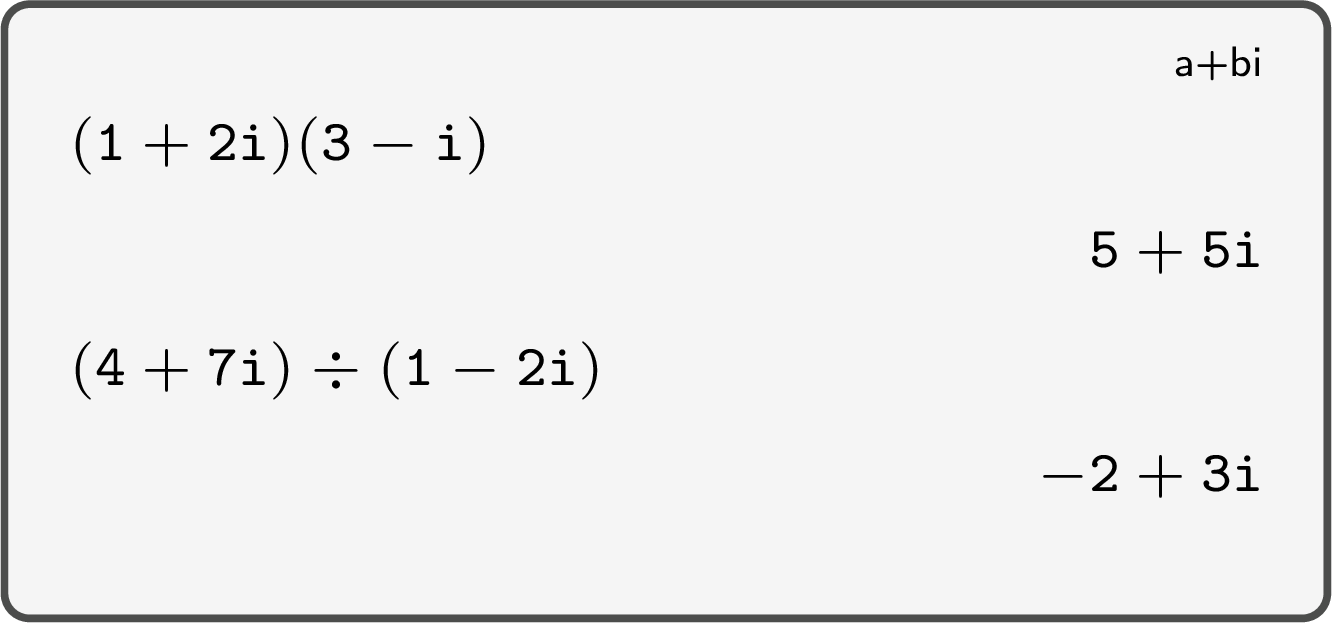
Example
Use technology to write each number in the form \(a + bi\), then check the second one by hand. - \((3 - 2i)^4\);
- \(\dfrac{2 + 5i}{3 - 4i}\).
- In complex mode, the input \((3 - 2i)^4\) displays \(-119 - 120i\). Two integers, confirmed by hand with \((3 - 2i)^2 = 5 - 12i\) and \((5 - 12i)^2 = 25 - 120i + 144i^2 = -119 - 120i\): \((3 - 2i)^4 = -119 - 120i\).
- The input \((2 + 5i) \div (3 - 4i)\) displays \(-0.56 + 0.92i\): two short decimals, which the computation by hand, with the conjugate \(3 + 4i\) of the denominator, confirms to be exact: $$\begin{aligned}[t] \frac{2 + 5i}{3 - 4i} &= \frac{(2 + 5i)(3 + 4i)}{(3 - 4i)(3 + 4i)} && \text{(multiply by the conjugate)}\\ &= \frac{6 + 8i + 15i + 20i^2}{3^2 + 4^2} && \text{(expand; \((3 - 4i)(3 + 4i) = 3^2 + 4^2\))}\\ &= \frac{-14 + 23i}{25} && \text{(\(i^2 = -1\))}\\ &= -0.56 + 0.92i. \end{aligned}$$ So \(\dfrac{2 + 5i}{3 - 4i} = -0.56 + 0.92i\) exactly: the working gives the value displayed on the screen.
Skills to practice
- Calculating with Complex Numbers with Technology
III
Equality of Complex Numbers
III.1
Equal Complex Numbers
Proposition — Equality of Complex Numbers
Two complex numbers are equal if and only if their real parts are equal and their imaginary parts are equal: for \(a, b, c, d \in \R\), $$ a+bi=c+di \;\Leftrightarrow\; a=c \text{ and } b=d. $$ - (\(\Rightarrow\)) Suppose \(a+bi=c+di\). Then $$(a-c) + (b-d)i = 0.$$ This implies \(a-c = i(d-b)\). If \(d \neq b\), then $$i = \frac{a-c}{d-b}.$$ Since \(a,b,c,d\) are real, the right-hand side is a real number, while \(i\) is not real (because \(i^2=-1\) has no real solution). This is a contradiction. Therefore, the assumption \(d \neq b\) must be false, which means \(d=b\). Substituting this back into \(a-c = i(d-b)\) gives \(a-c = 0\), so \(a=c\).
- (\(\Leftarrow\)) Suppose \(a=c\) and \(b=d\). Then \(bi=di\). Adding the equalities \(a=c\) and \(bi=di\) gives $$a+bi = c+di.$$
Skills to practice
- Solving Equations by Equating Real and Imaginary Parts
IV
Properties of the Complex Conjugate
IV.1
Calculating with Conjugates
Proposition — Properties of the Conjugate
For all complex numbers \(z\) and \(w\): $$\begin{aligned}[t] \conjugate{\conjugate{z}} &= z, \qquad \conjugate{-z} = -\conjugate{z},\\
\conjugate{z + w} &= \conjugate{z} + \conjugate{w}, \qquad \conjugate{z - w} = \conjugate{z} - \conjugate{w},\\
\conjugate{zw} &= \conjugate{z} \; \conjugate{w},\\
\conjugate{\left(\frac{1}{z}\right)} &= \frac{1}{\conjugate{z}} \quad \text{if } z \neq 0, \qquad \conjugate{\left(\frac{z}{w}\right)} = \frac{\conjugate{z}}{\conjugate{w}} \quad \text{if } w \neq 0,\\
\conjugate{z^{\,n}} &= \left(\conjugate{z}\right)^{n} \quad \text{for every natural number } n. \end{aligned}$$ Since \(z^{-n} = \dfrac{1}{z^{n}}\) for \(z \neq 0\), the last property extends to every integer \(n\) when \(z \neq 0\).
Let \(z = a + bi\) and \(w = c + di\) with \(a, b, c, d \in \R\).
Conjugate of the conjugate. \(\conjugate{\conjugate{z}} = \conjugate{a - bi} = a + bi = z\).
Sum. $$\begin{aligned}[t] \conjugate{z + w} &= \conjugate{(a+c)+(b+d)i} && \text{(addition)}\\ &= (a+c)-(b+d)i && \text{(definition of the conjugate)}\\ &= (a-bi)+(c-di) && \text{(regroup)}\\ &= \conjugate{z}+\conjugate{w}. \end{aligned}$$ Product. On one hand, \(zw = (ac-bd)+(ad+bc)i\), so \(\conjugate{zw} = (ac-bd)-(ad+bc)i\). On the other hand, $$\begin{aligned}[t] \conjugate{z}\;\conjugate{w} &= (a-bi)(c-di) && \\ &= ac - adi - bci + bdi^2 && \text{(expand)}\\ &= (ac - bd) - (ad+bc)i. && \text{(\(i^2 = -1\))} \end{aligned}$$ The two results agree: \(\conjugate{zw} = \conjugate{z}\;\conjugate{w}\). Taking \(w = -1\) gives \(\conjugate{-z} = \conjugate{-1}\,\conjugate{z} = -\conjugate{z}\).
Inverse. Let \(z \neq 0\); then \(\conjugate{z} \neq 0\) too (its real and imaginary parts are \(a\) and \(-b\), not both zero). Taking the conjugate of both sides of \(z \times \dfrac{1}{z} = 1\) and using the product property: $$\conjugate{z} \times \conjugate{\left(\frac{1}{z}\right)} = \conjugate{1} = 1,$$ so \(\conjugate{\left(\dfrac{1}{z}\right)}\) is the inverse of \(\conjugate{z}\): \(\conjugate{\left(\dfrac{1}{z}\right)} = \dfrac{1}{\conjugate{z}}\).
Power. For every natural number \(n\), let \(P(n)\) be the property « \(\conjugate{z^{\,n}} = \left(\conjugate{z}\right)^n\) ».
- Base case: with the convention \(z^0 = 1\) for every complex number \(z\), \(\conjugate{z^{\,0}} = \conjugate{1} = 1 = \left(\conjugate{z}\right)^0\), so \(P(0)\) is true.
- Inductive step: suppose \(P(n)\) is true for some natural number \(n\). Then $$\begin{aligned}[t] \conjugate{z^{\,n+1}} &= \conjugate{z^{\,n} \times z} && \text{(\(z^{n+1} = z^n \times z\))}\\ &= \conjugate{z^{\,n}} \; \conjugate{z} && \text{(conjugate of a product)}\\ &= \left(\conjugate{z}\right)^{n} \conjugate{z} && \text{(inductive hypothesis)}\\ &= \left(\conjugate{z}\right)^{n+1}, \end{aligned}$$ so \(P(n+1)\) is true.
- Conclusion: by induction, \(P(n)\) is true for every natural number \(n\).
Proposition — Conjugate, Real and Imaginary Parts
For any complex number \(z = a+bi\) (with \(a, b \in \R\)): $$\begin{aligned}[t] z\conjugate{z} &= a^2 + b^2, \\
z + \conjugate{z} &= 2\,\Re(z), \\
z - \conjugate{z} &= 2i\,\Im(z). \end{aligned}$$ In particular: - \(z\) is a real number if and only if \(\conjugate{z} = z\);
- \(z\) is purely imaginary if and only if \(\conjugate{z} = -z\).
Let \(z = a+bi\) with \(a, b \in \R\). $$\begin{aligned}[t] z\conjugate{z} &= (a+bi)(a-bi) && \\
&= a^2 - (bi)^2 && \text{(\((x+y)(x-y) = x^2 - y^2\))}\\
&= a^2 - b^2 i^2 && \text{(power of a product)}\\
&= a^2 + b^2. \end{aligned}$$ $$\begin{aligned}[t] z + \conjugate{z} &= (a+bi) + (a-bi) \\
&= 2a = 2\,\Re(z),\\
z - \conjugate{z} &= (a+bi) - (a-bi) \\
&= 2bi = 2i\,\Im(z). \end{aligned}$$ Then \(\conjugate{z} = z\) is equivalent to \(z - \conjugate{z} = 0\), that is \(2i\,\Im(z) = 0\), that is \(\Im(z) = 0\): this means exactly that \(z\) is real. Similarly \(\conjugate{z} = -z\) is equivalent to \(z + \conjugate{z} = 0\), that is \(\Re(z) = 0\): this means exactly that \(z\) is purely imaginary.
Note
The identity \(z\conjugate{z} = a^2+b^2\) is the engine of complex division: multiplying a denominator by its conjugate always produces a real, nonnegative number (zero only for \(z=0\)). The geometric viewpoint on complex numbers will call this quantity the square of the modulus of \(z\).
Method — Solving an Equation Involving \(z\) and \(\conjugate{z}\)
- If only \(\conjugate{z}\) appears (for instance \(-\conjugate{z} = 5 - i\)): isolate \(\conjugate{z}\), then take the conjugate of both sides, since \(\conjugate{\conjugate{z}} = z\).
- If \(z\) and \(\conjugate{z}\) both appear (for instance \(2z + \conjugate{z} = 3 - 2i\)): write \(z = a + bi\) with \(a, b\) real, so that \(\conjugate{z} = a - bi\); expand and gather the real and imaginary parts; equate them with those of the right-hand side, which gives a system of two equations in \(a\) and \(b\).
- Check the solution in the equation.
Skills to practice
- Recognising Properties of the Conjugate
- Proving Properties of the Complex Conjugate
- Solving Complex Equations involving the Conjugate
V
Quadratic Equations in \(\mathbb{C}\)
V.1
Quadratic Equations with Complex Roots
Proposition — Solving equations of the form \(z^2 \equal k\)
Consider the equation \(z^2 = k\), where \(k\) is a real number. - If \(k > 0\), the equation has two distinct real solutions: $$ z_1 = \sqrt{k} \quad \text{and} \quad z_2 = -\sqrt{k} $$
- If \(k = 0\), the equation has a unique real solution: $$ z_0 = 0 $$
- If \(k < 0\), the equation has two conjugate purely imaginary solutions: $$ z_1 = i\sqrt{-k} \quad \text{and} \quad z_2 = -i\sqrt{-k} $$
In each case the equation \(z^2 = k\) is turned into a product equal to zero, and a product of complex numbers is zero if and only if one of its factors is zero.
- If \(k > 0\): \(z^2 - k = z^2 - \left(\sqrt{k}\right)^2 = \left(z - \sqrt{k}\right)\left(z + \sqrt{k}\right)\), so \(z^2 = k\) if and only if \(z = \sqrt{k}\) or \(z = -\sqrt{k}\).
- If \(k = 0\): \(z^2 = z \times z = 0\) if and only if \(z = 0\).
- If \(k < 0\): then \(-k > 0\) and, since \(i^2 = -1\), \(k = -(-k) = i^2 (-k) = \left(i\sqrt{-k}\right)^2\); hence \(z^2 - k = \left(z - i\sqrt{-k}\right)\left(z + i\sqrt{-k}\right)\), and \(z^2 = k\) if and only if \(z = i\sqrt{-k}\) or \(z = -i\sqrt{-k}\).
Proposition — Solving Quadratic Equations with Real Coefficients in \(\mathbb{C}\)
Consider the equation \(az^2 + bz + c = 0\), where \(a, b,\) and \(c\) are real numbers and \(a \neq 0\).Let \(\Delta = b^2 - 4ac\) be the discriminant of this equation.
- If \(\Delta > 0\), the equation has two distinct real solutions: $$ z_1 = \frac{-b - \sqrt{\Delta}}{2a} \quad \text{and} \quad z_2 = \frac{-b + \sqrt{\Delta}}{2a} $$
- If \(\Delta = 0\), the equation has a unique real solution: $$ z_0 = \frac{-b}{2a} $$
- If \(\Delta < 0\), the equation has two conjugate complex solutions: $$ z_1 = \frac{-b - i\sqrt{-\Delta}}{2a} \quad \text{and} \quad z_2 = \frac{-b + i\sqrt{-\Delta}}{2a} $$
- If \(\Delta \neq 0\), the quadratic can be factorized as: \(az^2 + bz + c = a(z - z_1)(z - z_2)\).
Let \(a, b, c\) be real numbers with \(a \neq 0\) and \(\Delta = b^2 - 4ac\). For every complex number \(z\), the canonical form holds in \(\C\) exactly as in \(\R\), since it only uses the rules of algebra: $$\begin{aligned}[t] az^2 + bz + c &= a\left[z^2 + \frac{b}{a}z + \frac{c}{a}\right] && \text{(factor out \(a \neq 0\))}\\
&= a\left[\left(z + \frac{b}{2a}\right)^2 - \frac{b^2}{4a^2} + \frac{c}{a}\right] && \text{(complete the square)}\\
&= a\left[\left(z + \frac{b}{2a}\right)^2 - \frac{\Delta}{4a^2}\right]. && \text{(\(\frac{b^2 - 4ac}{4a^2} = \frac{\Delta}{4a^2}\))} \end{aligned}$$ In each case the bracket factors, and the equation \(az^2 + bz + c = 0\) becomes a product equal to zero.
- \(\Delta > 0\): \(\dfrac{\Delta}{4a^2} = \left(\dfrac{\sqrt{\Delta}}{2a}\right)^2\), so, as a difference of two squares, $$az^2 + bz + c = a\left(z + \frac{b}{2a} - \frac{\sqrt{\Delta}}{2a}\right)\left(z + \frac{b}{2a} + \frac{\sqrt{\Delta}}{2a}\right) = a(z - z_2)(z - z_1).$$
- \(\Delta = 0\): \(az^2 + bz + c = a\left(z + \dfrac{b}{2a}\right)^2 = a(z - z_0)^2\), a product of two equal factors.
- \(\Delta < 0\): \(-\Delta > 0\) and \(\dfrac{\Delta}{4a^2} = -\dfrac{-\Delta}{4a^2} = i^2\,\dfrac{-\Delta}{4a^2} = \left(\dfrac{i\sqrt{-\Delta}}{2a}\right)^2\), so, again as a difference of two squares, $$az^2 + bz + c = a\left(z + \frac{b}{2a} - \frac{i\sqrt{-\Delta}}{2a}\right)\left(z + \frac{b}{2a} + \frac{i\sqrt{-\Delta}}{2a}\right) = a(z - z_2)(z - z_1),$$ and \(z_1\), \(z_2\) are conjugates, since they differ only by the sign of their imaginary part.
Example
Solve in \(\R\), then in \(\C\), the equations \(z^2 + 10 = 0\) and \(z^2 - 4z + 5 = 0\). - \(z^2 + 10 = 0\) is equivalent to \(z^2 = -10\), an equation of the form \(z^2 = k\) with \(k = -10 < 0\). In \(\R\), it has no solution. In \(\C\), its solutions are \(i\sqrt{10}\) and \(-i\sqrt{10}\): \(S = \left\{-i\sqrt{10}, i\sqrt{10}\right\}\).
- For \(z^2 - 4z + 5 = 0\): \(a = 1\), \(b = -4\), \(c = 5\) and $$\Delta = b^2 - 4ac = (-4)^2 - 4 \times 1 \times 5 = 16 - 20 = -4 < 0.$$ In \(\R\), there is no solution. In \(\C\), there are two conjugate solutions: $$\begin{aligned}[t] z_1 &= \frac{-b - i\sqrt{-\Delta}}{2a} = \frac{4 - i\sqrt{4}}{2} = \frac{4 - 2i}{2} = 2 - i, \\ z_2 &= \frac{-b + i\sqrt{-\Delta}}{2a} = \frac{4 + 2i}{2} = 2 + i, \end{aligned}$$ so \(S = \{2 - i, 2 + i\}\) and \(z^2 - 4z + 5 = (z - 2 + i)(z - 2 - i)\). Check: \((2 + i)^2 - 4(2 + i) + 5 = 3 + 4i - 8 - 4i + 5 = 0\).
Example
Use technology to solve the equation \(2z^2 - 3z + 5 = 0\) in \(\C\), then find its solutions exactly.
The calculator is set to complex mode, then the polynomial solver, degree \(2\), receives \(a = 2\), \(b = -3\) and \(c = 5\). 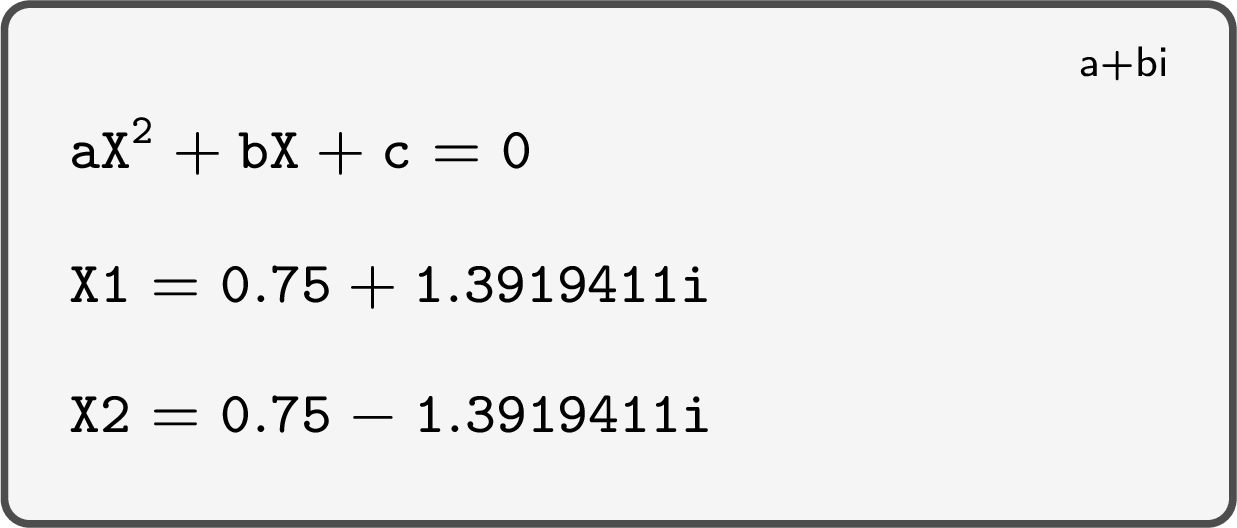
The solutions are \(z \approx 0.75 - 1.39i\) and \(z \approx 0.75 + 1.39i\). Exactly: \(a = 2\), \(b = -3\), \(c = 5\) are real and $$\Delta = b^2 - 4ac = (-3)^2 - 4 \times 2 \times 5 = 9 - 40 = -31 < 0,$$ so the equation has two conjugate complex solutions: $$z_1 = \frac{-b - i\sqrt{-\Delta}}{2a} = \frac{3 - i\sqrt{31}}{4} \quad \text{and} \quad z_2 = \frac{-b + i\sqrt{-\Delta}}{2a} = \frac{3 + i\sqrt{31}}{4}.$$ Since \(\frac{3}{4} = 0.75\) and \(\frac{\sqrt{31}}{4} \approx 1.3919411\), the screen displays approximations of these exact values, and its two roots are conjugates, as the resolution in \(\C\) predicts.
Skills to practice
- Recognising the Solutions of a Quadratic Equation in \(\mathbb{C}\)
- Solving Quadratic Equations with Technology
- Solving Quadratic Equations
- Factorising Quadratic Polynomials
- Solving Equations by Factorisation
VI
Going further
Skills to practice
- Solving Problems without Technology
- Solving Problems with Technology
- Quiz
Jump to section