International Baccalaureate · MYP 5 Extended
Probability
I
Venn Diagrams with Three Sets
I.1
Regions of a Three-Set Venn Diagram
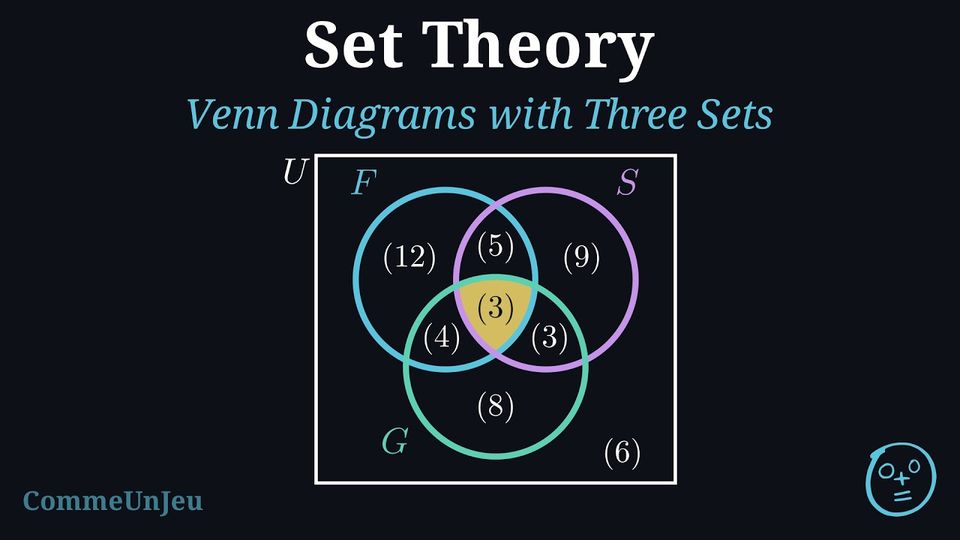
A survey often asks several questions at once: which of three sports each pupil plays, which of three languages each one studies. The answers describe three sets \(A\), \(B\) and \(C\) of the same universal set. Their Venn diagram has three circles that overlap in pairs, and the counting method of two sets still works, one region after the other.
Definition — Three-Set Venn Diagram
Three sets \(A\), \(B\) and \(C\), drawn as three circles that overlap in pairs and share a common central part inside \(U\), divide the diagram into eight regions, numbered here from \(1\) to \(8\). Every element of \(U\) lies in exactly one region. 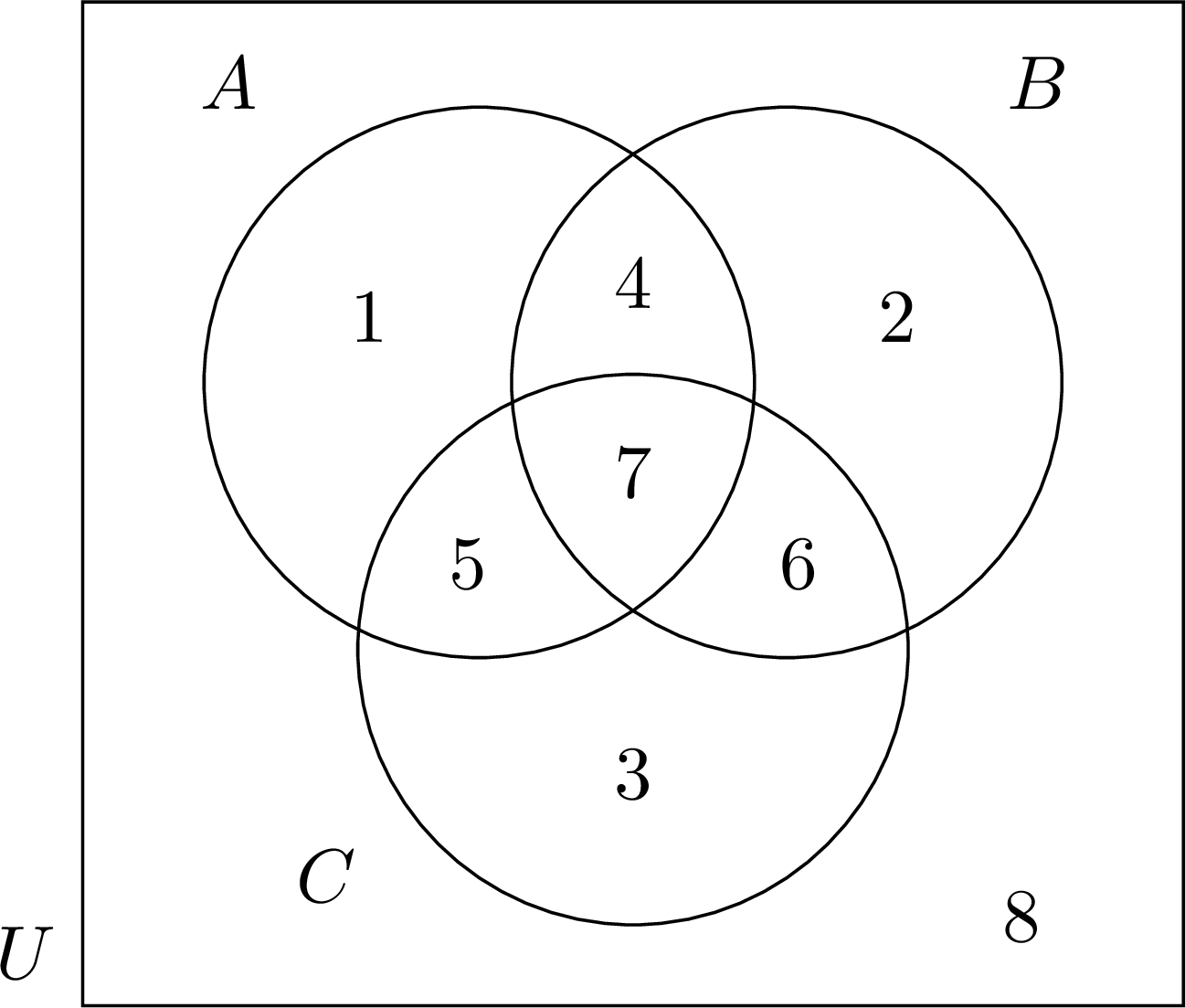
| Region | Set | Its elements are |
| \(1\) | \(A \cap B' \cap C'\) | in \(A\) only |
| \(2\) | \(A' \cap B \cap C'\) | in \(B\) only |
| \(3\) | \(A' \cap B' \cap C\) | in \(C\) only |
| \(4\) | \(A \cap B \cap C'\) | in \(A\) and \(B\), not in \(C\) |
| \(5\) | \(A \cap B' \cap C\) | in \(A\) and \(C\), not in \(B\) |
| \(6\) | \(A' \cap B \cap C\) | in \(B\) and \(C\), not in \(A\) |
| \(7\) | \(A \cap B \cap C\) | in all three sets |
| \(8\) | \(A' \cap B' \cap C'\) | in none of the sets |
Method — Filling a Three-Set Venn Diagram
- Start from the centre, the region \(A \cap B \cap C\). If its number is unknown, call it \(x\).
- Then the three regions “exactly two”: from each intersection of two sets, subtract the centre; for instance \(\Card{A \cap B \cap C'} = \Card{A \cap B} - \Card{A \cap B \cap C}\).
- Then the three regions “one set only”: from each set, subtract the three regions already filled inside its circle.
- Finally the outside: \(\Card{U}\) minus the seven numbers inside the circles. When \(x\) is unknown and the outside is given by the statement, this last step gives the equation: the eight regions add up to \(\Card{U}\).
- Check that every region holds a whole number of elements, zero or more (or a percentage between \(0\) and \(100\) when the regions hold percentages).
Example
The members of a sports centre were asked which facilities they had used during the last month. \(45\pourcent\) had used the pool, \(40\pourcent\) the gym and \(30\pourcent\) the courts; \(15\pourcent\) had used the pool and the gym, \(10\pourcent\) the pool and the courts, \(12\pourcent\) the gym and the courts (each of these three percentages includes the members who used all three facilities), and \(20\pourcent\) had used none of them. What percentage of the members had used all three facilities?
Let \(P\), \(G\) and \(C\) be the sets of the members who used the pool, the gym and the courts, and write the percentage of the members in each region. All the members together make \(100\pourcent\). Let \(x\) be the percentage in the centre \(P \cap G \cap C\). The regions “exactly two” hold \(15 - x\), \(10 - x\) and \(12 - x\); then, for the pool only, $$\begin{aligned}[t] 45 - x - (15 - x) - (10 - x) &= 45 - x - 15 + x - 10 + x && \text{(remove the brackets)} \\
&= 20 + x, \end{aligned}$$ and likewise \(40 - x - (15 - x) - (12 - x) = 13 + x\) for the gym only and \(30 - x - (10 - x) - (12 - x) = 8 + x\) for the courts only. 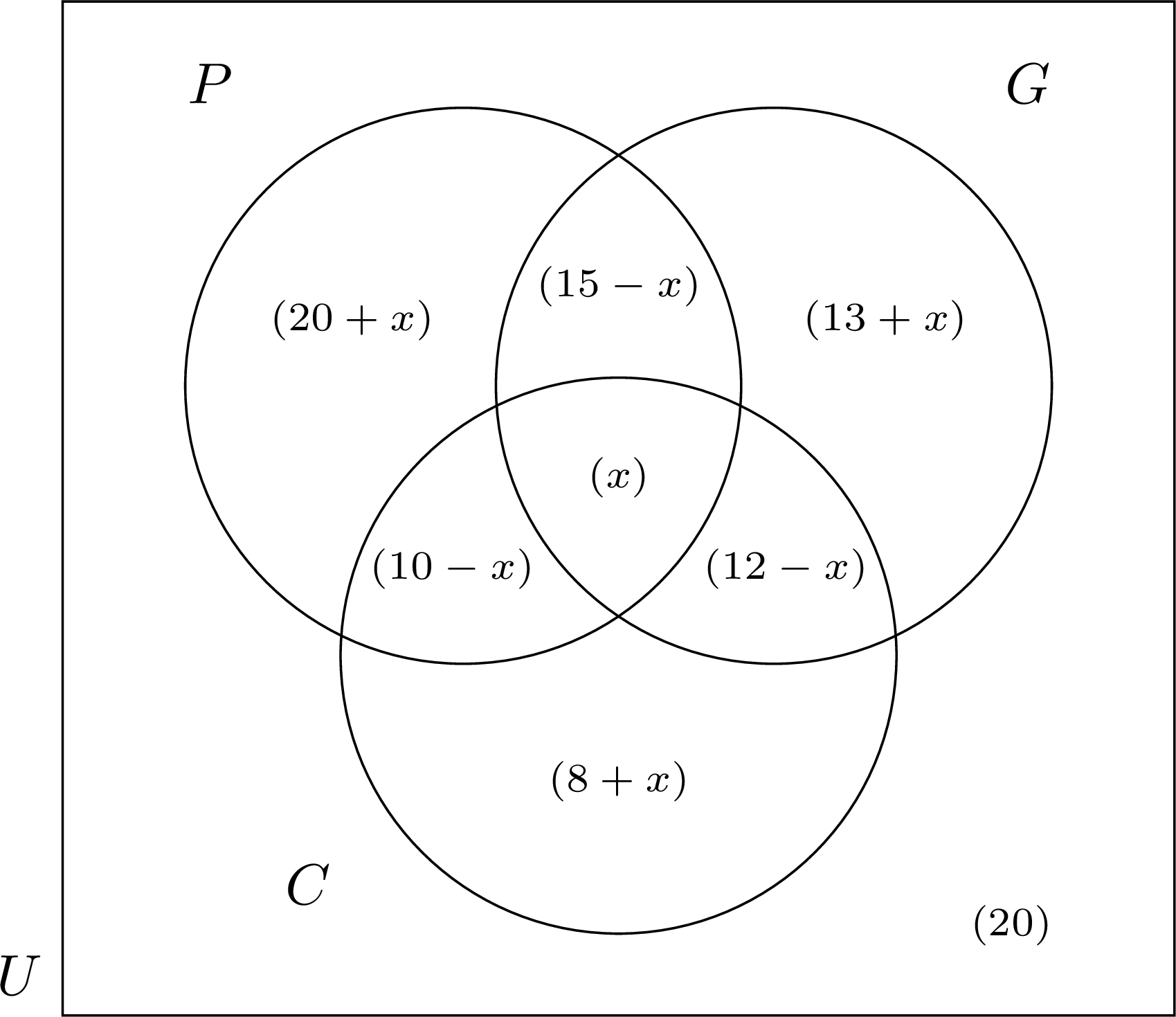
The eight regions make up all the members: $$\begin{aligned}[t] (20 + x) + (13 + x) + (8 + x) + (15 - x) + (10 - x) + (12 - x) + x + 20 &= 100 && \text{(the regions make up } U\text{)} \\
98 + x &= 100 && \text{(collect the terms)} \\
x &= 2 && \text{(subtract } 98\text{)} \end{aligned}$$ Check: the regions hold \(22\), \(15\), \(10\), \(13\), \(8\), \(10\), \(2\) and \(20\), which add up to \(100\). So \(2\pourcent\) of the members used all three facilities.
Skills to practice
- Solving Problems with Three Sets
II
The Algebra of Events
II.1
Events in the Language of Sets
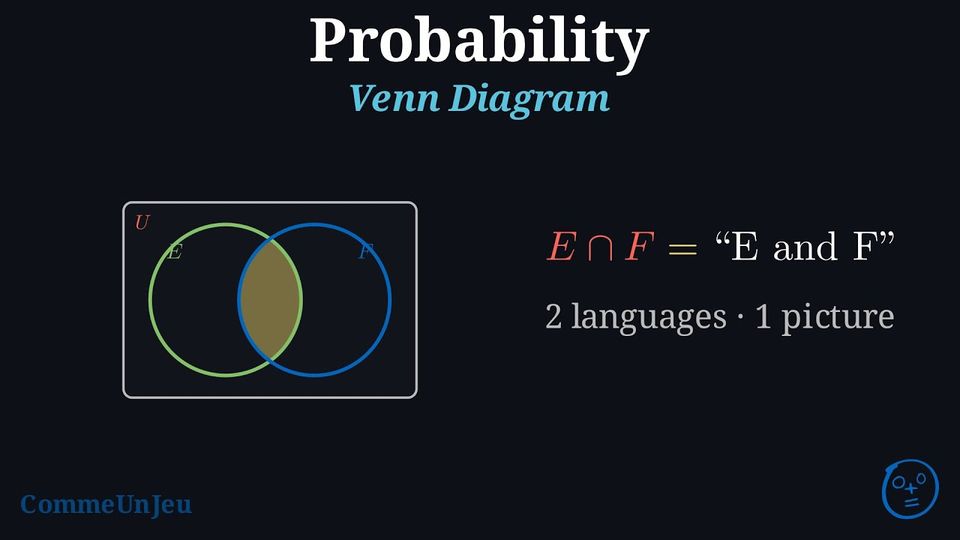
Definition — Set Theory and Probability Vocabulary
| Notation | Set Vocabulary | Probability Vocabulary | Venn Diagram |
| \(U\) | Universal set | Sample space | 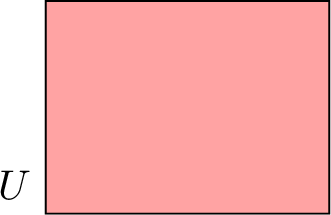 |
| \(x\) | Element of \(U\) | Outcome | 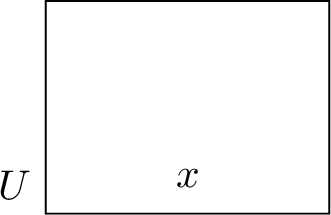 |
| \(\emptyset\) | Empty set | Impossible event | |
| \(E\) | Subset of \(U\) | Event | 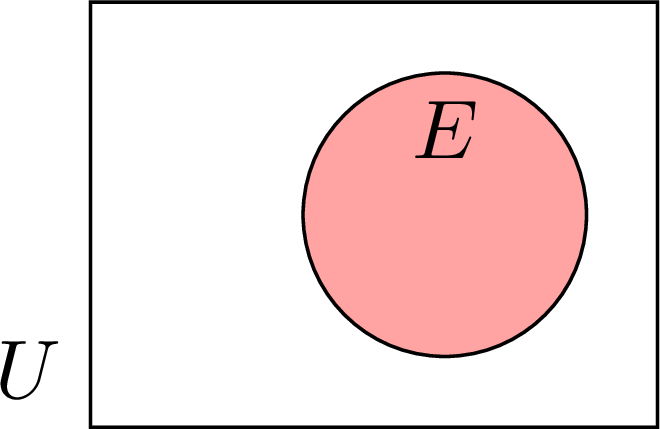 |
| \(x \in E\) | \(x\) is an element of \(E\) | \(x\) is an outcome of \(E\) | 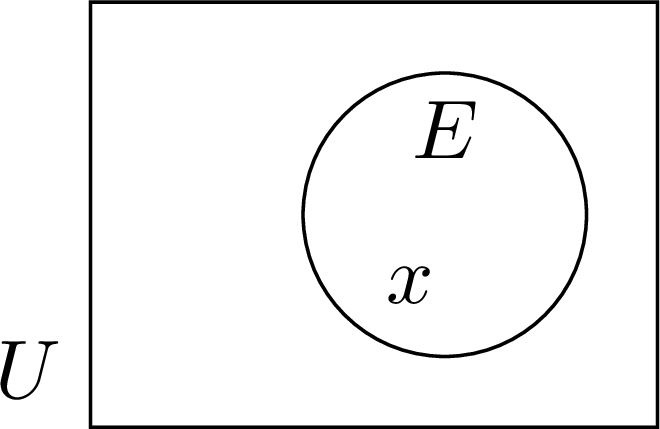 |
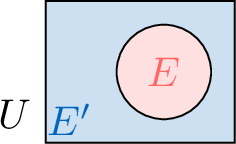
| \(E'\) | Complement of \(E\) in \(U\) | Complementary event of \(E\) | 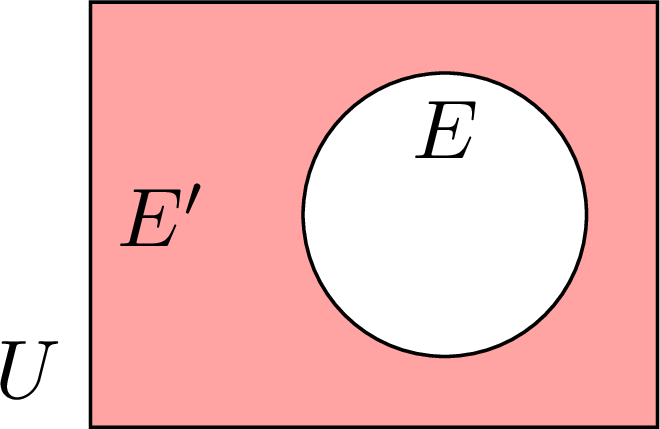 |
| \(E \cup F\) | Union of \(E\) and \(F\) | \(E\) or \(F\) | 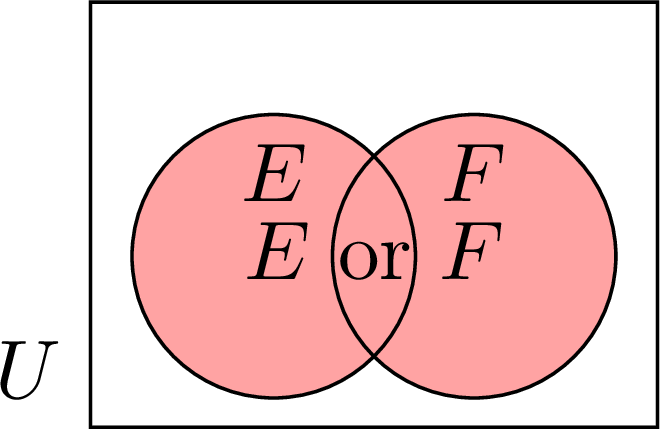 |
| \(E \cap F\) | Intersection of \(E\) and \(F\) | \(E\) and \(F\) | 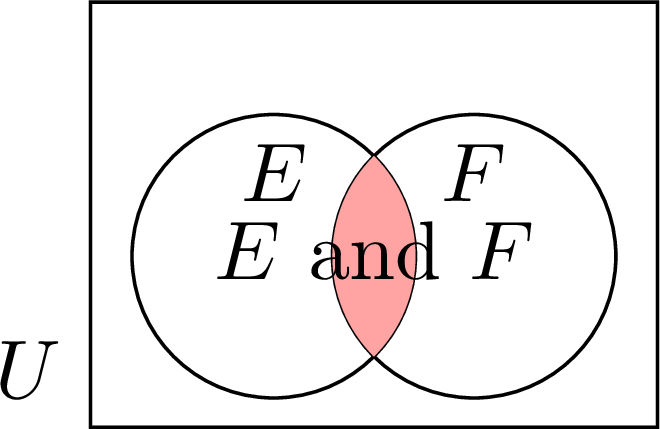 |
| \(E \cap F = \emptyset\) | \(E\) and \(F\) are disjoint | \(E\) and \(F\) are mutually exclusive | 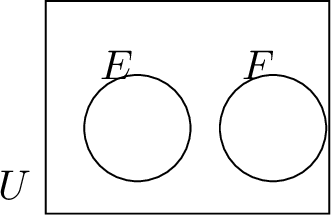 |
Example
One die is rolled: \(U = \{1, 2, 3, 4, 5, 6\}\). Consider the events \(E\): “the result is even” and \(F\): “the result is at least five”. Using the language of sets: - Is \(4 \in E\)? Is \(4 \in F\)?
- Write \(E \cup F\), \(E \cap F\) and \(E'\).
- Are \(E\) and \(F\) mutually exclusive?
Here \(E = \{2, 4, 6\}\) and \(F = \{5, 6\}\).
- \(4\) is even, so \(4 \in E\); but \(4 < 5\), so \(4 \notin F\).
- \(E \cup F = \{2, 4, 5, 6\}\) (in \(E\) or in \(F\)); \(E \cap F = \{6\}\) (in both); \(E' = \{1, 3, 5\}\) (everything else in \(U\)).
- \(E \cap F = \{6\} \neq \varnothing\): the outcome \(6\) realises both events, so \(E\) and \(F\) are not mutually exclusive.
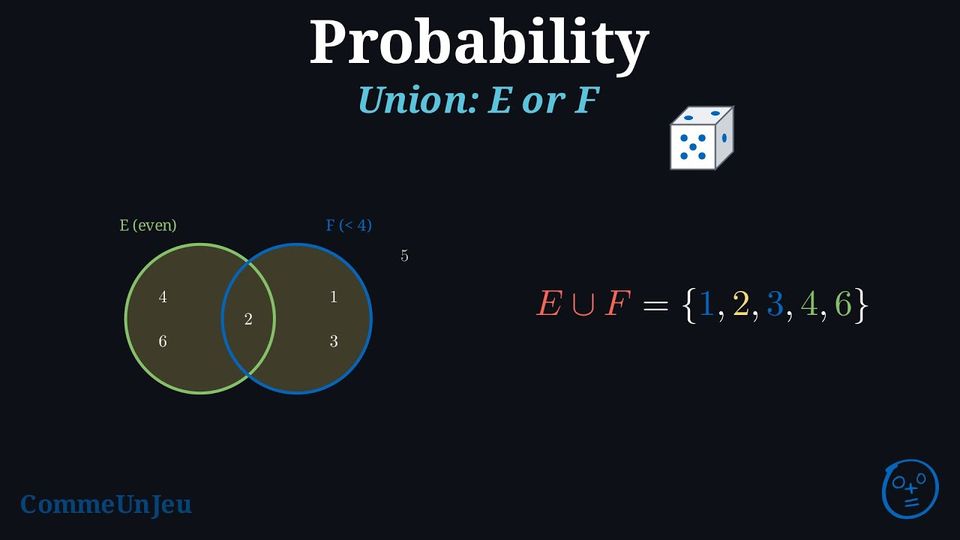
Definition — \(E\) or \(F\)
The union of two events \(E\) and \(F\), denoted \(E \cup F\), is the event that occurs if \(E\) occurs, or \(F\) occurs, or both occur. We read this as “E or F”. It includes all outcomes that are in at least one of the events. Example
A standard six-sided die is rolled. Let event \(E\) be “rolling an even number” and event \(F\) be “rolling a number less than 4”. Find the event \(E \cup F\).
The events are \(E = \{2, 4, 6\}\) and \(F = \{1, 2, 3\}\).
The union \(E \cup F\) contains all outcomes that appear in either set, without repetition: $$ E \cup F = \{1, 2, 3, 4, 6\}. $$
The union \(E \cup F\) contains all outcomes that appear in either set, without repetition: $$ E \cup F = \{1, 2, 3, 4, 6\}. $$
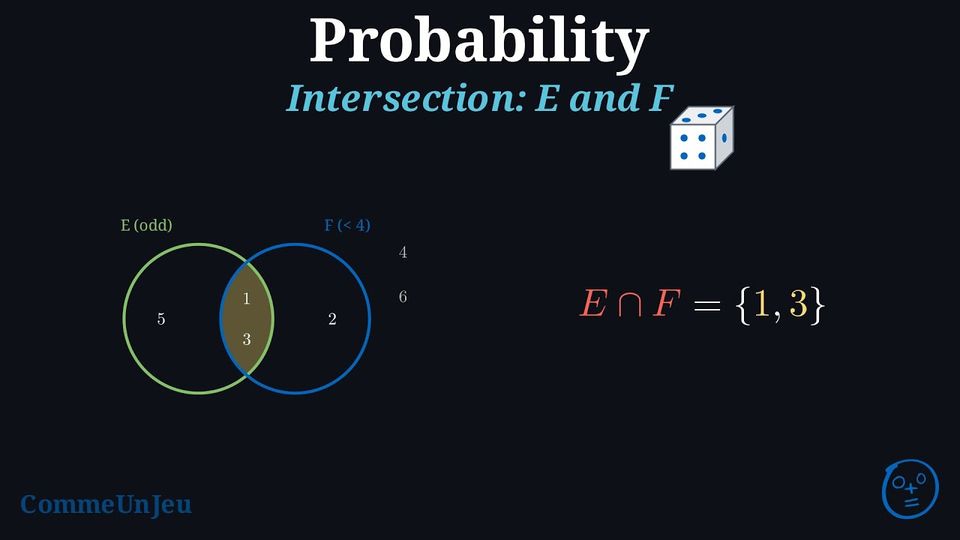
Definition — \(E\) and \(F\)
The intersection of two events \(E\) and \(F\), denoted \(E \cap F\), is the event that occurs if both \(E\) and \(F\) occur simultaneously. We read this as “E and F”. It includes all outcomes that are common to both events. Example
A standard six-sided die is rolled. Let event \(E\) be “rolling an odd number” and event \(F\) be “rolling a number less than 4”. Find the event \(E \cap F\).
The events are \(E = \{1, 3, 5\}\) and \(F = \{1, 2, 3\}\).
The intersection \(E \cap F\) contains only the outcomes that are in both sets: $$ E \cap F = \{1, 3\}. $$
The intersection \(E \cap F\) contains only the outcomes that are in both sets: $$ E \cap F = \{1, 3\}. $$
Skills to practice
- Finding the Union and the Intersection of Two Events in a Venn Diagram
II.2
Mutually Exclusive Events
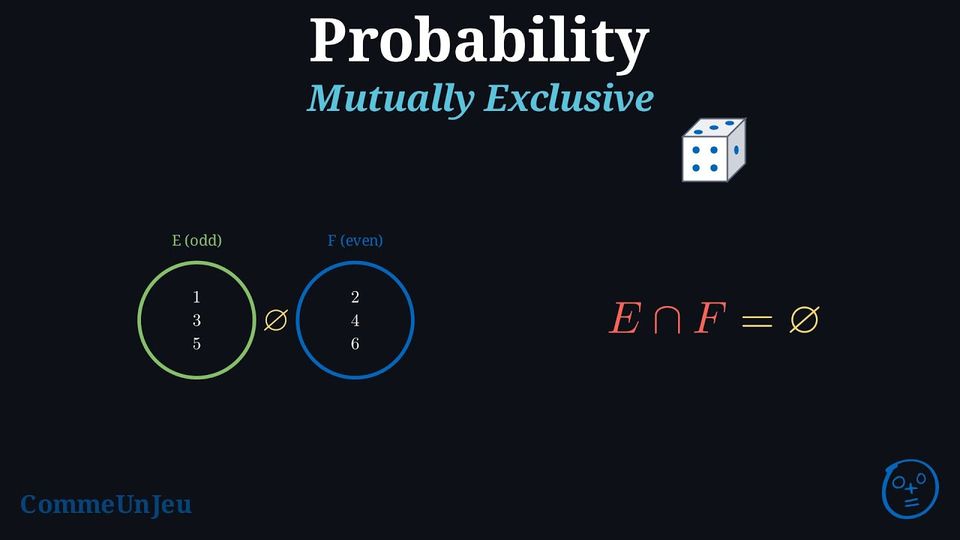
Definition — Mutually Exclusive
Two events \(E\) and \(F\) are mutually exclusive (or disjoint) if they have no outcomes in common. This means they cannot occur at the same time. Their intersection is the empty set (\(\emptyset\)): $$E \cap F = \emptyset.$$ Example
When rolling a die, let \(E\) be the event “rolling an odd number” and \(F\) be the event “rolling an even number”. Show that \(E\) and \(F\) are mutually exclusive.
The event sets are \(E = \{1, 3, 5\}\) and \(F = \{2, 4, 6\}\).
We find their intersection: $$ E \cap F = \emptyset. $$ Since there are no outcomes common to both events, they are mutually exclusive.
We find their intersection: $$ E \cap F = \emptyset. $$ Since there are no outcomes common to both events, they are mutually exclusive.
Mutually exclusive does not mean complementary. Two complementary events are always mutually exclusive, but the converse is false. With a die, \(A = \{1, 2\}\) and \(B = \{5, 6\}\) have no outcome in common: they are mutually exclusive. They are not complementary, since \(3\) and \(4\) belong to neither of them. Two events are complementary when they are mutually exclusive and together cover the whole sample space.
Skills to practice
- Recognising Mutually Exclusive Events
II.3
Partitions of the Sample Space
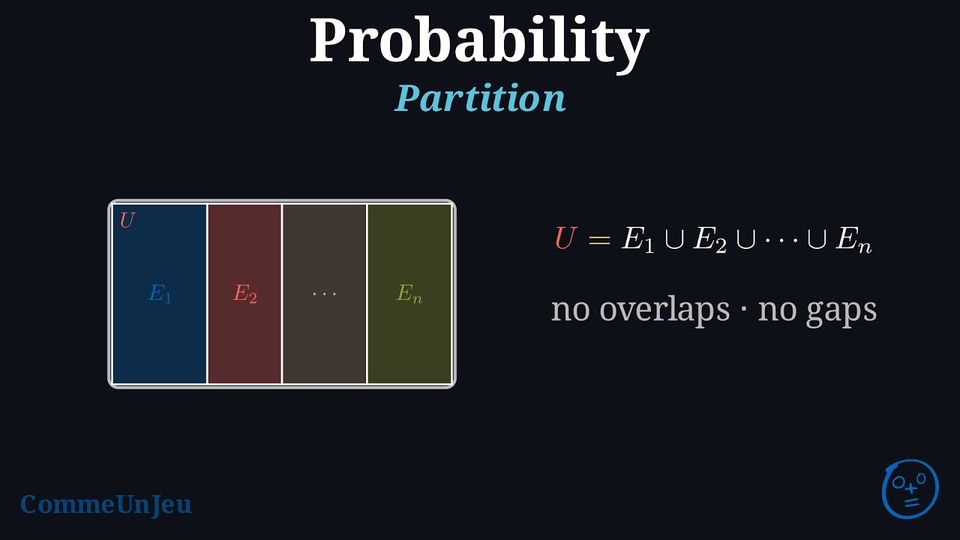
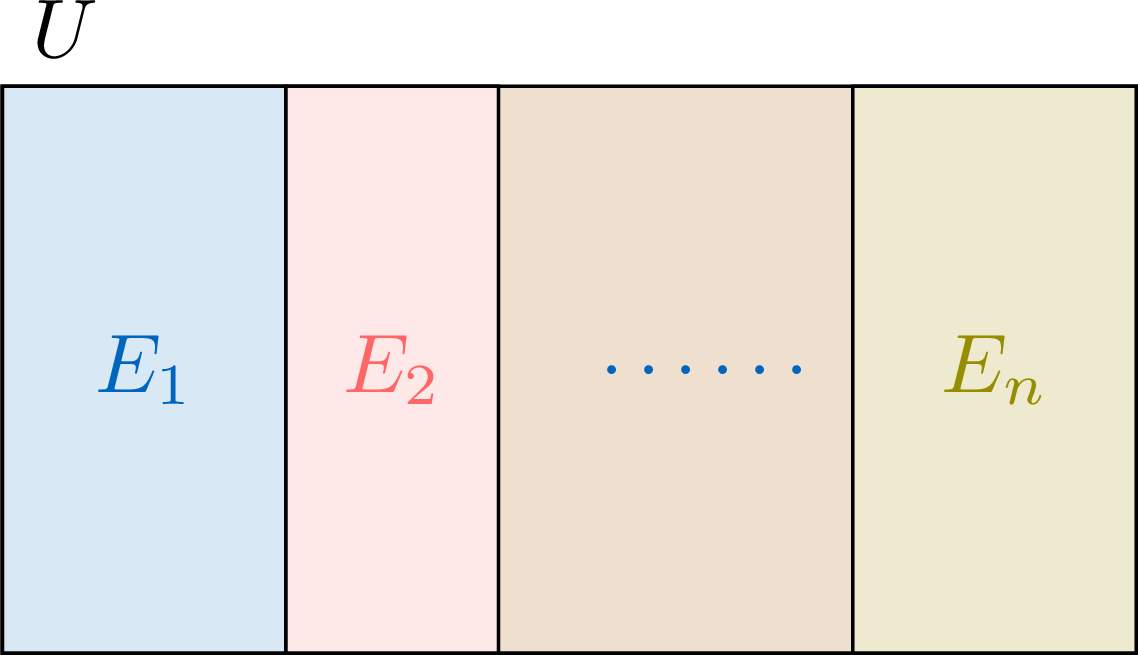
So far we have looked at single events and, with the complementary event, at the two-piece split of the sample space into an event \(E\) and its complement \(E'\). We now cut the sample space \(U = \{x_1, x_2, \dots, x_n\}\) into any number of pieces. Cutting up \(U\) is a question about sets of outcomes only — it uses nothing about chance. Attaching a probability \(P(E_i)\) to each piece is a separate step — and however we cut \(U\) into pieces, the chances of the pieces always total \(1\).
Definition — Partition of the Sample Space
A partition of the sample space \(U\) is a collection of events \(E_1, E_2, \dots, E_n\) that are pairwise mutually exclusive and whose union is the sample space: every outcome of \(U\) belongs to exactly one of them. In symbols: - they are pairwise mutually exclusive: \(E_i \cap E_j = \emptyset\) whenever \(i \neq j\);
- they cover the whole sample space: \(E_1 \cup E_2 \cup \dots \cup E_n = U\).
Example
A fair six-sided die is rolled, so \(U = \{1, 2, 3, 4, 5, 6\}\). Do the events \(E_1 = \{1, 2\}\), \(E_2 = \{3, 4\}\) and \(E_3 = \{5, 6\}\) form a partition of \(U\)?
Yes. No two of the three events share an outcome (\(E_1 \cap E_2 = \emptyset\), \(E_1 \cap E_3 = \emptyset\) and \(E_2 \cap E_3 = \emptyset\)), and together they give back every outcome: \(E_1 \cup E_2 \cup E_3 = \{1, 2, 3, 4, 5, 6\} = U\). Each face of the die therefore belongs to exactly one of them, so \(\{E_1, E_2, E_3\}\) is a partition of \(U\).
Proposition — The Finest Partition
Taking each outcome on its own as an event, the single-outcome events \(\{x_1\}, \{x_2\}, \dots, \{x_n\}\) form a partition of the sample space \(U\) — the finest one.
Two different single-outcome events share no outcome, so \(\{x_i\} \cap \{x_j\} = \emptyset\) whenever \(i \neq j\): they do not overlap. Every outcome of \(U\) is one of the \(x_i\), so \(\{x_1\} \cup \{x_2\} \cup \dots \cup \{x_n\} = U\): together they cover the sample space. They therefore form a partition. It is the finest one, because any event is a union of single-outcome events — no partition cuts \(U\) into smaller pieces.
Example
A fair six-sided die is rolled. Give the finest partition of the sample space \(U = \{1, 2, 3, 4, 5, 6\}\).
The finest partition splits the sample space into its single outcomes — one event for each face of the die: $$\{1\}, \quad \{2\}, \quad \{3\}, \quad \{4\}, \quad \{5\}, \quad \{6\}.$$ With the die faces, these single-outcome events are \(\{\) \(\}, \{\)
 \(\}, \{\)
 \(\}, \{\)
 \(\}, \{\)
 \(\}, \{\)
 \(\}\). No two of them share a face, and their union is the whole sample space, \(\{1\} \cup \{2\} \cup \{3\} \cup \{4\} \cup \{5\} \cup \{6\} = U\). The coarser partition \(\{1, 2\}, \{3, 4\}, \{5, 6\}\) seen above groups these single outcomes in pairs — the finest partition cannot be split any further.
\(\}, \{\)\(\}, \{\)\(\}, \{\)\(\}, \{\)\(\}, \{\)\(\}\). No two of them share a face, and their union is the whole sample space, \(\{1\} \cup \{2\} \cup \{3\} \cup \{4\} \cup \{5\} \cup \{6\} = U\). The coarser partition \(\{1, 2\}, \{3, 4\}, \{5, 6\}\) seen above groups these single outcomes in pairs — the finest partition cannot be split any further. Proposition — Partition Induced on an Event
Let \(\{E_1, E_2, \dots, E_n\}\) be a partition of the sample space \(U\), and let \(B\) be any event. Then the events $$\textcolor{colorprop}{B \cap E_1,\quad B \cap E_2,\quad \dots,\quad B \cap E_n}$$ are pairwise mutually exclusive, and their union is \(B\): they form a partition of \(B\). 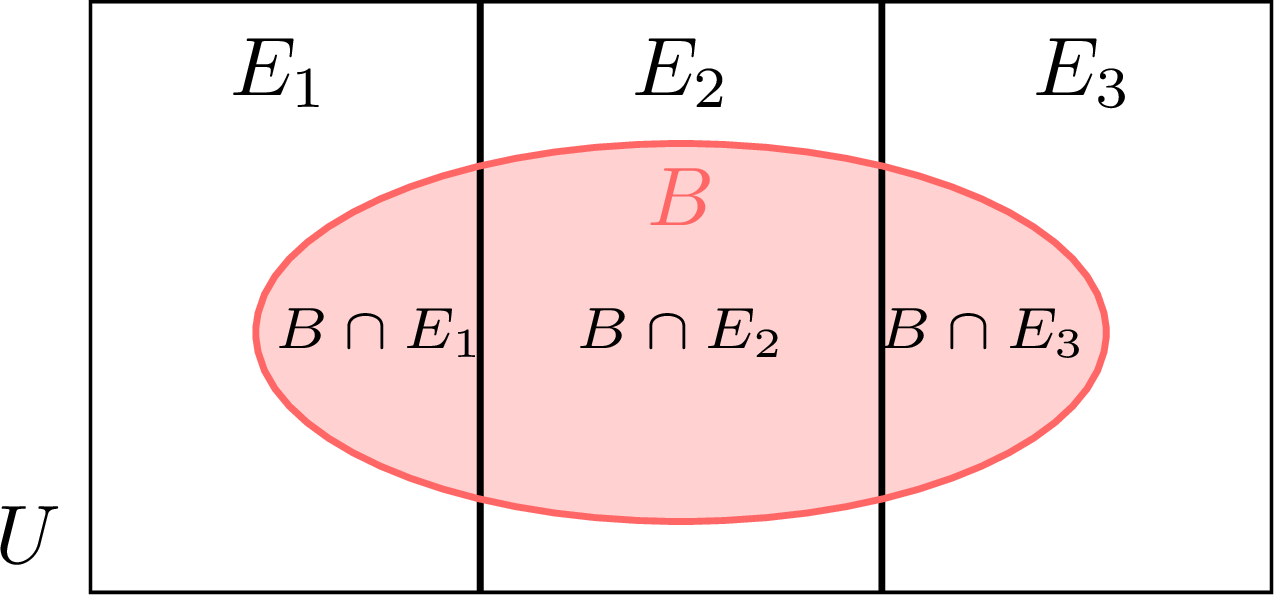
Everything rests on the equivalent formulation of the definition: every outcome of \(U\) belongs to exactly one of \(E_1, E_2, \dots, E_n\).
- The pieces do not overlap. Take \(i \neq j\). An outcome of \((B \cap E_i) \cap (B \cap E_j)\) would belong to \(E_i\) and to \(E_j\), whereas it belongs to at most one of the two. There is no such outcome: $$(B \cap E_i) \cap (B \cap E_j) = \emptyset.$$
- The pieces give back \(B\). An outcome of any \(B \cap E_i\) is an outcome of \(B\). Conversely, let \(x\) be an outcome of \(B\): it is an outcome of \(U\), so it belongs to exactly one \(E_i\); being in \(B\) as well, it is in \(B \cap E_i\). Every outcome of \(B\) therefore lies in one of the pieces: $$(B \cap E_1) \cup (B \cap E_2) \cup \dots \cup (B \cap E_n) = B.$$
Skills to practice
- Recognising a Partition
III
The Axioms of Probability
III.1
The Axioms of Probability
An Event Is a Set and a Probability Is a Number
Rolling a fair die, the event “the result is even” is the set \(A = \{2, 4, 6\}\); its probability is the number \(P(A) = \frac{3}{6} = \frac{1}{2}\). Events combined with “or”, “and”, “not” measure nothing by themselves; a probability attaches a number to each event. The two objects must be kept apart, because two classic mistakes come from mixing them:
- writing \(P(A) = \{2, 4, 6\}\): a probability is never a set, \(P(A)\) is the number \(\frac{1}{2}\);
- writing \(A = \frac{1}{2}\) or saying “the event \(A\) is one half”: an event is never a number, \(A\) is a set of outcomes and \(\frac{1}{2}\) is its probability.
All of probability is built upon three fundamental rules called axioms. These are statements we accept as true and from which all other rules can be derived. The probability of an event \(E\), denoted \(P(E)\), is a number that quantifies its likelihood.
Definition — Probability Axioms
A function \(P\) is a probability measure if it satisfies the following three axioms for any events \(E\) and \(F\) in a sample space \(U\): - Axiom 1 (Non-negativity): The probability of any event is a non-negative number. $$P(E) \geq 0$$
- Axiom 2 (Total Probability): The probability of the entire sample space is 1. $$P(U) = 1$$
- Axiom 3 (Additivity for Mutually Exclusive Events): If two events \(E\) and \(F\) are mutually exclusive (\(E \cap F = \emptyset\)), then the probability of their union is the sum of their individual probabilities. $$P(E \cup F) = P(E) + P(F)$$
Visualizing the Axioms with Venn Diagrams
Venn diagrams can help us understand the probability axioms. In this context, the entire area of the universal set \(U\) is considered to have a total probability of 1. The probability of any event \(E\) is represented by the proportion of the total area that the event covers.
- Axiom 1: \(P(E) \geq 0\)
An area is never negative: the region representing event \(E\) cannot be smaller than nothing.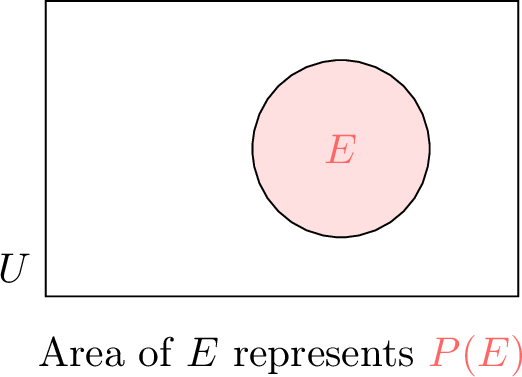
- Axiom 2: \(P(U) = 1\)
It is certain that some outcome in the sample space occurs. Therefore, the probability of the entire sample space is 1 (or 100\(\pourcent\)).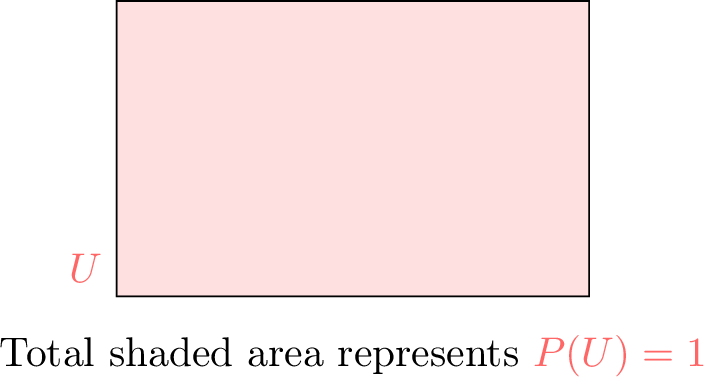
- Axiom 3: \(P(E \cup F) = P(E) + P(F)\) for Mutually Exclusive Events
If two events \(E\) and \(F\) are mutually exclusive, they do not overlap in the Venn diagram. The total area covered by their union (\(E \cup F\)) is simply the sum of their individual areas.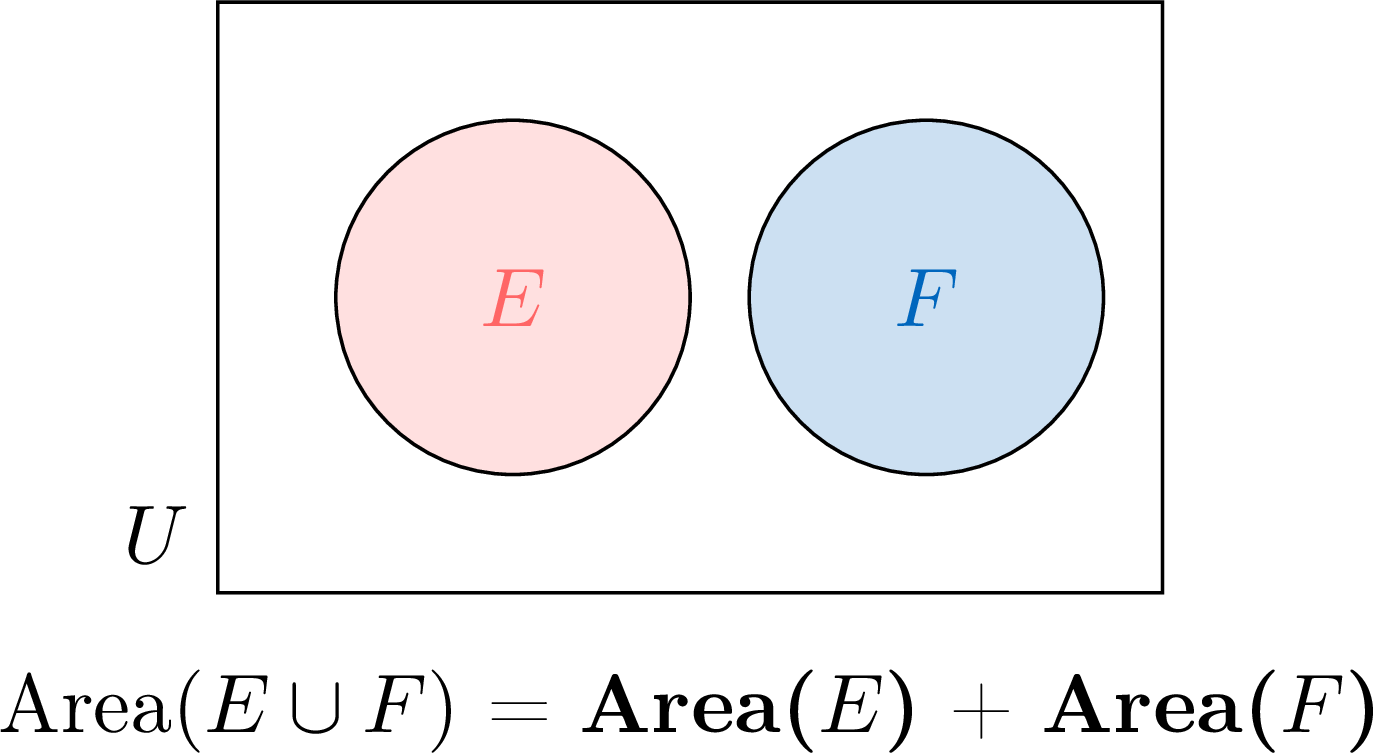
Skills to practice
- Telling Events from Probabilities
IV
The Rules, Carried Over from the Events
IV.1
The Probabilities Add Up to 1
Proposition — Sum over a Partition
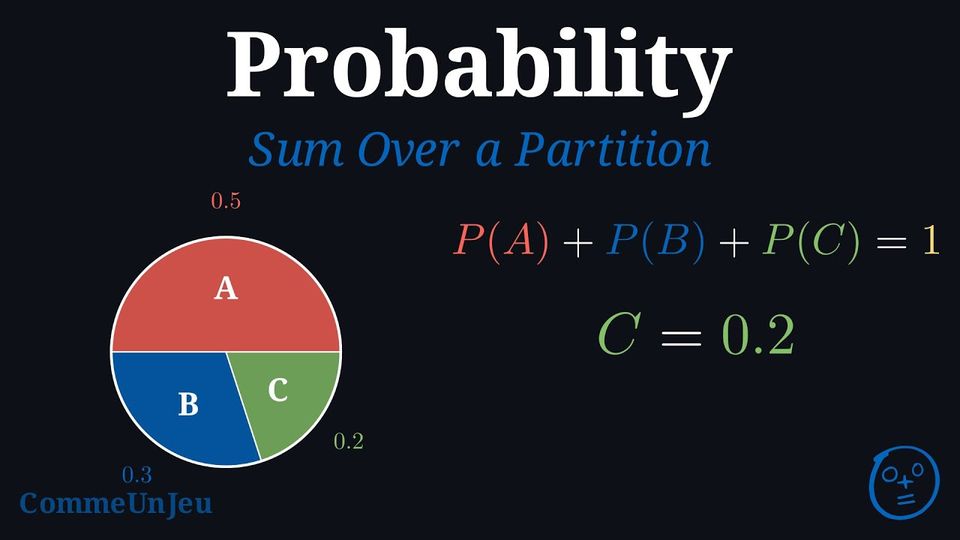
If the events \(E_1, E_2, \dots, E_n\) form a partition of the sample space, then their probabilities add up to \(1\): $$\textcolor{colorprop}{P(E_1)} + \textcolor{colordef}{P(E_2)} + \dots + \textcolor{olive}{P(E_n)} = 1.$$
The events of a partition are pairwise mutually exclusive and together cover the whole sample space. Adding their probabilities therefore gives: $$\begin{aligned}[t] P(E_1) + \dots + P(E_n) &= P(E_1 \cup \dots \cup E_n) && \text{(Axiom 3 --- pairwise mutually exclusive)}\\
&= P(U) && \text{(the events cover \(U\))}\\
&= 1 && \text{(Axiom 2).} \end{aligned}$$ The statement about the outcomes is this same result applied to the finest partition \(\{x_1\}, \{x_2\}, \dots, \{x_n\}\).
Method — Finding a Missing Probability
When the probabilities of all the events of a partition but one are known, the missing one is found by subtracting from \(1\): $$P(\text{missing event}) = 1 - (\text{sum of the known probabilities}).$$ Example
A spinner is divided into three sectors \(A\), \(B\) and \(C\) of different sizes, with \(P(A) = 0.5\) and \(P(B) = 0.3\). 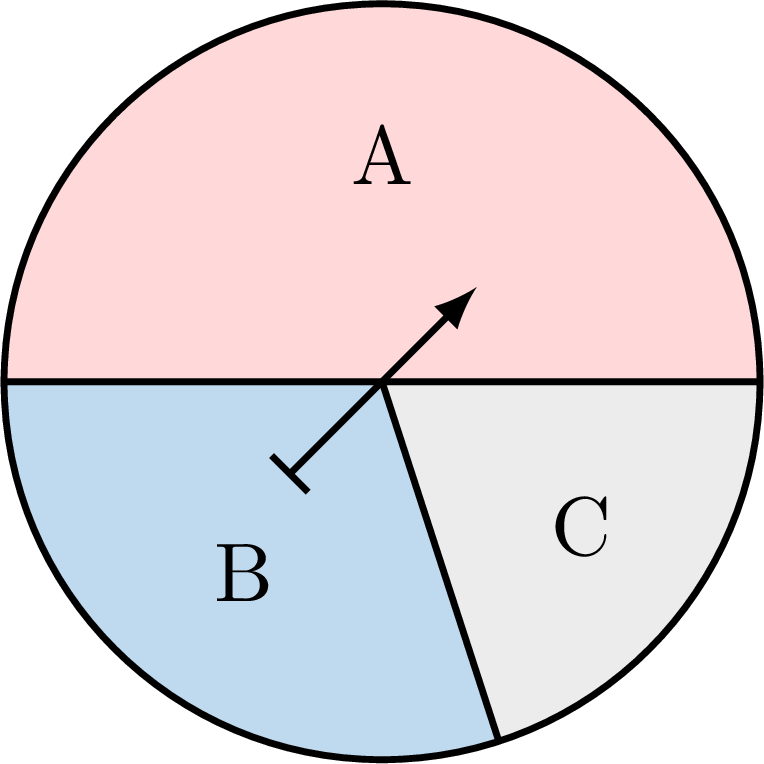
The spinner lands in exactly one of the three sectors, so \(\{A, B, C\}\) is a partition of the sample space and the three probabilities add up to \(1\): $$\begin{aligned}[t] P(C) &= 1 - \big(P(A) + P(B)\big) && \text{(the probabilities add up to 1)}\\
&= 1 - (0.5 + 0.3) && \text{(\(P(A) = 0.5\), \(P(B) = 0.3\))}\\
&= 1 - 0.8 \\
&= 0.2. \end{aligned}$$
Definition — Equally Likely
When all outcomes are equally likely, the probability of an event \(E\) is: $$\textcolor{colordef}{\begin{aligned} P(E) &= \frac{\text{number of outcomes in the event}}{\text{number of outcomes in the sample space}}\\
&=\dfrac{\Card{E}}{\Card{U}}\\
\end{aligned}}$$ Proposition — Equally Likely Outcomes
If the \(n\) outcomes of \(U = \{x_1, x_2, \dots, x_n\}\) all have the same probability, then each outcome has probability \(\dfrac{1}{n}\) and, for every event \(E\), $$\textcolor{colorprop}{P(E) = \dfrac{\Card{E}}{\Card{U}}}.$$
The impossible event first. The events \(U\) and \(\emptyset\) have no outcome in common, and \(U \cup \emptyset = U\), so Axiom 3 applies: $$\begin{aligned}[t] P(U) &= P(U \cup \emptyset) && \text{(\(U = U \cup \emptyset\))}\\
&= P(U) + P(\emptyset) && \text{(Axiom 3, since \(U \cap \emptyset = \emptyset\))}, \end{aligned}$$ hence \(P(\emptyset) = 0\). Each outcome. Let \(p\) be the common probability of the outcomes. The singletons \(\{x_1\}, \{x_2\}, \dots, \{x_n\}\) form the finest partition of \(U\), so by the Proposition “Sum over a Partition” their probabilities add up to \(1\): $$\begin{aligned}[t] 1 &= P(\{x_1\}) + P(\{x_2\}) + \dots + P(\{x_n\}) && \text{(Sum over a Partition)}\\
&= n \times p && \text{(\(n\) equal terms)}, \end{aligned}$$ hence \(p = \dfrac{1}{n}\). Each event. If \(E = \emptyset\), then \(P(E) = 0 = \dfrac{0}{n} = \dfrac{\Card{E}}{\Card{U}}\). Otherwise, \(E\) is the union of the \(\Card{E}\) singletons of its outcomes, which are pairwise mutually exclusive, and Axiom 3, applied step by step, adds their probabilities: $$\begin{aligned}[t] P(E) &= \underbrace{\frac{1}{n} + \frac{1}{n} + \dots + \frac{1}{n}}_{\Card{E} \text{ terms}} && \text{(Axiom 3, step by step)}\\
&= \Card{E} \times \frac{1}{n}\\
&= \frac{\Card{E}}{\Card{U}} && \text{(\(n = \Card{U}\))}. \end{aligned}$$ So the formula of the Definition “Equally Likely” is not an extra rule: when all the outcomes have the same probability, it follows from the axioms.
Skills to practice
- Finding a Missing Probability
- Calculating the Probability of E or F and of E and F
IV.2
The Complement Rule and the Addition Law
Proposition — Complement Rule
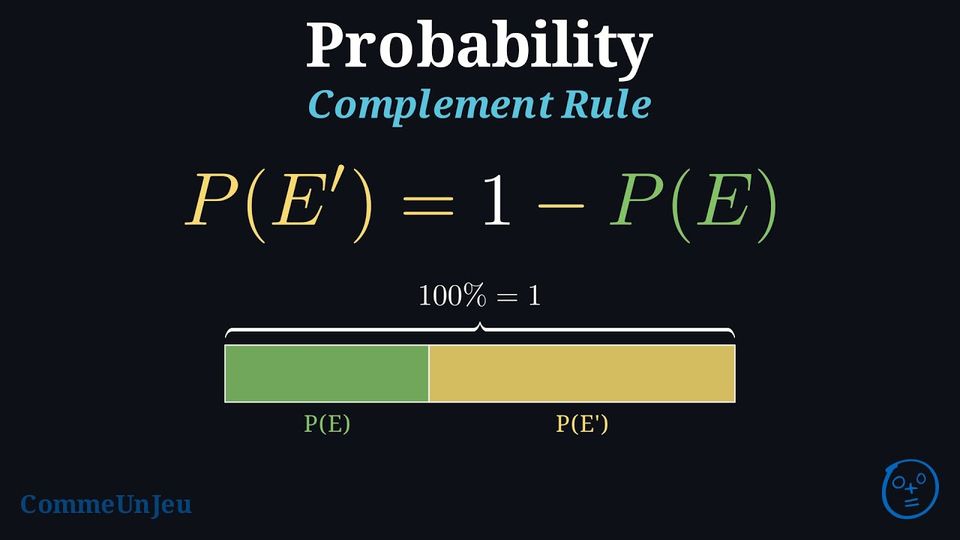
For any event \(E\) and its complementary event \(E'\), $$\textcolor{colorprop}{P(E') = 1 - P(E)}$$ 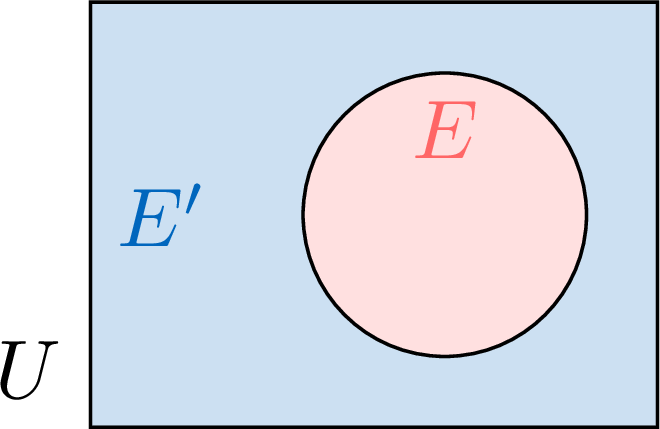
- Algebraic Proof
By definition, an event \(E\) and its complement \(E'\) are mutually exclusive (\(E \cap E' = \emptyset\)) and their union is the entire sample space (\(E \cup E' = U\)).
Using Axiom 3: \(P(E \cup E') = P(E) + P(E')\).
Using Axiom 2: \(P(U) = 1\).
Since \(E \cup E' = U\), we can equate their probabilities: $$ P(E) + P(E') = P(U) = 1. $$ Rearranging the formula gives the complement rule: $$P(E') = 1 - P(E).$$ In particular, the complement of the sample space \(U\) is the impossible event, \(U' = \emptyset\), so $$\begin{aligned}[t] P(\emptyset) &= P(U') && \text{(\(\emptyset\) is the complement of \(U\))}\\ &= 1 - P(U) && \text{(complement rule)}\\ &= 1 - 1 && \text{(Axiom 2)}\\ &= 0. \end{aligned}$$ The impossible event has probability \(0\). - Geometric Illustration
The total area of the sample space, \(\textcolor{olive}{P(U)}\), , is the sum of the area of the event, \(P(E)\), and the area of its complement, \(P(E')\).
So, $$\textcolor{colordef}{P(E)} + \textcolor{colorprop}{P(E')} = \textcolor{olive}{P(U)}.$$ Since \(\textcolor{olive}{P(U) = 1}\) (from Axiom 2), we have: $$\textcolor{colordef}{P(E)} + \textcolor{colorprop}{P(E')} = 1.$$
The probabilities of two mutually exclusive events need not add up to \(1\). A fair die is rolled: the sample space \(U = \{1, 2, 3, 4, 5, 6\}\) is made of \(6\) equally likely outcomes. The events \(A = \{1, 2\}\) and \(B = \{5, 6\}\) are mutually exclusive but not complementary, and $$\begin{aligned}[t] P(A) + P(B) &= \frac{2}{6} + \frac{2}{6} && \text{(each event holds \(2\) of the \(6\) equally likely outcomes)}\\
&= \frac{2}{3}, \end{aligned}$$ not \(1\). The events whose probabilities always add up to \(1\) are complementary events, which together cover the whole sample space: \(P(E) + P(E') = 1\).
Proposition — Monotonicity
If an event \(A\) is contained in an event \(B\) — that is, every outcome of \(A\) is also an outcome of \(B\) — then $$\textcolor{colorprop}{A \subseteq B \implies P(A) \leq P(B)}.$$ 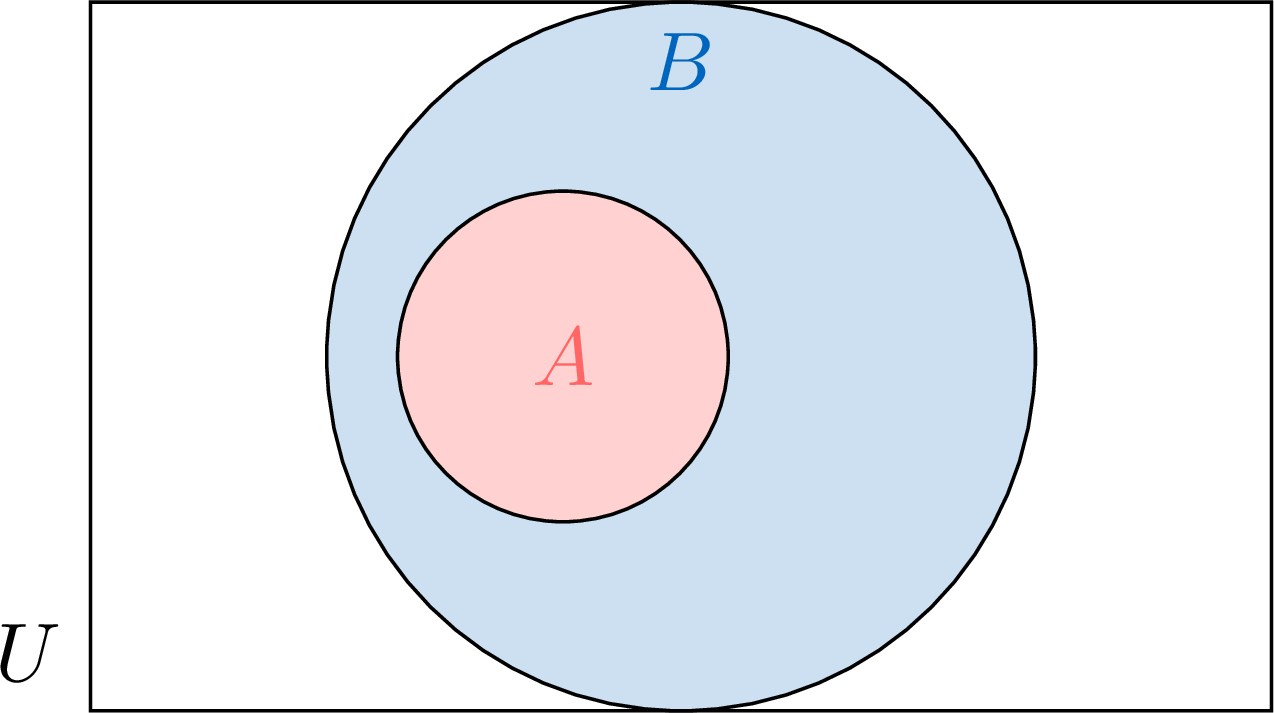
The event \(A\) and its complement \(A'\) form the two-piece partition of \(U\). The Proposition “Partition Induced on an Event” therefore cuts \(B\) into two mutually exclusive pieces, \(B \cap A\) and \(B \cap A'\): 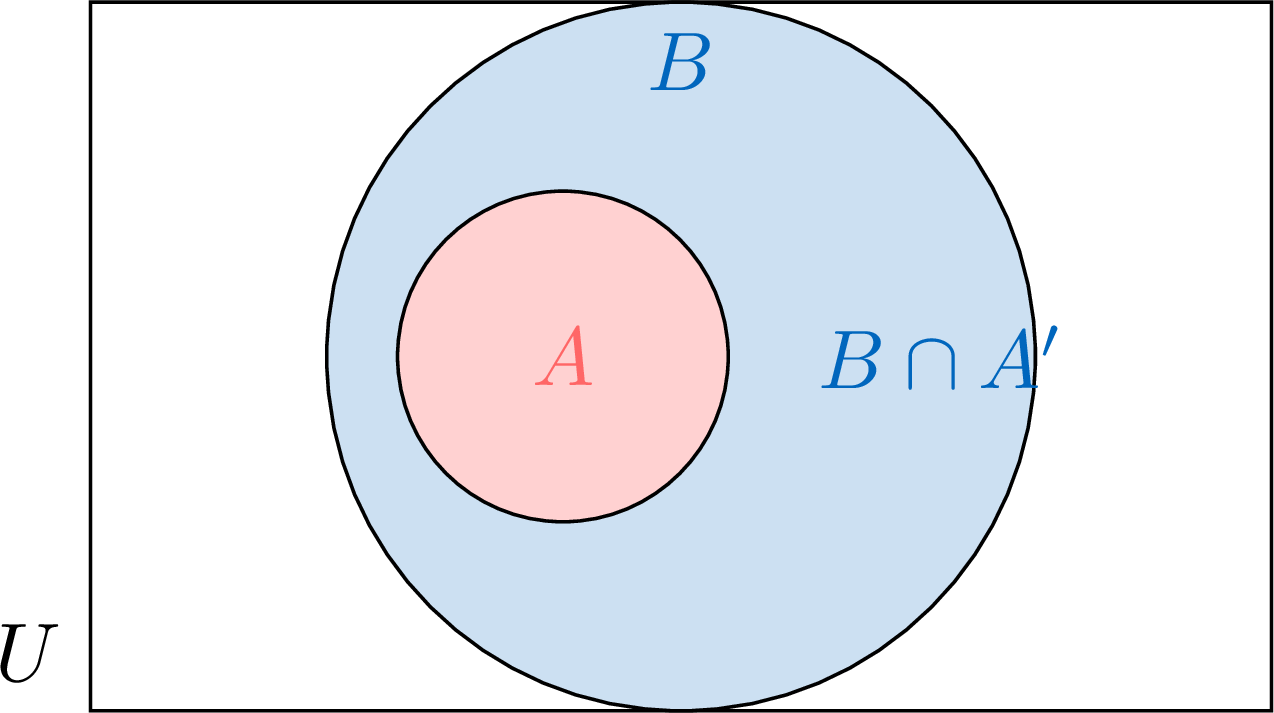
$$\begin{aligned}[t] B &= (B \cap A) \cup (B \cap A') && \text{(the partition \(\{A, A'\}\) cuts \(B\))}\\
&= A \cup (B \cap A') && \text{(\(B \cap A = A\), since \(A \subseteq B\))} \end{aligned}$$ The two pieces are mutually exclusive, so Axiom 3 applies, and Axiom 1 closes the argument: $$\begin{aligned}[t] P(B) &= P(A) + P(B \cap A') && \text{(Axiom 3)}\\
&\geq P(A) && \text{(Axiom 1: \(P(B \cap A') \geq 0\)).} \end{aligned}$$ So \(A \subseteq B\) implies \(P(A) \leq P(B)\). The hypothesis \(A \subseteq B\) was used exactly once: to replace \(B \cap A\) by \(A\).
Proposition — Bounds of a Probability
For any event \(E\), $$\textcolor{colorprop}{0 \leq P(E) \leq 1}.$$ A probability is never negative, and never exceeds the probability of the whole sample space.
The lower bound is Axiom 1. For the upper bound, every event is a part of the sample space, so \(E \subseteq U\), and monotonicity applies: $$\begin{aligned}[t] P(E) &\leq P(U) && \text{(monotonicity, since \(E \subseteq U\))}\\
&= 1 && \text{(Axiom 2).} \end{aligned}$$
Proposition — Addition Law of Probability
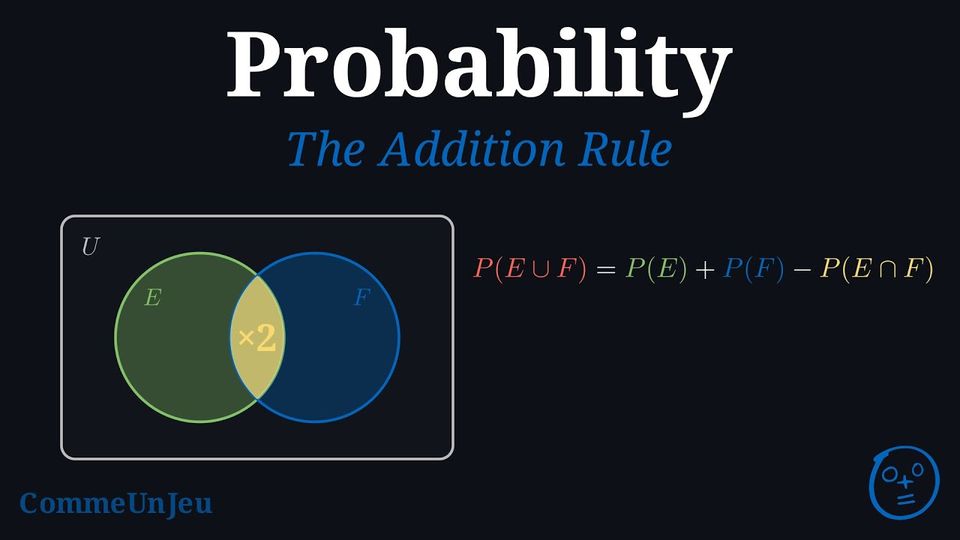
For any two events \(E\) and \(F\), $$\textcolor{colorprop}{P(E \cup F) = P(E) + P(F) - P(E \cap F)}$$ which can also be written $$\textcolor{colorprop}{P(E \cup F) + P(E \cap F) = P(E) + P(F)}.$$ This formula holds whether or not \(E\) and \(F\) are mutually exclusive. If they are mutually exclusive, then \(P(E \cap F) = 0\) and the formula becomes \(P(E \cup F) = P(E) + P(F)\).
The Venn diagram below shows the sample space \(U\) with two intersecting events, \(E\) and \(F\). 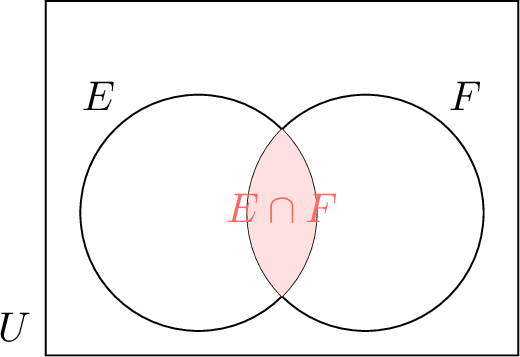
The region represents the event \(E \cap F\); its probability \(P(E \cap F)\) is counted twice in \(P(E) + P(F)\). To correct for this, we must subtract \(P(E \cap F)\) once.
Therefore, the total probability of the union is $$P(E \cup F) = P(E) + P(F) - P(E \cap F).$$ The same count, written with events. The union \(E \cup F\) is made of the outcomes of \(E\) together with the outcomes of \(F\) that are not in \(E\): \(E \cup F = E \cup (F \cap E')\), two events with no outcome in common. In the same way, \(F = (F \cap E) \cup (F \cap E')\), two events with no outcome in common, so \(P(F) = P(F \cap E) + P(F \cap E')\). Hence $$\begin{aligned}[t] P(E \cup F) &= P(E) + P(F \cap E') && \text{(\(E\) and \(F \cap E'\) have no outcome in common)}\\ &= P(E) + P(F) - P(F \cap E) && \text{(\(P(F \cap E') = P(F) - P(F \cap E)\))}, \end{aligned}$$ and since \(F \cap E = E \cap F\), this is the addition law.
Therefore, the total probability of the union is $$P(E \cup F) = P(E) + P(F) - P(E \cap F).$$ The same count, written with events. The union \(E \cup F\) is made of the outcomes of \(E\) together with the outcomes of \(F\) that are not in \(E\): \(E \cup F = E \cup (F \cap E')\), two events with no outcome in common. In the same way, \(F = (F \cap E) \cup (F \cap E')\), two events with no outcome in common, so \(P(F) = P(F \cap E) + P(F \cap E')\). Hence $$\begin{aligned}[t] P(E \cup F) &= P(E) + P(F \cap E') && \text{(\(E\) and \(F \cap E'\) have no outcome in common)}\\ &= P(E) + P(F) - P(F \cap E) && \text{(\(P(F \cap E') = P(F) - P(F \cap E)\))}, \end{aligned}$$ and since \(F \cap E = E \cap F\), this is the addition law.
Method — Using the Addition Relation
The relation ties together four quantities: \(P(A)\), \(P(B)\), \(P(A \cap B)\) and \(P(A \cup B)\). Knowing three of them always gives the fourth. - Name the two events and translate the sentence: “\(A\) or \(B\)” — possibly both — is \(A \cup B\); “\(A\) and \(B\)” is \(A \cap B\).
- Write down the three known quantities, each as a probability of one of these four events.
- Write the relation as a balance: the two sides always weigh the same, $$P(A \cup B) + P(A \cap B) = P(A) + P(B).$$
- Isolate the missing quantity by moving the other three to the opposite side.
- Check the result: a probability lies between \(0\) and \(1\), and \(P(A \cap B)\) can exceed neither \(P(A)\) nor \(P(B)\), since the outcomes of \(A \cap B\) are among those of \(A\), and among those of \(B\).
Example
A school is holding a talent show. One student is chosen at random: the outcomes of this experiment are the students of the school, and \(U\) is the set of all of them. Let \(S\) be the set of the students who participate in singing and \(D\) the set of the students who participate in dancing. The probability that the chosen student participates in singing is \(0.4\), the probability that they participate in dancing is \(0.3\), and the probability that they participate in both singing and dancing is \(0.1\). Find the probability that the chosen student participates in singing or dancing (possibly both).
The events are the sets \(S\) (the students who sing) and \(D\) (the students who dance); “singing or dancing” is the event \(S \cup D\), and “both” is the event \(S \cap D\). We are given:
- \(P(S) = 0.4\)
- \(P(D) = 0.3\)
- \(P(S \cap D) = 0.1\)
- singing only: \(P(S) - P(S \cap D) = 0.4 - 0.1 = 0.3\);
- dancing only: \(P(D) - P(S \cap D) = 0.3 - 0.1 = 0.2\);
- both: \(P(S \cap D) = 0.1\).
Skills to practice
- Using the Addition Law
- Applying the Addition Law in Context
- Explaining the Addition Law
- Using the Addition Relation in Context
V
Going further
Skills to practice
- Solving Probability Problems
- Investigating Patterns in Unions of Events
- Quiz
Jump to section