International Baccalaureate · MYP 4
Probability
Discover the essentials of probability: sample spaces, events, and the complement rule. Learn to represent multi-step experiments using tree diagrams and tables. Covers theoretical calculations for equally likely outcomes and estimates based on experimental trials.
I
Sample Space
Definition — Outcome
An outcome is one possible result of a random experiment.Example
What are all the possible outcomes when you flip a coin? 
The outcomes are Heads (H) =  and Tails (T) =
  .
.
and Tails (T) = .Example
What are the outcomes when you roll a six-sided die?
The outcomes are\(1 = \) ,\(2 = \)
 ,\(3 = \)
 ,\(4 = \)
 ,\(5 = \)
 and \(6 = \)
 .
.
,\(2 = \),\(3 = \),\(4 = \),\(5 = \)and \(6 = \).Definition — Sample Space
The sample space is the set of all possible outcomes of a random experiment.Example
What’s the sample space when you flip a coin?
The sample space is \(\{\text{Heads}, \text{Tails}\} = \{\),\(\}\), or just \(\{\text{H}, \text{T}\}\) for short.
,\(\}\), or just \(\{\text{H}, \text{T}\}\) for short.Example
What’s the sample space when you roll a six-sided die?
The sample space is \(\{1, 2, 3, 4, 5, 6\} = \{\),,,,,\(\}\).
,,,,,\(\}\).Skills to practice
- Finding the sample spaces
II
Events
Once we know all the possible outcomes of an experiment (the sample space), we can focus on specific outcomes we are interested in. An event is a set of outcomes (it may contain one outcome, several outcomes, or even none at all).
Definition — Event
An event (often denoted by a capital letter like \(E\)) is a subset of the sample space.Example
For the experiment of rolling a die, list the outcomes in the event \(E\): “rolling an even number”.
Among the outcomes of the sample space \(\{1, 2, 3, 4, 5, 6\} = \{\),,,,,\(\}\), the event of rolling an even number is\(E = \{2, 4, 6\} = \{\),,\(\}\).
,,,,,\(\}\), the event of rolling an even number is\(E = \{2, 4, 6\} = \{\),,\(\}\).Skills to practice
- Finding Events for Die-Rolling Events
- Finding Events in a Casino Spinner
III
Complementary Events
In probability, it is often useful to consider the outcomes that do not belong to a specific event. This set of “other” outcomes is known as the complementary event. It represents everything in the sample space that is outside the original event. The complement of an event \(E\) is denoted by \(E'\).
Definition — Complementary Event
The complementary event of an event \(E\), denoted \(E'\), \(E^c\), or \(\overline{E}\), is the set of all outcomes in the sample space that are not in \(E\).Example
In the experiment of rolling a fair six-sided die, let \(E\) be the event “rolling an even number”. Find the complementary event, \(E'\).
The sample space is \(\{1, 2, 3, 4, 5, 6\} = \{\),,,,,\(\}\).
The event is \(E = \{2, 4, 6\} = \{\),,\(\}\).
The complementary event \(E'\) contains all outcomes in the sample space that are not in \(E\).
Therefore, \(E' = \{1, 3, 5\} = \{\),,\(\}\). This is the event “rolling an odd number”.
,,,,,\(\}\).The event is \(E = \{2, 4, 6\} = \{\)
,,\(\}\).The complementary event \(E'\) contains all outcomes in the sample space that are not in \(E\).
Therefore, \(E' = \{1, 3, 5\} = \{\)
,,\(\}\). This is the event “rolling an odd number”.Skills to practice
- Finding the Complementary Events
IV
Multi-Step Random Experiments
A multi-step experiment is a random experiment made up of a sequence of two or more simple steps. For example, flipping two coins is a multi-step experiment composed of two actions: flipping the first coin and then flipping the second.
In many multi-step experiments, we can find the total number of possible outcomes by multiplying the number of outcomes at each step. To display all the combined outcomes, we can use tools like lists, tables, or tree diagrams.
In many multi-step experiments, we can find the total number of possible outcomes by multiplying the number of outcomes at each step. To display all the combined outcomes, we can use tools like lists, tables, or tree diagrams.
Method — Representing Sample Spaces for Multi-Step Experiments
When an experiment has more than one step, the sample space can be represented in several ways:- by listing all possible ordered outcomes;
- using a table (best for two-step experiments);
- using a tree diagram (useful for any number of steps).
Example
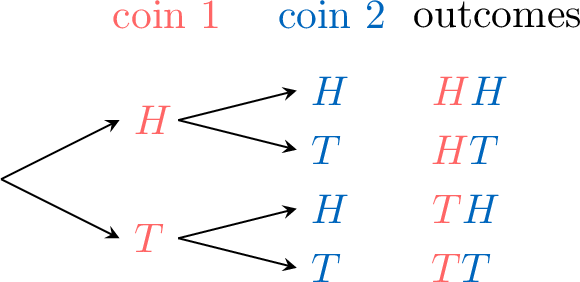
For the experiment of tossing two coins, represent the sample space by:- listing all possible outcomes;
- using a table;
- using a tree diagram.
- List:
Each outcome records the result of coin 1 first, then coin 2:$$\{\textcolor{colordef}{H}\textcolor{colorprop}{H}, \textcolor{colordef}{H}\textcolor{colorprop}{T}, \textcolor{colordef}{T}\textcolor{colorprop}{H}, \textcolor{colordef}{T}\textcolor{colorprop}{T}\}$$ - Table:
\(\begin{aligned} & \textcolor{colorprop}{\text{coin 2}} \\ \textcolor{colordef}{\text{coin 1}} \end{aligned} \) \(\textcolor{colorprop}{H}\) \(\textcolor{colorprop}{T}\) \(\textcolor{colordef}{H}\) \(\textcolor{colordef}{H}\textcolor{colorprop}{H}\) \(\textcolor{colordef}{H}\textcolor{colorprop}{T}\) \(\textcolor{colordef}{T}\) \(\textcolor{colordef}{T}\textcolor{colorprop}{H}\) \(\textcolor{colordef}{T}\textcolor{colorprop}{T}\) - Tree diagram:
Skills to practice
- Finding Outcome in a Table
- Counting the Number of Possible Outcomes in a Table
- Counting the Number of Possible Outcomes for an Event
- Counting the Number of Possible Outcomes in a Tree diagram
V
Definition
When you flip a coin, there are two possible outcomes: heads or tails. The chance of getting heads is 1 out of 2. We can write this as a fraction:
Definition — Probability
The probability of an event \(E\), written \(P(E)\), is a number that tells us how likely the event is to happen. It is always between \(0\) (impossible) and \(1\) (certain). In other words, for any event \(E\), we have \(0 \leq P(E) \leq 1\).
Example
The probability of an event is \(P(\text{event}) = \frac{1}{4}\). Represent this probability as a decimal and a percentage.- Fraction: \( \frac{1}{4} \)
- Decimal: To convert a fraction to a decimal, divide the numerator by the denominator:$$ 1 \div 4 = 0.25 $$
- Percentage: To convert a decimal to a percentage, multiply by 100 and add the percent sign:$$ 0.25 = 0.25 \times 100\pourcent = 25\pourcent $$
Skills to practice
- Describing Probabilities with Words
- Making Decisions Using Probabilities
VI
Equally Likely
Have you ever flipped a fair coin or rolled a fair die? In these experiments, each outcome is just as likely as the others. We call these equally likely outcomes.
Definition — Equally Likely
When all the outcomes in the sample space are equally likely to occur, the probability of an event \(E\) is:$$P(E) = \frac{\text{number of outcomes in the event}}{\text{number of outcomes in the sample space}}$$Example
What’s the probability of rolling an even number with a fair six-sided die?- Sample space \(= \{1, 2, 3, 4, 5, 6\}\) (6 outcomes).
- \(E = \{2, 4, 6\}\) (3 outcomes).
- $$\begin{aligned}P(E) &= \frac{3}{6} \\ &= \frac{1}{2} \end{aligned}$$
Skills to practice
- Finding Probabilities in a Casino Spinner
- Finding Probabilities in a Dice Experiment
- Calculating with Equally Likely Outcomes
- Calculating the Probability In Multi-Step Random Experiments
VII
Complement Rule
If there is a \(40\pourcent\) chance of rain tomorrow, what is the chance that it will not rain?\(100\pourcent - 40\pourcent = 60\pourcent\) This calculation is an application of the complement rule. It is a shortcut to find the probability that an event does not happen.
Proposition — Complement Rule
For any event \(E\) and its complementary event \(E'\), their probabilities must add up to \(1\) (or \(100\pourcent\)):$$\textcolor{colorprop}{P(E) + P(E') = 1}$$This leads to the useful formula for finding the probability of the complement:$$\textcolor{colorprop}{P(E') = 1 - P(E)}$$Example
Farid has a \(0.8\) (\(80\pourcent\)) chance of finishing his homework on time tonight (event \(E\)). What is the probability that he does not finish on time?
The complementary event \(E'\) is “Farid does not finish his homework on time”. Using the complement rule:$$\begin{aligned}P(E') &= 1 - P(E) \\
&= 1 - 0.8 \\
&= 0.2\end{aligned}$$There is a \(0.2\) (or \(20\pourcent\)) probability that he does not finish on time.
Skills to practice
- Applying the Complement Rule
- Completing a Probability Tree Diagram
VIII
Probability of Independent Events
Independent events are events where knowing that one event has happened does not change the probability that the other event happens. For example, when rolling two fair dice at the same time, the result of the first die does not change the chances for the second die — they are independent events.
Definition — Independent Events
If two events, \(A\) and \(B\), are independent, the probability that both events happen (that is, \(P(A\cap B)\) or \(P(A \text{ and } B)\)) is the product of their individual probabilities. This is called the multiplication rule for independent events:$$P(A \text{ and } B) = P(A) \times P(B)$$Example
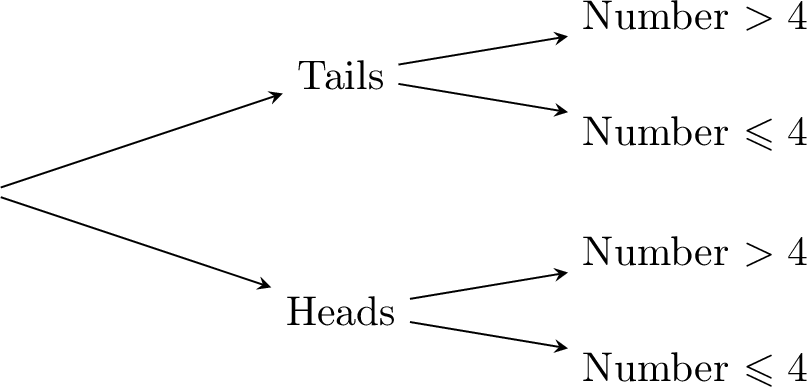
An experiment consists of the following two independent actions:- Tossing a fair coin.
- Rolling a fair six-sided die.
Let \(T\) be the event “getting tails” and \(N\) be the event “rolling a number greater than 4”.
- The events are independent, so we can use the multiplication rule.
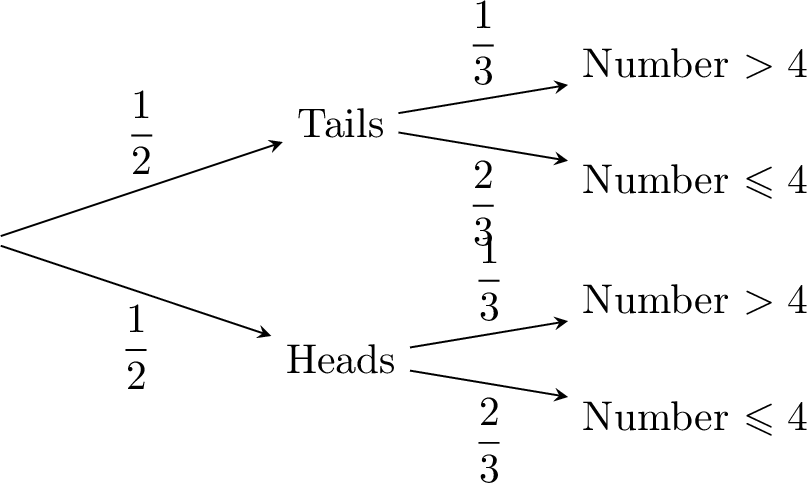
- The probability of getting tails is \(P(T) = \dfrac{1}{2}\).
- The outcomes for a number greater than 4 are \(\{5, 6\}\). There are 2 favourable outcomes out of 6 total outcomes. So, \(P(N) = \dfrac{2}{6} = \dfrac{1}{3}\).
- Now, we multiply the probabilities to find the probability of both events happening:$$\begin{aligned}P(T \text{ and } N) &= P(T) \times P(N) \\ &= \dfrac{1}{2} \times \dfrac{1}{3} \\ &= \dfrac{1}{6}\end{aligned}$$
Method — Using a Probability Tree Diagram
- Draw branches for each step: Draw branches for the first event (coin toss) and then, from the end of each of those branches, draw the branches for the second event (die roll).
- Write probabilities on each branch: The probabilities on the branches from a single point must add up to 1. Because the events are independent, the probabilities on the die-roll branches are the same after “Tails” and after “Heads”.
- Multiply along the path: To find the probability of a combined event, multiply the probabilities along the path from start to finish.
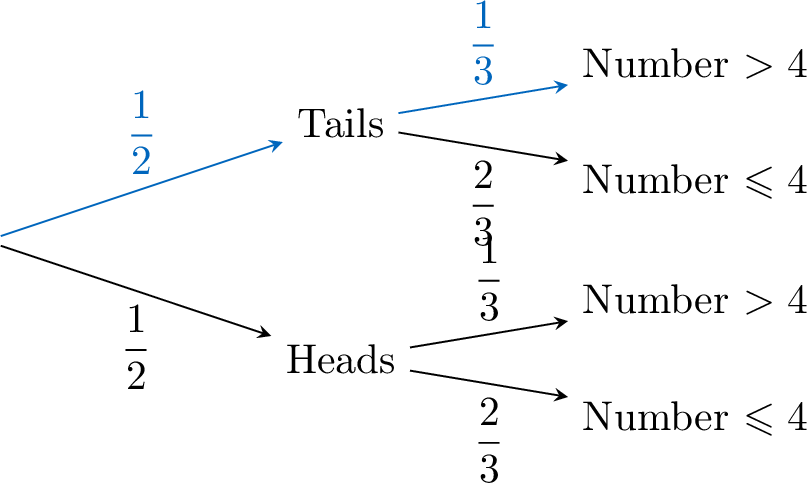 $$\textcolor{colorprop}{P(\text{"Tails" and "Number > 4"})=\frac{1}{2}\times \frac{1}{3}}$$
Skills to practice
- Draw a Probability Tree for Two Independent Events
- Calculating Probabilities from a Tree Diagram
- Calculating Probabilities from a Tree Diagram
- Calculating the Probability of Two Independent Events
IX
Experimental Probability
So far, we have calculated theoretical probability. This is what we expect to happen based on logic. For example, we expect a coin to land on heads half the time, so we say \(P(\text{Heads}) = \frac{1}{2}\).
But what if we can’t use logic? What if the outcomes are not equally likely? In these cases, we need to do an experiment to estimate the probability.
But what if we can’t use logic? What if the outcomes are not equally likely? In these cases, we need to do an experiment to estimate the probability.
Isaac wants to find the probability that a cone he drops will land on its base. The possible outcomes are “base down” or “on its side”.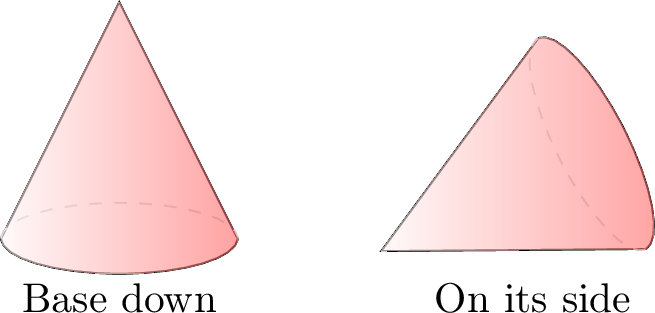
- Base down: 15 times.
- On its side: 35 times.
Definition — Experimental Probability (Relative Frequency)
The experimental probability of an event is an estimate found by repeating an experiment many times. It is calculated with the formula:$$ \text{Experimental Probability} = \frac{\text{Number of times an event occurs}}{\text{Total number of trials}} $$The more trials we do, the better our estimate of the true probability will be.Skills to practice
- Calculating Experimental Probabilities in Percentage Form
- Conducting Experiments to Estimate Probabilities
X
Review \& Beyond
Skills to practice
- Quiz
Jump to section