International Baccalaureate · DP 2: Applications and Interpretation SL
Revision: Calculus
I
Toolbox: The Trapezoidal Rule
Recappreviously studied — click to reread
When an antiderivative is hard or impossible to express with elementary functions, a definite integral can be estimated numerically. The trapezoidal rule approximates the area under \(y=f(x)\) by trapezia of equal width.
Proposition — The Trapezoidal Rule
Divide \([a,b]\) into \(n\) strips of width \(h=\dfrac{b-a}{n}\), with points \(x_0=a,\,x_1,\dots,x_n=b\). Then $$ \int_a^b f(x)\,\mathrm{d}x \approx \frac{h}{2}\Big[\,f(x_0)+2f(x_1)+2f(x_2)+\dots+2f(x_{n-1})+f(x_n)\,\Big]. $$ 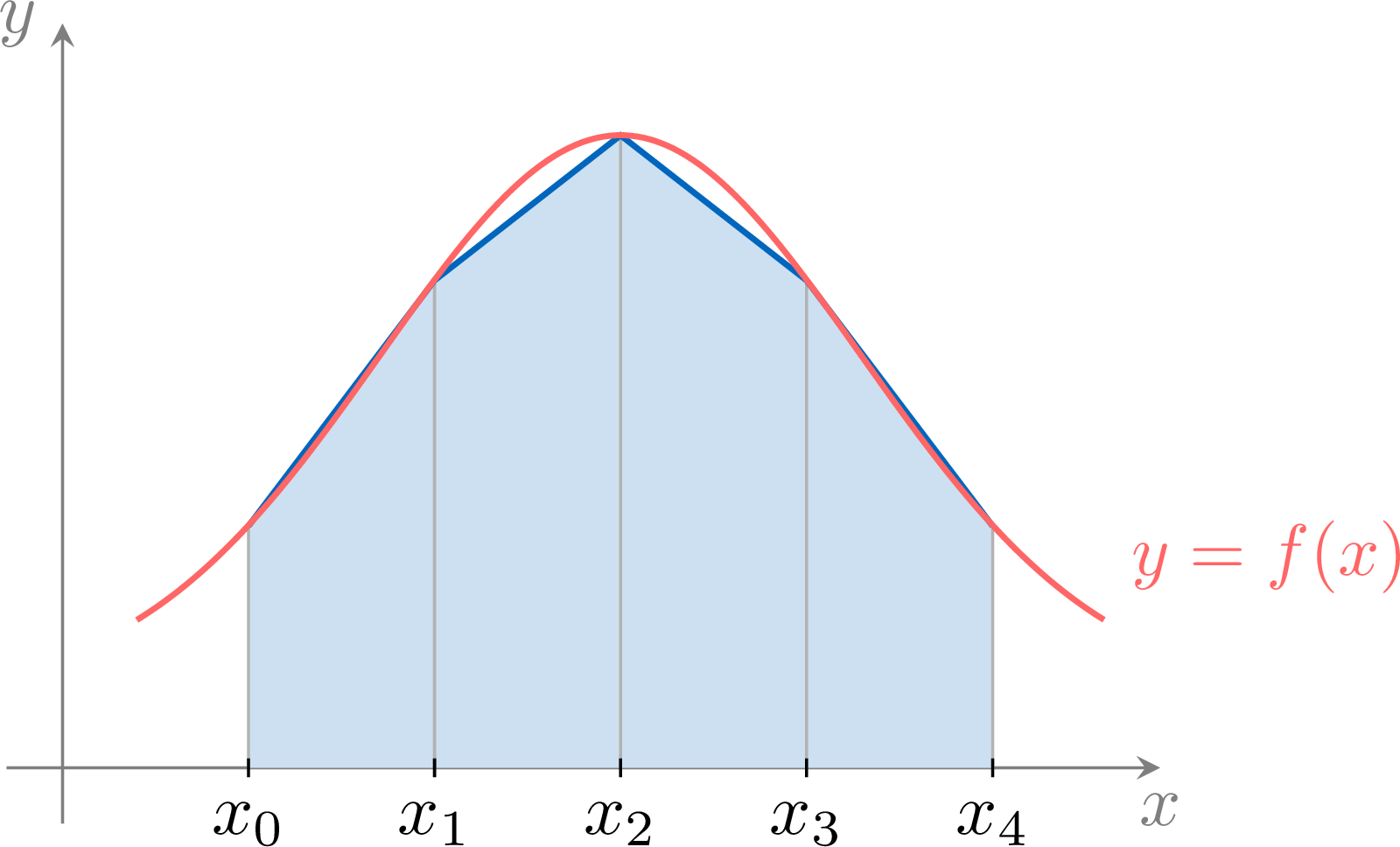
Example
Estimate \(\displaystyle\int_0^4 \sqrt{x}\,\mathrm{d}x\) using the trapezoidal rule with \(n=4\) strips.
Here \(h=\frac{4-0}{4}=1\), with \(x_0,\dots,x_4=0,1,2,3,4\) and \(f(x)=\sqrt{x}\): $$ \begin{array}{c|ccccc} x & 0 & 1 & 2 & 3 & 4 \\
\hline f(x) & 0 & 1 & \sqrt2 & \sqrt3 & 2 \end{array} $$ $$\begin{aligned} \int_0^4\!\sqrt{x}\,\mathrm{d}x &\approx \tfrac{1}{2}\big[0+2(1)+2\sqrt2+2\sqrt3+2\big] &&\text{(trapezoidal rule)}\\
&= 2+\sqrt2+\sqrt3 \approx 5.15 &&\text{(by technology: }\approx5.33) \end{aligned}$$ The top side of each trapezium joins two points of the curve \(y = \sqrt{x}\): it is a chord, and the curve lies above it. Each trapezium lies inside the region under the curve on its strip, so this underestimates the integral. 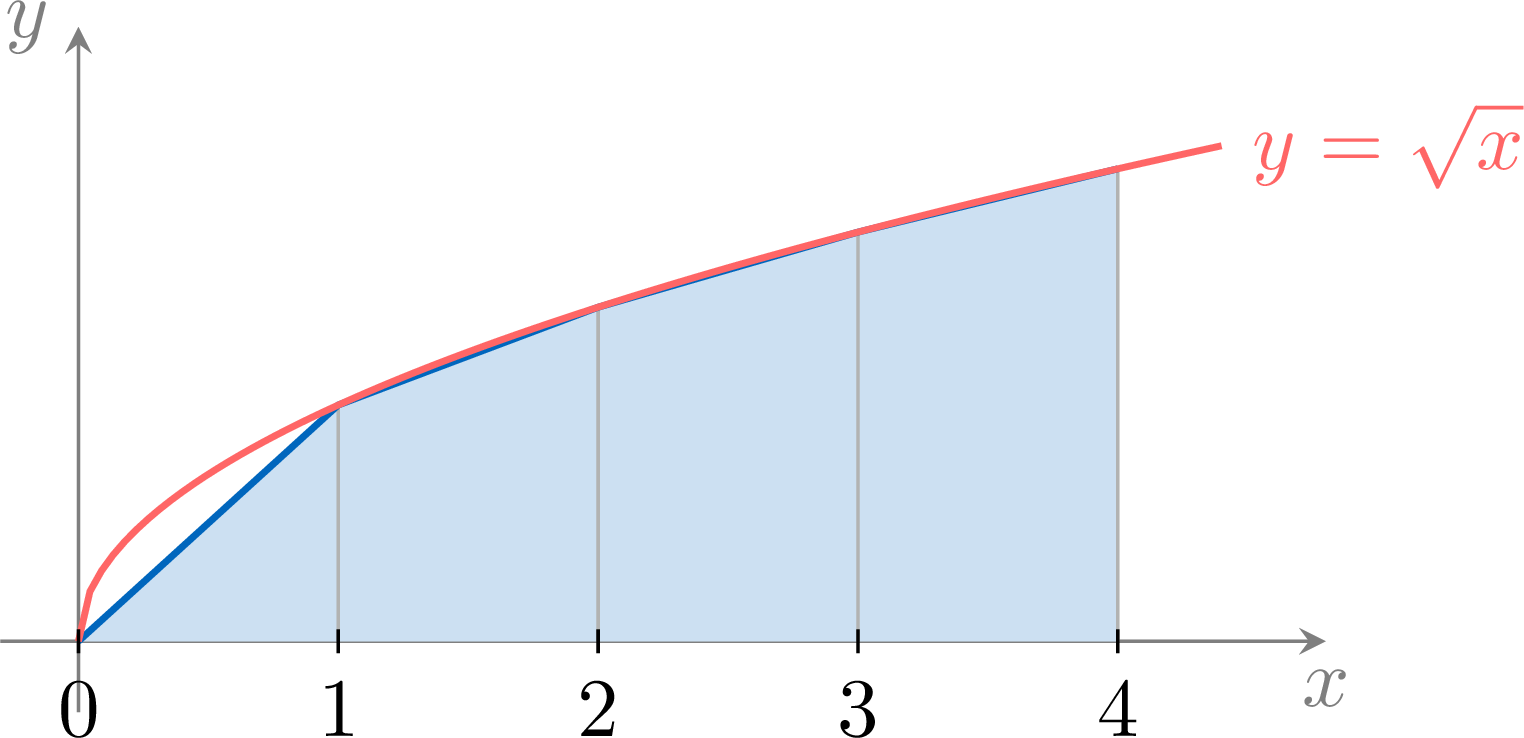
Skills to practice
- Estimating an Integral with the Trapezoidal Rule
II
Toolbox: Definite Integrals with Technology
Recappreviously studied — click to reread
Method — Evaluating a Definite Integral with Technology
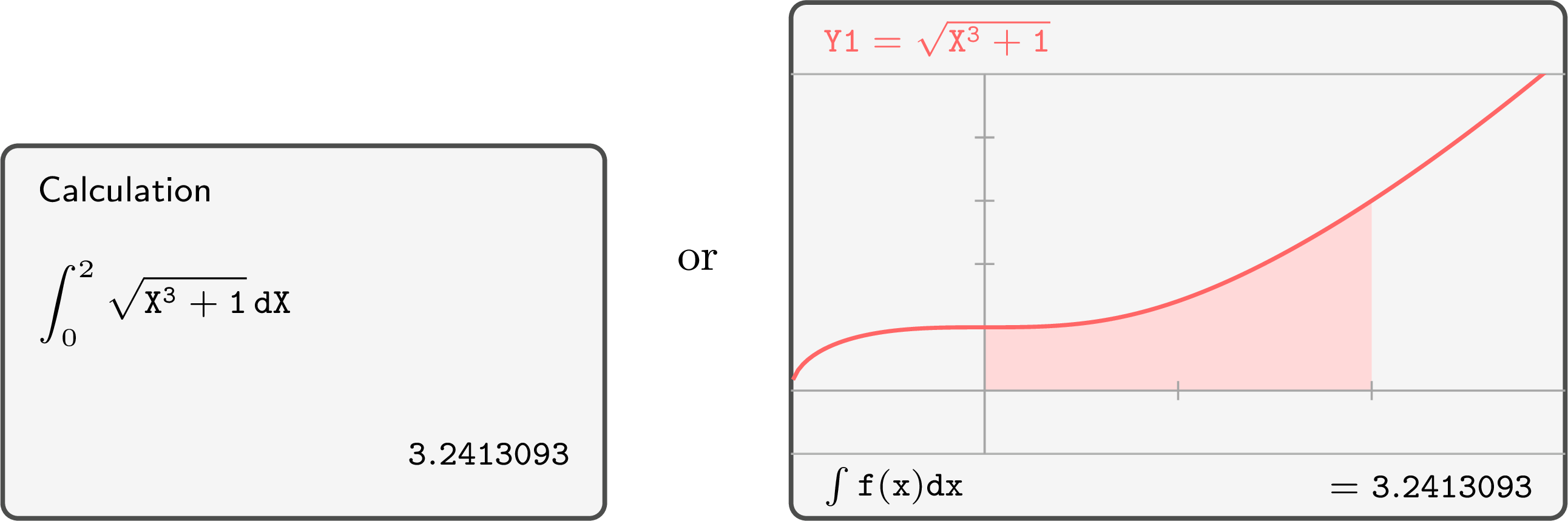
A graphing calculator evaluates a definite integral \(\displaystyle\int_a^b f(x)\,\mathrm{d}x\) numerically, even when no formula gives its value. It offers two tools: the integral template of the calculation screen, where the integrand and the two bounds are typed, and the integral tool of the graph screen, which asks for the lower bound, then the upper bound, and shades the region. Both return a decimal approximation of the signed area. - Write the integral first, on paper: the integrand, the bounds and the differential, \(\displaystyle\int_a^b f(x)\,\mathrm{d}x\). This expression is the method; the calculator only evaluates it. For an area, a sketch first shows where the curve lies above or below the \(x\)-axis between \(a\) and \(b\).
- Set the angle unit to radians when \(f(x)\) contains \(\sin\), \(\cos\) or \(\tan\).
- Enter the integral: the integrand, written with the variable \(X\) of the calculator, then the lower bound \(a\) and the upper bound \(b\), in this order.
- Report the value to 3 significant figures, unless the question asks for another accuracy.
- Interpret the sign: the value is a signed area. It is the area of the region only when \(f(x) \ge 0\) on \([a, b]\); when \(f(x) \le 0\) on the whole of \([a, b]\), the area is \(-\displaystyle\int_a^b f(x)\,\mathrm{d}x\). When the curve crosses the \(x\)-axis between \(a\) and \(b\), the area of the region is \(\displaystyle\int_a^b |f(x)|\,\mathrm{d}x\), evaluated with the absolute-value function of the calculator; alternatively, the zeros of \(f\) in \([a, b]\) are found with the zero tool, \([a, b]\) is split at these zeros, and the absolute values of the integrals over the pieces, from \(a\) to the first zero and from the last zero to \(b\) included, are added.
Example
The region \(R\) is bounded by the curve \(y = \sqrt{x^3+1}\), the \(x\)-axis and the lines \(x = 0\) and \(x = 2\). - Write down an integral that gives the area of \(R\).
- Find the area of \(R\) with technology.
- Check that this value is plausible, with a rectangle that lies under the curve and a rectangle that contains \(R\).
- For \(0 \le x \le 2\), \(x^3 + 1 \ge 1\), so \(\sqrt{x^3+1} \ge 1 > 0\): the curve lies above the \(x\)-axis, and the area of \(R\) is $$\mathcal{A} = \int_0^2 \sqrt{x^3+1}\,\mathrm{d}x.$$
- The integral template, with the integrand \(\sqrt{X^3+1}\) and the bounds \(0\) and \(2\), displays \(3.2413093\); the integral tool of the graph screen, with the lower bound \(0\) and the upper bound \(2\), displays the same value. The area of \(R\) is \(\mathcal{A} \approx 3.24\) square units.
- On \([0, 2]\), \(x^3 + 1\) increases, so \(f(x) = \sqrt{x^3+1}\) increases from \(f(0) = 1\) to \(f(2) = \sqrt{9} = 3\). The rectangle of width \(2\) and height \(f(0)\) lies under the curve, and the rectangle of width \(2\) and height \(f(2)\) contains \(R\): $$\begin{aligned}[t] 2 \times f(0) &\le \mathcal{A} \le 2 \times f(2) &&\text{(one rectangle below, one rectangle above)}\\ 2 &\le \mathcal{A} \le 6. \end{aligned}$$ The value \(3.24\) lies between \(2\) and \(6\).
Skills to practice
- Calculating a Definite Integral with Technology
III
Exam-Style Questions
Skills to practice
- Working with Technology: Calculus
Jump to section