International Baccalaureate · DP 2: Analysis and Approaches HL
Revision: Algebra and Sequences
I
Toolbox: Arithmetic and Geometric Series
Recappreviously studied — click to reread
Proposition — Sum of an Arithmetic Sequence
The sum of the first terms of an arithmetic sequence is given by the formula:$$S_n = \text{Number of terms} \times \frac{(\text{First term} + \text{Last term})}{2}$$ - If a sequence starts at \(u_0\) and ends at \(u_n\), there are \(\boldsymbol{n+1}\) terms. The formula is:$$S_n = \frac{n+1}{2}(u_0 + u_n)$$
- If a sequence starts at \(u_1\) and ends at \(u_n\), there are \(\boldsymbol{n}\) terms. The formula is:$$S_n = \frac{n}{2}(u_1 + u_n)$$
Proposition — Sum of a Geometric Sequence
The sum of the first terms of a geometric sequence is given by the formula:$$S_n = \text{First term} \times \frac{1 - (\text{common ratio})^{\text{Number of terms}}}{1 - \text{common ratio}}$$ - If a sequence starts at \(u_0\) and has a common ratio \(r\), the sum of the first \(\boldsymbol{n+1}\) terms is:$$S_n = u_0 \left( \frac{1 - r^{n+1}}{1 - r} \right)$$
- If a sequence starts at \(u_1\) and has a common ratio \(r\), the sum of the first \(\boldsymbol{n}\) terms is:$$S_n = u_1 \left( \frac{1 - r^{n}}{1 - r} \right)$$
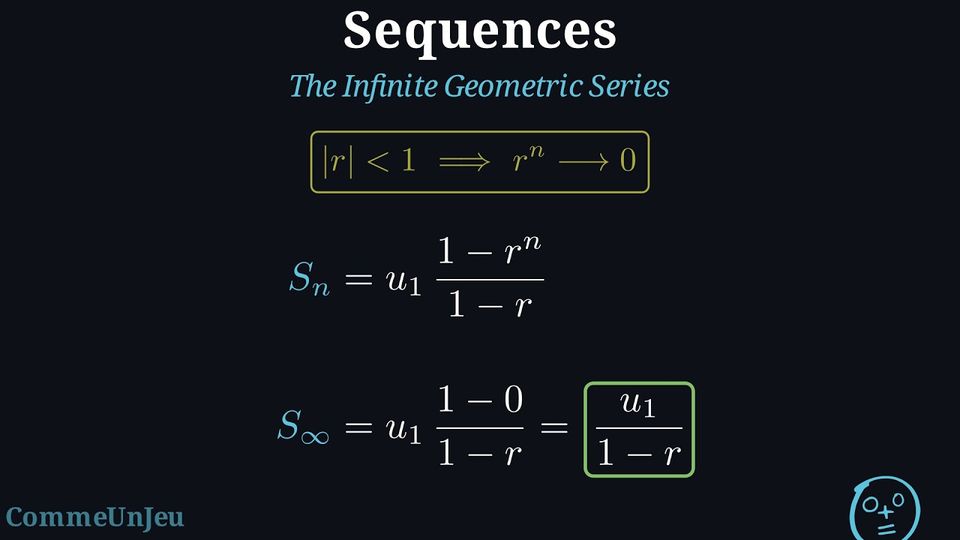
Proposition — Convergence of a Geometric Series
An infinite geometric series (with non-zero first term) converges to a finite sum if and only if its common ratio \(r\) is between -1 and 1, i.e., \(\boldsymbol{|r| < 1}\).If the series converges, its sum to infinity, denoted \(S_\infty\), is given by the formula:$$\boldsymbol{S_\infty = \frac{u_1}{1-r}}$$ where \(u_1\) is the first term and \(|r|<1\).If the sequence starts at \(u_0\), the formula is:$$\boldsymbol{S_\infty = \frac{u_0}{1-r}}$$
Skills to practice
- Calculating the Sum of an Infinite Geometric Series
II
Toolbox: Laws of Logarithms and Change of Base
Recappreviously studied — click to reread
Proposition — Laws of Logarithms
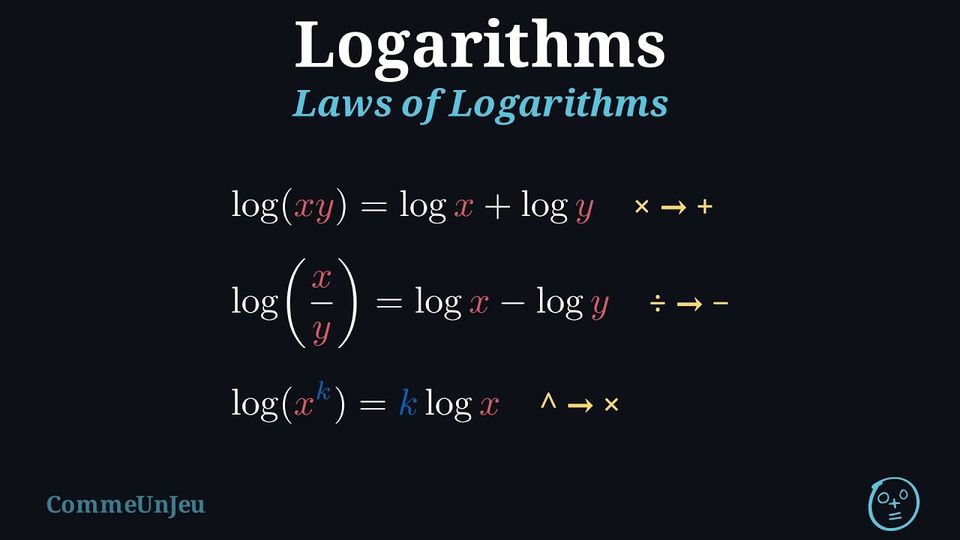
For \(x>0\), \(y>0\), \(a>0\) with \(a\neq 1\), and for any real number \(k\): - Product Rule: \(\log_a (xy) = \log _a x + \log _a y\)
- Quotient Rule: \(\log _a \left(\dfrac{x}{y}\right) = \log _a x - \log_a y\)
- Power Rule: \(\log_a (x^k) = k \log_a x\)
Proposition — Change of Base Rule
For any \(a>0\), \(a \neq 1\), \(b>0\), \(b \neq 1\), and \(x > 0\):$$\log_a x = \frac{\log_b x}{\log_b a}.$$ Skills to practice
- Writing as a Single Logarithm in Base \(a\)
III
Toolbox: The Binomial Theorem
Recappreviously studied — click to reread
Proposition — Binomial Theorem
For any non-negative integer \(n\) and any real numbers \(a\) and \(b\), we have$$\begin{aligned}(a+b)^n&=\sum_{k=0}^{n} \binom{n}{k}a^{\,n-k}b^{\,k}\\
&= \binom{n}{0}a^n b^0 + \binom{n}{1}a^{n-1}b^1 + \binom{n}{2}a^{n-2}b^2 + \dotsb + \binom{n}{n}a^0 b^n,\end{aligned}$$ with the convention \(x^0 = 1\) for every real number \(x\), \(x = 0\) included. Skills to practice
- Finding a Coefficient or a Constant Term
IV
Exam-Style Questions
Skills to practice
- Working without Technology: Sequences and Series
- Working with Technology: Sequences and Series
- Working without Technology: Exponents and Logarithms
- Working with Technology: Exponents and Logarithms
- Working without Technology: The Binomial Theorem
- Working with Technology: The Binomial Theorem
- Working without Technology: Further Algebra
- Working with Technology: Further Algebra
- Quiz
Jump to section