International Baccalaureate · DP 1: Applications and Interpretation SL
Straight Lines
I
Lines in the Cartesian Plane
I.1
Gradient
Recappreviously studied — click to reread
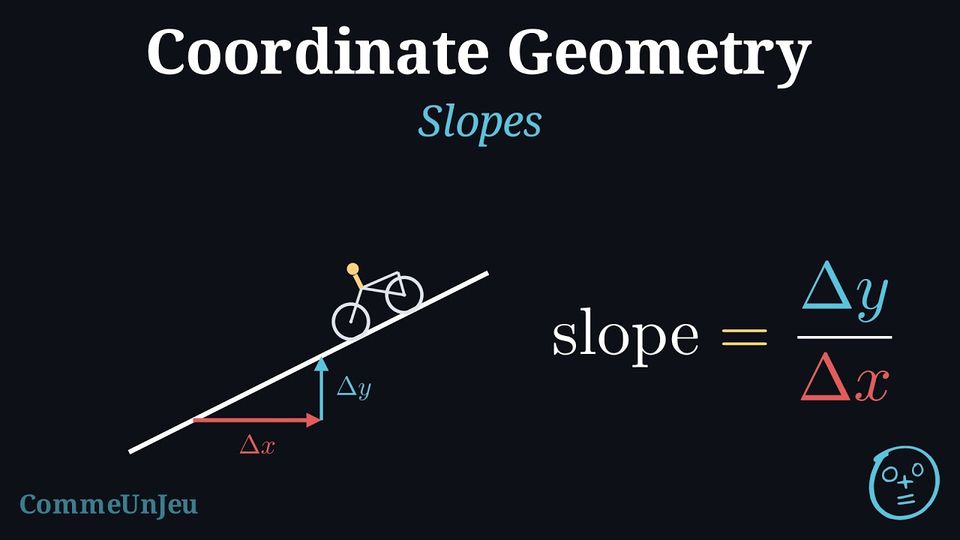
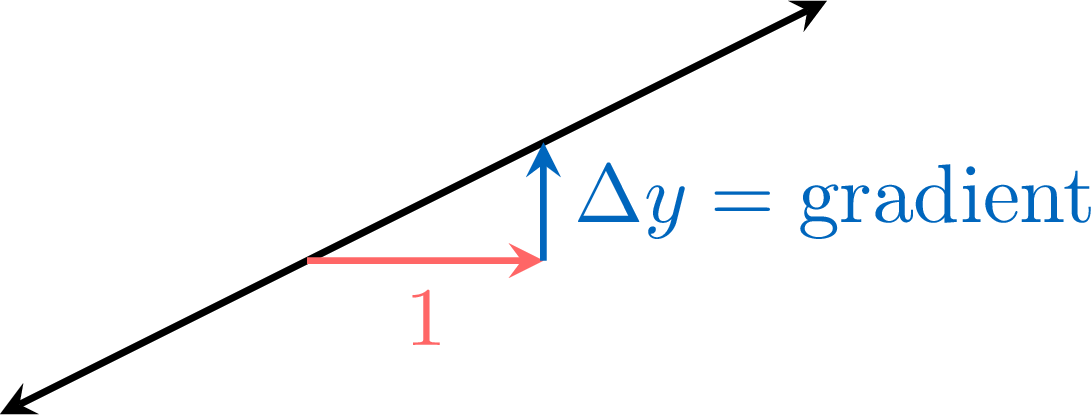
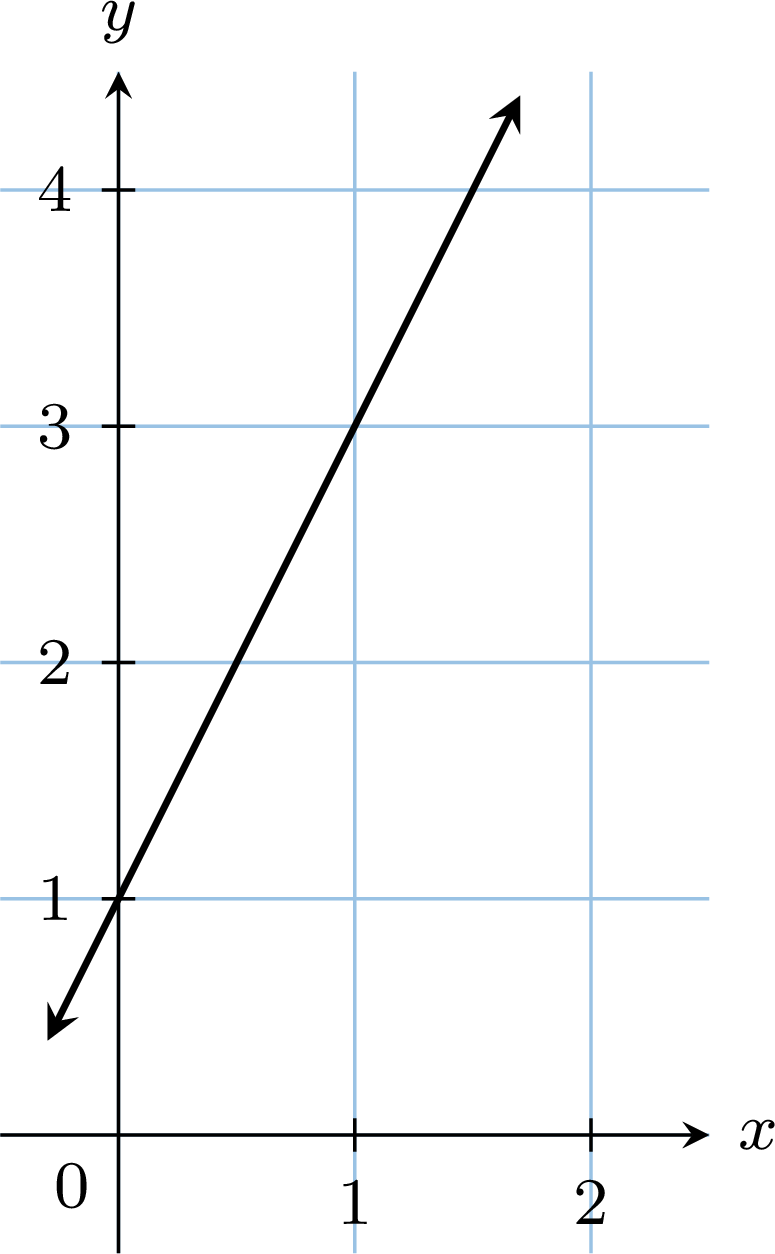
The gradient (also called the slope) of a line describes its direction and steepness. It is a number that tells us how much the \(y\)-coordinate of a point on the line changes when the \(x\)-coordinate increases by \(1\) unit.
- A positive gradient indicates that the line goes up (ascends) as you move to the right.
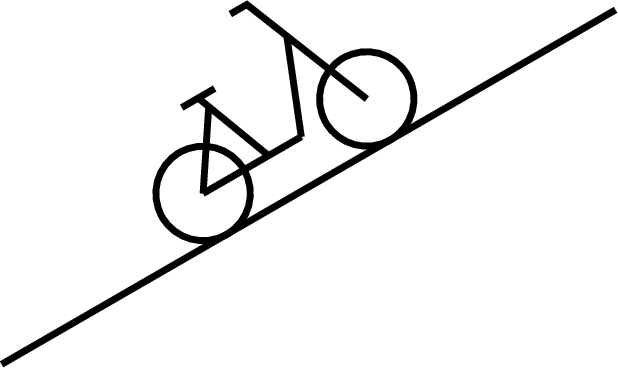
- A negative gradient indicates that the line goes down (descends) as you move to the right.
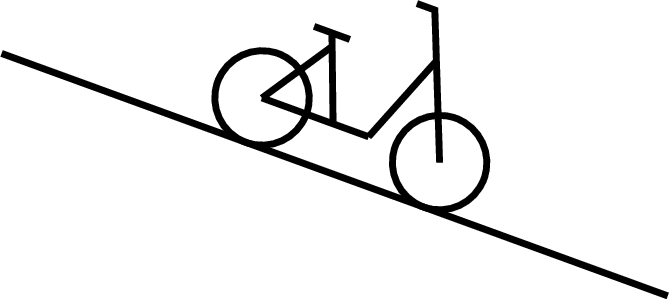
- A gradient of zero means the line is horizontal: as you move to the right, there is no vertical change.

Definition — Gradient
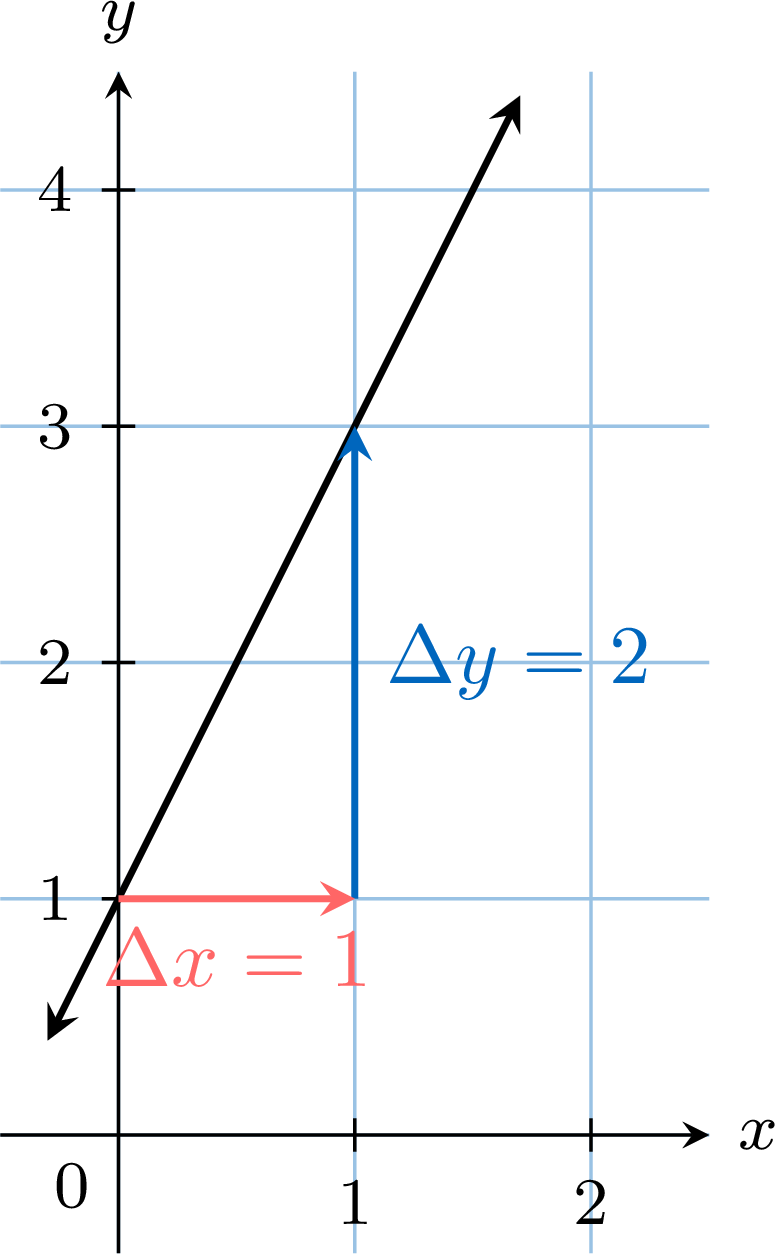
The gradient (also called the slope) of a non-vertical line is defined as the ratio of the change in the vertical direction (\(\Delta y\)) to the change in the horizontal direction (\(\Delta x\)), for any two distinct points on the line. This ratio is the same no matter which two points on the line we choose:$$\text{gradient} = \dfrac{\textcolor{colorprop}{\Delta y}}{\textcolor{colordef}{\Delta x}} = \dfrac{\textcolor{colorprop}{\text{vertical change}}}{\textcolor{colordef}{\text{horizontal change}}}, \quad \text{where } \textcolor{colordef}{\Delta x} \neq 0$$ 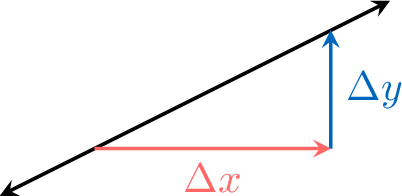
In the special case where \(x\) increases by exactly \(1\) — that is, \(\Delta x = 1\) — the gradient is simply \(\Delta y\): the gradient tells how much \(y\) changes for one unit step in \(x\).
Example
Skills to practice
- Finding Gradients
I.2
The Gradient Formula
Recappreviously studied — click to reread
Proposition — Gradient Formula
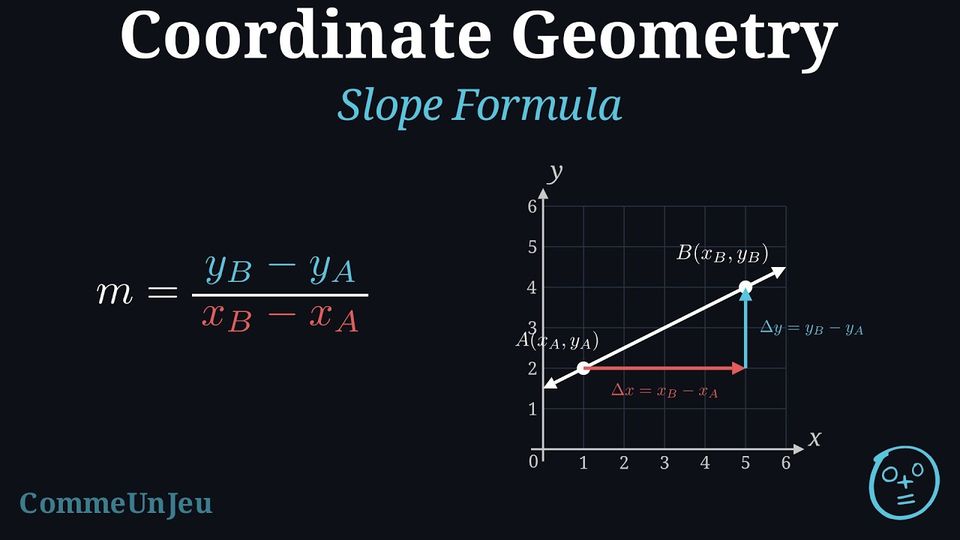
The gradient (also called the slope) of a non-vertical line passing through two distinct points \(A\left(\textcolor{colordef}{x_A}, \textcolor{colorprop}{y_A}\right)\) and \(B\left(\textcolor{colordef}{x_B}, \textcolor{colorprop}{y_B}\right)\) is given by the formula:$$\text{gradient} =\frac{\textcolor{colorprop}{y_B}-\textcolor{colorprop}{y_A}}{\textcolor{colordef}{x_B}-\textcolor{colordef}{x_A}}, \quad \text{where } \textcolor{colordef}{x_A} \neq \textcolor{colordef}{x_B}$$ The order of the points does not matter, as long as we subtract in the same order in the numerator and the denominator. 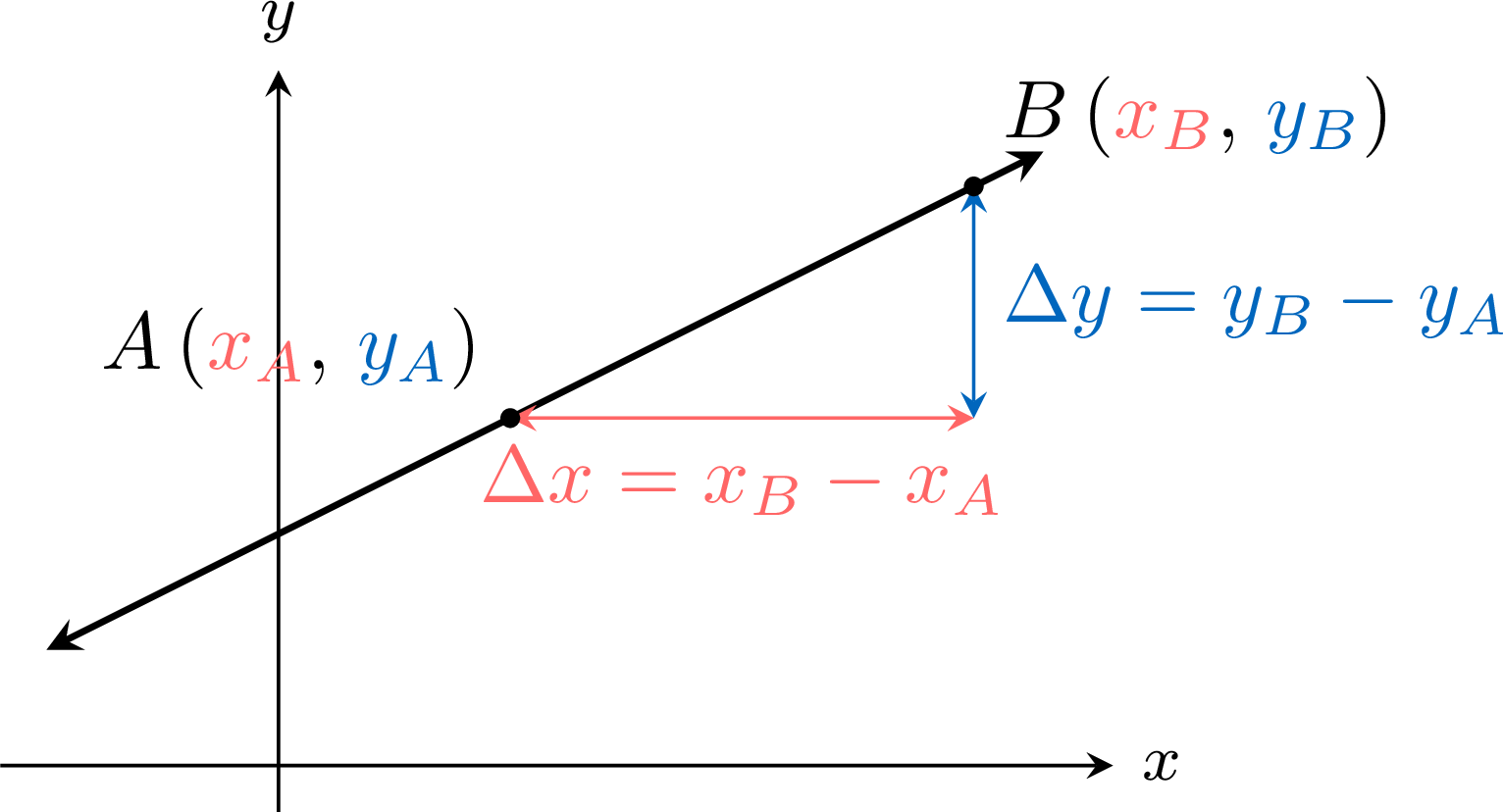
Example
Find the gradient of the line \(\Line{AB}\) for \(A\left(\textcolor{colordef}{1}, \textcolor{colorprop}{2}\right)\) and \(B\left(\textcolor{colordef}{5}, \textcolor{colorprop}{4}\right)\). 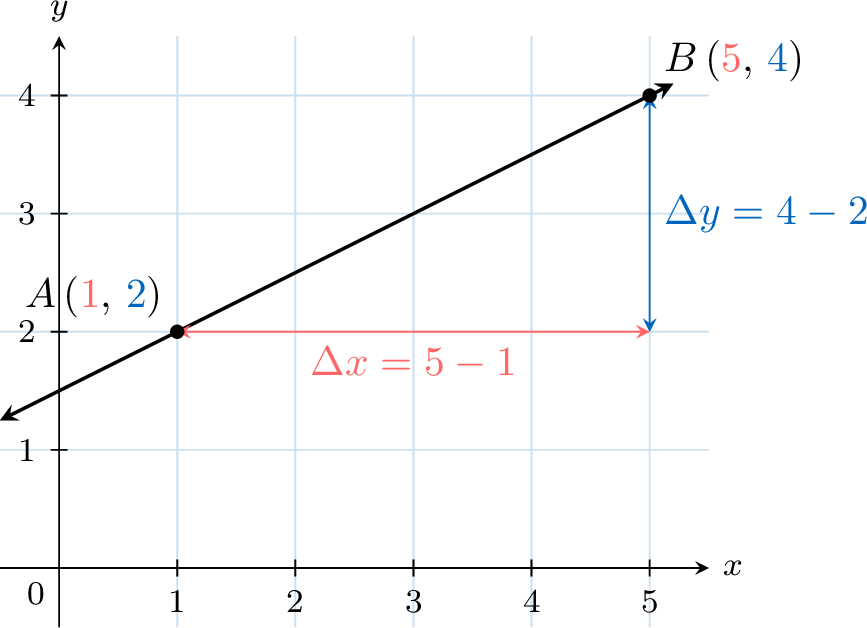
Skills to practice
- Calculating the Gradient from Two Points
I.3
The \(y\)-Intercept
Recappreviously studied — click to reread
Definition — \(y\)-Intercept
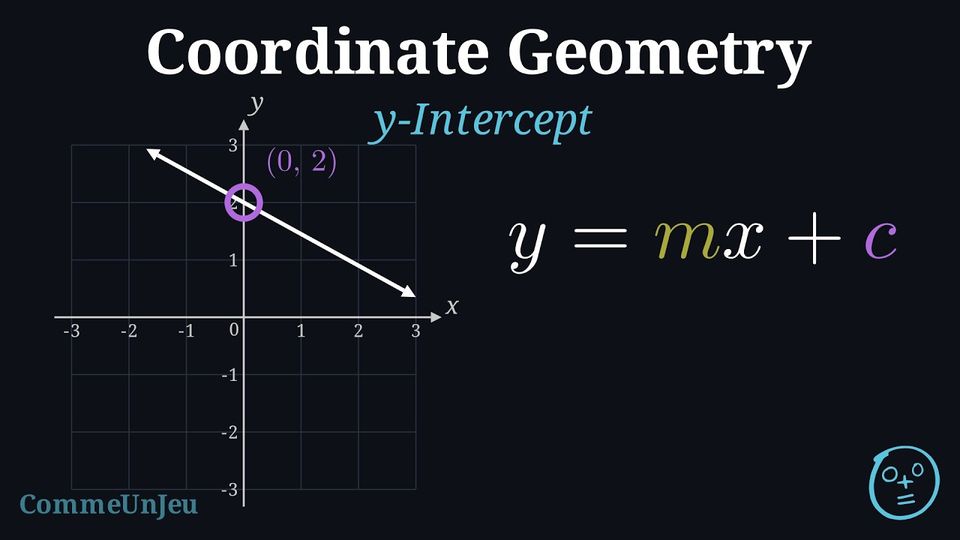
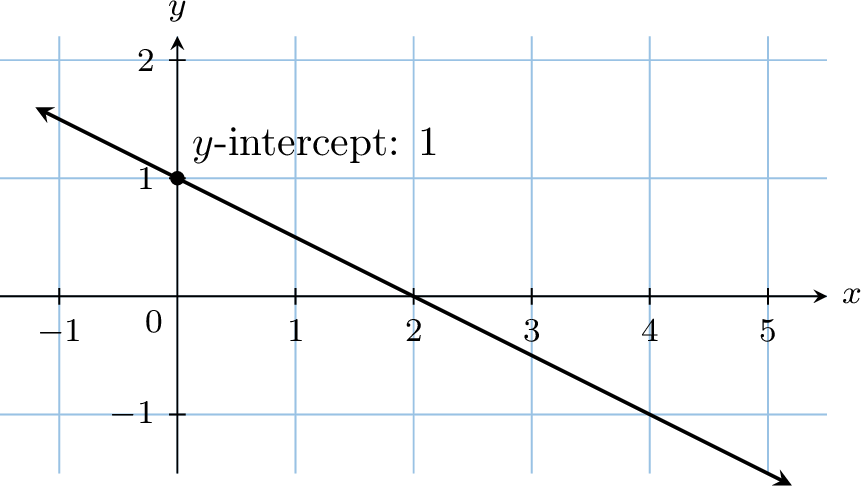
The \(y\)-intercept is the value of \(y\) where the graph crosses the \(y\)-axis (when \(x=0\)). Example
Find the \(y\)-intercept. 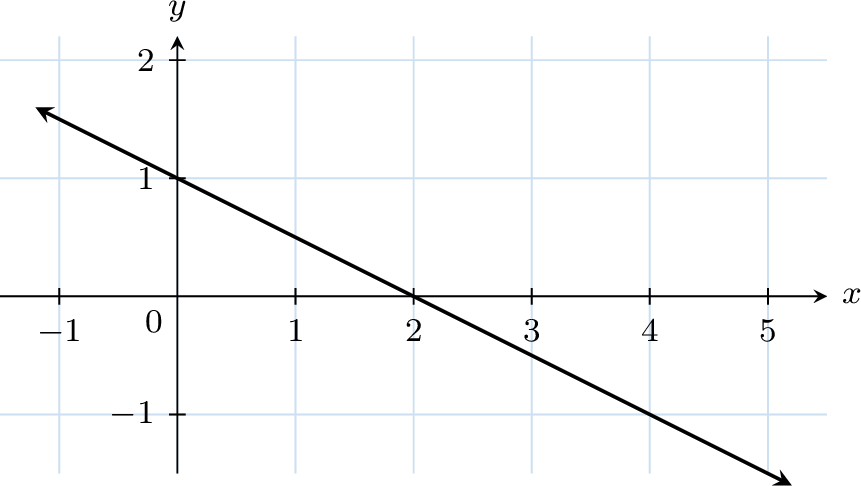
Skills to practice
- The \(y\)-Intercept
I.4
Equations of a Line
Recappreviously studied — click to reread
An equation like \(\textcolor{colorprop}{y}=2\textcolor{colordef}{x}-1\) describes a relationship between the variables \(\textcolor{colordef}{x}\) and \(\textcolor{colorprop}{y}\). For any value of \(\textcolor{colordef}{x}\) we choose, the equation tells us the corresponding value of \(\textcolor{colorprop}{y}\).
We can use this to find coordinates \((\textcolor{colordef}{x}, \textcolor{colorprop}{y})\) for points that satisfy the equation.
Each pair in the table, for example \((0,-1)\) or \((3,5)\), makes the equation \(\textcolor{colorprop}{y}=2\textcolor{colordef}{x}-1\) true. When we plot these points on a coordinate plane, we see they all lie on the same straight line. The equation \(\textcolor{colorprop}{y}=2\textcolor{colordef}{x}-1\) is the equation of this line, because it is true for every point on the line (and only for the points on this line). 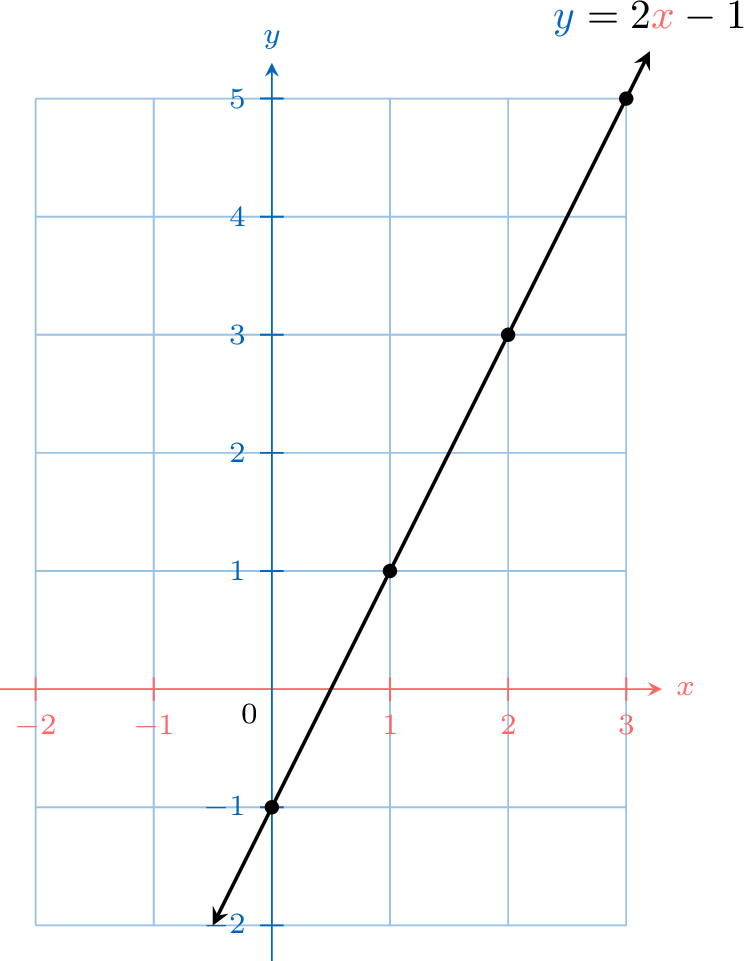
We can use this to find coordinates \((\textcolor{colordef}{x}, \textcolor{colorprop}{y})\) for points that satisfy the equation.
- If \(\textcolor{colordef}{x} = \textcolor{colordef}{1}\), then \(\textcolor{colorprop}{y} = 2(\textcolor{colordef}{1}) - 1 = \textcolor{colorprop}{1}\). This gives us the point \((1, 1)\).
- If \(\textcolor{colordef}{x} = \textcolor{colordef}{2}\), then \(\textcolor{colorprop}{y} = 2(\textcolor{colordef}{2}) - 1 = \textcolor{colorprop}{3}\). This gives us the point \((2, 3)\).
| \(\textcolor{colordef}{x}\) | \(\textcolor{colordef}{0}\) | \(\textcolor{colordef}{1}\) | \(\textcolor{colordef}{2}\) | \(\textcolor{colordef}{3}\) |
| \(\textcolor{colorprop}{y}\) | \(\textcolor{colorprop}{-1}\) | \(\textcolor{colorprop}{1}\) | \(\textcolor{colorprop}{3}\) | \(\textcolor{colorprop}{5}\) |
Definition — Gradient-Intercept Form
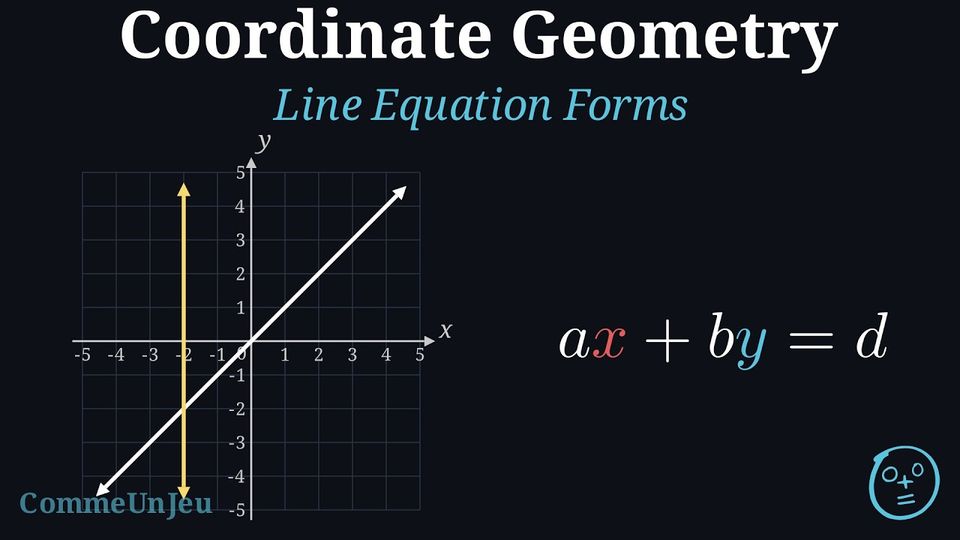
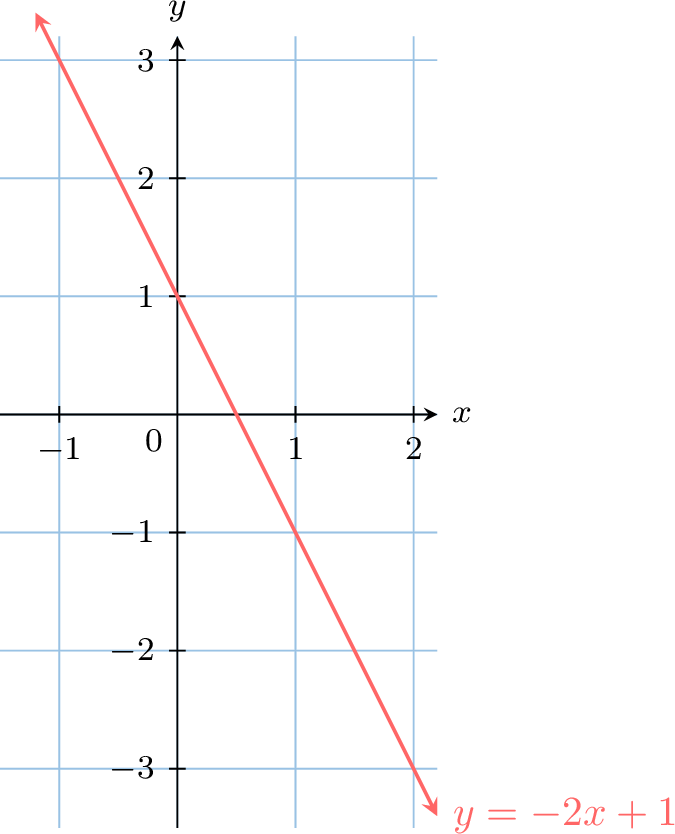
The gradient-intercept form (also called the slope-intercept form) of a non-vertical line's equation is:$$y = mx + c$$ where \(m\) is the gradient (also called the slope) and \(c\) is the \(y\)-intercept.For a vertical line, the equation is \( x = k \) where \(k\) is a constant.
Example
Definition — General Form of Equation of a Line
The general form of the equation of a line is:$$ax + by = d$$ where \(a\), \(b\), and \(d\) are constants, and \(a\) and \(b\) are not both zero. - If \(b \neq 0\), solving for \(y\) gives \(y = -\dfrac{a}{b}x + \dfrac{d}{b}\): the line is not vertical, and its gradient is \(-\dfrac{a}{b}\).
- If \(b = 0\), then \(a \neq 0\) and the equation becomes \(x = \dfrac{d}{a}\): the line is vertical.
Definition — Point-Gradient Form
A line with gradient \(m\) passing through the point \((x_1, y_1)\) has the equation $$y - y_1 = m(x - x_1),$$ called its point-gradient form (also called the point-slope form). It is the gradient formula in disguise: a point \((x, y)\) with \(x \neq x_1\) lies on the line exactly when \(\dfrac{y - y_1}{x - x_1} = m\). Example
Find the equation of the line with gradient \(2\) passing through \(A(3, 1)\).
$$\begin{aligned}[t] y - 1 &= 2(x - 3) && \text{(point-gradient form with } m=2, \ (x_1,y_1)=(3,1)\text{)} \\
y - 1 &= 2x - 6 && \text{(expand)} \\
y &= 2x - 5. \end{aligned}$$ For a line through two points, first compute the gradient with the gradient formula, then use the point-gradient form with either of the two points.
Skills to practice
- Stating the Gradient and the \(y\)-Intercept
- Rewriting Equations in Gradient-Intercept Form
- Finding the Equation of a Line Through a Point
- Finding the Equation of a Line Through Two Points
- Justifying Equations of Lines
I.5
Graphing a Line
Recappreviously studied — click to reread
Method — Graphing a Line Using Two Points
To graph a line given by \(y = mx + c\): - Find the first point \((x_1, y_1)\):
- Choose any convenient value for \(x_1\) (often an integer).
- Substitute \(x_1\) into the equation to calculate \(y_1\).
- Find a second point \((x_2, y_2)\):
- Choose a different value for \(x_2\).
- Substitute \(x_2\) into the equation to calculate \(y_2\).
- Draw the line:
- Plot both points on a graph.
- Use a ruler to draw a straight line passing through both points.
Example
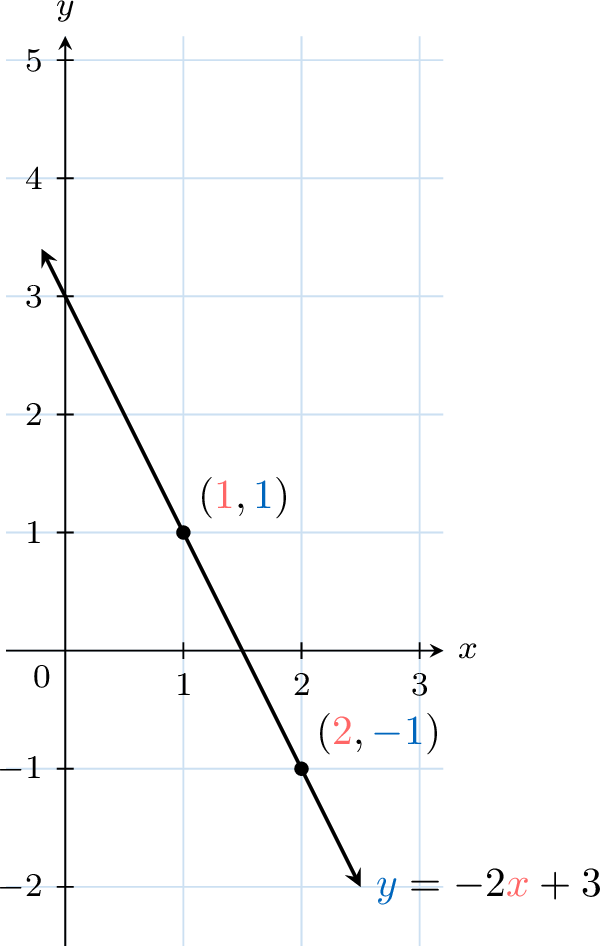
Graph the line \(y = -2x + 3\). - For \(\textcolor{colordef}{x} = \textcolor{colordef}{1}\),$$\begin{aligned}[t]\textcolor{colorprop}{y} &= -2 \times \textcolor{colordef}{1} + 3 \\ &= \textcolor{colorprop}{1}\end{aligned}$$
- For \(\textcolor{colordef}{x} = \textcolor{colordef}{2}\),$$\begin{aligned}[t]\textcolor{colorprop}{y} &= -2 \times \textcolor{colordef}{2} + 3 \\ &= \textcolor{colorprop}{-1}\end{aligned}$$
- So, the points \((\textcolor{colordef}{1}, \textcolor{colorprop}{1})\) and \((\textcolor{colordef}{2}, \textcolor{colorprop}{-1})\) are on the graph.
-
Method — Graphing a Line Using the \(y\)-Intercept and Slope
To graph a line \(y = mx + c\): - Plot the \(y\)-intercept:
- Mark the point \((0, c)\) on the graph.
- Use the gradient \(m\) to find a second point:
- From \((0, c)\), move horizontally by a chosen amount \(\Delta x\) (for example, \(1\) or \(2\) units).
- Then move vertically by \(\Delta y = m \cdot \Delta x\).
- Mark the second point.
- Draw the line:
- Draw a straight line passing through both points.
Example
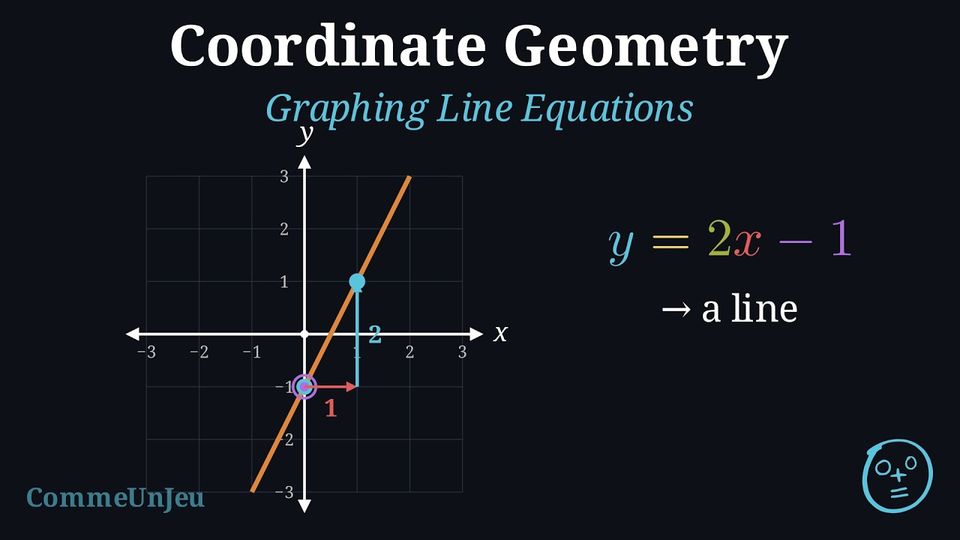
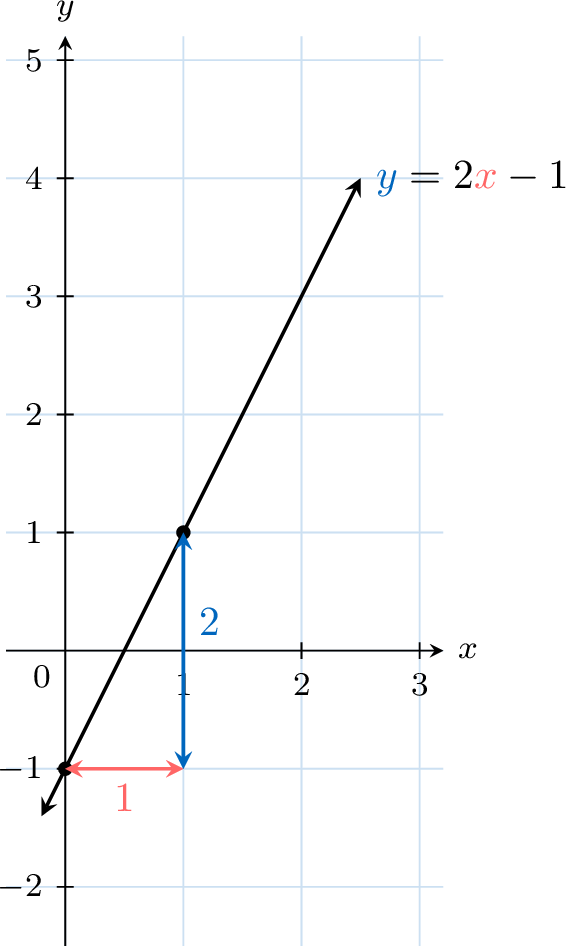
Graph the line \(y = 2x - 1\). - The \(y\)-intercept is \(-1\), so plot the point \((0, -1)\).
- The slope is \(2\): from \((0, -1)\), move \(1\) unit right (\(\Delta x = 1\)), then \(2\) units up (\(\Delta y = 2\)), to reach \((1, 1)\).
- Draw the line through these two points.
-
Skills to practice
- Graphing Lines from their Equations
I.6
Parallel and Perpendicular Lines
Recappreviously studied — click to reread
Proposition — Parallel Lines
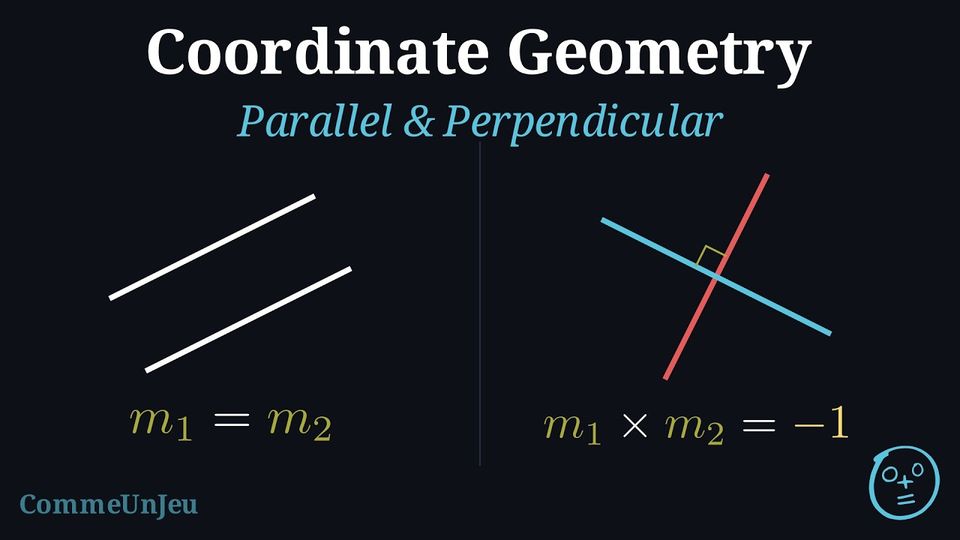
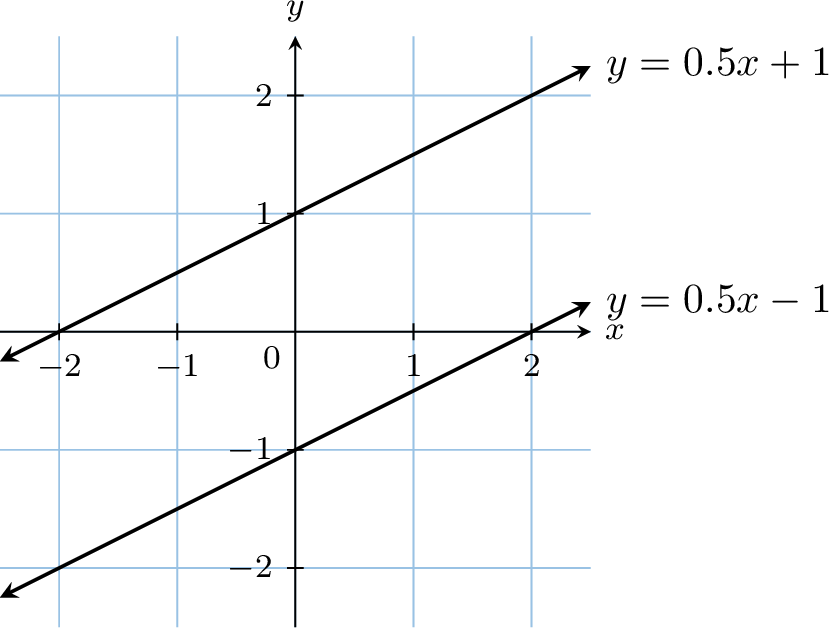
Two distinct, non-vertical lines$$L_1 : y = m_1 x + c_1 \quad \text{and} \quad L_2 : y = m_2 x + c_2$$ are parallel if and only if they have the same gradient (also called slope), i.e.\ \(m_1 = m_2\). (If \(m_1 = m_2\) and \(c_1 = c_2\), the two equations represent the same line — which is why the proposition assumes the lines are distinct.)All vertical lines (of the form \(x = k\)) are parallel to each other.
Proposition — Perpendicular Lines
In a coordinate plane whose axes are perpendicular and have the same unit, two non-vertical lines are perpendicular if and only if the product of their gradients \(m_1\) and \(m_2\) is \(-1\), i.e.\ \(m_1 \cdot m_2 = -1\). Equivalently, their gradients are negative reciprocals:$$m_2 = -\frac{1}{m_1}.$$ Additionally, a vertical line (undefined gradient) is always perpendicular to a horizontal line (gradient \(0\)). 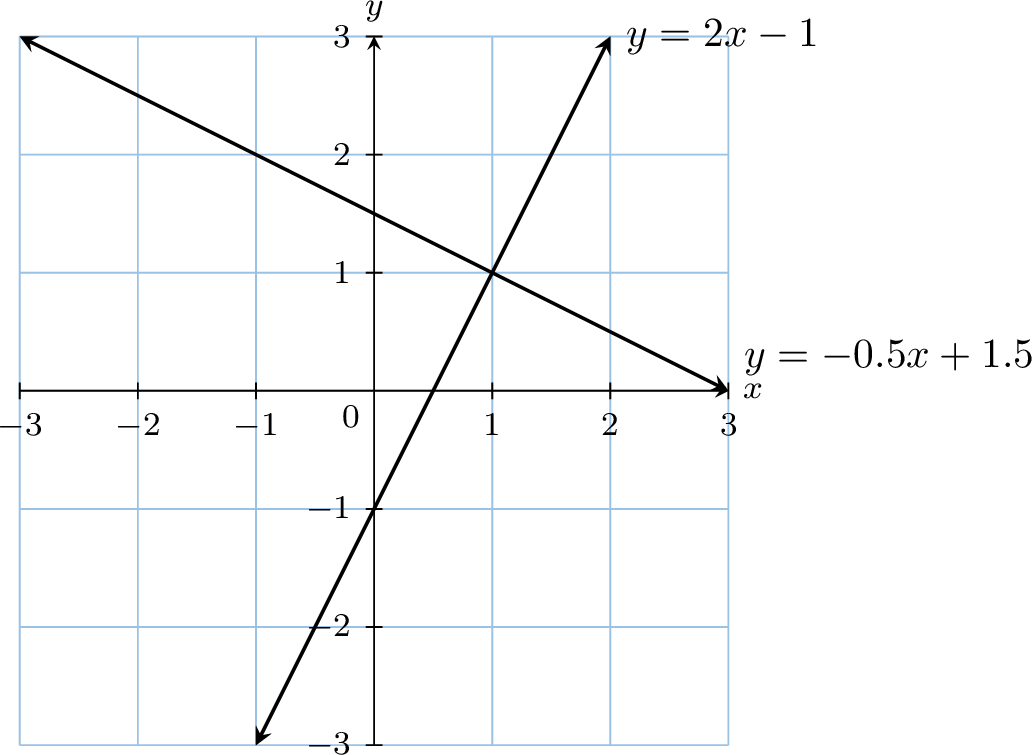
Let \(\ell_1\) have gradient \(m_1 \neq 0\) (when \(m_1 = 0\), \(\ell_1\) is horizontal and the lines perpendicular to it are vertical, with no gradient), and let \(O\) be a point of \(\ell_1\). Its gradient triangle at \(O\) goes \(1\) across and \(m_1\) up, ending at a point \(P\) of \(\ell_1\).
Rotate this triangle a quarter-turn about \(O\). The rotation sends \(\ell_1\) to the line \(\ell_2\) perpendicular to \(\ell_1\) at \(O\), so the image of \(P\) is a point \(P'\) of \(\ell_2\) — and the sides of the triangle swap roles: the run of length \(1\) becomes a rise of \(1\), and the signed rise \(m_1\) becomes a signed run of \(-m_1\). Reading the rotated triangle as a gradient triangle of \(\ell_2\): $$m_2 = \frac{\text{rise}}{\text{run}} = \frac{1}{-m_1}, \qquad \text{so} \qquad m_1 \cdot m_2 = -1.$$ Conversely, if \(m_1 m_2 = -1\), then \(m_2 = -\frac{1}{m_1}\) is the gradient of the perpendicular to \(\ell_1\): a line with this gradient is parallel to that perpendicular, hence itself perpendicular to \(\ell_1\). 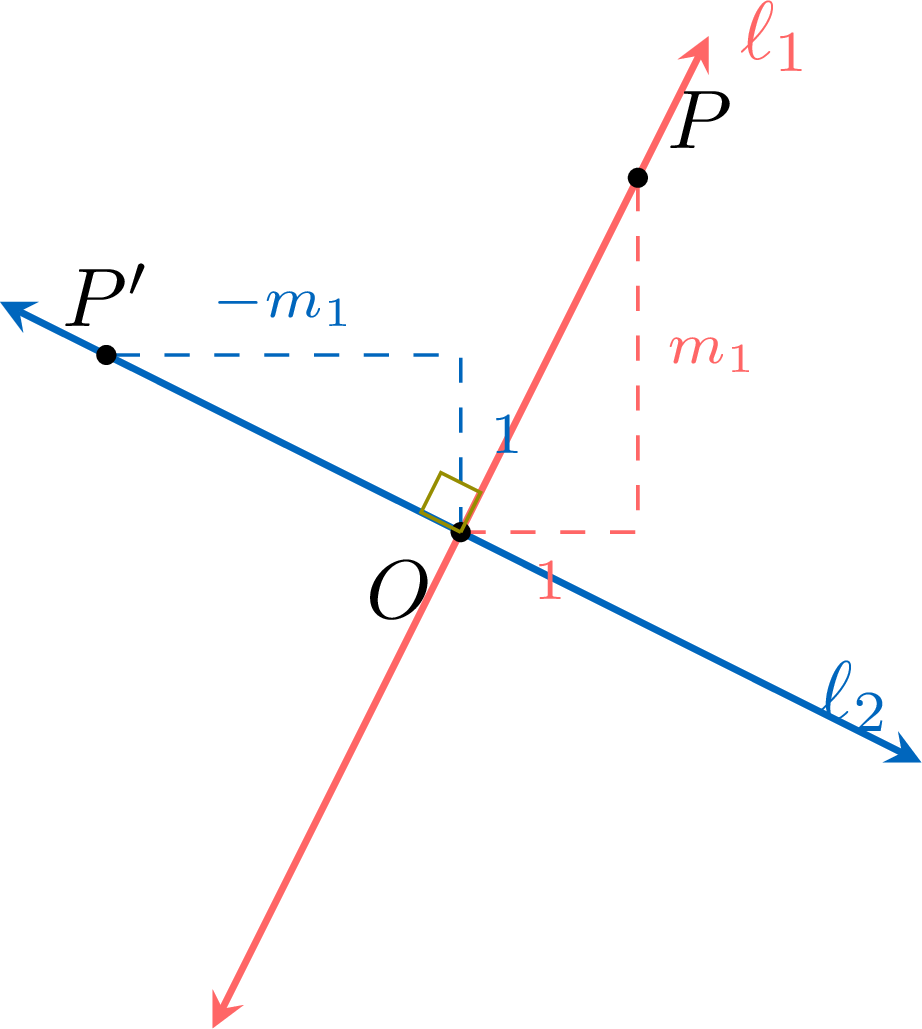
Rotate this triangle a quarter-turn about \(O\). The rotation sends \(\ell_1\) to the line \(\ell_2\) perpendicular to \(\ell_1\) at \(O\), so the image of \(P\) is a point \(P'\) of \(\ell_2\) — and the sides of the triangle swap roles: the run of length \(1\) becomes a rise of \(1\), and the signed rise \(m_1\) becomes a signed run of \(-m_1\). Reading the rotated triangle as a gradient triangle of \(\ell_2\): $$m_2 = \frac{\text{rise}}{\text{run}} = \frac{1}{-m_1}, \qquad \text{so} \qquad m_1 \cdot m_2 = -1.$$ Conversely, if \(m_1 m_2 = -1\), then \(m_2 = -\frac{1}{m_1}\) is the gradient of the perpendicular to \(\ell_1\): a line with this gradient is parallel to that perpendicular, hence itself perpendicular to \(\ell_1\).
Example
Determine whether the lines \(y=3x+2\) and \(y=3x-1\) are parallel, perpendicular, or neither.
Both lines have gradient \(m=3\), so they are parallel (and distinct, since \(2 \neq -1\)).
Example
Determine whether the lines \(y=4x-3\) and \(y=-\frac{1}{4}x+5\) are parallel, perpendicular, or neither.
The gradients are \(m_1=4\) and \(m_2=-\dfrac{1}{4}\), and \(4 \times \left(-\dfrac{1}{4}\right) = -1\), so they are perpendicular.
Skills to practice
- Deciding Whether Lines Are Parallel or Perpendicular
- Finding the Equation of a Parallel or Perpendicular Line
II
Perpendicular Bisectors
II.1
The Perpendicular Bisector of a Segment
Recappreviously studied — click to reread
Definition — Midpoint Formula
The midpoint \(M\) of the segment \(\Segment{AB}\), with \(A(x_A, y_A)\) and \(B(x_B, y_B)\), has coordinates $$M\left(\frac{x_A + x_B}{2},\ \frac{y_A + y_B}{2}\right):$$ each coordinate of \(M\) is the mean of the corresponding coordinates of \(A\) and \(B\). 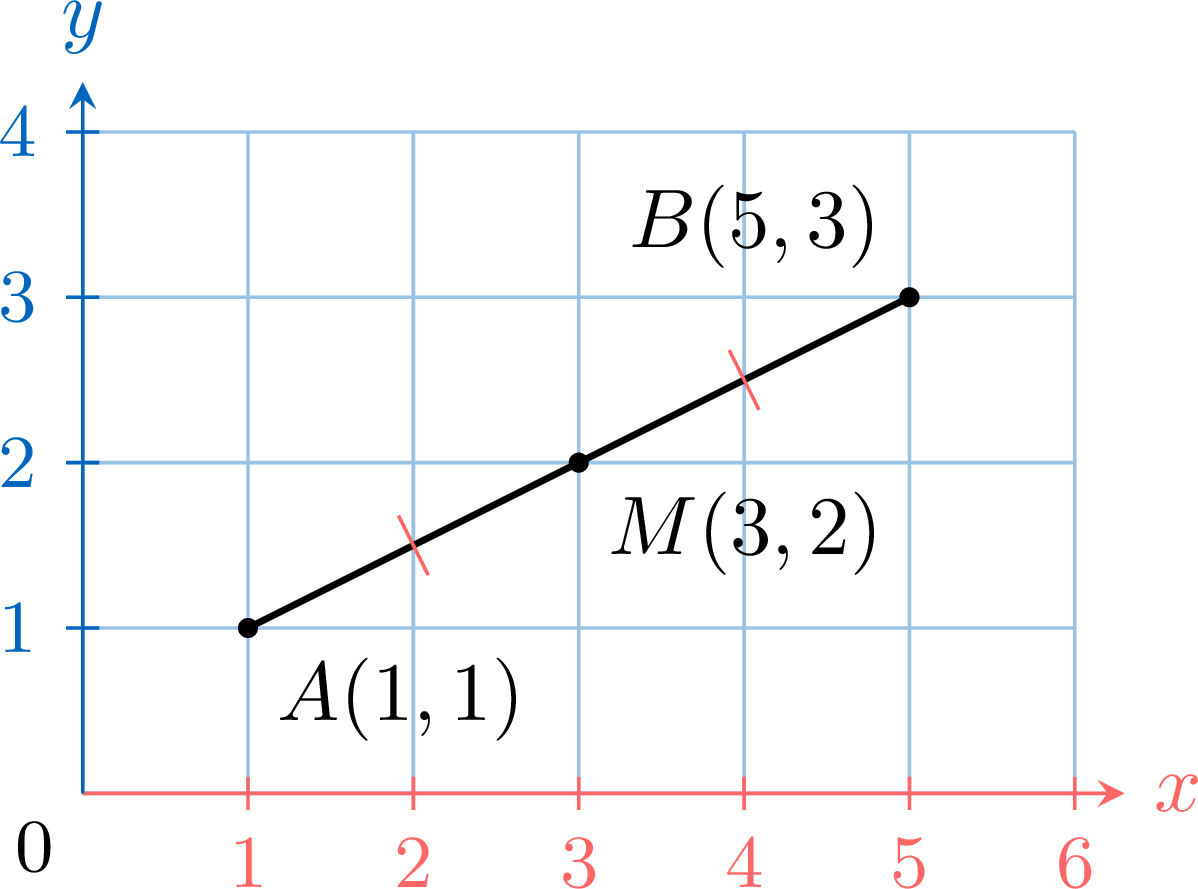
Definition — Perpendicular Bisector
The perpendicular bisector of a line segment is a line that is perpendicular to the segment and passes through its midpoint. 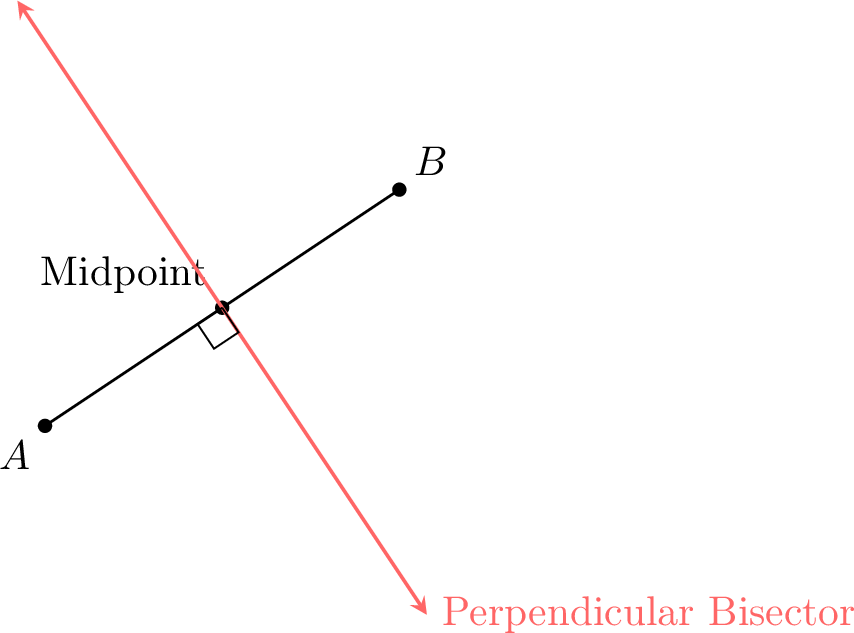
Proposition — Perpendicular bisector and equidistance
The perpendicular bisector of a segment \(\Segment{AB}\) is the set of all the points at the same distance from \(A\) and from \(B\). In other words, a point \(M\) lies on the perpendicular bisector of \(\Segment{AB}\) if and only if \(MA = MB\). 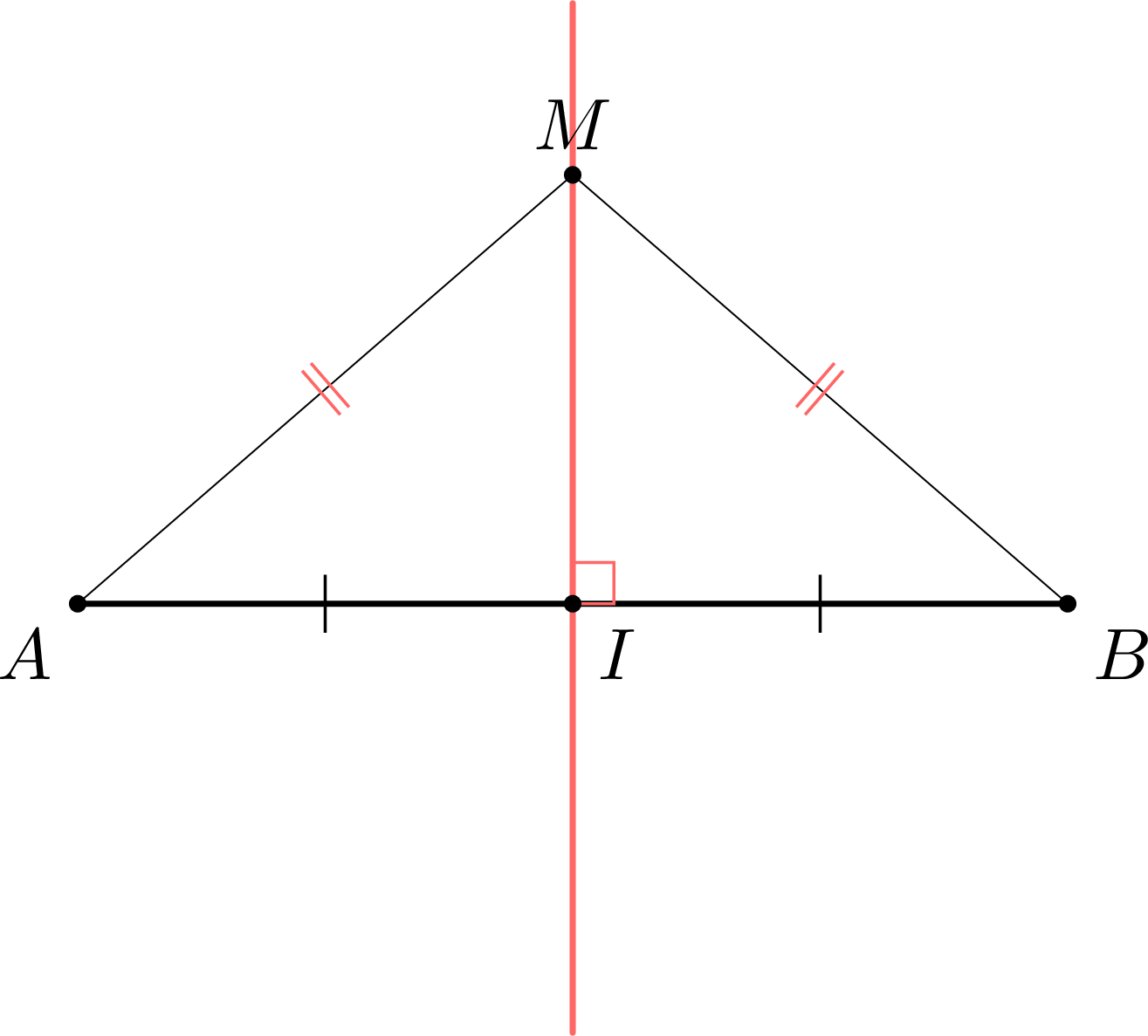
The perpendicular bisector passes through the midpoint \(I\) of \(\Segment{AB}\) (so \(IA = IB\)) and is perpendicular to \(\Segment{AB}\). Folding the figure along this line therefore brings \(A\) exactly onto \(B\).
- If \(M\) is on the line, the fold leaves \(M\) in place and carries \(\Segment{MA}\) onto \(\Segment{MB}\), so \(MA = MB\).
- If \(M\) is not on the line, it lies on \(A\)'s side or on \(B\)'s side, and it is then closer to the point on its own side: \(MA \neq MB\). This second point, the converse, is accepted without proof here — folding sends \(M\) to another point \(M'\), but that is not enough to compare \(MA\) and \(MB\); its proof goes through the triangle inequality.
Method — Finding the Equation of a Perpendicular Bisector
To find the equation of the perpendicular bisector of the segment joining \(A(x_A, y_A)\) and \(B(x_B, y_B)\) (with \(A \neq B\)): - Find the gradient of the segment \(\Segment{AB}\) (when \(x_A \neq x_B\)): $$ m_{AB} = \frac{y_B - y_A}{x_B - x_A}. $$
- Find the gradient of the perpendicular line (\(m_\perp\)) when \(m_{AB} \neq 0\): $$ m_\perp = -\frac{1}{m_{AB}}. $$
- Find the midpoint of \(\Segment{AB}\): $$ M = \left(\frac{x_A+x_B}{2}, \frac{y_A+y_B}{2}\right). $$
- Use the point-gradient form with the midpoint \(M(x_M,y_M)\) and the perpendicular gradient \(m_\perp\): $$ y - y_M = m_\perp(x - x_M). $$
- If \(\Segment{AB}\) is horizontal (\(m_{AB}=0\)), then the perpendicular bisector is a vertical line \(x = x_M\).
- If \(\Segment{AB}\) is vertical (\(x_A = x_B\)), then the perpendicular bisector is a horizontal line \(y = y_M\).
Example
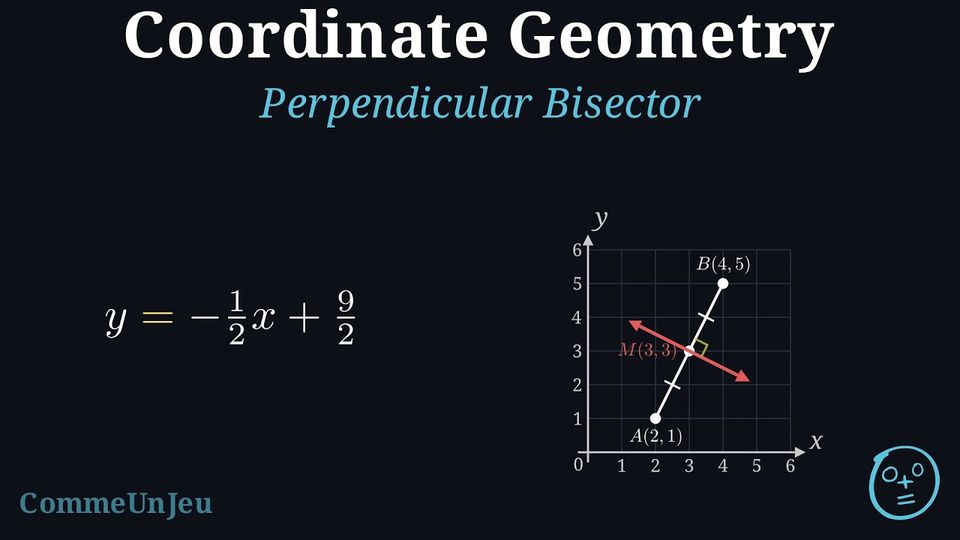
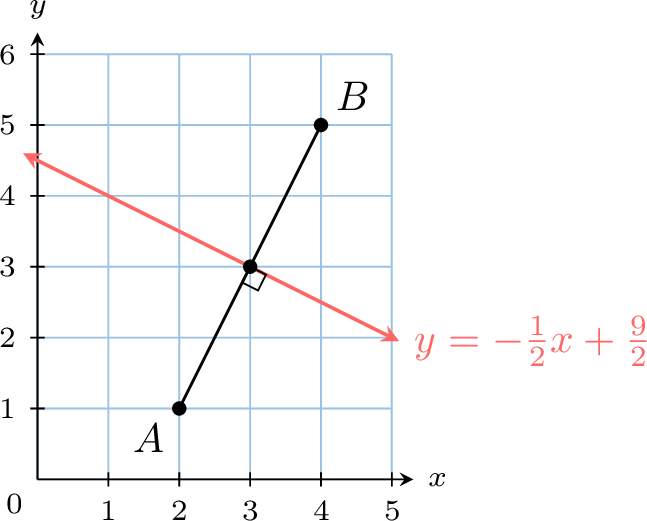
Find the equation of the perpendicular bisector of the line segment with endpoints \(A(2, 1)\) and \(B(4, 5)\). - The gradient of the segment \(\Segment{AB}\) is$$m_{AB} = \frac{5-1}{4-2} = \frac{4}{2} = 2.$$
- The gradient of the perpendicular bisector is \(m_\perp = -\dfrac{1}{2}\).
- The midpoint of \(\Segment{AB}\) is$$M = \left(\frac{2+4}{2}, \frac{1+5}{2}\right) = (3, 3).$$
- Using the point-gradient form \(y-y_1 = m(x-x_1)\) with the point \((3,3)\) and the gradient \(-\dfrac{1}{2}\): $$ \begin{aligned} y-3 &= -\frac{1}{2}(x-3) \\ y-3 &= -\frac{1}{2}x + \frac{3}{2} \\ y &= -\frac{1}{2}x + \frac{3}{2} + 3 \\ y &= -\frac{1}{2}x + \frac{9}{2}. \end{aligned} $$
Skills to practice
- Computing Midpoints and Perpendicular Bisectors
- Justifying Midpoints and Perpendicular Bisectors
III
Simultaneous Equations
III.1
The Intersection of Two Lines
Recappreviously studied — click to reread
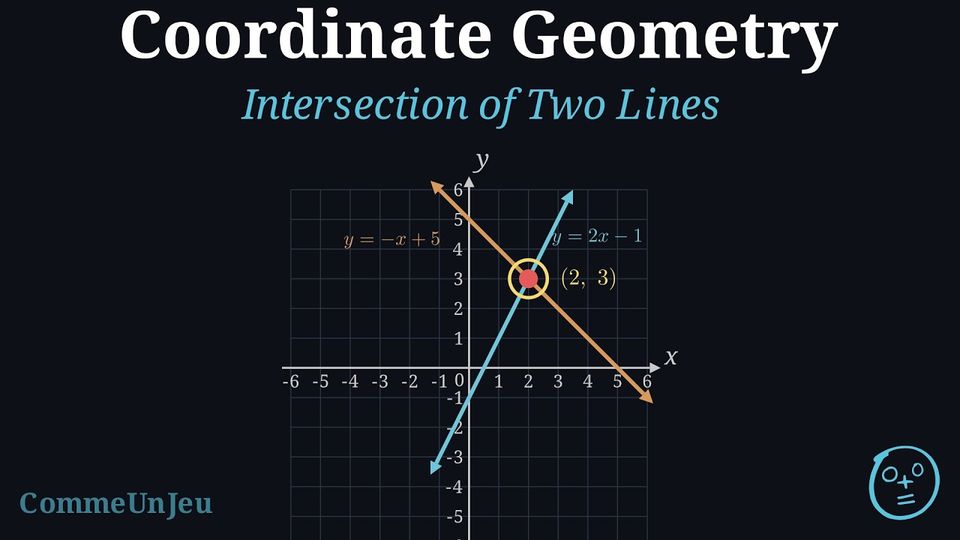
Definition — Intersection of Lines
The intersection of two non-parallel lines is the single point where they cross or meet. The coordinates of this point must satisfy the equations of both lines. If two lines are parallel and distinct, they have no point of intersection; if they have the same equation, they intersect at infinitely many points (they are the same line). 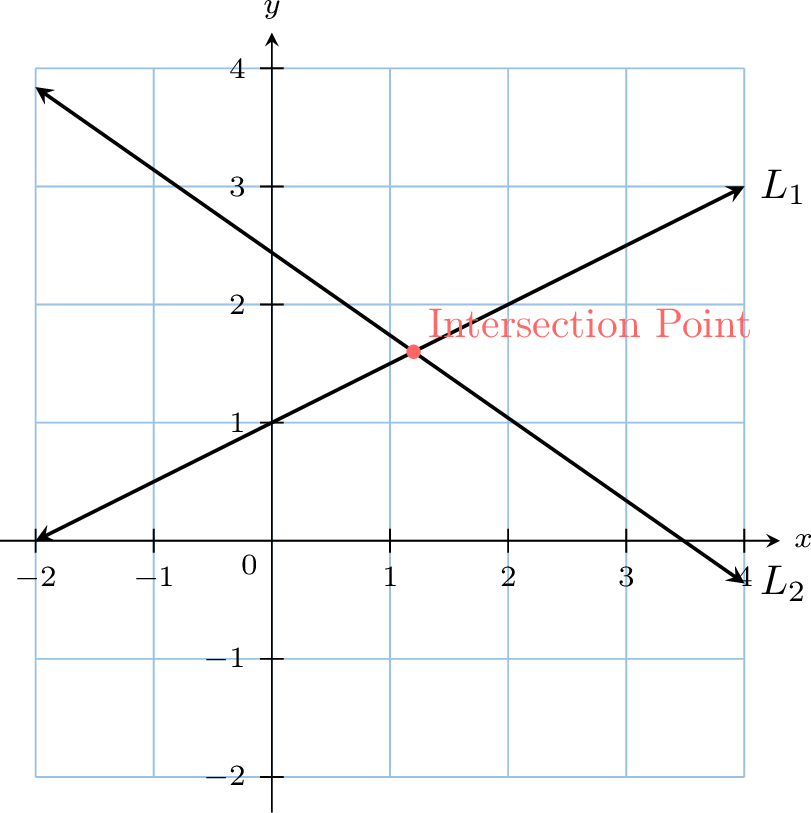
Proposition — Parallel or Intersecting Lines
Two lines of the plane that are not parallel are intersecting: they have exactly one point of intersection. - The non-vertical lines \(y = m_1x + c_1\) and \(y = m_2x + c_2\) intersect if and only if \(m_1 \neq m_2\).
- A vertical line \(x = k\) and a non-vertical line \(y = mx + c\) always intersect: they meet at the point \((k, mk + c)\).
Method — Finding the Intersection of Two Lines
To find the point of intersection of two lines given by \(y = m_1x + c_1\) and \(y = m_2x + c_2\): - Check the gradients.
- If \(m_1 = m_2\) and \(c_1 \neq c_2\), the lines are parallel and there is no point of intersection.
- If \(m_1 = m_2\) and \(c_1 = c_2\), the lines coincide and have infinitely many common points.
- If \(m_1 \neq m_2\), continue to the next steps.
- Set the expressions for \(y\) equal to each other, since at the intersection point, the \(y\)-coordinates are the same: $$ m_1x + c_1 = m_2x + c_2. $$ (If one of the lines is vertical, \(x = k\), substitute \(x = k\) into the other equation instead.)
- Solve for \(x\). This will give the \(x\)-coordinate of the intersection.
- Substitute the value of \(x\) back into either of the original line equations to find the corresponding \(y\)-coordinate.
Example
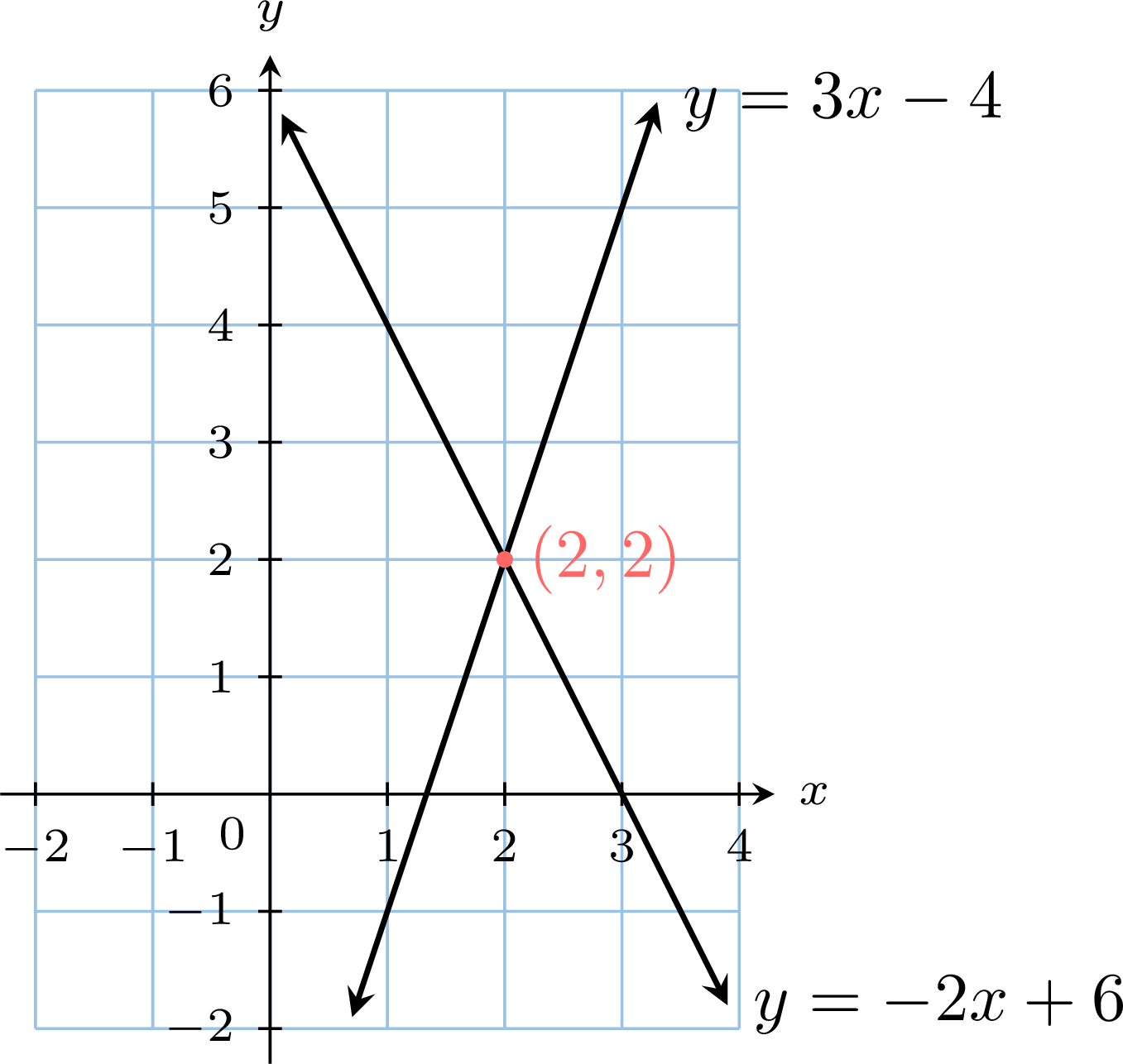
Find the point of intersection of the lines \(y=3x-4\) and \(y=-2x+6\). - Set the expressions for \(y\) equal to each other: $$ 3x-4 = -2x+6. $$
- Solve for \(x\): $$ \begin{aligned} 3x + 2x &= 6 + 4 \\ 5x &= 10 \\ x &= 2. \end{aligned} $$
- Substitute \(x=2\) into either equation to find \(y\): $$ y = 3(2) - 4 = 6-4 = 2. $$
Example
Determine the point of intersection of the lines \(d\) with equation \(x = -2\) and \(d'\) with equation \(y = 3x + 4\).
The line \(d\) is vertical and the line \(d'\) is not: they meet at exactly one point \(M\). Every point of \(d\) has \(x\)-coordinate \(-2\), so \(M\) has \(x\)-coordinate \(-2\), and its \(y\)-coordinate is given by the equation of \(d'\): $$\begin{aligned} y &= 3 \times (-2) + 4 && \text{(substitute } x = -2 \text{ into } y = 3x + 4\text{)}\\
&= -6 + 4 \\
&= -2 \end{aligned}$$ The lines intersect at \(M(-2, -2)\). Check: \(M\) lies on \(d\) (its \(x\)-coordinate is \(-2\)) and on \(d'\), since \(3 \times (-2) + 4 = -2\). 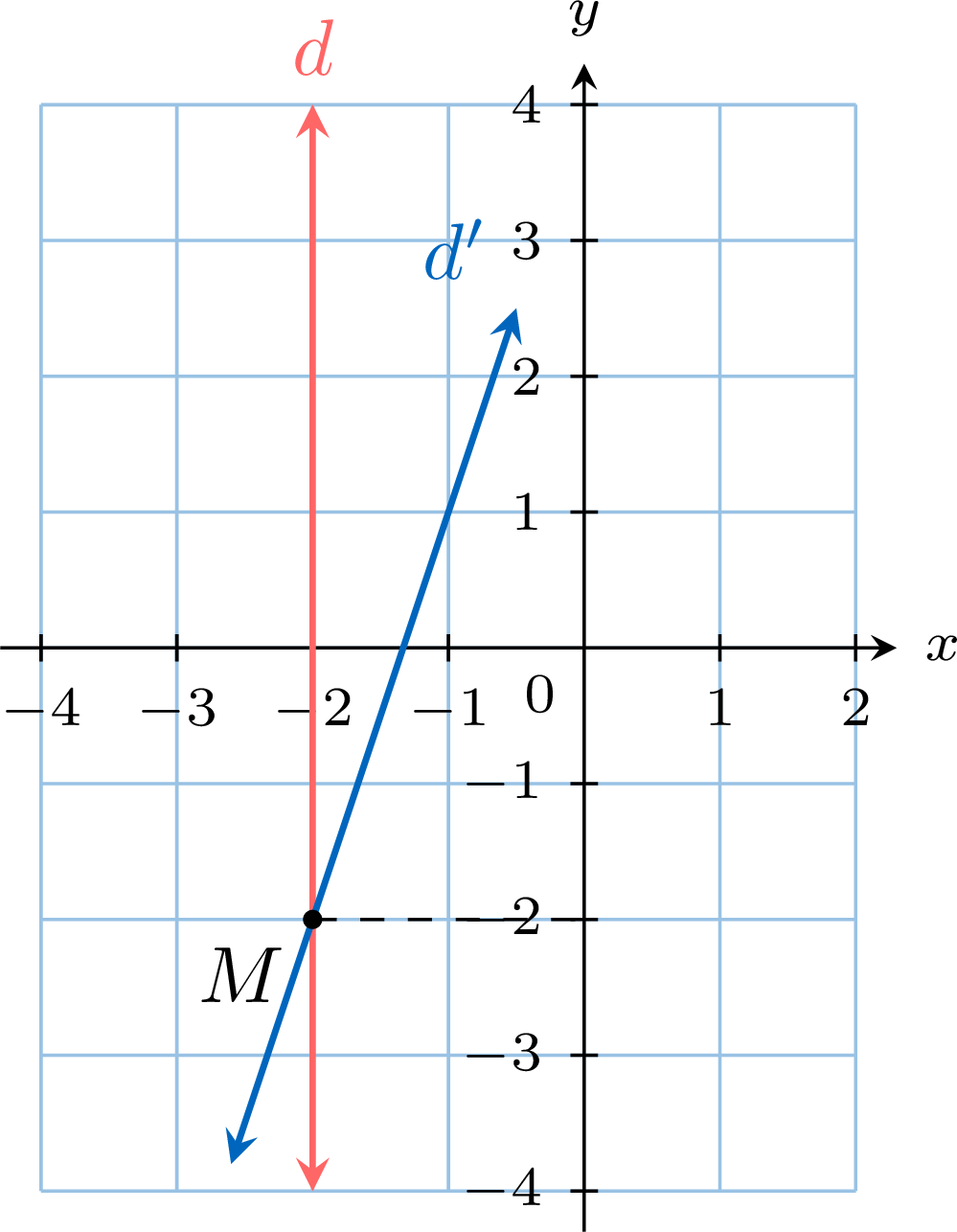
Skills to practice
- Finding the Intersection of Two Lines
- Justifying and Finding the Intersection Point
III.2
Solving Simultaneous Equations Algebraically
Recappreviously studied — click to reread
Definition — System of Two Equations
Two equations in the same two unknowns, to be satisfied at the same time, form a system of two equations, also called simultaneous equations. The system is written with a brace: $$\begin{cases} x + y = 26 \\
2x + 3y = 61 \end{cases}$$ A solution of the system is a pair \((x, y)\) that is a solution of each of the two equations. To solve the system is to find all its solutions. Proposition — Graphical Meaning of a System
Consider a system whose two equations can be rearranged in the forms \(y = m_1x + c_1\) and \(y = m_2x + c_2\). In a coordinate plane, each of them is the equation of a line. A pair \((x, y)\) is a solution of the system if and only if the point with coordinates \((x, y)\) lies on both lines: the solutions of the system are the coordinates of the intersection points of the two lines. 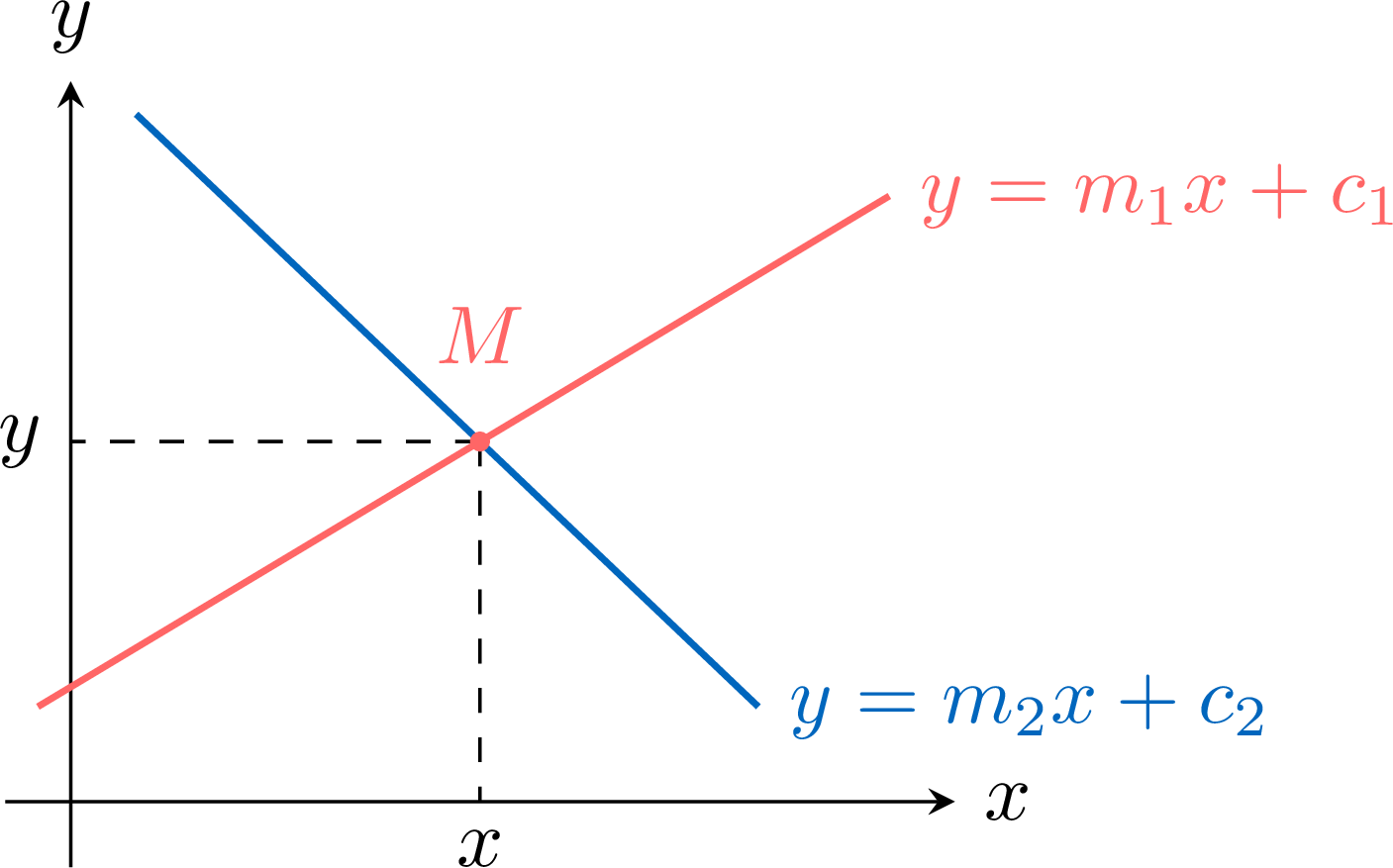
Rearranging an equation with balance moves does not change its solutions, so the system has the same solutions as \(\begin{cases} y = m_1x + c_1 \\ y = m_2x + c_2 \end{cases}\). Let \(M\) be the point with coordinates \((x, y)\). By the definition of the equation of a line, \(M\) lies on the first line if and only if \(y = m_1x + c_1\) is true, and \(M\) lies on the second line if and only if \(y = m_2x + c_2\) is true. Hence \(M\) lies on both lines if and only if \((x, y)\) satisfies both equations, that is, if and only if \((x, y)\) is a solution of the system.
Method — Solving by Substitution
- Isolate one unknown in one of the equations: preferably an unknown whose coefficient is \(1\) or \(-1\), which avoids fractions.
- Substitute: in the other equation, replace this unknown by the expression found, written between brackets.
- Solve the equation obtained: it has only one unknown.
- Back-substitute: replace the value found in the expression of step 1 to get the other unknown.
- Check the pair in both original equations, then conclude.
Example
Solve the system \(\begin{cases} x - 2y = 1 \\ 3x + 4y = 23 \end{cases}\).
The unknown \(x\) has coefficient \(1\) in the first equation, so it is isolated there: adding \(2y\) to both sides gives \(x = 1 + 2y\). It is substituted into the second equation, with brackets: $$\begin{aligned}[t] 3(1 + 2y) + 4y &= 23 && \text{(replace } x \text{ by } 1 + 2y\text{)} \\
3 + 6y + 4y &= 23 && \text{(expand)} \\
3 + 10y &= 23 && \text{(collect the like terms)} \\
10y &= 20 && \text{(subtract } 3 \text{ from both sides)} \\
y &= 2 && \text{(divide both sides by } 10\text{)} \end{aligned}$$ Then \(x = 1 + 2 \times 2 = 5\). Check: \(5 - 2 \times 2 = 1\) and \(3 \times 5 + 4 \times 2 = 15 + 8 = 23\), both true. The solution is the pair \((5, 2)\). Without the brackets, \(3 \times 1 + 2y\) would multiply only the \(1\) by \(3\).
Proposition — Combining Two Equations
If a pair \((x, y)\) satisfies two equations \(A = B\) and \(C = D\), then it also satisfies: - \(A + C = B + D\) and \(A - C = B - D\): the two equations can be added or subtracted side by side;
- \(kA = kB\) for any number \(k\): an equation can be multiplied by a number.
Suppose that the pair \((x, y)\) satisfies \(A = B\) and \(C = D\): with these values of \(x\) and \(y\), the expressions \(A\) and \(B\) are the same number, and so are \(C\) and \(D\). Then $$\begin{aligned}[t] A + C &= B + C && \text{(since } A = B\text{)} \\
&= B + D && \text{(since } C = D\text{)} \end{aligned}$$ In the same way, \(A - C = B - C = B - D\). Finally, multiplying the same number, \(A = B\), by \(k\) gives the same product: \(kA = kB\). So the pair satisfies the three new equations.
Method — Solving by Elimination
- Write both equations in the form \(ax + by = c\), with the unknowns lined up.
- Choose the unknown to eliminate. If needed, multiply one equation, or both, by nonzero numbers so that the two coefficients of this unknown become opposite (or equal).
- Add the two equations when these coefficients are opposite, subtract them when they are equal: the chosen unknown disappears.
- Solve the equation obtained, which has only one unknown.
- Back-substitute the value found in one of the original equations to find the other unknown.
- Check the pair in both original equations, then conclude. When the combinations lead to one value of each unknown, they only show that no other pair is possible; the check shows that this pair is indeed a solution. When both unknowns disappear, the Method “Recognising the Case While Solving” applies.
Example
Solve the system \(\begin{cases} 3x + 2y = 12 \\ 5x - 3y = 1 \end{cases}\).
No coefficient is \(1\) or \(-1\), so elimination avoids fractions. To eliminate \(y\), whose coefficients are \(2\) and \(-3\), the first equation is multiplied by \(3\) and the second by \(2\): the coefficients of \(y\) become \(6\) and \(-6\), which are opposite. $$\begin{aligned}[t] 9x + 6y &= 36 && \text{(first equation multiplied by } 3\text{)} \\
10x - 6y &= 2 && \text{(second equation multiplied by } 2\text{)} \\
19x &= 38 && \text{(add the two new equations)} \\
x &= 2 && \text{(divide both sides by } 19\text{)} \end{aligned}$$ Back-substituting in the first equation, \(3 \times 2 + 2y = 12\), so \(2y = 6\) and \(y = 3\). Check: \(3 \times 2 + 2 \times 3 = 12\) and \(5 \times 2 - 3 \times 3 = 1\), both true. The solution is the pair \((2, 3)\). Eliminating \(x\) first, with the multipliers \(5\) and \(3\) and a subtraction, gives the same pair.
Method — Choosing a Method
- First tidy each equation: expand the brackets, clear fractions or decimals by multiplying both sides by a suitable number, and bring the unknowns to the left-hand side.
- If an unknown has coefficient \(1\) or \(-1\), or if an equation already gives \(y = \ldots\) or \(x = \ldots\), substitution is quick.
- If no coefficient is \(1\) or \(-1\), or if two coefficients of the same unknown are already equal or opposite, elimination avoids fractions.
- Both methods give the same solutions, whether there is one, none or infinitely many: the choice only changes the amount of computation. A graph gives a picture of the solution and a reading of it; only a check by calculation shows that a pair read is exact.
Skills to practice
- Solving Systems with Any Method
III.3
The Number of Solutions
Recappreviously studied — click to reread
Solving \(\begin{cases} x - 2y = 5 \\ x - 2y = 7 \end{cases}\) by subtraction removes \(x\) and \(y\) at the same time and leaves \(0 = -2\): false, whatever the pair. Solving \(\begin{cases} x - 2y = 5 \\ 2x - 4y = 10 \end{cases}\) after multiplying the first equation by \(2\) also removes both unknowns, and leaves \(0 = 0\): an equality that no longer says anything about \(x\) and \(y\). In the first case no pair can be a solution; in the second one, which pairs are solutions? The two lines of a system explain what happens.
Proposition — Number of Solutions of a System
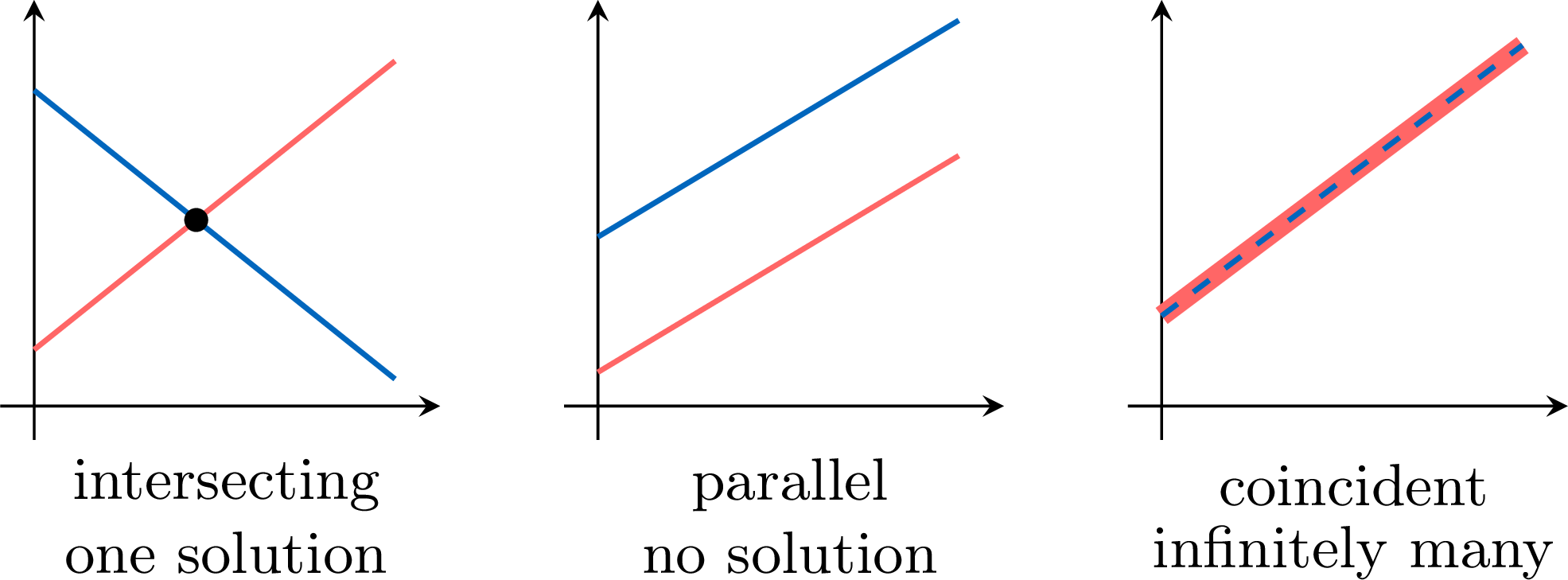
Consider a system whose equations can be rearranged as \(y = m_1x + c_1\) and \(y = m_2x + c_2\), where \(m_1\) and \(m_2\) are the gradients (also called slopes) of the two lines. - If \(m_1 \neq m_2\), the lines are intersecting: the system has exactly one solution.
- If \(m_1 = m_2\) and \(c_1 \neq c_2\), the lines are parallel and distinct: the system has no solution.
- If \(m_1 = m_2\) and \(c_1 = c_2\), the lines are coincident (they are the same line): the system has infinitely many solutions, all the pairs \((x, m_1x + c_1)\).
A solution \((x, y)\) satisfies \(y = m_1x + c_1\) and \(y = m_2x + c_2\), so the two expressions of \(y\) are equal: $$\begin{aligned}[t] m_1x + c_1 &= m_2x + c_2 && \text{(both are equal to } y\text{)} \\
m_1x - m_2x + c_1 &= c_2 && \text{(subtract } m_2x \text{ from both sides)} \\
m_1x - m_2x &= c_2 - c_1 && \text{(subtract } c_1 \text{ from both sides)} \\
(m_1 - m_2)x &= c_2 - c_1 && \text{(factorise by } x\text{)} \end{aligned}$$
- If \(m_1 \neq m_2\), then \(m_1 - m_2 \neq 0\), and dividing by it gives the single value \(x = \dfrac{c_2 - c_1}{m_1 - m_2}\), then the single value \(y = m_1x + c_1\). For this \(x\) the two expressions of \(y\) are equal, so this pair satisfies both equations: exactly one solution.
- If \(m_1 = m_2\), the last equation reads \(0 \times x = c_2 - c_1\). When \(c_1 \neq c_2\), it is false for every \(x\): no solution. When \(c_1 = c_2\), the two equations are the same equation, and every pair \((x, m_1x + c_1)\) satisfies both: infinitely many solutions.
Method — Recognising the Case While Solving
When substitution or elimination makes both unknowns disappear: - a false equality, such as \(0 = -2\), means that no pair is a solution: the lines are parallel and distinct;
- an equality that is always true, such as \(0 = 0\), means that the two equations describe the same line: the solutions are all the pairs \((x, y)\) satisfying one of the equations, written \(y = mx + c\).
Example
Solve each system, then interpret the result with the two lines. - \(\begin{cases} 2x - y = 3 \\ -4x + 2y = 1 \end{cases}\)
- \(\begin{cases} x + 3y = 6 \\ 2x + 6y = 12 \end{cases}\)
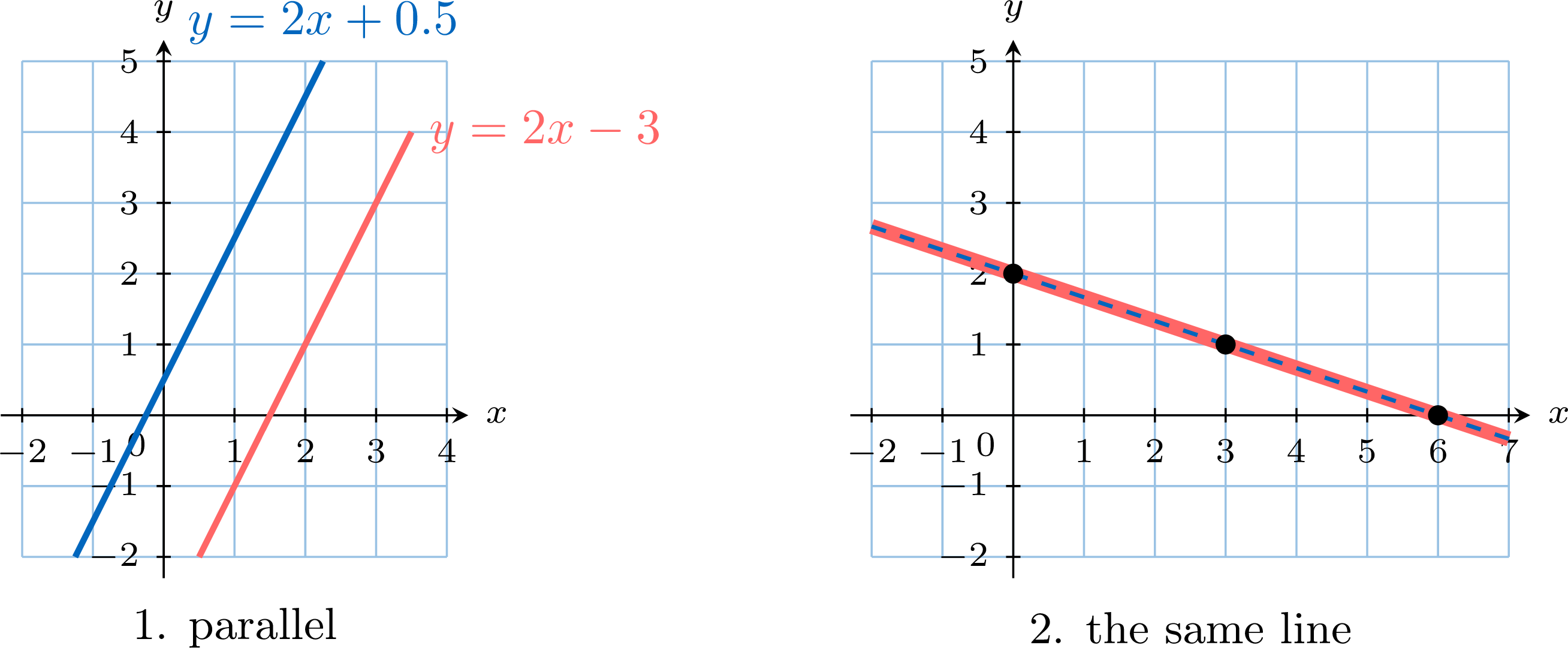
- Multiplying the first equation by \(2\) makes the coefficients of \(x\) opposite: $$\begin{aligned}[t] 4x - 2y &= 6 && \text{(first equation multiplied by } 2\text{)} \\ 0 &= 7 && \text{(add the second equation)} \end{aligned}$$ The equality \(0 = 7\) is false: the system has no solution. Indeed, the equations rearrange as \(y = 2x - 3\) and \(y = 2x + 0.5\): the same gradient \(2\), different \(y\)-intercepts. The lines are parallel and distinct.
- Multiplying the first equation by \(2\) gives \(2x + 6y = 12\), exactly the second equation: subtracting leaves \(0 = 0\), always true. The system has infinitely many solutions: the two equations describe the same line, \(y = -\dfrac{1}{3}x + 2\). The solutions are all the pairs \(\left(x, -\dfrac{1}{3}x + 2\right)\), for example \((0, 2)\), \((3, 1)\) and \((6, 0)\).
Skills to practice
- Predicting the Number of Solutions
III.4
Solving Problems with a System
Recappreviously studied — click to reread
Method — Solving a Problem with a System
- Choose the unknowns: name them with letters, and state what each one represents, with its unit.
- Translate each piece of information of the statement into an equation.
- Solve the system, by the method of your choice.
- Check the values in the statement itself, not only in the equations: a mistake made while translating survives a check in the equations.
- Answer the question with a sentence and the units, after making sure that the values make sense (whole numbers of people, prices that are not negative, …).
Example
For a school play, an adult ticket costs \(\dollar 8\) and a pupil ticket costs \(\dollar 5\). In all, \(150\) tickets were sold, for \(\dollar 921\). How many adult tickets and how many pupil tickets were sold?
Unknowns: \(x\) is the number of adult tickets, \(y\) the number of pupil tickets.
Equations: \(150\) tickets in all gives \(x + y = 150\); the takings of \(\dollar 921\) give \(8x + 5y = 921\).
Solving: the first equation gives \(y = 150 - x\), substituted into the second one: $$\begin{aligned}[t] 8x + 5(150 - x) &= 921 && \text{(replace } y \text{ by } 150 - x\text{)} \\ 8x + 750 - 5x &= 921 && \text{(expand)} \\ 3x + 750 &= 921 && \text{(collect the like terms)} \\ 3x &= 171 && \text{(subtract } 750 \text{ from both sides)} \\ x &= 57 && \text{(divide both sides by } 3\text{)} \end{aligned}$$ Then \(y = 150 - 57 = 93\).
Check in the statement: \(57 + 93 = 150\) tickets, and \(8 \times 57 + 5 \times 93 = 456 + 465 = 921\) dollars.
Answer: \(57\) adult tickets and \(93\) pupil tickets were sold.
Example
Plumber A charges a call-out fee of \(\dollar 40\) plus \(\dollar 30\) per hour of work. Plumber B charges a call-out fee of \(\dollar 20\) plus \(\dollar 35\) per hour. - Write the cost \(y\), in dollars, of \(x\) hours of work with each plumber.
- For how many hours of work do the two plumbers charge the same price? What is this price?
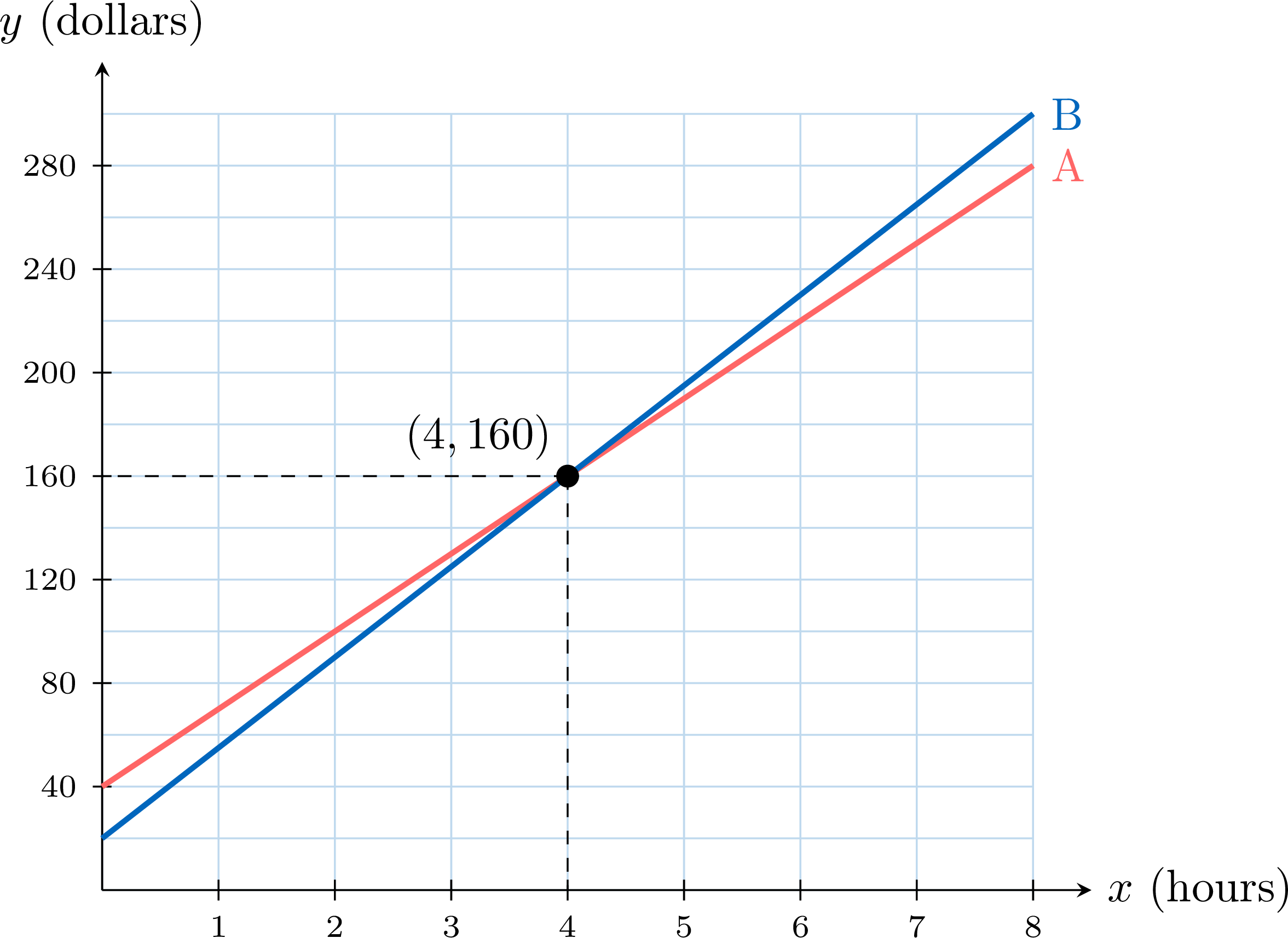
- Draw the two lines for \(0 \le x \le 8\) in the same coordinate plane, and read the answer: which plumber is cheaper for \(6\) hours of work?
- Plumber A: \(y = 30x + 40\). Plumber B: \(y = 35x + 20\).
- The same price for the same number of hours means a solution of the system \(\begin{cases} y = 30x + 40 \\ y = 35x + 20 \end{cases}\). Equating the two expressions of \(y\): $$\begin{aligned}[t] 30x + 40 &= 35x + 20 && \text{(both are equal to } y\text{)} \\ 40 &= 5x + 20 && \text{(subtract } 30x \text{ from both sides)} \\ 20 &= 5x && \text{(subtract } 20 \text{ from both sides)} \\ x &= 4 && \text{(divide both sides by } 5\text{)} \end{aligned}$$ Then \(y = 30 \times 4 + 40 = 160\). Check: \(35 \times 4 + 20 = 160\) as well. For \(4\) hours of work, both plumbers charge \(\dollar 160\).
- The two lines are drawn below, each from two of its points: \((0, 40)\) and \((8, 280)\) for plumber A, \((0, 20)\) and \((8, 300)\) for plumber B. Their intersection point is \((4, 160)\). To its right, the line of plumber A is below the line of plumber B: for more than \(4\) hours, plumber A is cheaper. For \(6\) hours: \(30 \times 6 + 40 = 220\) against \(35 \times 6 + 20 = 230\), so plumber A is cheaper, by \(\dollar 10\).
Skills to practice
- Solving Problems with a System
III.5
Solving Simultaneous Equations with Technology
Factorisation, completing the square and the quadratic formula give the roots of every quadratic equation exactly. Many equations are out of their reach: the equation \(x^3 - 3x + 1 = 0\) has three real solutions, and none of these methods finds them. A graphing calculator, or graphing software, finds such solutions numerically. It draws graphs and locates the points where a graph crosses the \(x\)-axis or another graph, and its solvers return the roots of a polynomial equation and the solution of a system of linear equations. Its answers are in general decimal approximations, displayed with many digits.
Menu names differ from one model to another: each Method gives its steps in words, with a mock-up of what the screen displays. Unless a question says otherwise, a value that is not exact is given to 3 significant figures, counted from the first non-zero digit: \(2.2573340 \approx 2.26\), \(0.0283416 \approx 0.0283\) and \(31.962 \approx 32.0\).
Menu names differ from one model to another: each Method gives its steps in words, with a mock-up of what the screen displays. Unless a question says otherwise, a value that is not exact is given to 3 significant figures, counted from the first non-zero digit: \(2.2573340 \approx 2.26\), \(0.0283416 \approx 0.0283\) and \(31.962 \approx 32.0\).
Method — Solving an Equation Graphically with Technology
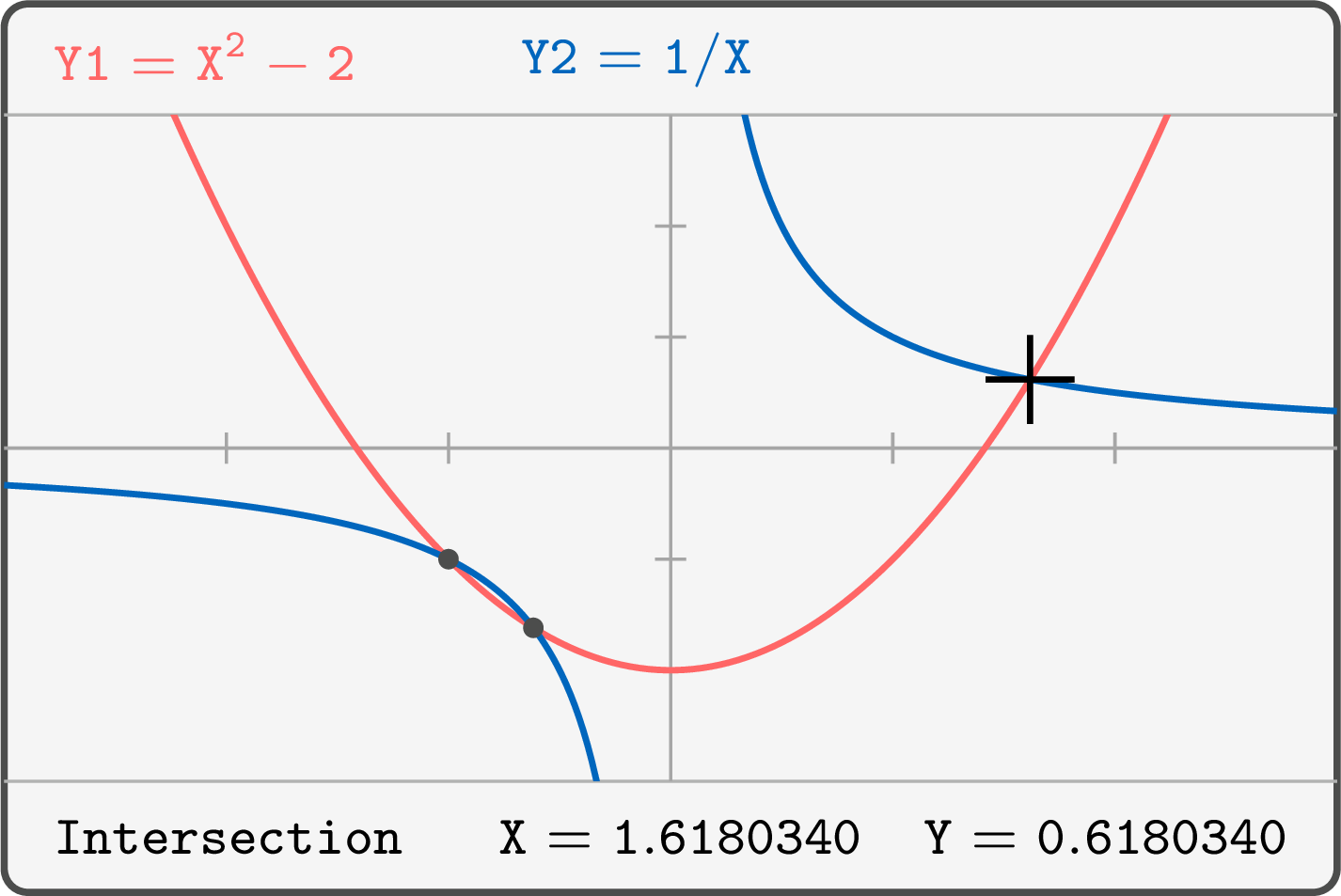
The solutions of an equation \(f(x) = g(x)\) are the \(x\)-coordinates of the points where the graphs of \(f\) and \(g\) meet; the solutions of an equation \(f(x) = 0\) are the \(x\)-intercepts of the graph of \(f\). - Enter each side as a function: \(Y_1 = f(x)\) and \(Y_2 = g(x)\). For an equation \(f(x) = 0\), enter \(f(x)\) alone.
- Choose a window that shows every point of intersection, or every \(x\)-intercept. A table of values of \(f(x) - g(x)\) helps: a change of sign between two consecutive values of \(x\) signals a solution between them, provided the curves have no break between these two values: this holds for polynomials, and for rational functions away from the values that make a denominator zero.
- In the analysis tools of the graph menu, choose intersection (for \(f(x) = 0\): zero), select the curves and give a first guess, or bounds, close to one point. Read the \(x\)-coordinate \(X\) of the point displayed: the \(y\)-coordinate \(Y\) is the common value of the two sides, not a solution.
- Repeat for each point, then report the solutions: exactly when the screen shows an exact value that substitution confirms, otherwise to 3 significant figures.
Example
Use technology to find the point of intersection of the lines with equations \(y = 0.4x + 1.3\) and \(y = -1.7x + 5.2\).
The gradients, \(0.4\) and \(-1.7\), are different: the lines meet at exactly one point. The two equations are entered as \(Y_1 = 0.4x + 1.3\) and \(Y_2 = -1.7x + 5.2\), and graphed in the window \(-2 \le x \le 5\), \(-2 \le y \le 6\). The intersection tool displays \(X = 1.8571429\) and \(Y = 2.0428571\). 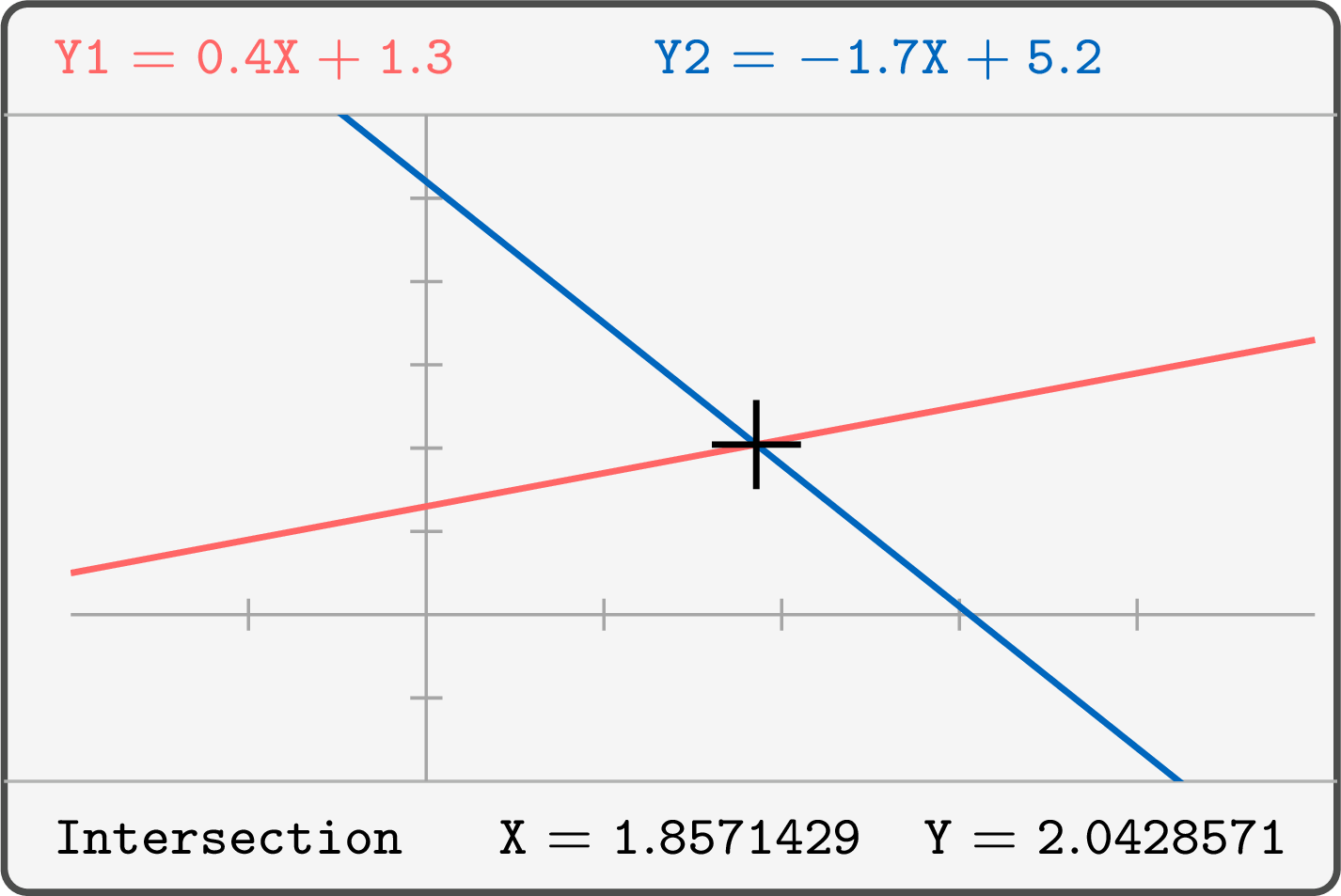
The question asks for a point, so both coordinates are part of the answer: \(Y\) is the \(y\)-coordinate of the point of intersection. (When the question is an equation \(f(x) = g(x)\), only \(X\) is a solution.) To 3 significant figures, the point of intersection is \((1.86, 2.04)\).
Check with the displayed values, which are rounded: \(0.4 \times 1.8571429 + 1.3 \approx 2.04\) and \(-1.7 \times 1.8571429 + 5.2 \approx 2.04\). Equating the two expressions of \(y\) gives \(2.1x = 3.9\): the exact coordinates are \(x = \dfrac{13}{7}\) and \(y = \dfrac{143}{70}\), whose decimal approximations are on the screen.
Check with the displayed values, which are rounded: \(0.4 \times 1.8571429 + 1.3 \approx 2.04\) and \(-1.7 \times 1.8571429 + 5.2 \approx 2.04\). Equating the two expressions of \(y\) gives \(2.1x = 3.9\): the exact coordinates are \(x = \dfrac{13}{7}\) and \(y = \dfrac{143}{70}\), whose decimal approximations are on the screen.
Method — Solving a Linear System with the Equation Solver
The linear system solver, in the equation menu of a graphing calculator, solves a system of two linear equations in two unknowns, or of three linear equations in three unknowns. - Write each equation in the form \(ax + by = c\) (two unknowns) or \(ax + by + cz = d\) (three unknowns): the unknowns on the left, in the same order in every equation, and the constant on the right.
- Open the linear system solver and choose the number of unknowns.
- Enter the coefficients row by row, one row per equation, each with its sign, and \(0\) for a missing unknown.
- Solve and read the value of each unknown. If the solver reports no solution, or infinitely many, the system has no unique solution.
- Check the solution by substituting it in each original equation, then report each value exactly when the checks hold exactly, otherwise to 3 significant figures.
Example
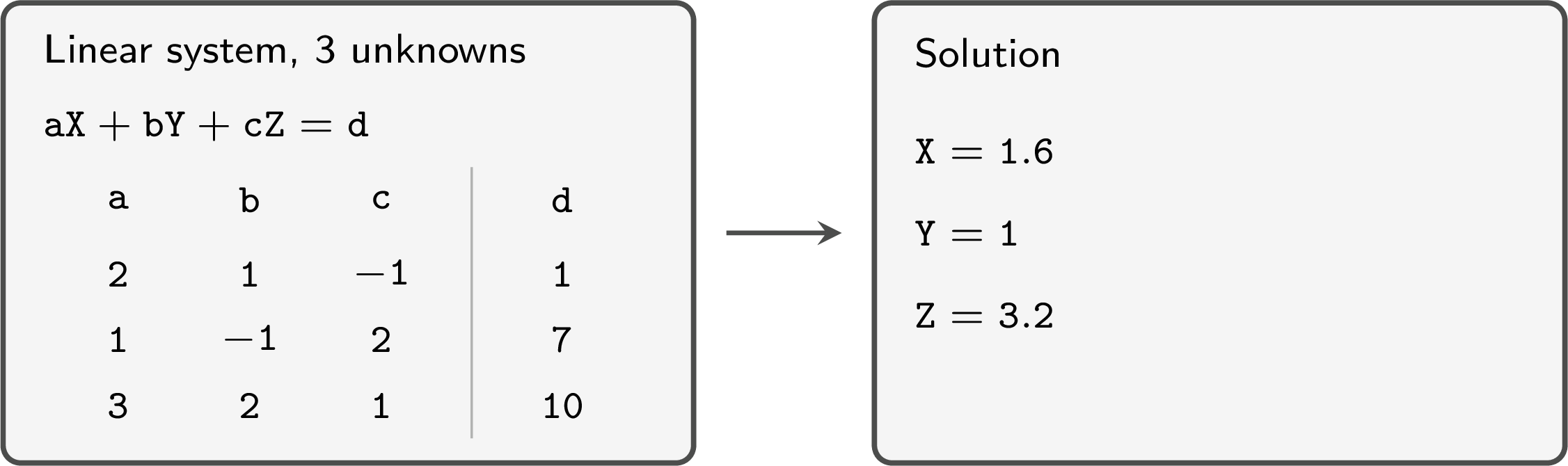
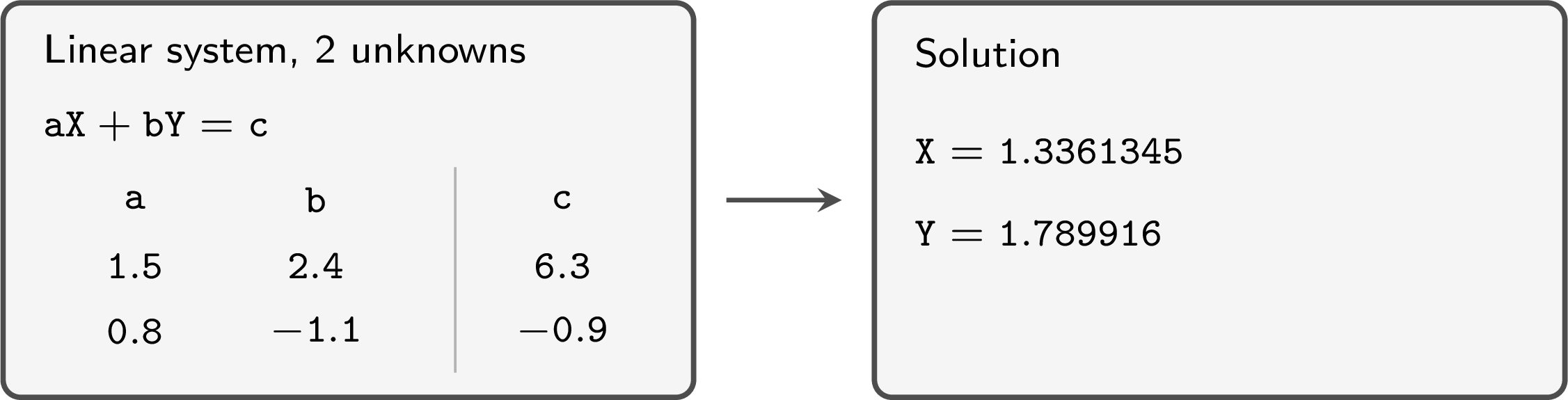
Use technology to answer. - Solve the system \(\begin{cases} 1.5x + 2.4y = 6.3 \\ 0.8x - 1.1y = -0.9 \end{cases}\), and interpret the solution with the two lines.
- For the system \(\begin{cases} 2x - 3y = 4 \\ -4x + 6y = 5 \end{cases}\), the linear system solver reports that there is no solution. Explain this message with the gradients of the two lines.
- Both equations already have the form \(ax + by = c\). The linear system solver, with two unknowns, the coefficients \(1.5\), \(2.4\), \(6.3\) in the first row and \(0.8\), \(-1.1\), \(-0.9\) in the second, displays \(x = 1.3361345\) and \(y = 1.789916\).
- Rearranged in the form \(y = mx + c\), the equations read \(y = \dfrac{2}{3}x - \dfrac{4}{3}\) and \(y = \dfrac{2}{3}x + \dfrac{5}{6}\). The two lines have the same gradient \(\dfrac{2}{3}\) and different \(y\)-intercepts: they are parallel and distinct, so they never meet, and the system has no solution. This is what the solver reports. The left-hand side of the second equation is \(-2\) times that of the first one, while \(5 \neq -2 \times 4\).
Skills to practice
- Intersecting Two Lines with Technology
IV
Going further
Skills to practice
- Setting Up and Solving Simultaneous Equations
- Reasoning and Problem-Solving
- Quiz
Jump to section