International Baccalaureate · DP 1: Applications and Interpretation HL
Logarithms
I
The Logarithm of a Number
I.1
Logarithms in Base 10
Recappreviously studied — click to reread
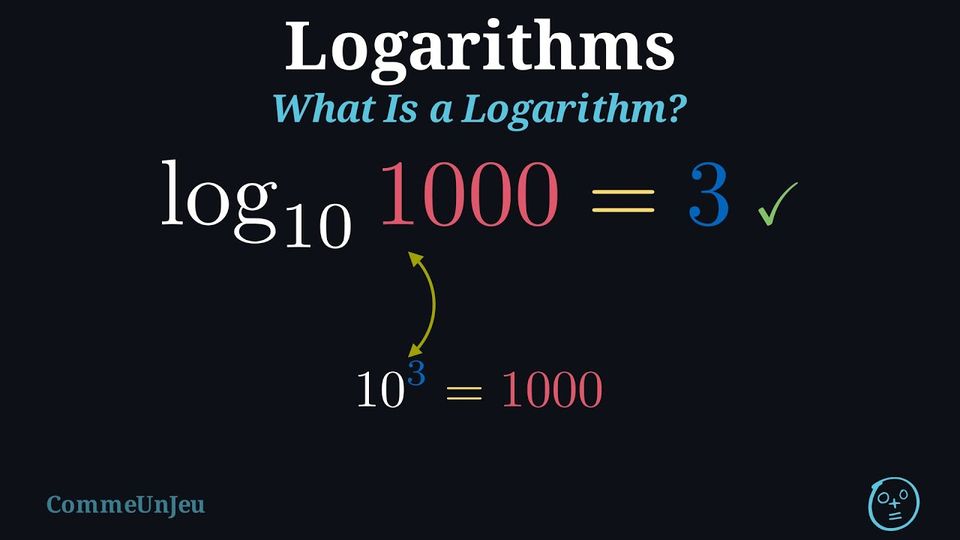
For a power of 10, the logarithm is simply the exponent read off the power. The table below shows this two-way reading:
For example, \(10^{-2} = 0.01\), so \(\log 0.01 = -2\); and \(10^{3} = 1000\), so \(\log 1000 = 3\).
The two operations travel in opposite directions between a number \(y\) and its exponent \(x\): the logarithm extracts the exponent, and raising 10 to a power rebuilds the number. 
| \(y\) | \(0.01\) | \(0.1\) | \(1\) | \(10\) | \(100\) | \(1000\) |
| \(y\) as a power of \(10\) | \(10^{-2}\) | \(10^{-1}\) | \(10^{0}\) | \(10^{1}\) | \(10^{2}\) | \(10^{3}\) |
| \(\log y\) | \(-2\) | \(-1\) | \(0\) | \(1\) | \(2\) | \(3\) |
The two operations travel in opposite directions between a number \(y\) and its exponent \(x\): the logarithm extracts the exponent, and raising 10 to a power rebuilds the number.
Definition — Logarithm
The (base 10) logarithm of a number \(y\) (where \(y > 0\)) is the exponent to which 10 must be raised to obtain \(y\). It is denoted \(\log_{10} y\) and defined by the equivalence: $$\log_{10} y = x \quad \Leftrightarrow \quad 10^x = y$$ As on most calculators and in exams, \(\log_{10} y\) is abbreviated \(\log y\); so \(\log y = \log_{10} y\). In other words, \(\log y\) is the exponent \(x\) such that \(10^x = y\).
Why \(\log 0\) and \(\log(-5)\) are undefined
The logarithm \(\log y\) is defined only for \(y > 0\). Indeed, a power of 10 is always strictly positive: \(10^x > 0\) for every real \(x\). Since no power of 10 equals \(0\) or a negative number, expressions such as \(\log 0\) and \(\log(-5)\) have no value.
Proposition — Inverse Properties of Logarithms
For real numbers: - \(10^{\log x} = x\) for any \(x > 0\),
- \(\log (10^x) = x\) for any real \(x\).
Example
Evaluate \(\log 100\).
\(\begin{aligned}[t]\log(100) &= \log\left(10^{2}\right) &&(100 = 10^2) \\&=2\\\end{aligned}\)
Since \(10^2 = 100\), the logarithm of \(100\) (base 10) is \(2\).
Since \(10^2 = 100\), the logarithm of \(100\) (base 10) is \(2\).
Skills to practice
- Evaluating Logarithms without a Calculator
I.2
Logarithms in Base \(a\)
Recappreviously studied — click to reread
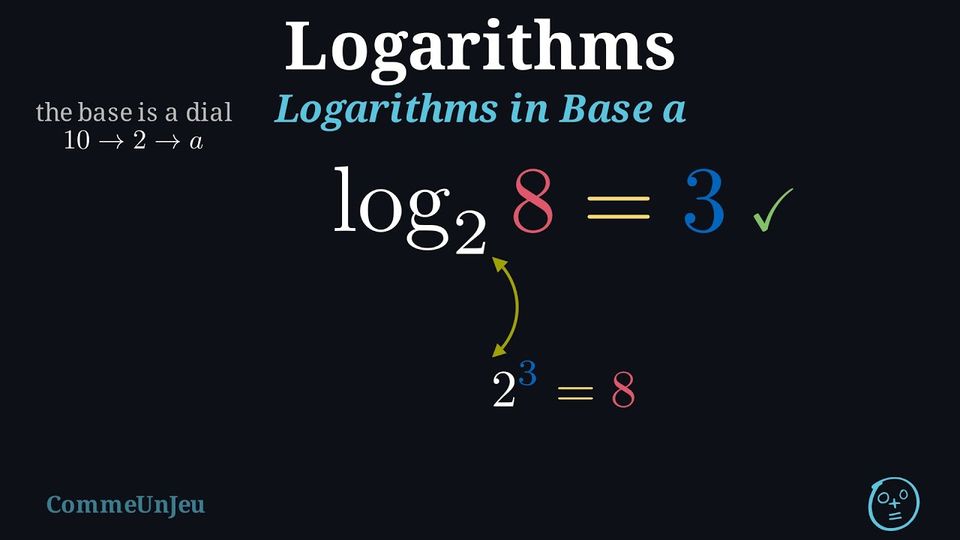
The logarithm in base \(10\) of a number is the exponent to which \(10\) must be raised in order to obtain that number.
We can use the same principle to define logarithms in other bases:
We can use the same principle to define logarithms in other bases:
Definition — Logarithm in Base a
For a positive number \(a \neq 1\), the logarithm base \(a\) of a number \(y\) (where \(y > 0\)) is the exponent to which \(a\) must be raised to obtain \(y\). It is denoted as:$$\log_a y = x \quad \Leftrightarrow \quad a^x = y.$$ Proposition — Inverse Properties of Logarithms in Base a
Let \(a>0\) with \(a\neq 1\). - \(a^{\log_a x} = x\) for any \(x > 0\),
- \(\log_a (a^x) = x\) for any real \(x\).
Example
Evaluate \(\log_2 8\).
\(\begin{aligned}[t]\log_2 8 &= \log_2 (2^3) &&(8 = 2^3)\\&=3\\\end{aligned}\)
Method — Solving Exponential Equations with Base a
To solve \(a^x = b\) (where \(a > 0\), \(a \neq 1\), \(b > 0\)): - Take the logarithm base \(a\) of both sides: \(\log_a (a^x) = \log_a b\)
- Simplify: \(x = \log_a b\)
Example
Solve \(3^x = 81\).
$$\begin{aligned}3^x &= 81 \\
\log_3 (3^x) &= \log_3 (81) &&\text{(applying \(\log_3\) to both sides)}\\
x &= \log_3 (3^4) &&(\log_3(3^x) = x,\ 81 = 3^4)\\
x &= 4\end{aligned}$$
Skills to practice
- Evaluating Logarithms in Base \(a\)
I.3
The Natural Logarithm
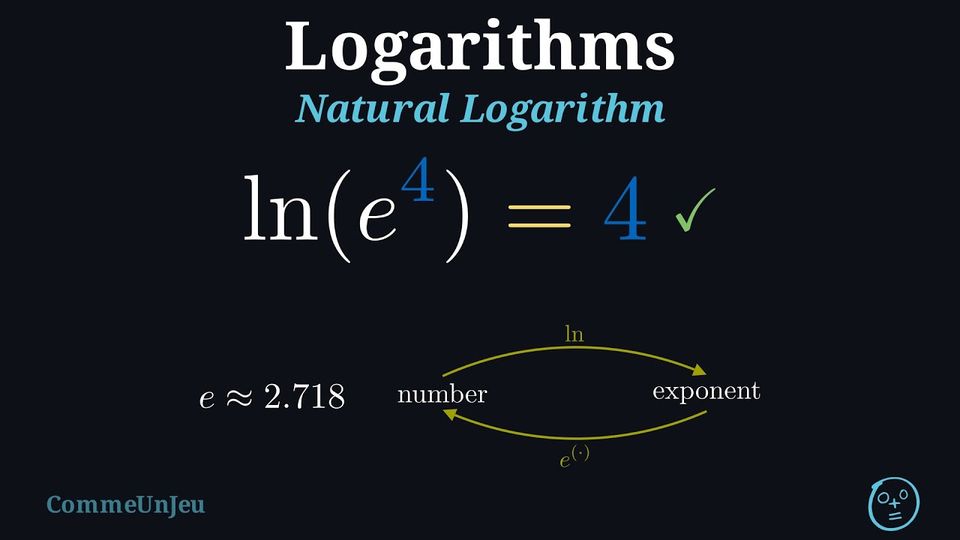
The natural logarithm, often denoted \(\ln x\), is the logarithm with base \(e\) (where \(e \approx 2.71828\) is the base of the natural exponential function). It is the inverse of the exponential function \(e^x\) and plays a central role in calculus, growth models, and many scientific applications.
Definition — Natural Logarithm
The natural logarithm, denoted \(\ln x\), is the logarithm base \(e\), defined for \(x>0\):$$\ln x = \log_e(x).$$ Proposition — Inverse Properties of Natural Logarithms
- \(e^{\ln x} = x\) for \(x > 0\),
- \(\ln (e^x) = x\) for any real \(x\).
Notation. A logarithm always has a base. Three forms are in use:
- \(\log_a x\) — the logarithm in base \(a\) (the base is written explicitly);
- \(\log x = \log_{10} x\) — the base-10 logarithm; as on calculators and in exams, the base 10 is omitted;
- \(\ln x = \log_e x\) — the natural logarithm (base \(e\)).
Skills to practice
- Evaluating Natural Logarithms
II
Laws of Logarithms
II.1
The Laws of Logarithms
Recappreviously studied — click to reread
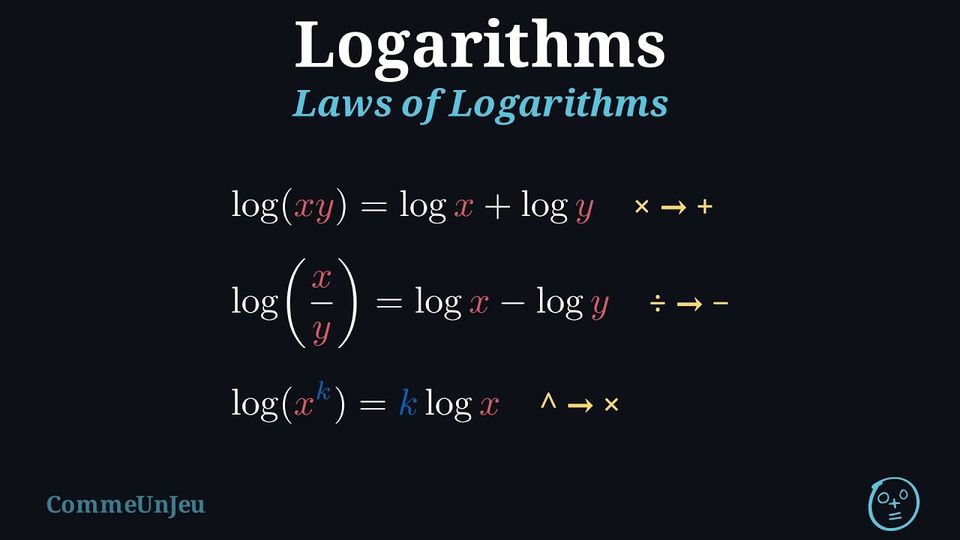
Proposition — Laws of Logarithms
For \(x>0\), \(y>0\), \(a>0\) with \(a\neq 1\), and for any real number \(k\): - Product Rule: \(\log_a (xy) = \log _a x + \log _a y\)
- Quotient Rule: \(\log _a \left(\dfrac{x}{y}\right) = \log _a x - \log_a y\)
- Power Rule: \(\log_a (x^k) = k \log_a x\)
$$\begin{aligned}\log_a(xy) &= \log_a\bigl(a^{\log_a x} \times a^{\log_a y}\bigr) &&(x = a^{\log_a x})\\
&= \log_a\bigl(a^{\log_a x + \log_a y}\bigr) &&\text{(exponent product law)}\\
&= \log_a x + \log_a y &&(\log_a(a^u) = u)\\
\\
\log_a\left(\frac{x}{y}\right) &= \log_a\left(\frac{a^{\log_a x}}{a^{\log_a y}}\right) &&(x = a^{\log_a x})\\
&= \log_a\bigl(a^{\log_a x - \log_a y}\bigr) &&\text{(exponent quotient law)}\\
&= \log_a x - \log_a y &&(\log_a(a^u) = u)\\
\\
\log_a(x^k) &= \log_a\left(\bigl(a^{\log_a x}\bigr)^k\right) &&(x = a^{\log_a x})\\
&= \log_a\bigl(a^{k \log_a x}\bigr) &&\text{(power of a power)}\\
&= k \log_a x\\
\end{aligned}$$
Example
Write as a single logarithm: \(\log (5)+\log (3)\).
\(\begin{aligned}[t]\log (5)+\log (3) &= \log (5\times 3) &&\text{(product rule)} \\&= \log 15\\\end{aligned}\)
Example
For \(a>0\) and \(b>0\), write \(\log\left(\dfrac{a^2 b}{10}\right)\) in terms of \(\log a\) and \(\log b\).
$$\begin{aligned}[t] \log\left(\dfrac{a^2 b}{10}\right) &= \log(a^2 b) - \log 10 &&\text{(quotient rule)}\\
&= \log(a^2) + \log b - \log 10 &&\text{(product rule)}\\
&= 2\log a + \log b - \log 10 &&\text{(power rule)}\\
&= 2\log a + \log b - 1 \end{aligned}$$ The laws also work in this direction: they break a single logarithm into a combination of simpler logarithms.
Skills to practice
- The Laws of Logarithms
II.2
Using the Laws with \(\ln\) and in Base \(a\)
In particular, for the natural logarithm, for \(x>0\) and \(y>0\):
- \(\ln (xy) = \ln x + \ln y\)
- \(\ln \left(\dfrac{x}{y}\right) = \ln x - \ln y\)
- \(\ln (x^k) = k \ln x\)
Example
Evaluate \(\ln \left(e^4\right)\).
\(\begin{aligned}[t]\ln\left(e^4\right) &= 4 \ln e &&\text{(power rule)}\\&=4 \times 1 &&(\ln e = 1)\\&=4\\\end{aligned}\)
Skills to practice
- Writing as a Single Natural Logarithm
- Writing as a Single Logarithm in Base \(a\)
III
Solving Exponential Equations
III.1
Solving Exponential Equations with Logarithms
Recappreviously studied — click to reread
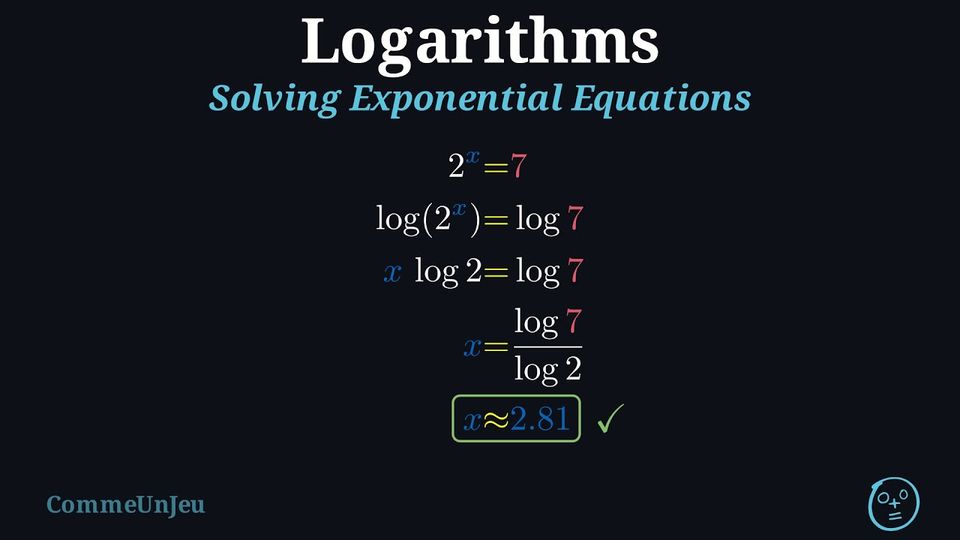
Some exponential equations are solved by writing both sides with the same base (e.g., \(2^x = 8 \Rightarrow 2^x = 2^3\)). However, most real-world problems involve values that are not perfect powers. To solve these, we use the power rule of logarithms to "bring down" the exponent.
Method — Solving \(a^x \equal b\)
To solve an equation \(a^x = b\) (where \(a > 0\), \(a \neq 1\), \(b > 0\)) in which the unknown is in the exponent: - Isolate the exponential term (\(a^x\)) if necessary.
- Take the logarithm (\(\log\) or \(\ln\)) of both sides.
- Use the Power Rule: \(\log(a^x) = x \log a\).
- Solve for \(x\) by dividing.
Example
Solve \(2^x = 7\).
$$\begin{aligned}2^x &= 7 \\
\log(2^x) &= \log 7 &&\text{(taking the logarithm of both sides)}\\
x \log 2 &= \log 7 &&\text{(power rule)}\\
x &= \frac{\log 7}{\log 2} &&\text{(dividing)}\\
\end{aligned}$$
Skills to practice
- Solving \(a^x \equal b\) with a Logarithm
- Solving Equations with \(e^x\)
III.2
Solving Exponential Models with Logarithms
Example
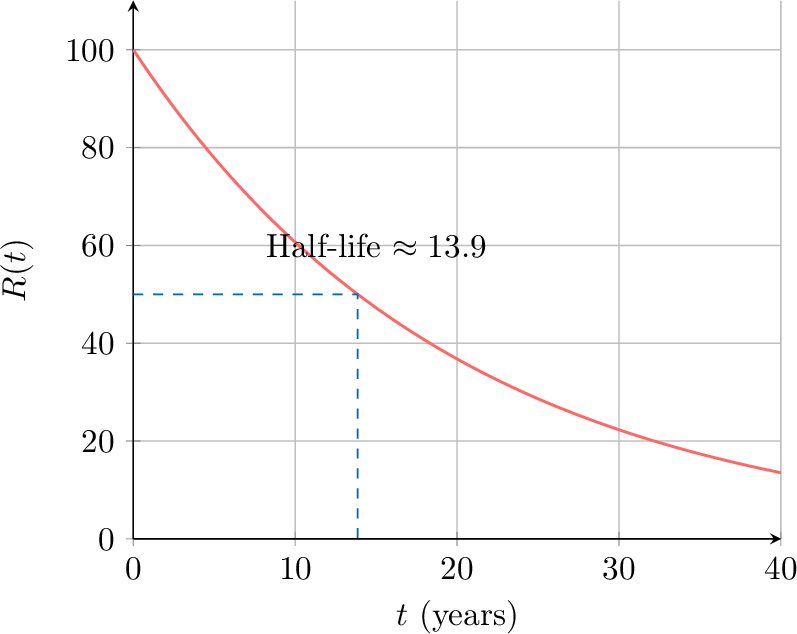
A radioactive element decays according to the formula \(R(t) = 100 e^{-0.05t}\), where \(R\) is the radiation in counts per minute and \(t\) is time in years. - State the initial radiation.
- Find the half-life (time taken for radiation to halve).
- Initial radiation: At \(t=0\), $$ R(0) = 100 e^0 = 100 \text{ cpm}. $$
- Half-life: We find \(t\) such that \(R(t) = 50\). $$ 50 = 100 e^{-0.05t} \implies 0.5 = e^{-0.05t}. $$ Taking \(\ln\) of both sides: $$ \ln(0.5) = -0.05t \implies t = \frac{\ln(0.5)}{-0.05} \approx 13.86 \text{ years}. $$
Example
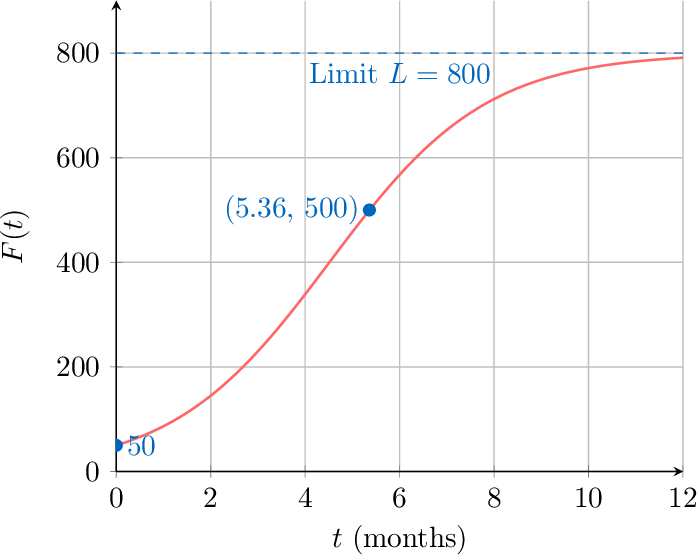
The number of fish in a lake, \(F\), can be modelled by the function$$ F(t) = \frac{800}{1 + Ce^{-0.6t}} $$ where \(t\) is the number of months after fish were introduced to the lake. - Initially, 50 fish were introduced to the lake. Find the value of \(C\).
- Write down the limiting capacity for the number of fish in the lake.
- Calculate the number of months it takes until there are 500 fish in the lake.
- Find \(C\): At \(t=0\), \(F=50\). $$ 50 = \frac{800}{1 + Ce^0} = \frac{800}{1+C}. $$ Hence $$ 1 + C = \frac{800}{50} = 16 \implies C = 15. $$ So, \(F(t) = \frac{800}{1 + 15e^{-0.6t}}\).
- Limiting capacity: $$ L = 800 \text{ fish}. $$
- Find \(t\) when \(F=500\): $$ 500 = \frac{800}{1 + 15e^{-0.6t}} \implies 1 + 15e^{-0.6t} = \frac{800}{500} = 1.6. $$ $$ 15e^{-0.6t} = 0.6 \implies e^{-0.6t} = 0.04. $$ $$ -0.6t = \ln(0.04) \implies t = \frac{\ln(0.04)}{-0.6} \approx 5.36 \text{ months}. $$
Skills to practice
- Finding When an Exponential Model Reaches a Value
- Solving Logistic Models with Logarithms
III.3
Logarithmic Scales in Science
Recappreviously studied — click to reread
Logarithms are used to describe quantities that vary over many orders of magnitude. In the scientific formulas below, the base-10 logarithm is written in full as \(\log_{10}\). Some important examples in science include:
- pH scale in chemistry: \(\text{pH} = -\log_{10} [H^+]\)
(where \([H^+]\) is the numerical value of the hydrogen ion concentration in moles per litre) - Richter scale for earthquakes (simplified model): \(\text{Magnitude} = \log_{10}\left(\dfrac{I}{I_0}\right)\)
(where \(I\) is the intensity of the earthquake, \(I_0\) is a reference intensity) - Decibel (dB) scale for sound: \(L = 10 \log_{10}\left(\dfrac{P}{P_0}\right)\)
(where \(P\) is the power/intensity measured, \(P_0\) is a reference level)
Example
The pH of a solution is \(3.2\). Find the hydrogen ion concentration \([H^+]\).
We know: $$\begin{aligned} \text{pH} &= -\log_{10}[H^+] \\
3.2 &= -\log_{10}[H^+] &&\text{(substituting the value)}\\
-3.2 &= \log_{10}[H^+] &&\text{(multiplying both sides by \(-1\))}\\
10^{-3.2} &= 10^{\log_{10}[H^+]} &&\text{(exponentiating both sides, base 10)}\\
[H^+] &= 10^{-3.2} \\
[H^+] &\approx 6.31 \times 10^{-4}\ \text{mol/L} &&\text{(using a calculator)} \end{aligned}$$
Skills to practice
- Logarithmic Scales in Science
IV
Logarithmic Functions
IV.1
The Logarithmic Function in Base \(a\)
Recappreviously studied — click to reread
Definition — Logarithmic Function in Base a
The logarithmic function in base a is \(f(x) = \log_a(x)\), where \(a\) is a positive constant and \(a \neq 1\). - Domain: \((0, +\infty)\)
- Range: \((-\infty, +\infty)\)
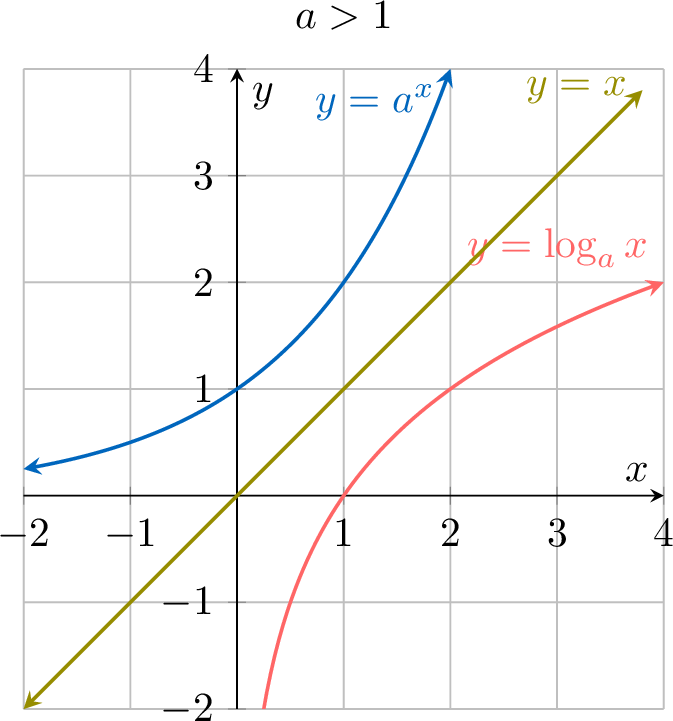
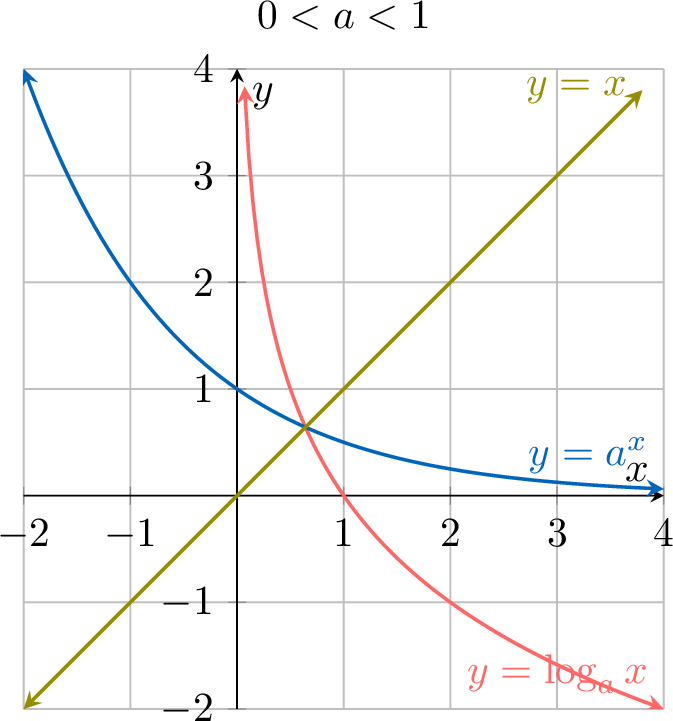
Proposition — Graph of the Logarithmic Function in Base a
The graph of \(\textcolor{colordef}{y = \log_a(x)}\) is the reflection of \(\textcolor{colorprop}{y = a^x}\) over the line \(\textcolor{olive}{y = x}\). It has a vertical asymptote at \(x=0\) and passes through the point \((1,0)\). - If \(a > 1\), the function is increasing.
- If \(0 < a < 1\), the function is decreasing.
 \(\quad\)
Example
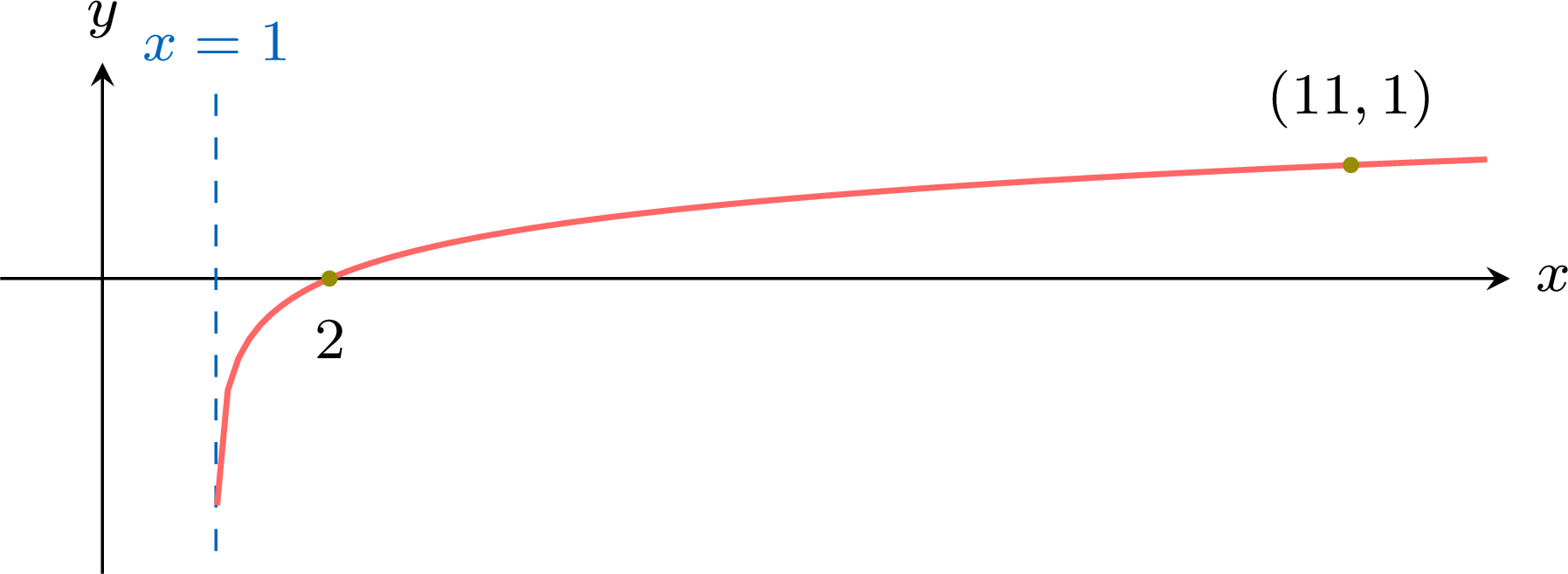
Study the function \(f(x) = \log(x - 1)\): domain, asymptote, intercept, and sketch. - Domain: the logarithm needs a positive input: \(x - 1 > 0\), so the domain is \((1, +\infty)\).
- Vertical asymptote: at the edge of the domain, \(x = 1\) (the whole curve of \(\log\) is shifted \(1\) unit right, and its asymptote moves with it).
- \(x\)-intercept: \(f(x) = 0\) when \(\log(x-1) = 0\), i.e. \(x - 1 = 1\) (since \(\log 1 = 0\)): the point \((2, 0)\).
- One exact point: \(f(11) = \log(10) = 1\) (ten to the power \(1\)): the point \((11, 1)\).
Skills to practice
- Finding Domains in Base \(a\)
IV.2
The Natural Logarithm Function
Definition — Natural Logarithm Function
The natural logarithm function is \(x\mapsto \ln x\). - Domain: \((0, +\infty)\)
- Range: \((-\infty, +\infty)\)
Proposition — Graph of the Natural Logarithm Function
The graph of \(\textcolor{colordef}{y = \ln x}\) is the reflection of \(\textcolor{colorprop}{y = e^x}\) over the line \(\textcolor{olive}{y = x}\). It has a vertical asymptote at \(x=0\), passes through (1,0), and is increasing. 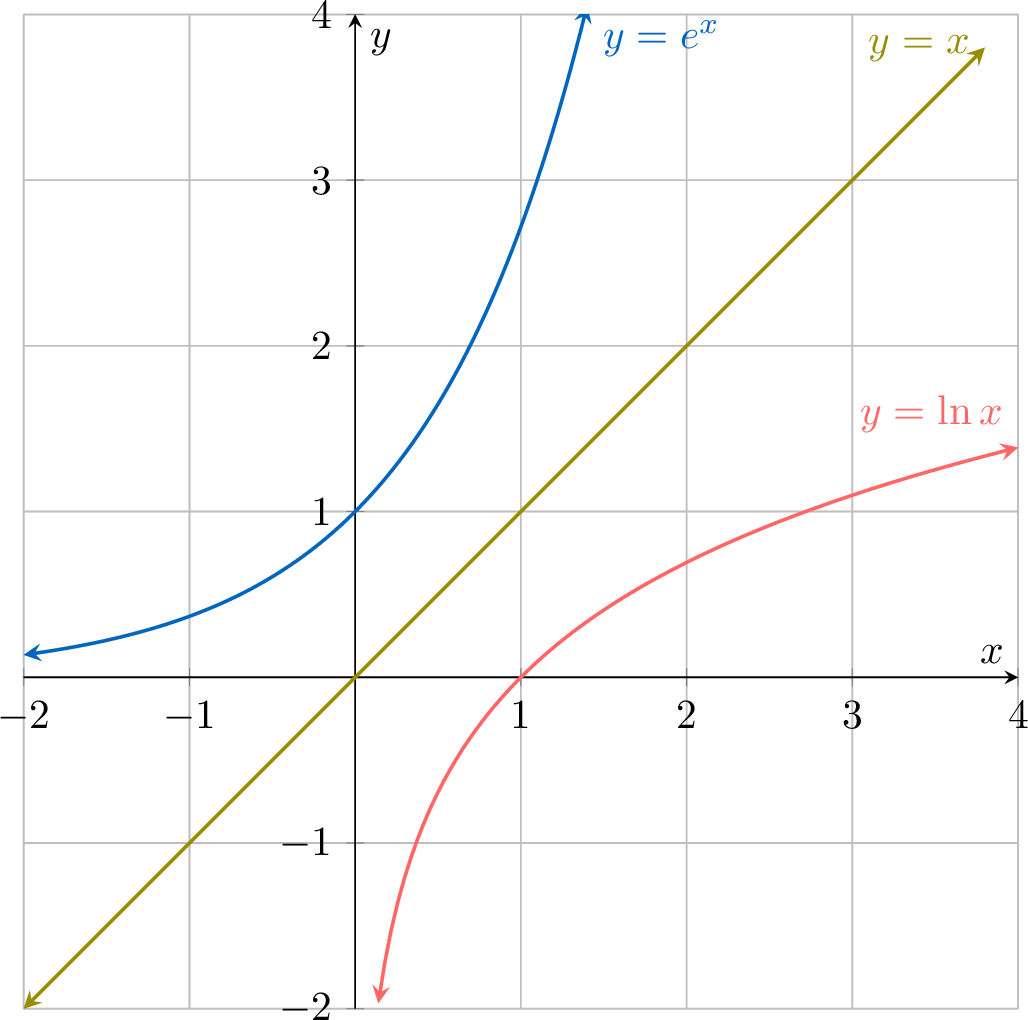
Skills to practice
- Finding Domains of Logarithmic Functions
- Finding Inverses and Asymptotes
- Graphing and Studying Logarithmic Functions
V
Logarithmic Models and Scales
V.1
Logarithmic Models
Definition — Logarithmic Model
A logarithmic model is a function of the form$$ f(x) = a + b\ln x, \qquad x>0,\; b\neq 0. $$ - \(\ln x\) denotes the natural logarithm (base \(e\)).
- \(a\) is the value of the function at \(x=1\), since \(f(1)=a\).
- \(b\) controls the rate of increase/decrease.
Proposition — Properties
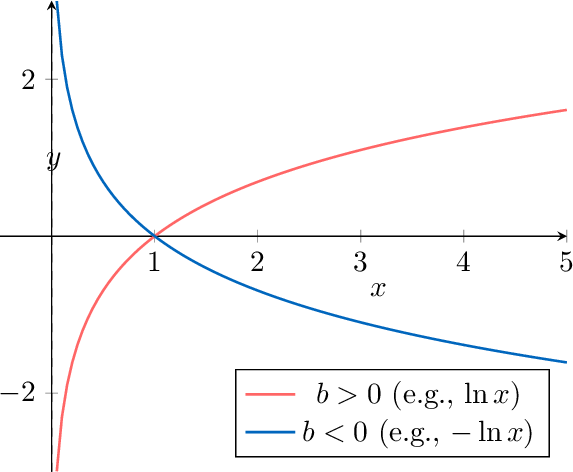
- The graph has a vertical asymptote at the \(y\)-axis (\(x=0\)).
- The function has one root (an \(x\)-intercept) given by $$ f(x)=0 \iff x=e^{-\frac{a}{b}}. $$
- If \(b > 0\), the function is increasing on \((0,+\infty)\). If \(b < 0\), the function is decreasing on \((0,+\infty)\).
Example
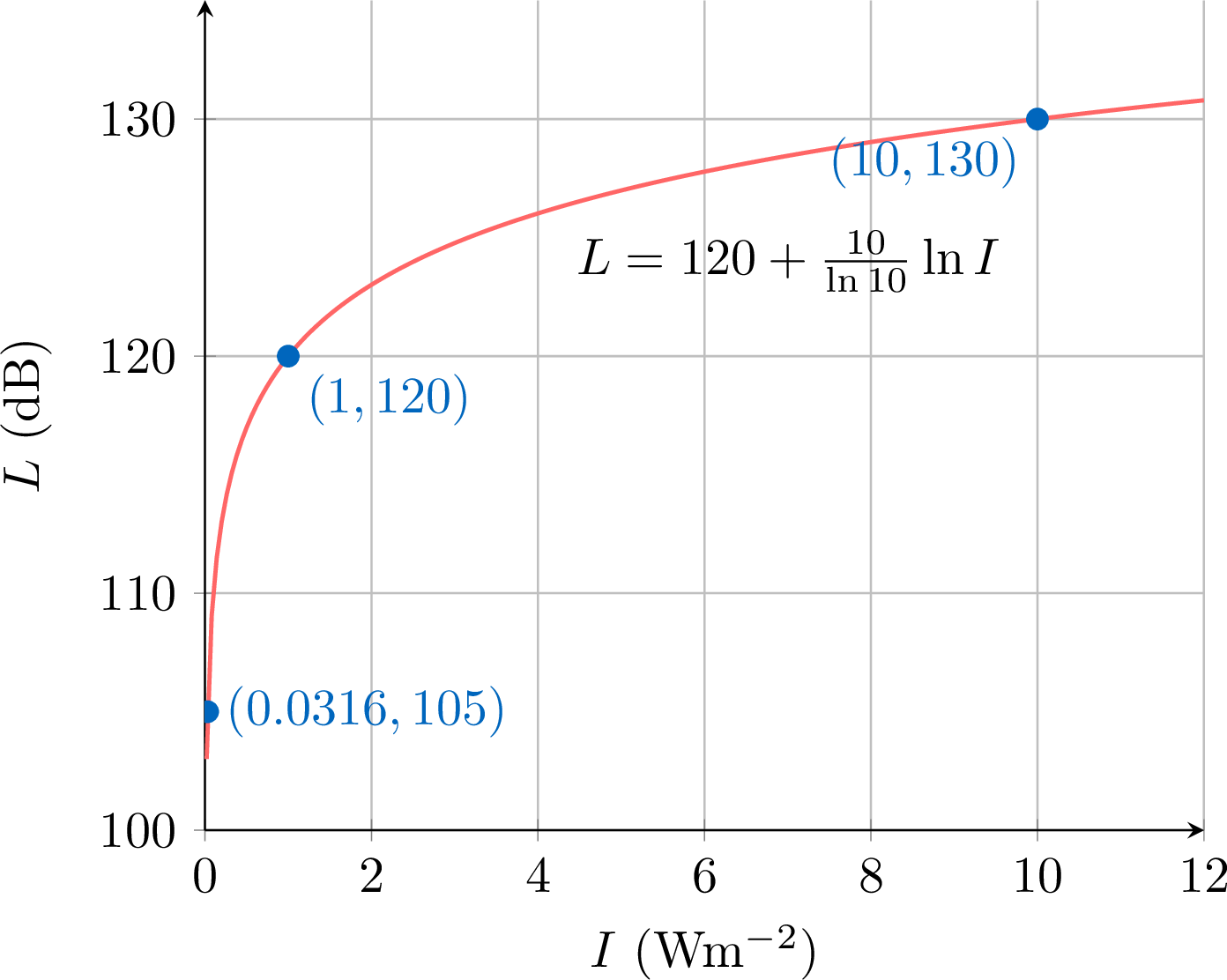
The sound intensity level \(L\), in decibels (dB), of a sound of intensity \(I\), in watts per square metre (Wm\(^{-2}\)), is \(L = 10 \log_{10}\left(\dfrac{I}{10^{-12}}\right)\), where \(I\) stands for its numerical value in Wm\(^{-2}\). The level can also be written as a logarithmic model $$ L(I) = a + b \ln I. $$ - A sound intensity of \(1 \text{ Wm}^{-2}\) produces a sound intensity level of \(120 \text{ dB}\). Write down the value of \(a\).
- A sound intensity of \(10 \text{ Wm}^{-2}\) produces a sound intensity level of \(130 \text{ dB}\). Find the value of \(b\).
- Find the sound intensity, in Wm\(^{-2}\), of a car alarm that has a sound intensity level of \(105 \text{ dB}\).
- Substitute \(I = 1\) and \(L = 120\): since \(\ln 1 = 0\), \(120 = a + b \times 0\), so \(a = 120\).
- Substitute \(I = 10\) and \(L = 130\): $$\begin{aligned}130 &= 120 + b \ln 10 &&\text{(substitution)}\\ b &= \frac{10}{\ln 10} \approx 4.34 &&\text{(dividing by } \ln 10 \gt 0\text{)} \end{aligned}$$ So \(L(I) = 120 + \dfrac{10}{\ln 10} \ln I\).
- With the exact value of \(b\): $$\begin{aligned}105 &= 120 + \frac{10}{\ln 10} \ln I &&\text{(substitution)}\\ \ln I &= -\frac{15 \ln 10}{10} = -1.5 \ln 10 &&\text{(isolating } \ln I\text{)}\\ I &= \left(e^{\ln 10}\right)^{-1.5} = 10^{-1.5} \approx 0.0316 \text{ Wm}^{-2} &&\text{(inverse property of } \ln\text{)} \end{aligned}$$ Check with the decibel formula: \(10 \log_{10}\left(\dfrac{10^{-1.5}}{10^{-12}}\right) = 10 \times 10.5 = 105\) dB.
Skills to practice
- Applying Logarithmic Models
V.2
Logarithmic Scales
A culture of bacteria is counted every hour: \(100\) bacteria at the start, and the number is multiplied by \(3\) every hour, up to \(656\,100\) after \(8\) hours. On an ordinary graph, drawn with the vertical scale needed for the last value, the first points are all squeezed against the horizontal axis. 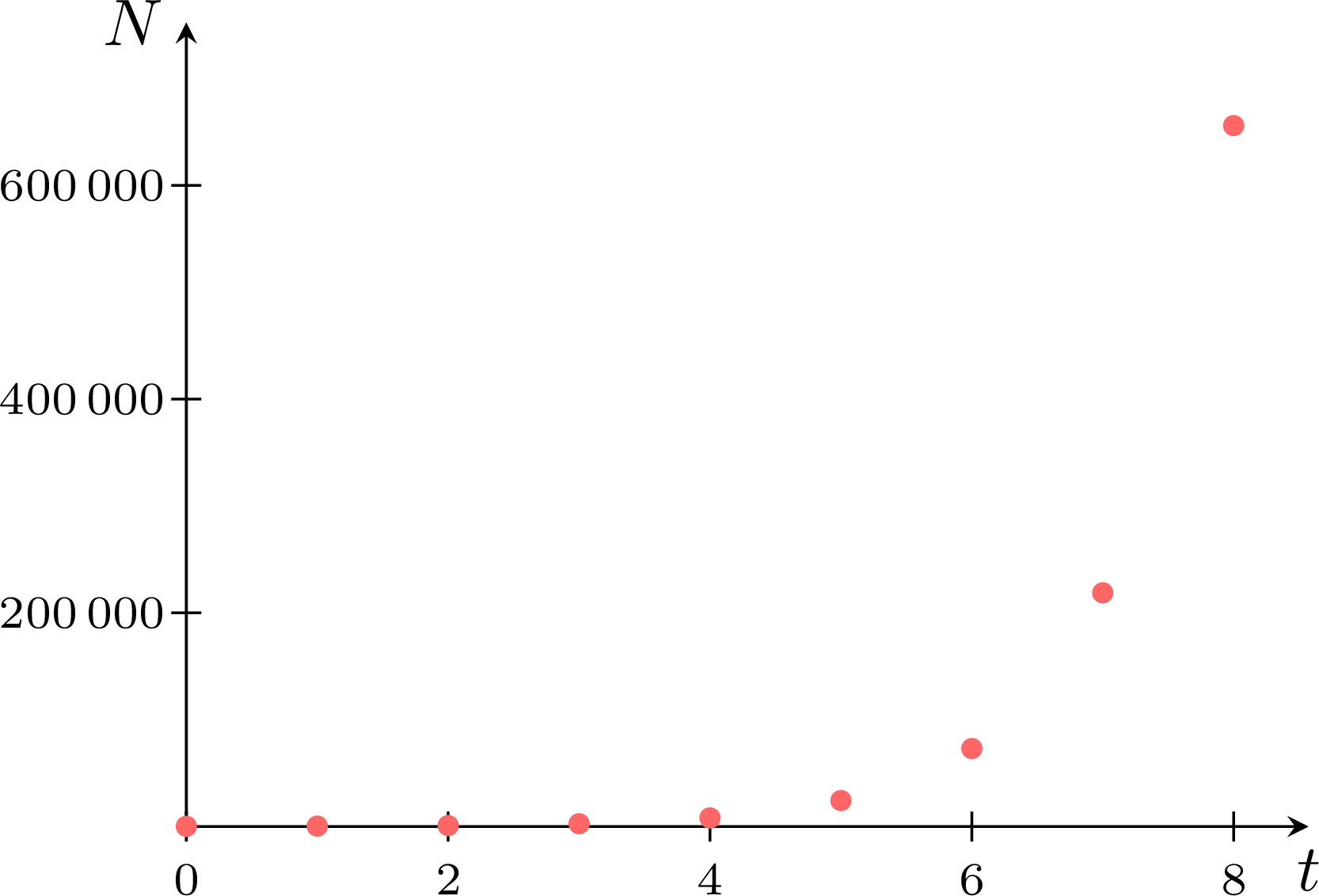
How could the vertical axis be graduated so that every point is clearly visible? What shape would the points then form?
Each hour multiplies the number by \(3\). On a vertical axis where each number \(N\) is placed at the height \(\log N\) (the axis below starts at the mark \(100\), at the height \(\log 100 = 2\)), a multiplication becomes an addition: \(\log(3N) = \log N + \log 3\). Each hour then raises the point by the same height \(\log 3 \approx 0.48\), and the values \(100\), \(1000\), \(10\,000\), …\ are equally spaced. The points are aligned: 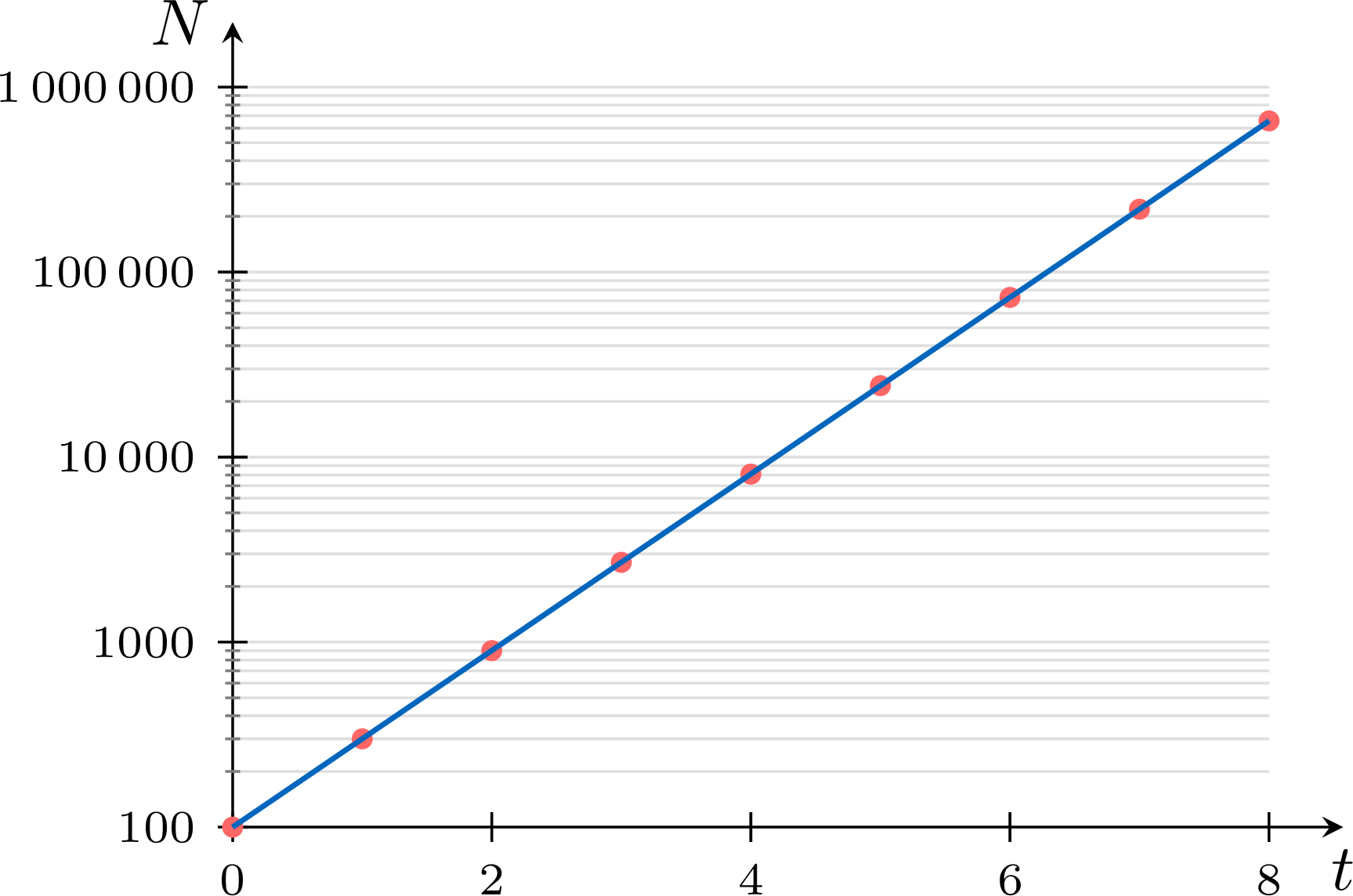
Definition — Logarithmic Scale and Logarithmic Frames
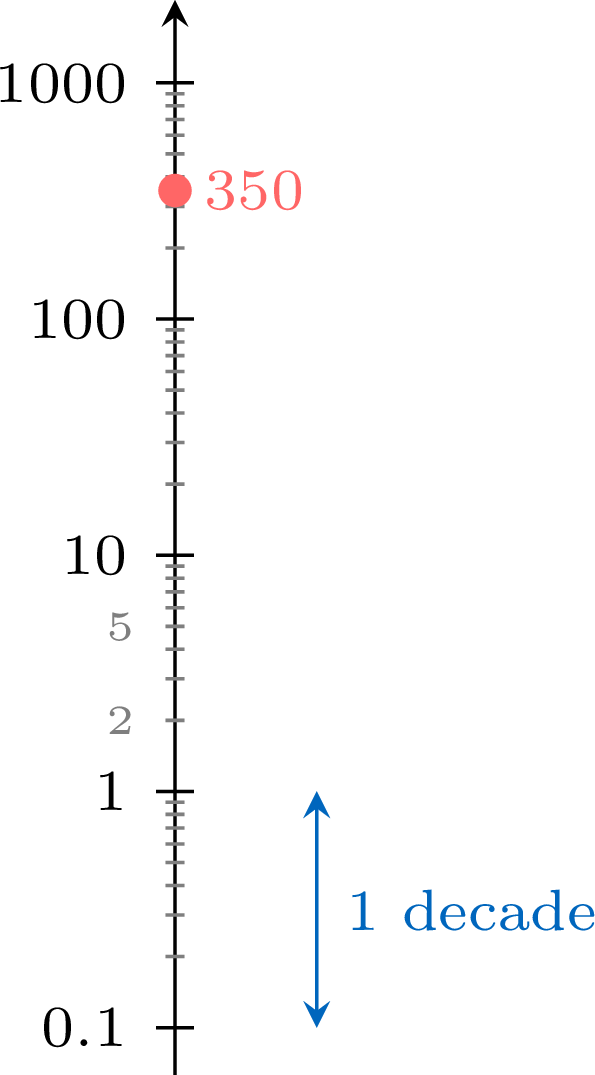
On a logarithmic scale, each number \(y \gt 0\) is placed at the signed position \(\log y\) from the mark \(1\) (above it if \(\log y \gt 0\), below it if \(\log y \lt 0\)), the unit of length being called a decade: the numbers \(0.1\), \(1\), \(10\), \(100\), \(1000\) are equally spaced, and between \(1\) and \(10\) the marks \(2, 3, \dots, 9\) stand at \(\log 2 \approx 0.30\), \(\log 3 \approx 0.48\), …, \(\log 9 \approx 0.95\) decade; the same pattern repeats in every decade. Zero and negative numbers have no place on such a scale. - A semi-logarithmic frame has an ordinary horizontal axis and a logarithmic vertical axis.
- A logarithmic frame (or log-log frame) has two logarithmic axes.
Method — Placing and Reading a Value on a Logarithmic Scale
- To place \(y \gt 0\): compute \(\log y\). It is the signed position, in decades, from the mark \(1\); its whole part tells between which powers of ten the point lies, and its decimal part how far it stands inside that decade.
- To read the point at the distance \(h\) decades from the mark \(1\) (above it if \(h \gt 0\), below it if \(h \lt 0\)): it represents \(y = 10^h\).
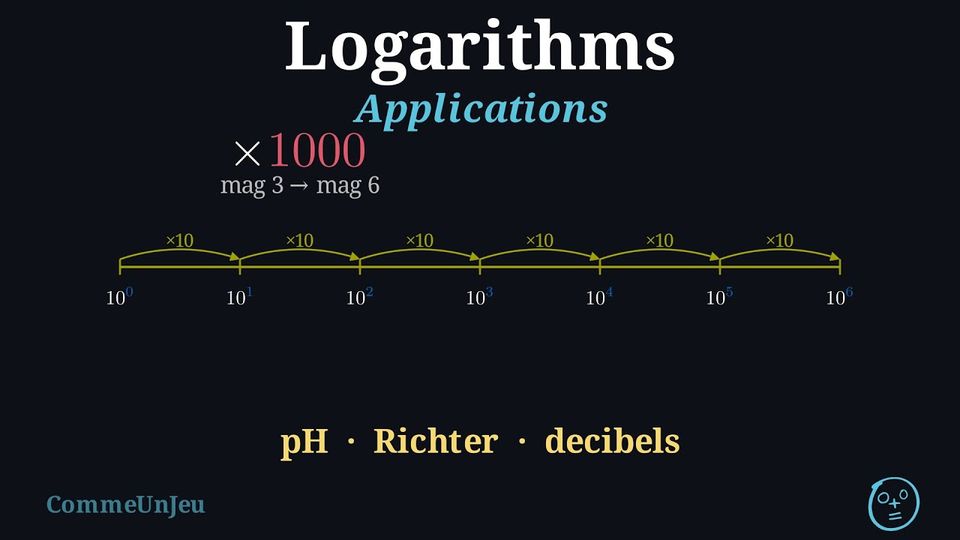
The figure below places the intensity ratio \(\frac{I}{I_0}\) of an earthquake on a logarithmic scale: the ticks \(10^0, 10^1, \dots, 10^6\) are drawn equally spaced. 
On this axis, the ticks are equally spaced, yet each step from one tick to the next multiplies the intensity ratio by \(10\). Equal steps on the axis correspond to equal factors of \(10\): the magnitude \(\log_{10}\left(\frac{I}{I_0}\right)\) increases by exactly \(1\) at each tick. Logarithms turn multiplicative scales into additive ones — this is why the pH, Richter and decibel scales can display enormous ranges of values on one readable axis.
Proposition — Exponential Functions in a Semi-Logarithmic Frame
Let \(k \gt 0\) and \(a \gt 0\). In a semi-logarithmic frame, the points of the curve of \(x \mapsto k \times a^x\) are aligned: their height \(Y = \log y\) satisfies $$\textcolor{colorprop}{Y = \log k + x \log a},$$ a straight line that rises by \(\log a\) decade when \(x\) increases by \(1\) (it falls when \(0 \lt a \lt 1\)), and that meets the vertical axis at the mark \(k\). Conversely, points aligned in a semi-logarithmic frame follow a model \(y = k \times a^x\).
$$\begin{aligned}Y = \log(k \times a^x) &= \log k + \log(a^x) &&\text{(logarithm of a product)}\\
&= \log k + x \log a &&\text{(power rule)}\end{aligned}$$ This is an affine expression of \(x\): the points are aligned, and for \(x = 0\) the height is \(\log k\), the height of the mark \(k\). Conversely, if \(Y = p\,x + q\), then \(y = 10^{p x + q} = 10^q \times (10^p)^x\): the model \(k \times a^x\) with \(k = 10^q\) and \(a = 10^p\).
Method — Finding an Exponential Model from a Straight Line
When points lie on a straight line in a semi-logarithmic frame: - Read two points of the line, \((x_1, y_1)\) and \((x_2, y_2)\), the values \(y_1\) and \(y_2\) being read on the logarithmic scale.
- Compute the rise per unit, \(\log a = \dfrac{\log y_2 - \log y_1}{x_2 - x_1}\), then \(a = 10^{\log a}\).
- Compute \(k\), the value at \(x = 0\): \(k = \dfrac{y_1}{a^{x_1}}\) (read directly if \(x_1 = 0\)).
Example
A capacitor discharges through a resistor. The voltage \(U\) (in volts) across it, measured every second from \(t = 0\) to \(t = 5\) and plotted in a semi-logarithmic frame, gives six points on the straight line through \((0, 12)\) and \((5, 0.75)\). 
$$\begin{aligned}\log a &= \frac{\log 0.75 - \log 12}{5 - 0} &&\text{(rise per second)}\\
&= \frac{\log(0.75 \div 12)}{5} = \frac{\log 0.0625}{5} &&\text{(logarithm of a quotient)}\\
a &= 10^{\frac{\log 0.0625}{5}} \approx 0.574 &&\text{(definition of the logarithm)} \end{aligned}$$ The line meets the vertical axis at \(12\), so \(k = 12\): \(U \approx 12 \times 0.574^t\). The voltage is halved when \(0.574^t = 0.5\), that is \(t = \dfrac{\log 0.5}{\log 0.574} \approx 1.25\) s. Check: in \(5\) s, four halvings divide the voltage by \(2^4 = 16\), and indeed \(12 \div 16 = 0.75\).
Logarithmic Frames and Power Functions
In a logarithmic frame, both coordinates are replaced by their logarithms. For \(x \gt 0\), the curve of \(x \mapsto k \times x^a\) (\(k \gt 0\)) becomes a straight line of slope \(a\) counted in decades (\(a\) decades up for one decade to the right), whatever the length of a decade on each axis, since \(\log y = \log k + a \log x\). Below, \(y = 3x^2\) for \(1 \le x \le 100\): when \(x\) is multiplied by \(10\) (one decade to the right), \(y\) is multiplied by \(100\) (two decades up). 
Such frames are used when both quantities span several orders of magnitude: the frequency response of a loudspeaker or of an amplifier (frequencies from \(20\) Hz to \(20\,000\) Hz), the size and the energy needs of animals, the brightness of stars and their distance.
Skills to practice
- Reading Logarithmic Scales and Frames
- Placing Values and Finding a Model
- Solving Problems with Logarithmic Scales
VI
Going further
Skills to practice
- Reasoning on Logarithmic Graphs
- Solving Problems
- Reasoning on Models and Scales
- Quiz
Jump to section