French National Education · Grade 7
Integers
Introduction to integers using visual particle models and number lines. Learn rules for adding and subtracting positive and negative numbers, finding opposites, and absolute values. Practical word problems cover temperature, altitude, and finance to master ordering and comparison.
I
What Are Integers?
Imagine a world with two types of particles: positives (+) and negatives (-). They interact in specific ways.
- When particles of the same type meet, they join forces.


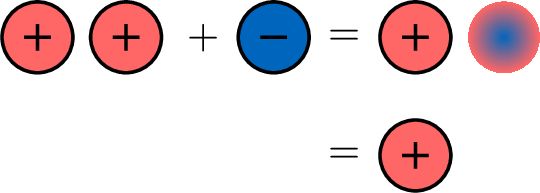
- When a positive and a negative particle meet, they cancel each other out, leaving nothing. This is called a zero pair.

- Let’s see what happens if 2 positives meet 1 negative. One zero pair is formed, leaving 1 positive.
- To show which type of particle we have, we put a sign in front of the number:
- The + sign for a group of positives.
- The - sign for a group of negatives.

- The + sign for a group of positives.
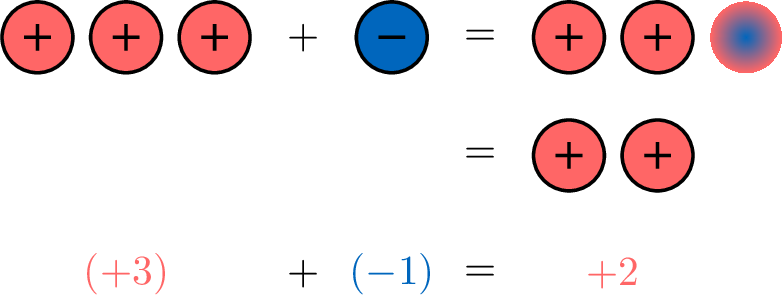
- Now, let’s see what happens when 3 positives meet 1 negative.
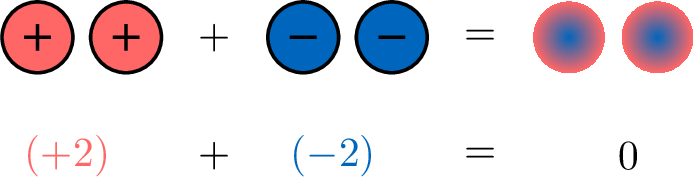
- Finally, let’s see what happens when 2 positives meet 2 negatives.
Definition — Integers
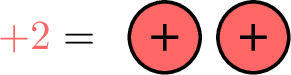
The integers are the set that contains the natural numbers (\(1, 2, 3, \dots\)), their opposites (\(-1, -2, -3, \dots\)), and \(0\).- Positive numbers (\(\textcolor{colordef}{+1}, \textcolor{colordef}{+2},\dots\)) are written with a positive sign \((+)\). This sign is often omitted (\(\textcolor{colordef}{+2}=\textcolor{colordef}{2}\)).
\(\textcolor{colordef}{+2}=\) 
- Negative numbers (\(\textcolor{colorprop}{-1}, \textcolor{colorprop}{-2},\dots\)) are written with a negative sign \((-)\).
\(\textcolor{colorprop}{-3}=\) 
- Zero (\(0\)) is neither positive nor negative.
- Two numbers are opposites if their sum is \(0\).
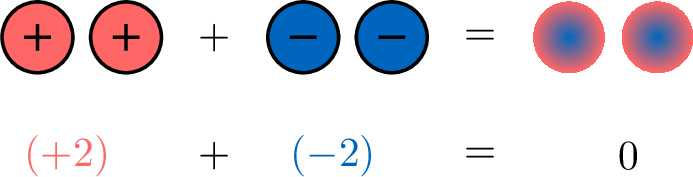
\(\textcolor{colorprop}{-2}\) is the opposite of \(\textcolor{colordef}{+2}\). - To avoid confusion between a number's sign and an operation sign, we often use parentheses. For example, \(\textcolor{colordef}{+1}+\textcolor{colorprop}{-2}\) can be written as \(\textcolor{colordef}{(+1)}+\textcolor{colorprop}{(-2)}\).
Example
Calculate \(\textcolor{colordef}{(+1)}+\textcolor{colorprop}{(-2)}\).-
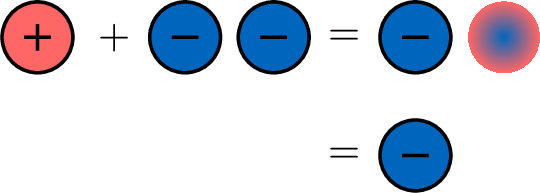
- So, \(\textcolor{colordef}{(+1)}+\textcolor{colorprop}{(-2)}=\textcolor{colorprop}{-1}\).
Definition — Absolute Value
The absolute value of a number is the number without its sign.- The absolute value of \(\textcolor{colordef}{+2}=\)
 is \(2\).
 - The absolute value of \(\textcolor{colorprop}{-3}=\)
 is \(3\).
Skills to practice
- Counting Positive and Negative Numbers
- Writing Integers from Words
- Finding the Opposite
- Finding the Opposite for Decimal Numbers
- Adding Small integers
- Finding Missing Numbers in Addition
- Finding the Absolute Value
- Finding the Absolute Value for Decimal Numbers
II
Rules of Addition
Method — Rules of Addition
- When you add two positive numbers, add their absolute values. The sum is also a positive number:$$\textcolor{colordef}{(+2)}+\textcolor{colordef}{(+4)}=\textcolor{colordef}{+6} \quad \text{as }2+4=6.$$

- When you add two negative numbers, add their absolute values. The sum is also a negative number:$$\textcolor{colorprop}{(-5)}+\textcolor{colorprop}{(-3)}=\textcolor{colorprop}{-8} \quad \text{as }5+3=8.$$

- When you add a positive number and a negative number, subtract the smaller absolute value from the larger one and use the sign of the number with the larger absolute value.
\(\textcolor{colorprop}{(-2)}+\textcolor{colordef}{(+5)}=\textcolor{colordef}{+3} \quad \text{as }5-2=3\) 
\(\textcolor{colordef}{(+2)}+\textcolor{colorprop}{(-6)}=\textcolor{colorprop}{-4} \quad \text{as }6-2=4\) 
Example
Calculate \(\textcolor{colorprop}{(-10)}+\textcolor{colordef}{(+3)}\).- \(\textcolor{colorprop}{(-10)}+\textcolor{colordef}{(+3)}=\textcolor{colorprop}{-7} \quad \text{as }10-3=7.\)
-

Skills to practice
- Adding Integers
- Adding Integers without Explicit Signs
- Adding Signed Decimal Numbers
- Adding Multiple Integers
- Adding Integers in Real-World Problems
III
Subtraction
- For the subtraction, \(\textcolor{colordef}{(+3)}-\textcolor{colordef}{(+2)}\):
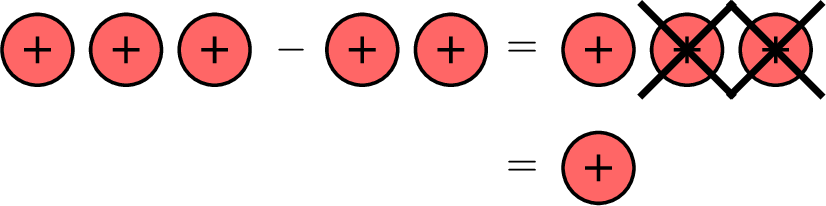
- For the addition, \(\textcolor{colordef}{(+3)}+\textcolor{colorprop}{(-2)}\):
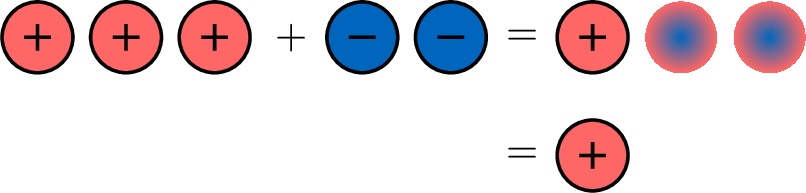
- Therefore, these two operations are equivalent:
\(\textcolor{colordef}{(+3)}-\textcolor{colordef}{(+2)}=\textcolor{colordef}{(+3)}+\textcolor{colorprop}{(-2)}\) 
- For the subtraction, \(\textcolor{colordef}{(+3)}-\textcolor{colordef}{(+2)}\):
- For the subtraction, \(\textcolor{colorprop}{(-3)}-\textcolor{colorprop}{(-2)}\):
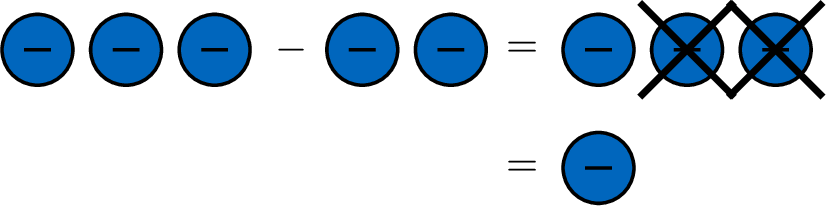
- For the addition, \(\textcolor{colorprop}{(-3)}+\textcolor{colordef}{(+2)}\):

- Therefore, these two operations are equivalent:
\(\textcolor{colorprop}{(-3)}-\textcolor{colorprop}{(-2)}=\textcolor{colorprop}{(-3)}+\textcolor{colordef}{(+2)}\) 
- For the subtraction, \(\textcolor{colorprop}{(-3)}-\textcolor{colorprop}{(-2)}\):
- In conclusion, these examples show a fundamental rule in arithmetic: subtracting any number is equivalent to adding the number with its opposite sign.
Definition — Subtraction
Subtracting a number means adding its opposite.Example
Calculate \(\textcolor{colordef}{(+4)}-\textcolor{colorprop}{(-2)}\).
$$\begin{aligned}[t]\textcolor{colordef}{(+4)}-\textcolor{colorprop}{(-2)}&=\textcolor{colordef}{(+4)}+\textcolor{colordef}{(+2)}&&\text{(add the opposite)}\\
&=\textcolor{colordef}{+6}&&\text{(same sign: add the absolute values)}\end{aligned}$$
Skills to practice
- Converting Subtraction to Addition
- Subtracting Integers Step by Step
- Subtracting Integers
- Subtracting Integers without Explicit Signs
- Adding/Subtracting Multiple Integers
- Subtracting Integers in Real-World Problems
IV
On the Number Line
- To show both positive and negative numbers on a number line, we extend the number line in both directions from zero.

- For each move from left to right by \(1\), the number increases by \(1\): \(0+1=\textcolor{colordef}{+1}\), \(\textcolor{colordef}{+1}+1=\textcolor{colordef}{+2},\dots\)

- For each move from right to left by \(1\), the number decreases by \(1\): \(0-1=\textcolor{colorprop}{-1}\), \(\textcolor{colorprop}{-1}-1=\textcolor{colorprop}{-2},\dots\)

Definition — Number line
A number line is a straight line with markings at equal intervals to denote the numbers.


Skills to practice
- Finding x On the Number Line
- Finding Decimal Numbers On the Number Line
V
Ordering
In the set of integers, the order is defined as:$$\dots\lt\textcolor{colorprop}{-3}\lt\textcolor{colorprop}{-2}\lt\textcolor{colorprop}{-1}\lt 0 \lt \textcolor{colordef}{+1}\lt\textcolor{colordef}{+2}\lt\textcolor{colordef}{+3}\lt\dots $$So, as you move along the number line from left to right, the numbers increase.
- As \(\textcolor{colordef}{+3}\) is to the right of \(\textcolor{colorprop}{-5}\), \(\textcolor{colorprop}{-5} \lt \textcolor{colordef}{+3}\). So, when one number is positive and the other is negative, the positive number is greater.
- As \(\textcolor{colorprop}{-2}\) is to the right of \(\textcolor{colorprop}{-4}\), \(\textcolor{colorprop}{-4}\lt \textcolor{colorprop}{-2}\). So, when both numbers are negative, the number closer to zero is greater (the number with the smaller absolute value is greater).
- As \(\textcolor{colordef}{+6}\) is to the right of \(\textcolor{colordef}{+4}\), \(\textcolor{colordef}{+4}\lt \textcolor{colordef}{+6}\). So, when both numbers are positive, the number further from zero is greater (the number with the greater absolute value is greater).
Method — Compare two numbers
- When one number is positive and the other is negative, the positive number is greater.
- When both numbers are negative, the number closer to zero is greater (the number with the smaller absolute value is greater).
- When both numbers are positive, the number further from zero is greater (the number with the greater absolute value is greater).
Example
Compare \(\textcolor{colorprop}{-4}\) and \(\textcolor{colordef}{+3}\).- As \(\textcolor{colordef}{+3}\) is positive and \(\textcolor{colorprop}{-4}\) is negative, the positive number is greater than the negative number: \(\textcolor{colorprop}{-4}\lt \textcolor{colordef}{+3}\).
-

Skills to practice
- Comparing Small Integers
- Comparing Integers
- Comparing Integers in Real-World Problems
VI
Review \& Beyond
Skills to practice
- Quiz
Jump to section