Fonction logarithme népérien
Dans de nombreux domaines scientifiques, nous devons résoudre des équations où l'inconnue est en exposant, comme \(e^x = a\). Pour ce faire, nous utilisons la fonction réciproque de l'exponentielle : le logarithme népérien. Alors que la fonction exponentielle croît extrêmement vite, le logarithme croît très lentement.
Définition et lien avec l'exponentielle
La fonction exponentielle est continue et strictement croissante de \(\mathbb{R}\) vers \(]0, +\infty[\). Par le théorème de la bijection, pour tout réel \(x\) strictement positif, il existe un unique réel \(y\) tel que \(e^y = x\). Cette unique solution \(y\) est appelée logarithme népérien de \(x\) et est notée \(\ln(x)\).
Définition Logarithme népérien
La fonction logarithme népérien, notée \(\ln\), est la fonction définie sur \(]0, +\infty[\) qui, à tout réel \(x > 0\), associe l'unique solution de l'équation \(e^y = x\) d'inconnue \(y\). On note :$$ y = \ln(x) $$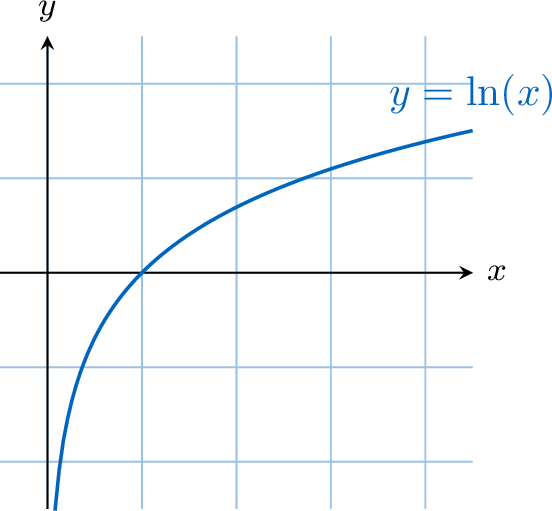
Proposition Réciprocité
Pour tout \(x > 0\) et tout réel \(y\) :
\(\ln(1) = 0\) (car \(e^0 = 1\)) et \(\ln(e) = 1\) (car \(e^1 = e\))
- \(e^y = x \iff y = \ln(x)\)
- \(e^{\ln(x)} = x\)
- \(\ln(e^y) = y\)
\(\ln(1) = 0\) (car \(e^0 = 1\)) et \(\ln(e) = 1\) (car \(e^1 = e\))
Proposition Symétrie
Les courbes représentatives des fonctions exponentielle et logarithme népérien sont symétriques par rapport à la droite d'équation \(y = x\).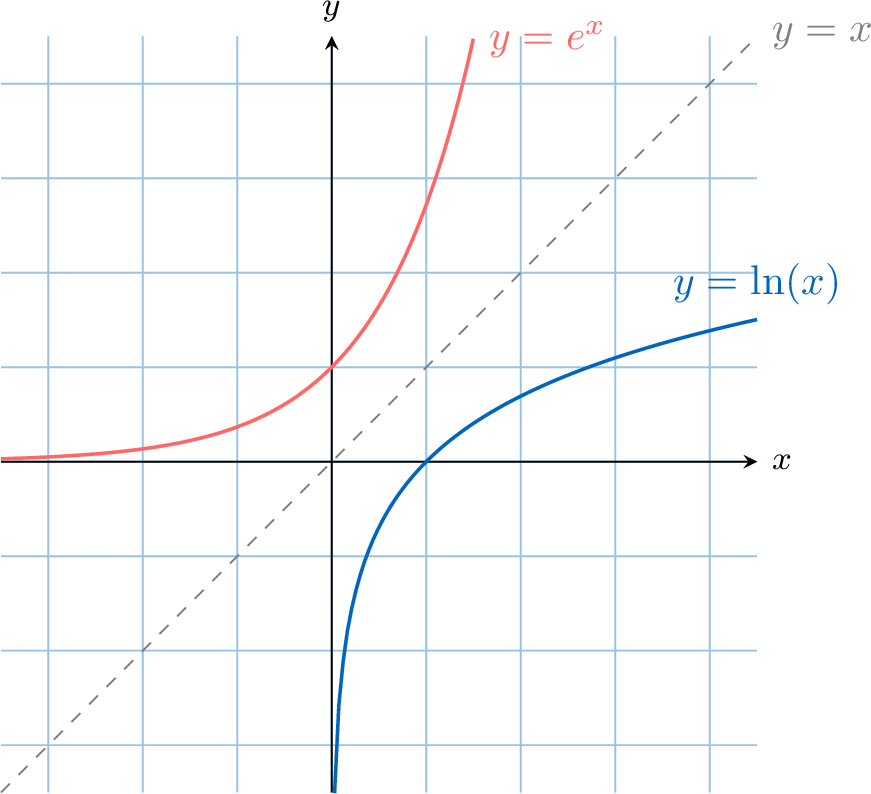
Propriétés algébriques
Proposition Relation fonctionnelle
Pour tous réels \(a\) et \(b\) strictement positifs :$$\ln(a \times b) = \ln(a) + \ln(b)$$
Pour tous réels \(a\) et \(b\) strictement positifs :$$ \begin{aligned}e^{\ln(ab)} &= ab && \text{(par définition : } x = e^{\ln(x)}\text{)} \\
e^{\ln(ab)}&= e^{\ln(a)} \times e^{\ln(b)} && \text{(car } a = e^{\ln(a)} \text{ et } b = e^{\ln(b)}\text{)} \\
e^{\ln(ab)}&= e^{\ln(a) + \ln(b)} && \text{(propriété : } e^x \times e^y = e^{x+y}\text{)} \\
\ln(ab) &= \ln(a) + \ln(b) && \text{(propriété : } e^x =e^y \iff x=y\text{)} \\
\end{aligned} $$
Proposition Autres règles de calcul
Pour tous \(a > 0\), \(b > 0\) et tout entier relatif \(n\) :
- Inverse : \(\ln\left(\frac{1}{b}\right) = -\ln(b)\)
- Quotient : \(\ln\left(\frac{a}{b}\right) = \ln(a) - \ln(b)\)
- Puissance : \(\ln(a^n) = n\ln(a)\)
- Racine carrée : \(\ln(\sqrt{a}) = \frac{1}{2}\ln(a)\)
- Logarithme d'un inverse : Soit \(b > 0\). $$ \begin{aligned} e^{\ln(1/b)} &= \frac{1}{b} && \text{(par définition : } x = e^{\ln(x)}\text{)} \\ e^{\ln(1/b)} &= \frac{1}{e^{\ln(b)}} && \text{(car } b = e^{\ln(b)}\text{)} \\ e^{\ln(1/b)} &= e^{-\ln(b)} && \text{(propriété : } 1/e^x = e^{-x}\text{)} \\ \ln(1/b) &= -\ln(b) && \text{(propriété : } e^x = e^y \iff x=y\text{)} \end{aligned} $$
- Logarithme d'un quotient : Soient \(a > 0\) et \(b > 0\). $$ \begin{aligned} e^{\ln(a/b)} &= \frac{a}{b} && \text{(par définition : } x = e^{\ln(x)}\text{)} \\ e^{\ln(a/b)} &= \frac{e^{\ln(a)}}{e^{\ln(b)}} && \text{(car } a = e^{\ln(a)} \text{ et } b = e^{\ln(b)}\text{)} \\ e^{\ln(a/b)} &= e^{\ln(a) - \ln(b)} && \text{(propriété : } e^x / e^y = e^{x-y}\text{)} \\ \ln(a/b) &= \ln(a) - \ln(b) && \text{(propriété : } e^x = e^y \iff x=y\text{)} \end{aligned} $$
- Logarithme d'une puissance : Soient \(a > 0\) et \(n \in \mathbb{Z}\). $$ \begin{aligned} e^{\ln(a^n)} &= a^n && \text{(par définition : } x = e^{\ln(x)}\text{)} \\ e^{\ln(a^n)} &= (e^{\ln(a)})^n && \text{(car } a = e^{\ln(a)}\text{)} \\ e^{\ln(a^n)} &= e^{n\ln(a)} && \text{(propriété : } (e^x)^n = e^{nx}\text{)} \\ \ln(a^n) &= n\ln(a) && \text{(propriété : } e^x = e^y \iff x=y\text{)} \end{aligned} $$
- Logarithme d'une racine carrée : Soit \(a > 0\). $$ \begin{aligned} e^{\ln(\sqrt{a})} &= \sqrt{a} = a^{1/2} && \text{(par définition et forme puissance)} \\ e^{\ln(\sqrt{a})} &= (e^{\ln(a)})^{1/2} && \text{(car } a = e^{\ln(a)}\text{)} \\ e^{\ln(\sqrt{a})} &= e^{\frac{1}{2}\ln(a)} && \text{(propriété : } (e^x)^n = e^{nx}\text{)} \\ \ln(\sqrt{a}) &= \frac{1}{2}\ln(a) && \text{(propriété : } e^x = e^y \iff x=y\text{)} \end{aligned} $$
Étude de la fonction
Proposition Dérivée et continuité
La fonction \(\ln\) est dérivable et continue sur \(]0, +\infty[\). Pour tout \(x > 0\) :$$\ln'(x) = \frac{1}{x}$$Puisque \(1/x > 0\) sur son domaine, le logarithme népérien est strictement croissant sur \(]0, +\infty[\).
On admet que la fonction \(\ln\) est dérivable sur \(]0, +\infty[\). On part de l'égalité :$$e^{\ln(x)} = x$$On dérive les deux membres par rapport à \(x\) :
- À droite : \((x)' = 1\).
- À gauche, en utilisant la règle de dérivation des fonctions composées \((e^{u(x)})' = u'(x)e^{u(x)}\) : $$\left(e^{\ln(x)}\right)' = \ln'(x) \times e^{\ln(x)} = \ln'(x) \times x$$
Proposition Limites et asymptote
Le logarithme népérien admet les limites suivantes :
- \(\displaystyle\lim_{x \to +\infty} \ln(x) = +\infty\)
- \(\displaystyle\lim_{x \to 0^+} \ln(x) = -\infty\)
Proposition Dérivée de \(\ln(u(x))\)
Soit \(u\) une fonction dérivable et strictement positive sur un intervalle \(I\). La fonction \(f(x) = \ln(u(x))\) est dérivable sur \(I\) et :$$\textcolor{colorprop}{(\ln(u(x)))' = \frac{u'(x)}{u(x)}}$$
Croissance comparée
Proposition Croissance comparée
Pour tout entier naturel \(n \ge 1\) :
- \(\displaystyle\lim_{x \to +\infty} \dfrac{\ln(x)}{x} = 0\)
- \(\displaystyle\lim_{x \to 0^+} x \ln(x) = 0\)
- \(\displaystyle\lim_{x \to +\infty} \dfrac{\ln(x)}{x^n} = 0\)
- \(\displaystyle\lim_{x \to 0^+} x^n \ln(x) = 0\)
- Pour \(x > 0\), \(\dfrac{\ln(x)}{x} = \dfrac{\ln(x)}{e^{\ln(x)}}\). Posons \(X = \ln(x)\). Quand \(x \to +\infty\), \(X \to +\infty\). Par le théorème de composition et la limite connue \(\displaystyle\lim_{X \to +\infty} \dfrac{X}{e^X} = 0\), on en déduit que \(\displaystyle\lim_{x \to +\infty} \dfrac{\ln(x)}{x} = 0\).
- Pour \(x > 0\), \(x \ln(x) = e^{\ln(x)} \times \ln(x)\). Posons \(X = \ln(x)\). Quand \(x \to 0^+\), \(X \to -\infty\). Par le théorème de composition et la limite connue \(\displaystyle\lim_{X \to -\infty} X e^X = 0\), on en déduit que \(\displaystyle\lim_{x \to 0^+} x \ln(x) = 0\).
- Pour \(n > 1\), on a \(\dfrac{\ln(x)}{x^n} = \dfrac{1}{x^{n-1}} \times \dfrac{\ln(x)}{x}\). Comme \(\displaystyle\lim_{x \to +\infty} \dfrac{1}{x^{n-1}} = 0\) et \(\displaystyle\lim_{x \to +\infty} \dfrac{\ln(x)}{x} = 0\), par produit de limites on obtient \(0\).
- Pour \(n > 1\), on a \(x^n \ln(x) = x^{n-1} \times x \ln(x)\). Comme \(\displaystyle\lim_{x \to 0^+} x^{n-1} = 0\) et \(\displaystyle\lim_{x \to 0^+} x \ln(x) = 0\), par produit de limites on obtient \(0\).