\( \definecolor{colordef}{RGB}{249,49,84} \definecolor{colorprop}{RGB}{18,102,241} \)

Table de multiplication

Un outil pour multiplier rapidement


Il y a 5 boîtes vides, et chaque boîte doit contenir 9 crayons pour être pleine.

Hugo veut trouver le nombre total de crayons nécessaires. Comment pouvons-nous l'aider à calculer cela ?

Hugo pourrait utiliser l'addition répétée : $$9+9+9+9+9$$Mais cela peut être lent. Un moyen beaucoup plus rapide est d'utiliser la multiplication :$$5 \times 9$$Si nous connaissons nos tables de multiplication, nous connaissons la réponse instantanément ! Comme nous savons que \(\textcolor{colordef}{5}\times \textcolor{colorprop}{9}=\textcolor{olive}{45}\), Hugo a besoin de 45 crayons. C'est pourquoi apprendre les tables de multiplication est si utile : elles sont un raccourci pour résoudre les problèmes rapidement !


Définition Table de multiplication
Une table de multiplication est un tableau utile qui montre les résultats de la multiplication d'un nombre par d'autres nombres (généralement de 0 à 10). Chaque nombre a sa propre table de multiplication.
Exemple
Utilise la table de multiplication de 4 pour calculer \(4\times 9\).$$\begin{aligned}\textcolor{colordef}{4}\times \textcolor{colorprop}{0}&=\textcolor{olive}{0}\\ \textcolor{colordef}{4}\times \textcolor{colorprop}{1}&=\textcolor{olive}{4}\\ \textcolor{colordef}{4}\times \textcolor{colorprop}{2}&=\textcolor{olive}{8 }\\ \textcolor{colordef}{4}\times \textcolor{colorprop}{3}&=\textcolor{olive}{12 }\\ \textcolor{colordef}{4}\times \textcolor{colorprop}{4}&=\textcolor{olive}{16 }\\ \textcolor{colordef}{4}\times \textcolor{colorprop}{5}&=\textcolor{olive}{20 }\\ \textcolor{colordef}{4}\times \textcolor{colorprop}{6}&=\textcolor{olive}{24 }\\ \textcolor{colordef}{4}\times \textcolor{colorprop}{7}&=\textcolor{olive}{28 }\\ \textcolor{colordef}{4}\times \textcolor{colorprop}{8}&=\textcolor{olive}{32 }\\ \textcolor{colordef}{4}\times \textcolor{colorprop}{9}&=\textcolor{olive}{36 }\\ \textcolor{colordef}{4}\times \textcolor{colorprop}{10}&=\textcolor{olive}{40}\end{aligned}$$

En regardant la table de multiplication de 4, on peut trouver la ligne pour \(4\times 9\) et voir que la réponse est 36.

Révision de nos premières tables

Proposition Tables de 2\(\virgule\) 3\(\virgule\) 4\(\virgule\) 5 et 10
\(\begin{aligned} \textcolor{colordef}{2}\times \textcolor{colorprop}{0}&=\textcolor{olive}{0}\\\textcolor{colordef}{2}\times \textcolor{colorprop}{1}&=\textcolor{olive}{2}\\ \textcolor{colordef}{2}\times \textcolor{colorprop}{2}&=\textcolor{olive}{4 }\\ \textcolor{colordef}{2}\times \textcolor{colorprop}{3}&=\textcolor{olive}{6 }\\ \textcolor{colordef}{2}\times \textcolor{colorprop}{4}&=\textcolor{olive}{8 }\\ \textcolor{colordef}{2}\times \textcolor{colorprop}{5}&=\textcolor{olive}{10 }\\ \textcolor{colordef}{2}\times \textcolor{colorprop}{6}&=\textcolor{olive}{12 }\\ \textcolor{colordef}{2}\times \textcolor{colorprop}{7}&=\textcolor{olive}{14 }\\ \textcolor{colordef}{2}\times \textcolor{colorprop}{8}&=\textcolor{olive}{16 }\\ \textcolor{colordef}{2}\times \textcolor{colorprop}{9}&=\textcolor{olive}{18 }\\ \textcolor{colordef}{2}\times \textcolor{colorprop}{10}&=\textcolor{olive}{20}\end{aligned}\) \(\quad \quad\) \(\begin{aligned}\textcolor{colordef}{3}\times \textcolor{colorprop}{0}&=\textcolor{olive}{0}\\\textcolor{colordef}{3}\times \textcolor{colorprop}{1}&=\textcolor{olive}{3}\\\textcolor{colordef}{3}\times \textcolor{colorprop}{2}&=\textcolor{olive}{6 }\\\textcolor{colordef}{3}\times \textcolor{colorprop}{3}&=\textcolor{olive}{9 }\\\textcolor{colordef}{3}\times \textcolor{colorprop}{4}&=\textcolor{olive}{12 }\\\textcolor{colordef}{3}\times \textcolor{colorprop}{5}&=\textcolor{olive}{15 }\\\textcolor{colordef}{3}\times \textcolor{colorprop}{6}&=\textcolor{olive}{18 }\\\textcolor{colordef}{3}\times \textcolor{colorprop}{7}&=\textcolor{olive}{21 }\\\textcolor{colordef}{3}\times \textcolor{colorprop}{8}&=\textcolor{olive}{24 }\\\textcolor{colordef}{3}\times \textcolor{colorprop}{9}&=\textcolor{olive}{27 }\\\textcolor{colordef}{3}\times \textcolor{colorprop}{10}&=\textcolor{olive}{30}\end{aligned}\) \(\quad \quad\) \(\begin{aligned}\textcolor{colordef}{4}\times \textcolor{colorprop}{0}&=\textcolor{olive}{0}\\\textcolor{colordef}{4}\times \textcolor{colorprop}{1}&=\textcolor{olive}{4}\\\textcolor{colordef}{4}\times \textcolor{colorprop}{2}&=\textcolor{olive}{8 }\\\textcolor{colordef}{4}\times \textcolor{colorprop}{3}&=\textcolor{olive}{12 }\\\textcolor{colordef}{4}\times \textcolor{colorprop}{4}&=\textcolor{olive}{16 }\\\textcolor{colordef}{4}\times \textcolor{colorprop}{5}&=\textcolor{olive}{20 }\\\textcolor{colordef}{4}\times \textcolor{colorprop}{6}&=\textcolor{olive}{24 }\\\textcolor{colordef}{4}\times \textcolor{colorprop}{7}&=\textcolor{olive}{28 }\\\textcolor{colordef}{4}\times \textcolor{colorprop}{8}&=\textcolor{olive}{32 }\\\textcolor{colordef}{4}\times \textcolor{colorprop}{9}&=\textcolor{olive}{36 }\\\textcolor{colordef}{4}\times \textcolor{colorprop}{10}&=\textcolor{olive}{40}\end{aligned}\) \(\quad \quad\) \(\begin{aligned}\textcolor{colordef}{5}\times \textcolor{colorprop}{0}&=\textcolor{olive}{0}\\\textcolor{colordef}{5}\times \textcolor{colorprop}{1}&=\textcolor{olive}{5}\\\textcolor{colordef}{5}\times \textcolor{colorprop}{2}&=\textcolor{olive}{10 }\\\textcolor{colordef}{5}\times \textcolor{colorprop}{3}&=\textcolor{olive}{15 }\\\textcolor{colordef}{5}\times \textcolor{colorprop}{4}&=\textcolor{olive}{20 }\\\textcolor{colordef}{5}\times \textcolor{colorprop}{5}&=\textcolor{olive}{25 }\\\textcolor{colordef}{5}\times \textcolor{colorprop}{6}&=\textcolor{olive}{30 }\\\textcolor{colordef}{5}\times \textcolor{colorprop}{7}&=\textcolor{olive}{35 }\\\textcolor{colordef}{5}\times \textcolor{colorprop}{8}&=\textcolor{olive}{40 }\\\textcolor{colordef}{5}\times \textcolor{colorprop}{9}&=\textcolor{olive}{45 }\\\textcolor{colordef}{5}\times \textcolor{colorprop}{10}&=\textcolor{olive}{50}\end{aligned}\) \(\quad \quad\) \(\begin{aligned}\textcolor{colordef}{10} \times \textcolor{colorprop}{0} &= \textcolor{olive}{0} \\\textcolor{colordef}{10} \times \textcolor{colorprop}{1} &= \textcolor{olive}{10} \\\textcolor{colordef}{10} \times \textcolor{colorprop}{2} &= \textcolor{olive}{20} \\\textcolor{colordef}{10} \times \textcolor{colorprop}{3} &= \textcolor{olive}{30} \\\textcolor{colordef}{10} \times \textcolor{colorprop}{4} &= \textcolor{olive}{40} \\\textcolor{colordef}{10} \times \textcolor{colorprop}{5} &= \textcolor{olive}{50} \\\textcolor{colordef}{10} \times \textcolor{colorprop}{6} &= \textcolor{olive}{60} \\\textcolor{colordef}{10} \times \textcolor{colorprop}{7} &= \textcolor{olive}{70} \\\textcolor{colordef}{10} \times \textcolor{colorprop}{8} &= \textcolor{olive}{80} \\\textcolor{colordef}{10} \times \textcolor{colorprop}{9} &= \textcolor{olive}{90} \\\textcolor{colordef}{10} \times \textcolor{colorprop}{10} &= \textcolor{olive}{100}\end{aligned}\)

La table de multiplication de 6


Combien y a-t-il de points au total sur ces 4 dominos ?
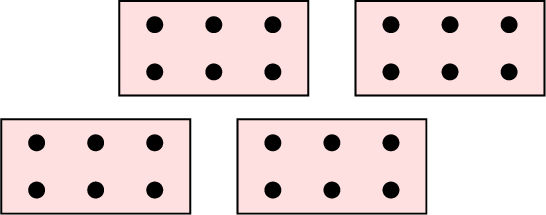
Nous avons 4 groupes de 6. On peut compter de 6 en 6 : 6, 12, 18, 24.

Il y a \(4 \times 6 = 6 + 6 + 6 + 6 = 24\) points.


Proposition Table de multiplication de6
\(\begin{aligned}\textcolor{colordef}{6}\times \textcolor{colorprop}{0}&=\textcolor{olive}{0}\\\textcolor{colordef}{6}\times \textcolor{colorprop}{1}&=\textcolor{olive}{6}\\\textcolor{colordef}{6}\times \textcolor{colorprop}{2}&=\textcolor{olive}{12 }\\\textcolor{colordef}{6}\times \textcolor{colorprop}{3}&=\textcolor{olive}{18 }\\\textcolor{colordef}{6}\times \textcolor{colorprop}{4}&=\textcolor{olive}{24 }\\\textcolor{colordef}{6}\times \textcolor{colorprop}{5}&=\textcolor{olive}{30 }\\\textcolor{colordef}{6}\times \textcolor{colorprop}{6}&=\textcolor{olive}{36 }\\\textcolor{colordef}{6}\times \textcolor{colorprop}{7}&=\textcolor{olive}{42 }\\\textcolor{colordef}{6}\times \textcolor{colorprop}{8}&=\textcolor{olive}{48 }\\\textcolor{colordef}{6}\times \textcolor{colorprop}{9}&=\textcolor{olive}{54 }\\\textcolor{colordef}{6}\times \textcolor{colorprop}{10}&=\textcolor{olive}{60}\end{aligned}\) \(\quad \quad\) \(\begin{aligned}\textcolor{colordef}{0}\times \textcolor{colorprop}{6}&=\textcolor{olive}{0}\\\textcolor{colordef}{1}\times \textcolor{colorprop}{6}&=\textcolor{olive}{6}\\\textcolor{colordef}{2}\times \textcolor{colorprop}{6}&=\textcolor{olive}{12}\\\textcolor{colordef}{3}\times \textcolor{colorprop}{6}&=\textcolor{olive}{18}\\\textcolor{colordef}{4}\times \textcolor{colorprop}{6}&=\textcolor{olive}{24}\\\textcolor{colordef}{5}\times \textcolor{colorprop}{6}&=\textcolor{olive}{30}\\\textcolor{colordef}{6}\times \textcolor{colorprop}{6}&=\textcolor{olive}{36}\\\textcolor{colordef}{7}\times \textcolor{colorprop}{6}&=\textcolor{olive}{42}\\\textcolor{colordef}{8}\times \textcolor{colorprop}{6}&=\textcolor{olive}{48}\\\textcolor{colordef}{9}\times \textcolor{colorprop}{6}&=\textcolor{olive}{54}\\\textcolor{colordef}{10}\times \textcolor{colorprop}{6}&=\textcolor{olive}{60}\end{aligned}\)

La table de multiplication de 7


Il y a 7 jours dans une semaine. Combien de jours y a-t-il dans 4 semaines ?

Nous avons 4 groupes de 7. On peut compter de 7 en 7 : 7, 14, 21, 28 jours.

Il y a \(4 \times 7 = 7 + 7 + 7 + 7 = 28\) jours.


Proposition Table de multiplication de 7
\(\begin{aligned}\textcolor{colordef}{7}\times \textcolor{colorprop}{0}&=\textcolor{olive}{0}\\\textcolor{colordef}{7}\times \textcolor{colorprop}{1}&=\textcolor{olive}{7}\\\textcolor{colordef}{7}\times \textcolor{colorprop}{2}&=\textcolor{olive}{14 }\\\textcolor{colordef}{7}\times \textcolor{colorprop}{3}&=\textcolor{olive}{21 }\\\textcolor{colordef}{7}\times \textcolor{colorprop}{4}&=\textcolor{olive}{28 }\\\textcolor{colordef}{7}\times \textcolor{colorprop}{5}&=\textcolor{olive}{35 }\\\textcolor{colordef}{7}\times \textcolor{colorprop}{6}&=\textcolor{olive}{42 }\\\textcolor{colordef}{7}\times \textcolor{colorprop}{7}&=\textcolor{olive}{49 }\\\textcolor{colordef}{7}\times \textcolor{colorprop}{8}&=\textcolor{olive}{56 }\\\textcolor{colordef}{7}\times \textcolor{colorprop}{9}&=\textcolor{olive}{63 }\\\textcolor{colordef}{7}\times \textcolor{colorprop}{10}&=\textcolor{olive}{70}\end{aligned}\) \(\quad \quad\) \(\begin{aligned}\textcolor{colordef}{0}\times \textcolor{colorprop}{7}&=\textcolor{olive}{0}\\\textcolor{colordef}{1}\times \textcolor{colorprop}{7}&=\textcolor{olive}{7}\\\textcolor{colordef}{2}\times \textcolor{colorprop}{7}&=\textcolor{olive}{14}\\\textcolor{colordef}{3}\times \textcolor{colorprop}{7}&=\textcolor{olive}{21}\\\textcolor{colordef}{4}\times \textcolor{colorprop}{7}&=\textcolor{olive}{28}\\\textcolor{colordef}{5}\times \textcolor{colorprop}{7}&=\textcolor{olive}{35}\\\textcolor{colordef}{6}\times \textcolor{colorprop}{7}&=\textcolor{olive}{42}\\\textcolor{colordef}{7}\times \textcolor{colorprop}{7}&=\textcolor{olive}{49}\\\textcolor{colordef}{8}\times \textcolor{colorprop}{7}&=\textcolor{olive}{56}\\\textcolor{colordef}{9}\times \textcolor{colorprop}{7}&=\textcolor{olive}{63}\\\textcolor{colordef}{10}\times \textcolor{colorprop}{7}&=\textcolor{olive}{70}\end{aligned}\)

La table de multiplication de 8


Une araignée a 8 pattes. Combien de pattes 4 araignées ont-elles en tout ?
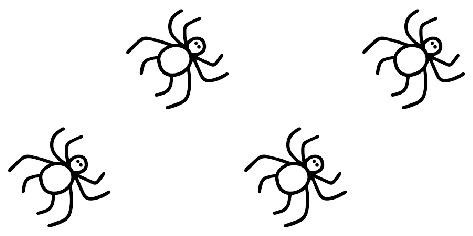
Nous avons 4 groupes de 8. On peut compter de 8 en 8 : 8, 16, 24, 32 pattes.

Il y a \(4 \times 8 = 8 + 8 + 8 + 8 = 32\) pattes.


Proposition Table de multiplication de8
\(\begin{aligned}\textcolor{colordef}{8}\times \textcolor{colorprop}{0}&=\textcolor{olive}{0}\\\textcolor{colordef}{8}\times \textcolor{colorprop}{1}&=\textcolor{olive}{8}\\\textcolor{colordef}{8}\times \textcolor{colorprop}{2}&=\textcolor{olive}{16 }\\\textcolor{colordef}{8}\times \textcolor{colorprop}{3}&=\textcolor{olive}{24 }\\\textcolor{colordef}{8}\times \textcolor{colorprop}{4}&=\textcolor{olive}{32 }\\\textcolor{colordef}{8}\times \textcolor{colorprop}{5}&=\textcolor{olive}{40 }\\\textcolor{colordef}{8}\times \textcolor{colorprop}{6}&=\textcolor{olive}{48 }\\\textcolor{colordef}{8}\times \textcolor{colorprop}{7}&=\textcolor{olive}{56 }\\\textcolor{colordef}{8}\times \textcolor{colorprop}{8}&=\textcolor{olive}{64 }\\\textcolor{colordef}{8}\times \textcolor{colorprop}{9}&=\textcolor{olive}{72 }\\\textcolor{colordef}{8}\times \textcolor{colorprop}{10}&=\textcolor{olive}{80}\end{aligned}\) \(\quad \quad\) \(\begin{aligned}\textcolor{colordef}{0}\times \textcolor{colorprop}{8}&=\textcolor{olive}{0}\\\textcolor{colordef}{1}\times \textcolor{colorprop}{8}&=\textcolor{olive}{8}\\\textcolor{colordef}{2}\times \textcolor{colorprop}{8}&=\textcolor{olive}{16}\\\textcolor{colordef}{3}\times \textcolor{colorprop}{8}&=\textcolor{olive}{24}\\\textcolor{colordef}{4}\times \textcolor{colorprop}{8}&=\textcolor{olive}{32}\\\textcolor{colordef}{5}\times \textcolor{colorprop}{8}&=\textcolor{olive}{40}\\\textcolor{colordef}{6}\times \textcolor{colorprop}{8}&=\textcolor{olive}{48}\\\textcolor{colordef}{7}\times \textcolor{colorprop}{8}&=\textcolor{olive}{56}\\\textcolor{colordef}{8}\times \textcolor{colorprop}{8}&=\textcolor{olive}{64}\\\textcolor{colordef}{9}\times \textcolor{colorprop}{8}&=\textcolor{olive}{72}\\\textcolor{colordef}{10}\times \textcolor{colorprop}{8}&=\textcolor{olive}{80}\end{aligned}\)

La table de multiplication de 9


Il y a 9 joueurs dans une équipe de baseball. Combien de joueurs y a-t-il dans 5 équipes ?

Nous avons 5 groupes de 9. On peut compter de 9 en 9 : 9, 18, 27, 36, 45 joueurs.
Il y a \(5 \times 9 = 9 + 9 + 9 + 9 + 9 = 45\) joueurs.


Proposition Table de multiplication de 9
\(\begin{aligned}\textcolor{colordef}{9}\times \textcolor{colorprop}{0}&=\textcolor{olive}{0}\\\textcolor{colordef}{9}\times \textcolor{colorprop}{1}&=\textcolor{olive}{9}\\\textcolor{colordef}{9}\times \textcolor{colorprop}{2}&=\textcolor{olive}{18 }\\\textcolor{colordef}{9}\times \textcolor{colorprop}{3}&=\textcolor{olive}{27 }\\\textcolor{colordef}{9}\times \textcolor{colorprop}{4}&=\textcolor{olive}{36 }\\\textcolor{colordef}{9}\times \textcolor{colorprop}{5}&=\textcolor{olive}{45 }\\\textcolor{colordef}{9}\times \textcolor{colorprop}{6}&=\textcolor{olive}{54 }\\\textcolor{colordef}{9}\times \textcolor{colorprop}{7}&=\textcolor{olive}{63 }\\\textcolor{colordef}{9}\times \textcolor{colorprop}{8}&=\textcolor{olive}{72 }\\\textcolor{colordef}{9}\times \textcolor{colorprop}{9}&=\textcolor{olive}{81 }\\\textcolor{colordef}{9}\times \textcolor{colorprop}{10}&=\textcolor{olive}{90}\end{aligned}\) \(\quad \quad\) \(\begin{aligned}\textcolor{colordef}{0}\times \textcolor{colorprop}{9}&=\textcolor{olive}{0}\\\textcolor{colordef}{1}\times \textcolor{colorprop}{9}&=\textcolor{olive}{9}\\\textcolor{colordef}{2}\times \textcolor{colorprop}{9}&=\textcolor{olive}{18}\\\textcolor{colordef}{3}\times \textcolor{colorprop}{9}&=\textcolor{olive}{27}\\\textcolor{colordef}{4}\times \textcolor{colorprop}{9}&=\textcolor{olive}{36}\\\textcolor{colordef}{5}\times \textcolor{colorprop}{9}&=\textcolor{olive}{45}\\\textcolor{colordef}{6}\times \textcolor{colorprop}{9}&=\textcolor{olive}{54}\\\textcolor{colordef}{7}\times \textcolor{colorprop}{9}&=\textcolor{olive}{63}\\\textcolor{colordef}{8}\times \textcolor{colorprop}{9}&=\textcolor{olive}{72}\\\textcolor{colordef}{9}\times \textcolor{colorprop}{9}&=\textcolor{olive}{81}\\\textcolor{colordef}{10}\times \textcolor{colorprop}{9}&=\textcolor{olive}{90}\end{aligned}\)

La grille de multiplication complète

Proposition Toutes les tables de multiplication de 1 à 10
Cette grille est un outil puissant qui montre toutes les tables de 1 à 10 en un seul endroit. Pour trouver la réponse à un problème comme \(7 \times 8\), trouve la ligne du 7 et la colonne du 8, et regarde où elles se croisent !
\(\times\) \(\textcolor{colorprop}{1}\) \(\textcolor{colorprop}{2}\) \(\textcolor{colorprop}{3}\) \(\textcolor{colorprop}{4}\) \(\textcolor{colorprop}{5}\) \(\textcolor{colorprop}{6}\) \(\textcolor{colorprop}{7}\) \(\textcolor{colorprop}{8}\) \(\textcolor{colorprop}{9}\) \(\textcolor{colorprop}{10}\)
\(\textcolor{colordef}{1}\) \(\textcolor{olive}{1}\) \(\textcolor{olive}{2}\) \(\textcolor{olive}{3}\) \(\textcolor{olive}{4}\) \(\textcolor{olive}{5}\) \(\textcolor{olive}{6}\) \(\textcolor{olive}{7}\) \(\textcolor{olive}{8}\) \(\textcolor{olive}{9}\) \(\textcolor{olive}{10}\)
\(\textcolor{colordef}{2}\) \(\textcolor{olive}{2}\) \(\textcolor{olive}{4}\) \(\textcolor{olive}{6}\) \(\textcolor{olive}{8}\) \(\textcolor{olive}{10}\) \(\textcolor{olive}{12}\) \(\textcolor{olive}{14}\) \(\textcolor{olive}{16}\) \(\textcolor{olive}{18}\) \(\textcolor{olive}{20}\)
\(\textcolor{colordef}{3}\) \(\textcolor{olive}{3}\) \(\textcolor{olive}{6}\) \(\textcolor{olive}{9}\) \(\textcolor{olive}{12}\) \(\textcolor{olive}{15}\) \(\textcolor{olive}{18}\) \(\textcolor{olive}{21}\) \(\textcolor{olive}{24}\) \(\textcolor{olive}{27}\) \(\textcolor{olive}{30}\)
\(\textcolor{colordef}{4}\) \(\textcolor{olive}{4}\) \(\textcolor{olive}{8}\) \(\textcolor{olive}{12}\) \(\textcolor{olive}{16}\) \(\textcolor{olive}{20}\) \(\textcolor{olive}{24}\) \(\textcolor{olive}{28}\) \(\textcolor{olive}{32}\) \(\textcolor{olive}{36}\) \(\textcolor{olive}{40}\)
\(\textcolor{colordef}{5}\) \(\textcolor{olive}{5}\) \(\textcolor{olive}{10}\) \(\textcolor{olive}{15}\) \(\textcolor{olive}{20}\) \(\textcolor{olive}{25}\) \(\textcolor{olive}{30}\) \(\textcolor{olive}{35}\) \(\textcolor{olive}{40}\) \(\textcolor{olive}{45}\) \(\textcolor{olive}{50}\)
\(\textcolor{colordef}{6}\) \(\textcolor{olive}{6}\) \(\textcolor{olive}{12}\) \(\textcolor{olive}{18}\) \(\textcolor{olive}{24}\) \(\textcolor{olive}{30}\) \(\textcolor{olive}{36}\) \(\textcolor{olive}{42}\) \(\textcolor{olive}{48}\) \(\textcolor{olive}{54}\) \(\textcolor{olive}{60}\)
\(\textcolor{colordef}{7}\) \(\textcolor{olive}{7}\) \(\textcolor{olive}{14}\) \(\textcolor{olive}{21}\) \(\textcolor{olive}{28}\) \(\textcolor{olive}{35}\) \(\textcolor{olive}{42}\) \(\textcolor{olive}{49}\) \(\textcolor{olive}{56}\) \(\textcolor{olive}{63}\) \(\textcolor{olive}{70}\)
\(\textcolor{colordef}{8}\) \(\textcolor{olive}{8}\) \(\textcolor{olive}{16}\) \(\textcolor{olive}{24}\) \(\textcolor{olive}{32}\) \(\textcolor{olive}{40}\) \(\textcolor{olive}{48}\) \(\textcolor{olive}{56}\) \(\textcolor{olive}{64}\) \(\textcolor{olive}{72}\) \(\textcolor{olive}{80}\)
\(\textcolor{colordef}{9}\) \(\textcolor{olive}{9}\) \(\textcolor{olive}{18}\) \(\textcolor{olive}{27}\) \(\textcolor{olive}{36}\) \(\textcolor{olive}{45}\) \(\textcolor{olive}{54}\) \(\textcolor{olive}{63}\) \(\textcolor{olive}{72}\) \(\textcolor{olive}{81}\) \(\textcolor{olive}{90}\)
\(\textcolor{colordef}{10}\) \(\textcolor{olive}{10}\) \(\textcolor{olive}{20}\) \(\textcolor{olive}{30}\) \(\textcolor{olive}{40}\) \(\textcolor{olive}{50}\) \(\textcolor{olive}{60}\) \(\textcolor{olive}{70}\) \(\textcolor{olive}{80}\) \(\textcolor{olive}{90}\) \(\textcolor{olive}{100}\)