International Baccalaureate · DP 1: Applications and Interpretation HL
Transformations of Functions
I
Translations, Stretches and Reflections
I.1
Translations
Recappreviously studied — click to reread
Function transformations take a basic “parent” function and modify it to create a new, related function. A sequence of transformations can translate, stretch or reflect the graph of the parent function.
Understanding these transformations makes it possible to predict the graph of a more complicated function from a simpler one, and to model real-world phenomena by adjusting a basic function to fit observed data. The transformations are vertical and horizontal translations, stretches (a stretch with a scale factor between \(0\) and \(1\) is also called a compression) and reflections.
Understanding these transformations makes it possible to predict the graph of a more complicated function from a simpler one, and to model real-world phenomena by adjusting a basic function to fit observed data. The transformations are vertical and horizontal translations, stretches (a stretch with a scale factor between \(0\) and \(1\) is also called a compression) and reflections.
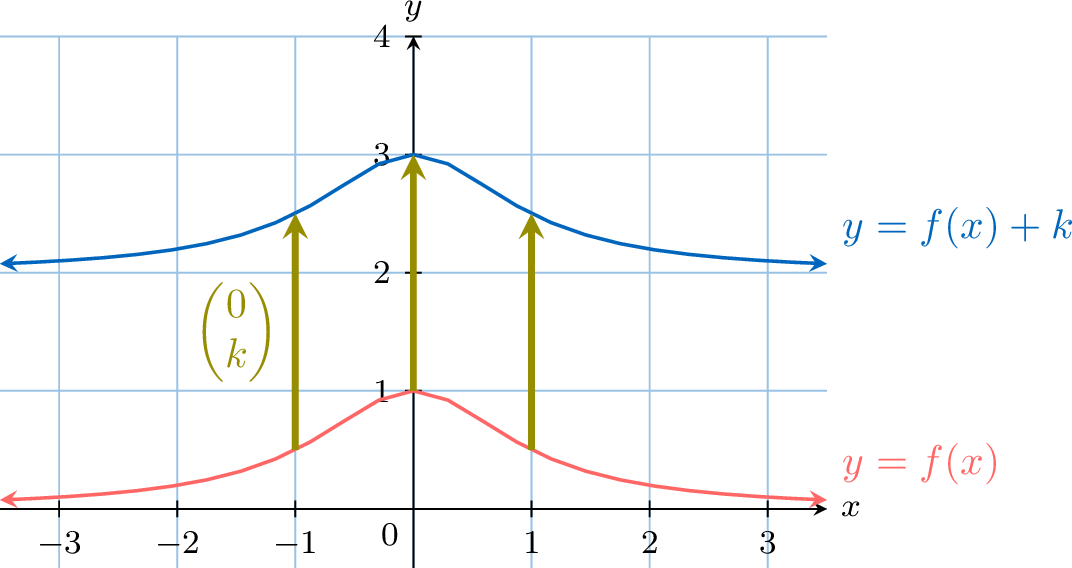
Definition — Vertical Translation by Adding a Constant
A vertical translation shifts the graph of a function up or down. The transformation is defined by:$$g(x) = f(x) + k$$ This transformation maps a point \((x, y)\) on the graph of \(f\) to a new point \((x, y+k)\) on the graph of \(g\). - If \(k>0\), the graph is translated \(\boldsymbol{k}\) units up.
- If \(k<0\), the graph is translated \(\boldsymbol{|k|}\) units down.
Definition — Horizontal Translation
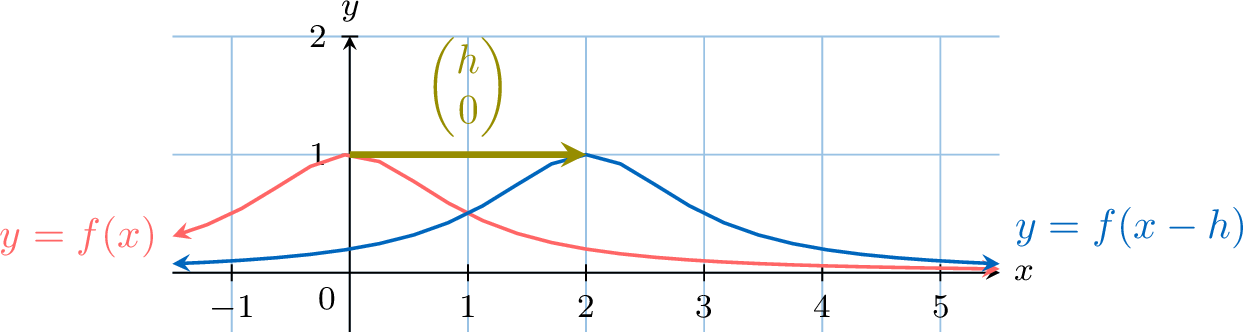
A horizontal translation shifts the graph of a function left or right. The transformation is defined by:$$g(x) = f(x-h)$$ This transformation maps a point \((x, y)\) on the graph of \(f\) to a new point \((x+h, y)\) on the graph of \(g\). - If \(h>0\), the graph is translated \(\boldsymbol{h}\) units to the right.
- If \(h<0\), the graph is translated \(\boldsymbol{|h|}\) units to the left.
Example
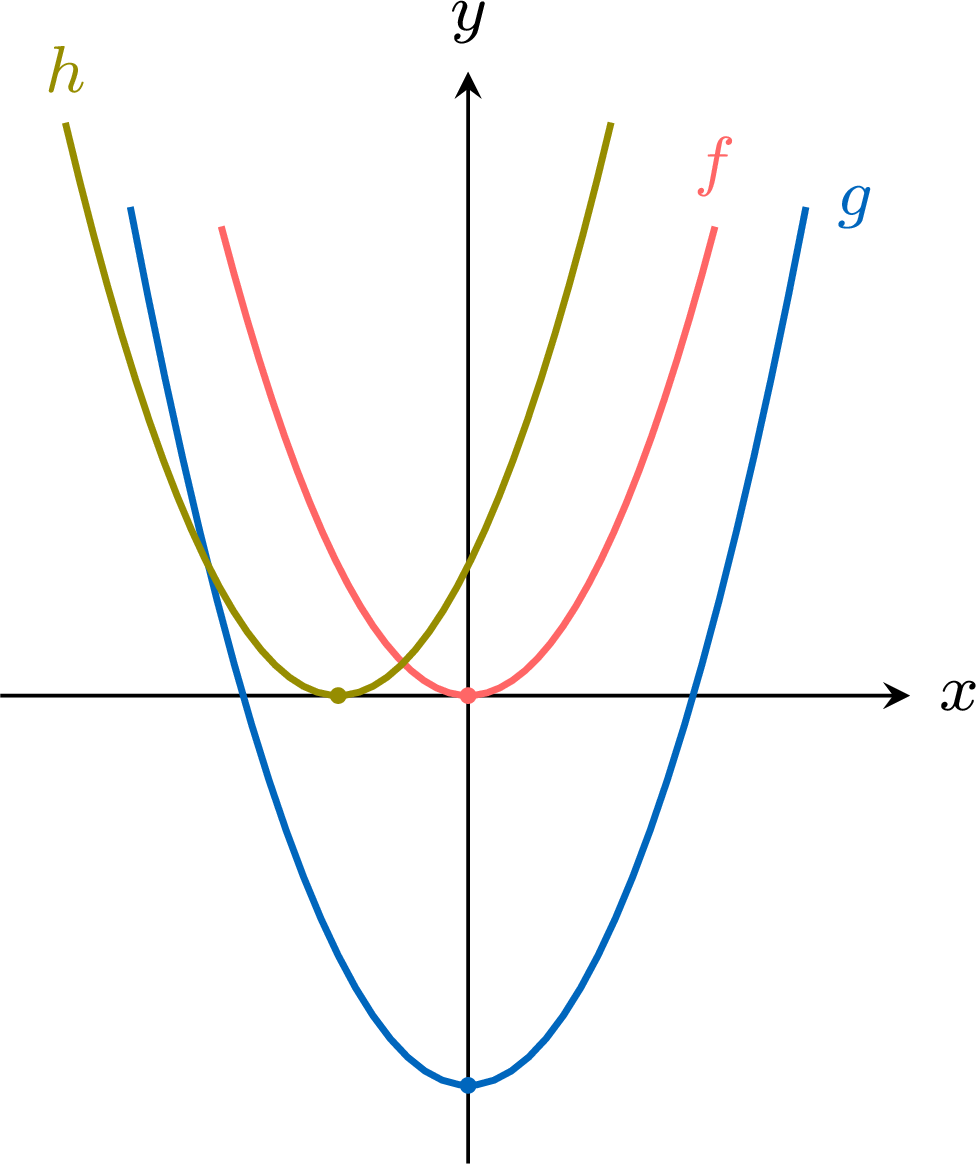
From the graph of \(f(x) = x^2\), plot \(g(x) = f(x) - 3\) and \(h(x) = f(x + 1)\). - \(g(x) = f(x) - 3\): every output is lowered by \(3\) — a vertical translation \(3\) units down. The vertex \((0, 0)\) moves to \((0, -3)\).
- \(h(x) = f(x + 1)\): the input \(x = -1\) now plays the role \(0\) used to play — a horizontal translation \(1\) unit to the left. The vertex \((0, 0)\) moves to \((-1, 0)\).
Translation by a Vector
The vertical and the horizontal translations combine into one. The translation by the vector \(\begin{pmatrix} h \\ k \end{pmatrix}\) moves each point \((x, y)\) of the graph of \(f\) to the point \((X, Y) = (x + h, y + k)\). Since \(x = X - h\) and \(Y = f(x) + k\), the image points satisfy \(Y = f(X - h) + k\); writing \((x, y)\) again for the coordinates, the image of the graph of \(y = f(x)\) is the graph of $$y = f(x - h) + k.$$ For example, the translation by the vector \(\begin{pmatrix} 3 \\ -2 \end{pmatrix}\) maps the graph of \(y = x^2\) onto the graph of \(y = (x - 3)^2 - 2\), and its vertex \((0, 0)\) to \((3, -2)\).
Skills to practice
- Translating Graphs
I.2
Stretches
Recappreviously studied — click to reread
Definition — Vertical Stretch
A vertical stretch stretches or compresses the graph of a function vertically. It is defined, for a number \(a \neq 0\), by:$$g(x) = a \cdot f(x)$$ This transformation maps a point \((x, y)\) to \((x, ay)\). - If \(|a|>1\), the graph is stretched vertically by a factor of \(|a|\).
- If \(0 < |a| < 1\), the graph is compressed vertically by a factor of \(|a|\).
- If \(a < 0\), the stretch or compression is followed by a reflection in the \(x\)-axis (\(a = -1\) gives the reflection alone).

Definition — Horizontal Stretch
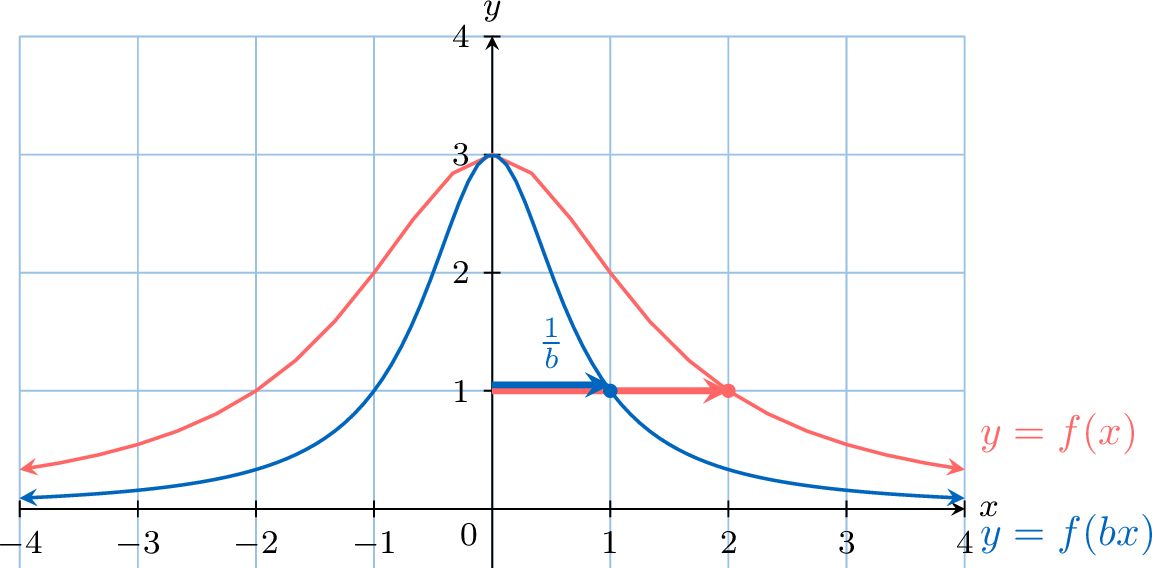
A horizontal stretch stretches or compresses the graph of a function horizontally. It is defined, for a number \(b \neq 0\), by:$$g(x) = f(bx)$$ This transformation maps a point \((x, y)\) to a new point \((\frac{x}{b}, y)\). - If \(|b|>1\), the graph is compressed horizontally by a factor of \(\frac{1}{|b|}\).
- If \(0 < |b| < 1\), the graph is stretched horizontally by a factor of \(\frac{1}{|b|}\).
- If \(b < 0\), the stretch or compression is followed by a reflection in the \(y\)-axis (\(b = -1\) gives the reflection alone).
Example
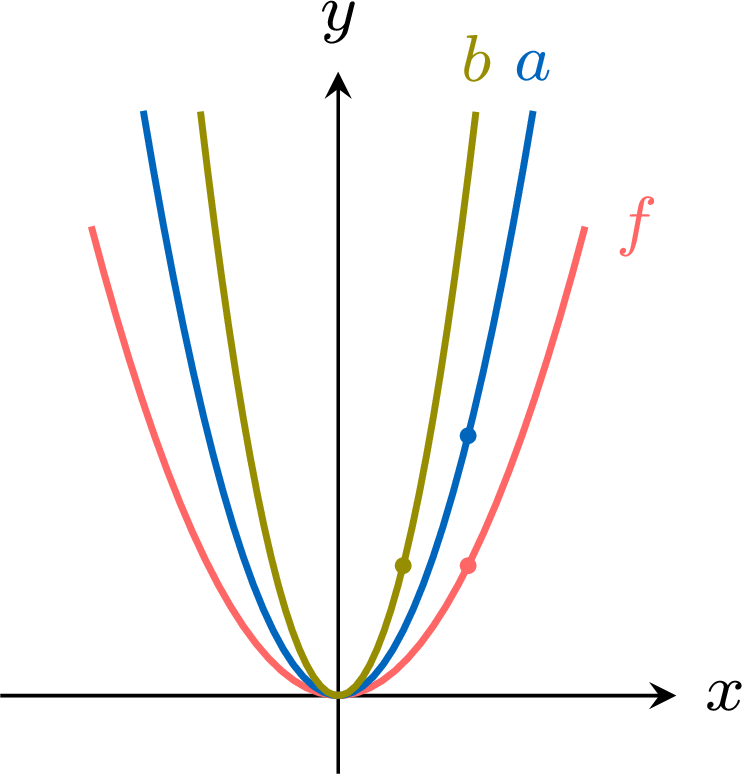
From the graph of \(f(x) = x^2\), plot \(a(x) = 2f(x)\) and \(b(x) = f(2x)\). - \(a(x) = 2f(x) = 2x^2\): every output is doubled — a vertical stretch with scale factor \(2\). The point \((1, 1)\) moves to \((1, 2)\).
- \(b(x) = f(2x) = 4x^2\): the input is consumed twice as fast — a horizontal stretch with scale factor \(\frac12\), a compression: every \(x\)-coordinate is halved. The point \((1, 1)\) moves to \(\left(\frac12, 1\right)\).
Stretches and Scale Factors
The number by which a stretch multiplies the distances to the axis that stays fixed is its scale factor. For \(a > 0\), the graph of \(y = a f(x)\) is the image of the graph of \(y = f(x)\) under the vertical stretch with scale factor \(a\): each point \((x, y)\) goes to \((x, ay)\). For \(b > 0\), the graph of \(y = f(bx)\) is its image under the horizontal stretch with scale factor \(\dfrac{1}{b}\): each point \((x, y)\) goes to \(\left(\dfrac{x}{b}, y\right)\). A scale factor greater than \(1\) moves the points away from the axis that stays fixed (the \(x\)-axis for a vertical stretch, the \(y\)-axis for a horizontal one), a scale factor between \(0\) and \(1\) brings them closer to it: the graph of \(y = f(2x)\) is the image of the graph of \(f\) under the horizontal stretch with scale factor \(\dfrac{1}{2}\), a compression.
Skills to practice
- Stretching Graphs
I.3
Reflections
Recappreviously studied — click to reread
Definition — Reflection in the x-axis
A reflection in the x-axis flips the graph of a function vertically. It is a special case of vertical stretch where \(a=-1\). It is defined by:$$g(x) = -f(x)$$ This transformation maps a point \((x, y)\) to \((x, -y)\). 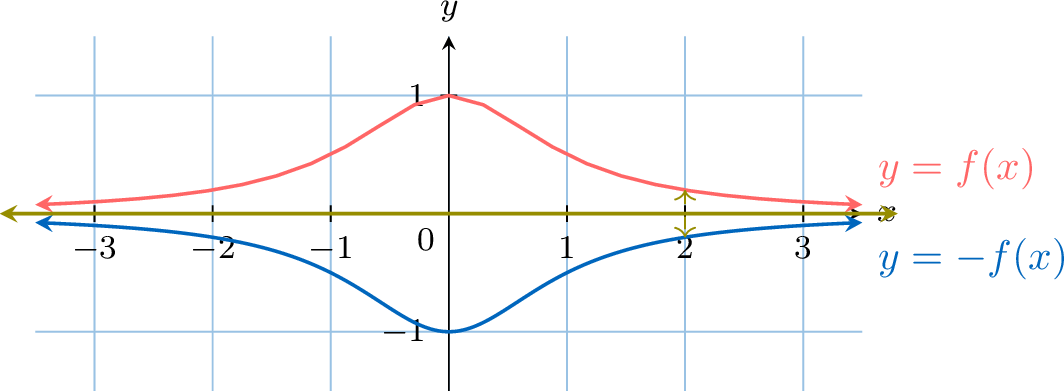
Definition — Reflection in the y-axis
A reflection in the y-axis flips the graph of a function horizontally. It is a special case of horizontal stretch where \(b=-1\). It is defined by:$$g(x) = f(-x)$$ This transformation maps a point \((x, y)\) to \((-x, y)\). 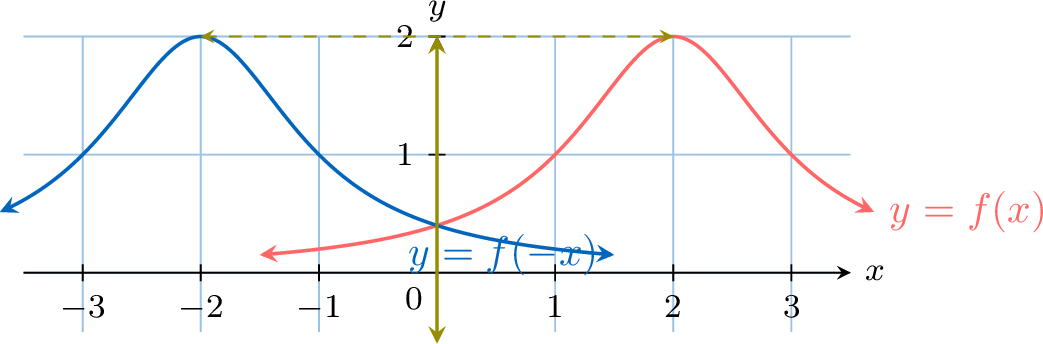
Example
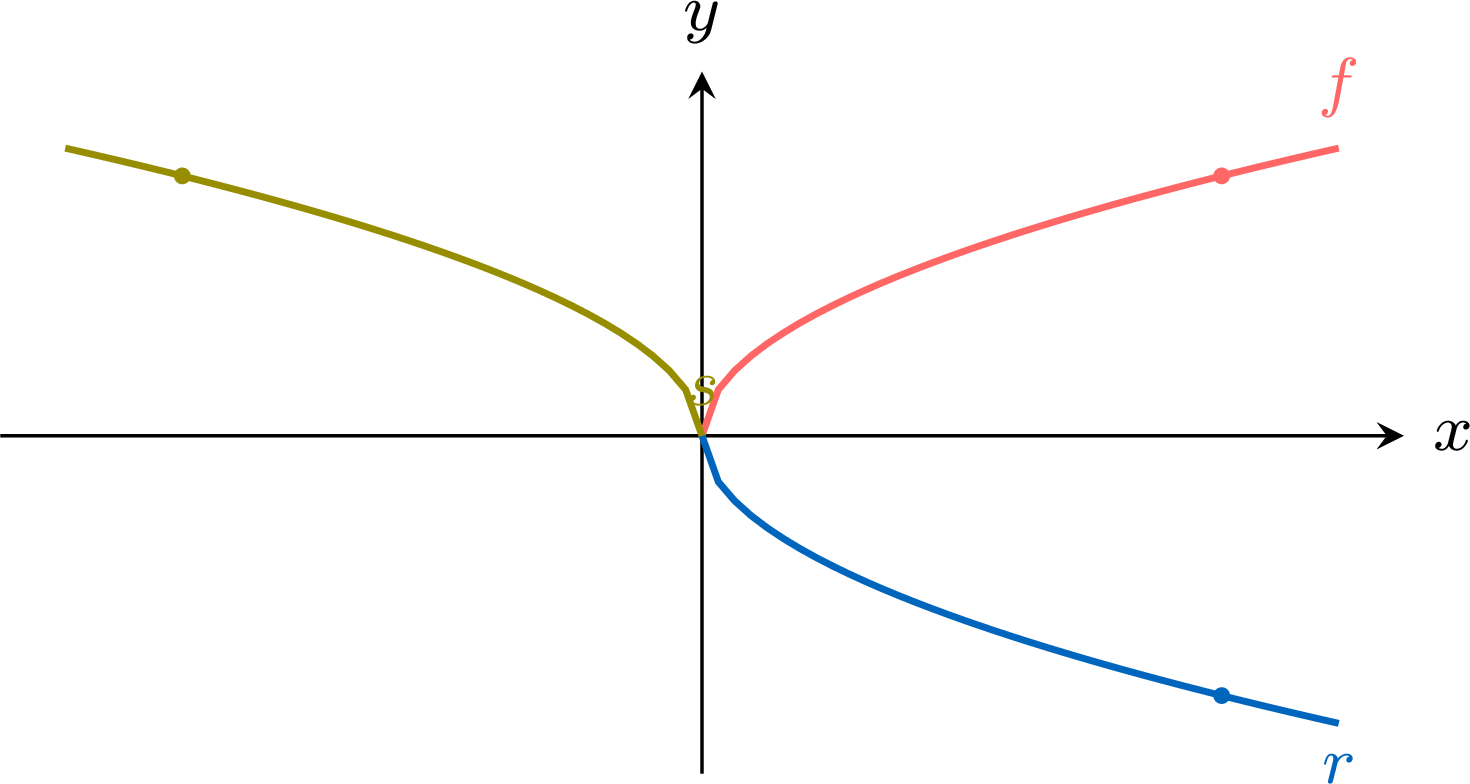
From the graph of \(f(x) = \sqrt{x}\), plot \(r(x) = -f(x)\) and \(s(x) = f(-x)\). - \(r(x) = -\sqrt{x}\): every output changes sign — a reflection in the \(x\)-axis. The curve flips below the axis; the point \((4, 2)\) moves to \((4, -2)\).
- \(s(x) = \sqrt{-x}\): every input changes sign — a reflection in the \(y\)-axis. The curve flips to the left half-plane (defined for \(x \le 0\)); the point \((4, 2)\) moves to \((-4, 2)\).
Skills to practice
- Reflecting Graphs
II
Composite Transformations
II.1
Combining Transformations
Recappreviously studied — click to reread
When several transformations are applied to a function, the order can matter between two horizontal transformations, or between two vertical ones (a stretch and a translation, for example); a horizontal transformation and a vertical one can be applied in either order. The standard form for a transformed function is:$$ g(x) = a \cdot f(b(x-c)) + d $$ To graph this function from the parent function \(f(x)\), apply the transformations in the following order:
Method — Order of Transformations
- Horizontal Transformations (inside the brackets):
- Apply the horizontal stretch with scale factor \(\frac{1}{|b|}\) (\(b \neq 0\)), followed by a reflection in the \(y\)-axis if \(b < 0\).
- Apply the horizontal translation (shift) by \(c\) units.
- Vertical Transformations (outside the brackets):
- Apply the vertical stretch with scale factor \(|a|\), followed by a reflection in the \(x\)-axis if \(a < 0\).
- Apply the vertical translation (shift) by \(d\) units.
Example
Describe the sequence of transformations that maps the graph of \(f(x)=\sqrt{x}\) onto the graph of \(g(x) = 3\sqrt{-x+2} - 4\).
First, we rewrite the function \(g(x)\) in the standard form \(a \cdot f(b(x-c)) + d\):$$ g(x) = 3\sqrt{-(x-2)} - 4 $$ Comparing this to \(f(x)=\sqrt{x}\), we have \(a=3\), \(b=-1\), \(c=2\), and \(d=-4\). The transformations are applied as follows: 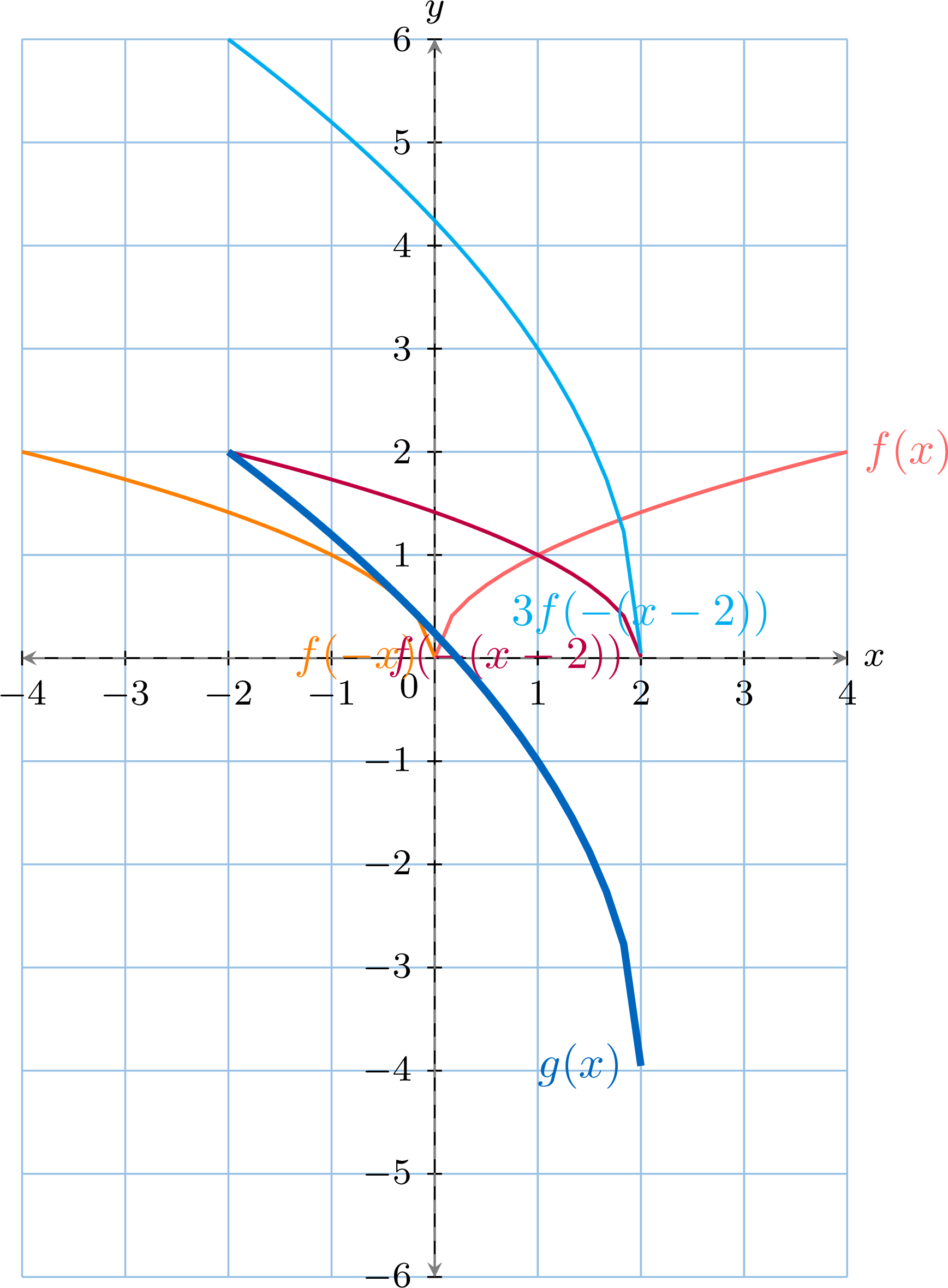
- Horizontal Transformations on \(f(x)=\sqrt{x}\):
- Reflection: Since \(b=-1\), reflect the graph in the y-axis (\(y = \sqrt{-x}\)).
- Translation: Since \(c=2\), translate the graph 2 units to the right (\(y = \sqrt{-(x-2)}\)).
- Vertical Transformations on the result:
- Stretch: Since \(a=3\), stretch the graph vertically with scale factor 3 (\(y = 3\sqrt{-(x-2)}\)).
- Translation: Since \(d=-4\), translate the graph 4 units down (\(y = 3\sqrt{-(x-2)} - 4\)).
Example
The graph of \(y = f(x)\) is reflected in the \(y\)-axis, then stretched horizontally with scale factor \(2\). Find an equation of the image, and check it with a point \((a, b)\) of the graph of \(f\).
Each transformation acts on the equation obtained at the previous step: a horizontal transformation replaces \(x\) in the current expression, a vertical transformation acts on the whole current expression.
Check with a point. The reflection sends a point \((a, b)\) of the graph of \(f\) to \((-a, b)\), and the stretch doubles the \(x\)-coordinate: \((-a, b)\) goes to \((-2a, b)\). At \(x = -2a\), the expression inside \(f\) is $$\begin{aligned}[t] -\frac{x}{2} &= -\frac{-2a}{2} && (x = -2a) \\ &= a, \end{aligned}$$ so \(f\left(-\dfrac{x}{2}\right) = f(a) = b\), since the point \((a, b)\) is on the graph of \(f\): the point \((-2a, b)\) is indeed on the image. Replacing \(x\) by \(-2x\) instead, that is writing \(f(-2x)\), would give the horizontal stretch with scale factor \(\dfrac{1}{2}\): the check with a point detects this error, since \(f\big(-2 \times (-2a)\big) = f(4a)\) is not equal to \(b\) in general. 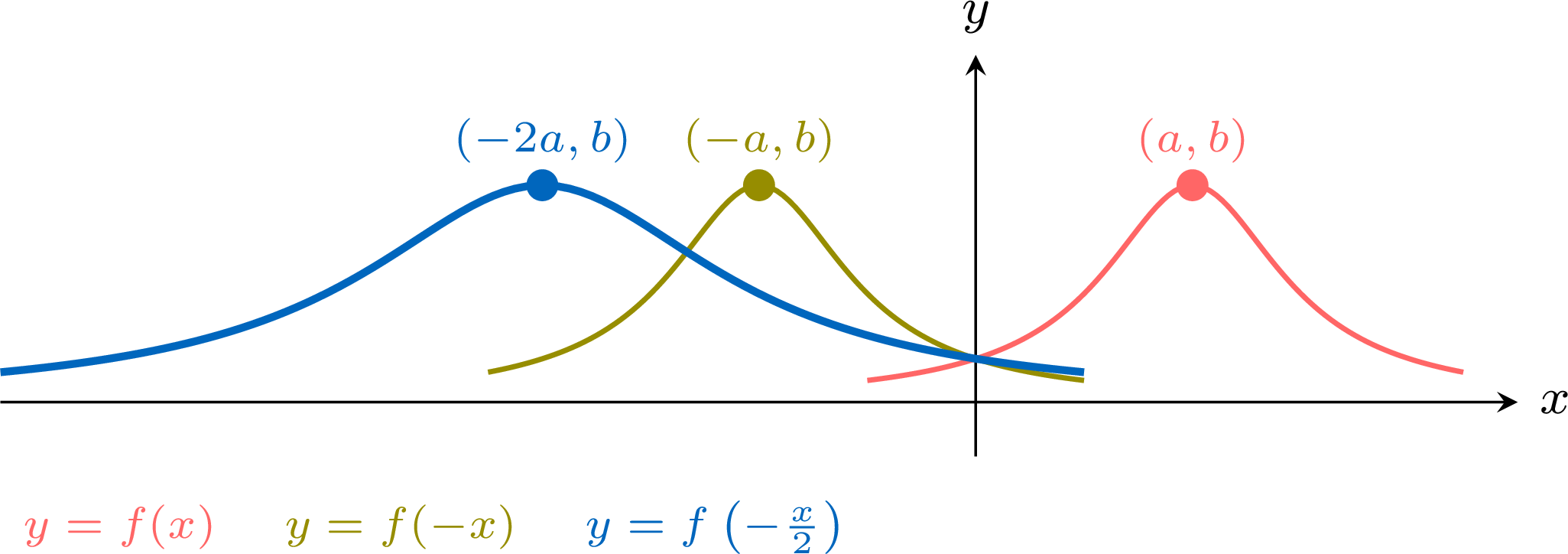
- Reflection in the \(y\)-axis: \(x\) is replaced by \(-x\): \(y = f(-x)\).
- Horizontal stretch with scale factor \(2\): \(x\) is replaced by \(\dfrac{x}{2}\) in the current expression \(f(-x)\): \(y = f\left(-\dfrac{x}{2}\right)\).
Check with a point. The reflection sends a point \((a, b)\) of the graph of \(f\) to \((-a, b)\), and the stretch doubles the \(x\)-coordinate: \((-a, b)\) goes to \((-2a, b)\). At \(x = -2a\), the expression inside \(f\) is $$\begin{aligned}[t] -\frac{x}{2} &= -\frac{-2a}{2} && (x = -2a) \\ &= a, \end{aligned}$$ so \(f\left(-\dfrac{x}{2}\right) = f(a) = b\), since the point \((a, b)\) is on the graph of \(f\): the point \((-2a, b)\) is indeed on the image. Replacing \(x\) by \(-2x\) instead, that is writing \(f(-2x)\), would give the horizontal stretch with scale factor \(\dfrac{1}{2}\): the check with a point detects this error, since \(f\big(-2 \times (-2a)\big) = f(4a)\) is not equal to \(b\) in general.
Skills to practice
- Sketching Combined Transformations
- Finding Equations after a Sequence of Transformations
III
Going further
Skills to practice
- Reasoning about Transformations
- Solving Problems with Transformations
Jump to section