International Baccalaureate · DP 1: Analysis and Approaches SL
Set Theory
A comprehensive introduction to set theory: elements, subsets, cardinality, and operations (union, intersection, complement). Explores Venn diagrams, set-builder notation, and number sets (N, Z, Q, R), plus representing solutions to linear inequalities using interval notation.
I
Sets
Definition — Set
A set is a collection of objects, called elements.We list its elements between curly brackets.
Example
List all eelments of the set \(E\), which includes all possible results when rolling a standard die  .
.
\(E=\{1,2,3,4,5,6\}=\{\), ,
, ,
, ,
, ,
, \(\}\).
,,,,,\(\}\).Definition — Element
- An element is an object contained in a set.
- \(\in\) means "is an element of" or "belongs to".
- \(\notin\) means "is not an element of" or "does not belong to".
Example
\(2\in \{1,2,3,4,5,6\}\) and \(7\notin \{1,2,3,4,5,6\}\).Definition — Equal sets
Two sets are equal if they have exactly the same elements.Example
Determine if the sets \(\{2,6,4\}\) and \(\{2,4,6\}\) are equal.
Yes, the sets \(\{2,6,4\}\) and \(\{2,4,6\}\) are equal because they contain the same elements: \(2\), \(4\), and \(6\).
Example
Determine if the sets \(\{1,2,3\}\) and \(\{1,2,4\}\) are equal.
No, the sets \(\{1,2,3\}\) and \(\{1,2,4\}\) are not equal because element \(3\) belongs to \(\{1,2,3\}\) but not to \(\{1,2,4\}\).
Definition — Empty Set
The empty set is a set with no elements. It is written as \(\{\}\) or \(\emptyset\).Skills to practice
- Listing the Elements
- Listing the Elements in Arithmetic
- Checking Membership
- Checking Membership in Geometry
- Checking Set Equality
II
Natural Numbers
Definition — Natural Numbers
The set of natural numbers, denoted \(\N\), is the set of counting numbers starting from zero:$$\N = \{0, 1, 2, 3, 4, 5, 6, \dots\}$$Skills to practice
- Checking Membership
III
Subsets
Definition — Subset
A set \(A\) is a subset of a set \(B\) if every element in \(A\) is also in \(B\). We write this as \(A \subseteq B\).Example
Is \(A \subseteq B\) when \(A = \{2, 4, 6\}\) and \(B = \{1, 2, 3, 4, 5, 6\}\)?
Check each element: \(2\), \(4\), and \(6\) from \(A\) are all in \(B = \{1, 2, 3, 4, 5, 6\}\). Since every element of \(A\) is in \(B\), \(A \subseteq B\).
Skills to practice
- Checking Subsets
IV
Set-Builder Notation
Definition — Set-Builder Notation
The set-builder notation is a way to describe a set by giving a rule that its elements must follow. It is written like this:$$\{x \in E \mid \text{condition on } x\}$$In this notation, \(x\) represents an element from a set \(E\), and the symbol \(\mid\) (or sometimes \(:\)) separates \(x\) from the condition it must meet.It reads: “the set of all \(x\) in \(E\) such that \(x\) satisfies the condition.”
Example
Let \(E=\{1, 2, 3, 4, 5, 6\}\) be the set of results from rolling a standard six-sided die  .
.What are the elements of the set \(\{x \in E \mid x \text{ is even}\}\)?
The set \(\{x \in E \mid x \text{ is even}\}\) contains all the even numbers in \(E\). Given \(E = \{1, 2, 3, 4, 5, 6\}\), the even numbers are \(2\), \(4\), and \(6\), so:$$\{x \in E \mid x \text{ is even}\} = \{2, 4, 6\}$$
Skills to practice
- Checking Membership
- Listing the Elements
- Writing in Set-Builder Form
- Checking Subsets
V
Ordered Pairs/n-tuples
Definition — Ordered Pair/n-tuple
An ordered pair, denoted by \((a, b)\), is a collection of two elements where one is designated as the first element (\(a\)) and the other as the second element (\(b\)). Two ordered pairs \((a, b)\) and \((c, d)\) are equal if and only if \(a=c\) and \(b=d\).More generally, an ordered n-tuple is a finite sequence of \(n\) elements, denoted \((a_1, a_2, \dots, a_n)\). Two n-tuples \((a_1, \dots, a_n)\) and \((b_1, \dots, b_n)\) are equal if and only if their corresponding elements are equal, i.e., \(a_i = b_i\) for all \(i=1, \dots, n\).
Example
In a sprint relay race, two runners are paired up. Let \(L\) denote Louis and \(H\) denote Hugo.The ordered pair \((L, H)\) means Louis runs first, then passes the baton to Hugo.
The ordered pair \((H, L)\) means Hugo runs first, then passes the baton to Louis.
These are two different orders/teams (ordered pairs).
Skills to practice
- Comparing Pairs and Sets
- Choosing Between Ordered Pairs and Sets
VI
Cardinality
Definition — Cardinality
\(\Card{A}\) denotes the number of elements in the set \(A\).Example
\(\Card{\{1,2,3,4,5,6\}}=6\) 
Definition — Finite and Infinite Sets
- A finite set has a finite number of elements. That is, you can count all its elements and finish counting.
- An infinite set has an unlimited number of elements; it is not finite.
Example
- \(\{1, 2, 3\}\) is finite because it has exactly 3 elements.\quad

- \(\N = \{0, 1, 2, 3, \dots\}\) is infinite because there is no end to counting.
Skills to practice
- Counting
- Counting Ways
- Classifying Sets as Finite or Infinite Sets
- Counting in Set-Builder
VII
Intersection and Union
Definition — Intersection
The intersection of two sets \(A\) and \(B\), written \(A \cap B\), is the set of elements that are in both \(A\) and \(B\).Example
What is the intersection \(\{1, 2, 3\} \cap \{2, 3, 4\}\)?
For the intersection \(\cap\), include all common elements: \(\textcolor{colorprop}{2}\) and \(\textcolor{olive}{3}\). So $$\{\textcolor{colordef}{1}, \textcolor{colorprop}{2}, \textcolor{olive}{3}\} \cap \{ \textcolor{colorprop}{2}, \textcolor{olive}{3},\textcolor{brown}{4}\} = \{\textcolor{colorprop}{2},\textcolor{olive}{3}\}$$
Definition — Union
The union of two sets \(A\) and \(B\), written \(A \cup B\), is the set of all elements in \(A\) or \(B\) (or both).Example
What is the union \(\{1, 2, 3\} \cup \{2, 3, 4\}\)?
For the union \(\cup\), include all elements from both sets without repeats: \(\textcolor{colordef}{1}, \textcolor{colorprop}{2}, \textcolor{olive}{3},\textcolor{brown}{4}\). So, $$\{\textcolor{colordef}{1}, \textcolor{colorprop}{2}, \textcolor{olive}{3}\} \cup \{ \textcolor{colorprop}{2}, \textcolor{olive}{3},\textcolor{brown}{4}\} = \{\textcolor{colordef}{1}, \textcolor{colorprop}{2}, \textcolor{olive}{3},\textcolor{brown}{4}\}$$
Skills to practice
- Finding the Intersection/Union: Level 1
- Finding the Intersection/Union: Level 2
VIII
Complement
Definition — Universal set
A universal set is the set of all elements considered.Definition — Complement
The complement of a set \(A\), denoted \(A'\), consists of all elements in universal set \(U\) that are not in \(A\). Sets \(A\) and \(A'\) are said to be complementary.Example
Given the universe \(U = \{1, 2, 3, 4, 5, 6\}\) and the set \(A = \{1, 3, 5\}\), find the complement \(A'\).
Start with the universe \(U = \{1, 2, 3, 4, 5, 6\}\).
The set \(A = \{1, 3, 5\}\) includes 1, 3, and 5.
The complement \(A'\) is all the elements in \(U\) that are not in \(A\):
$$A' = \{2, 4, 6\}$$
The set \(A = \{1, 3, 5\}\) includes 1, 3, and 5.
The complement \(A'\) is all the elements in \(U\) that are not in \(A\):
$$A' = \{2, 4, 6\}$$
Skills to practice
- Finding the Complement
IX
Venn Diagrams
Definition — Venn Diagram
A Venn diagram uses a rectangle to show the universal set \(U\) and circles to represent other sets within it.Example
Here’s a Venn diagram for \(U = \{1, 2, 3, 4, 5, 6\}\) and \(A = \{1, 3, 5\}\):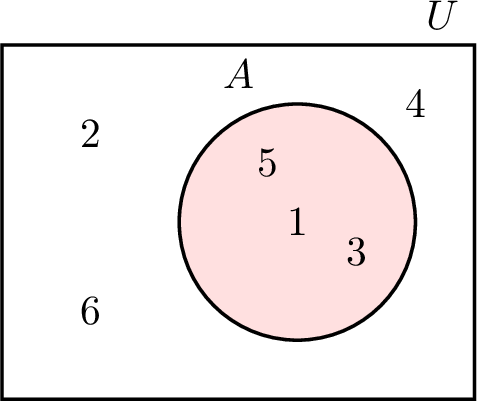
Definition — Key Venn Diagram Concepts
This table shows common set operations and their Venn diagrams:| Notation | Meaning | Venn Diagram |
| \(A\) | Set \(A\) | 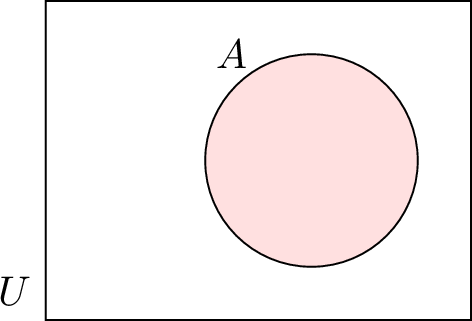 |
| \(A'\) | Complement of \(A\) (everything in \(U\) not in \(A\)) | 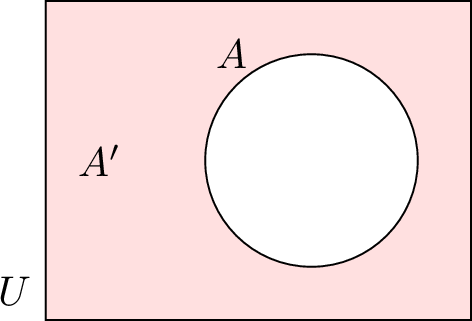 |
| \(A \subseteq B\) | \(A\) is a subset of \(B\) | 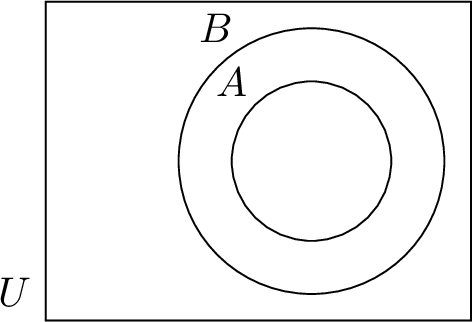 |
| \(A \cup B\) | Union of \(A\) and \(B\) (all elements in \(A\) or \(B\)) | 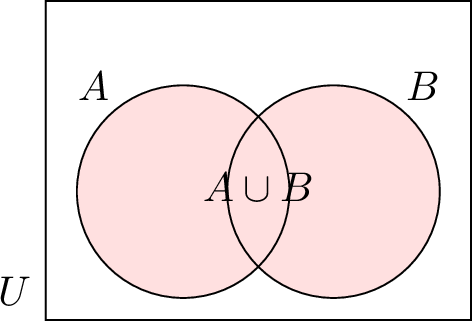 |
| \(A \cap B\) | Intersection of \(A\) and \(B\) (elements in both) | 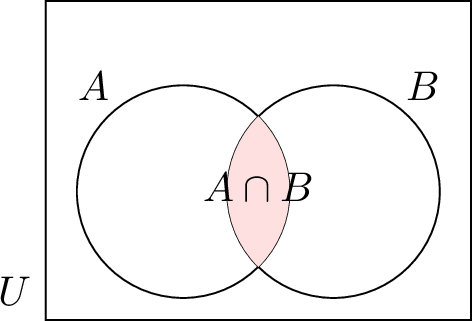 |
| \(A \cap B = \emptyset\) | \(A\) and \(B\) are disjoint (no common elements) | 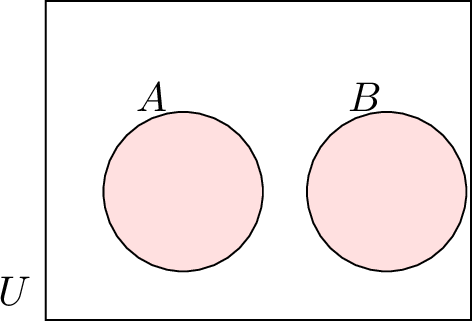 |
Venn diagrams help solve problems by showing the number of elements in each region.
Definition — Counting Elements
In a Venn diagram, we use parentheses around numbers to show how many elements are in each region.Example
Consider this Venn diagram: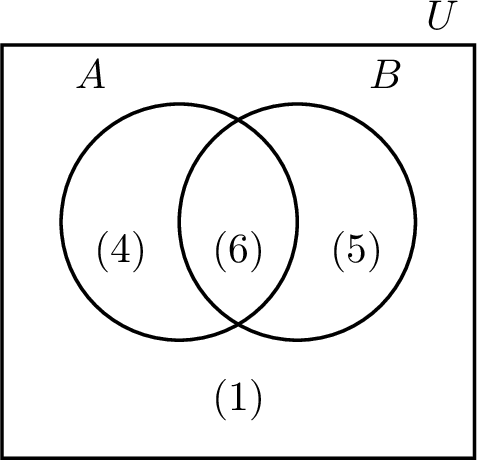
Skills to practice
- Identifying Elements Using Venn Diagrams
- Identifying Elements Using Venn Diagrams
- Solving Word Problems with Venn Diagrams
X
Number Sets
Number sets are groups of numbers defined by specific properties and form the foundation of mathematics. We begin with the simplest set, the natural numbers (\(\N\)), used for counting. We then build the integers (\(\Z\)) by adding negative numbers. Next, we expand to the rational numbers (\(\Q\)) by allowing fractions, covering all possible divisions between integers. Finally, we reach the real numbers (\(\R\)) by including irrational numbers, which fills the entire number line. Each set contains the previous ones.
Definition — Number Sets
- The natural numbers, denoted \(\N\), are the counting numbers, starting from zero:$$\N = \{0, 1, 2, 3, 4, 5, 6, \dots\}$$
- The integers, denoted \(\Z\), include all integers (negative, zero, positive):$$\Z = \{\dots, -3, -2, -1, 0, 1, 2, 3, \dots\}$$
- The rational numbers, denoted \(\Q\), are all numbers that can be written as a fraction \(\frac{p}{q}\), where \(p\) and \(q\) are integers and \(q \neq 0\):$$\Q = \left\{ \frac{p}{q} \mid p, q \in \Z,\, q \neq 0 \right\}$$
- The real numbers, denoted \(\R\), include all points on the number line: rational and irrational numbers (such as \(\sqrt{2}\) and \(\pi\)):$$\R = \{\text{all rational and irrational numbers}\}$$
Proposition — Relationships Between Number Sets
The number sets are nested as follows:$$\N \subset \Z \subset \Q \subset \R$$This means: every natural number is an integer, every integer is a rational number, and every rational number is a real number.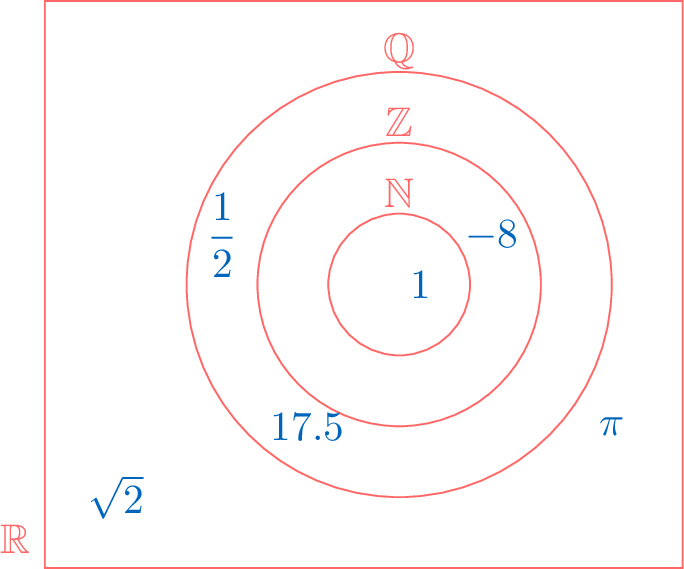
Skills to practice
- Checking Membership
XI
Intervals
Definition — Interval
An interval is a set of all real numbers between two endpoints, which may or may not be included in the set.Example
The set of all real numbers between \(0\) and \(1\), including \(1\) but not \(0\), is an interval. It is written as \(\{x \in \R \mid 0 < x \leq 1\}\).Method — Representing Intervals on a Number Line
Intervals are often shown on a number line using these conventions:- An open point (empty circle) or a parenthesis, means the endpoint is not included.
- A closed point (filled circle) or a bracket, means the endpoint is included.
- An arrow shows that the interval extends indefinitely (to \(+\infty\) or \(-\infty\)).
Example
The number line representation of \(\{x \in \R \mid 0 < x \leq 1\}\) is:
Definition — Interval Notation
| Interval Notation | Set-builder notation | Number line representation |
| \(\CloseBracketLeft a, b \CloseBracketRight\) | \(\{x \in \R \mid a \leqslant x \leqslant b\}\) |  |
| \(\CloseBracketLeft a, b \OpenBracketRight\) | \(\{x \in \R \mid a \leqslant x < b\}\) |  |
| \(\OpenBracketLeft a, b \CloseBracketRight\) | \(\{x \in \R \mid a < x \leqslant b\}\) |  |
| \(\OpenBracketLeft a, b \OpenBracketRight\) | \(\{x \in \R \mid a < x < b\}\) |  |
| \(\CloseBracketLeft a, +\infty\OpenBracketRight \) | \(\{x \in \R \mid a \leqslant x\}\) |  |
| \(\OpenBracketLeft a, +\infty \OpenBracketRight \) | \(\{x \in \R \mid a < x\}\) |  |
| \(\OpenBracketLeft -\infty, a\CloseBracketRight\) | \(\{x \in \R \mid x \leqslant a\}\) |  |
| \(\OpenBracketLeft -\infty, a\OpenBracketRight\) | \(\{x \in \R \mid x < a\}\) |  |
Skills to practice
- Converting Sets to Interval Notation
- Converting Number Line Graphs to Interval Notation
- Checking Membership
- Solving Linear Inequalities
XII
Review \& Beyond
Skills to practice
- Quiz
Jump to section