Lines in the Plane
Direction Vectors
Definition Direction Vector
A non-zero vector \(\vec{u}\) is a direction vector of a line \(d\) if there exist two distinct points \(A\) and \(B\) on \(d\) such that \(\Vect{u} = \Vect{AB}\).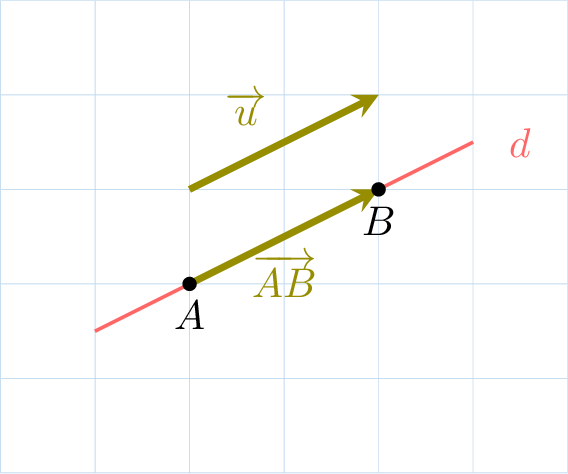
Proposition Multiple Direction Vectors
A line has an infinite number of direction vectors. If \(\vec{u}\) is a direction vector of line \(d\), then any vector \(k\vec{u}\) (where \(k \neq 0\)) is also a direction vector of \(d\).
Definition Line defined by Point and Vector
The line \(d\) passing through point \(A\) with direction vector \(\vec{u}\) is the set of all points \(M\) such that the vectors \(\Vect{AM}\) and \(\vec{u}\) are collinear.$$\Vect{AM} = k\vec{u} \quad \text{for some } k \in \mathbb{R}$$
Proposition Parallelism Criterion
Two lines \(d_1\) and \(d_2\) with direction vectors \(\vec{u}_1\) and \(\vec{u}_2\) are:
- parallel if and only if \(\vec{u}_1\) and \(\vec{u}_2\) are collinear (\(\det(\vec{u}_1, \vec{u}_2) = 0\)).
- intersecting (sécantes) if and only if \(\vec{u}_1\) and \(\vec{u}_2\) are not collinear (\(\det(\vec{u}_1, \vec{u}_2) \neq 0\)).
Cartesian Equations
Definition Cartesian Equation
Every line \(d\) in the plane has an equation of the form:$$\textcolor{olive}{a}x + \textcolor{olive}{b}y + \textcolor{olive}{c} = 0$$where \(a\) and \(b\) are not both zero. This is called a Cartesian equation of the line.
A direction vector for this line is \(\Vect{u}=\begin{pmatrix} \textcolor{olive}{-b} \\ \textcolor{olive}{a} \end{pmatrix}\).
A direction vector for this line is \(\Vect{u}=\begin{pmatrix} \textcolor{olive}{-b} \\ \textcolor{olive}{a} \end{pmatrix}\).
Example
Find a direction vector for the line with equation \(2x - 3y + 5 = 0\).
Here \(a = 2\) and \(b = -3\). Using \(\Vect{u}=\begin{pmatrix} -b \\ a \end{pmatrix}\), we get:$$\Vect{u}\begin{pmatrix} -(-3) \\
2 \end{pmatrix} = \Vect{u}\begin{pmatrix} 3 \\
2 \end{pmatrix}$$
Definition Slope-Intercept Form
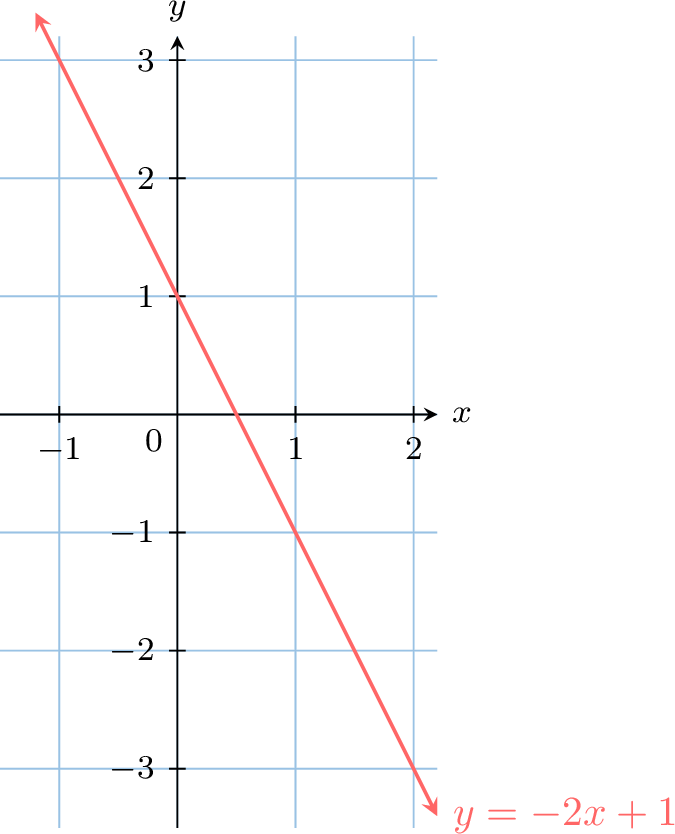
The slope-intercept form of a line's equation is:$$y = mx + c$$where \(m\) is the slope (gradient) and \(c\) is the \(y\)-intercept.
- The slope \(m\) tells us how much \(y\) changes when \(x\) increases by \(1\).
- The \(y\)-intercept \(c\) is the value of \(y\) when \(x = 0\), i.e. the point where the line crosses the \(y\)-axis.
Example
Proposition Reduced Equation of a Line
Every line in the plane admits a unique reduced equation:
- If the line \(d\) is not vertical (not parallel to the \(y\)-axis), its reduced equation is of the form: \(\boldsymbol{y = mx + c}\).
- If the line \(d\) is vertical (parallel to the \(y\)-axis), its reduced equation is of the form: \(\boldsymbol{x = k}\) (where \(k\) is a constant).
Proposition Slope Formula
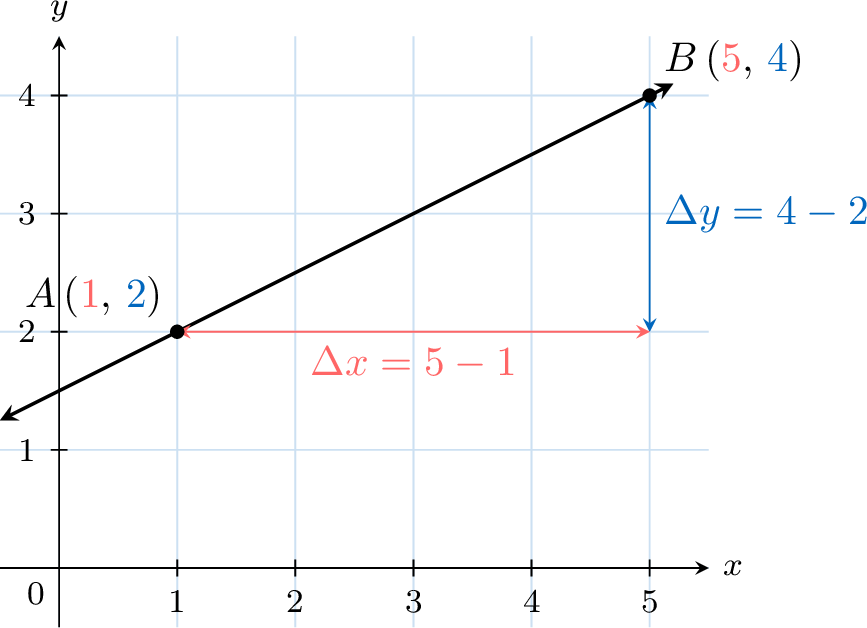
The slope of a non-vertical line passing through two distinct points \(A\left(\textcolor{colordef}{x_A}, \textcolor{colorprop}{y_A}\right)\) and \(B\left(\textcolor{colordef}{x_B}, \textcolor{colorprop}{y_B}\right)\) is given by the formula:$$\text{slope} = \frac{\textcolor{colorprop}{y_B}-\textcolor{colorprop}{y_A}}{\textcolor{colordef}{x_B}-\textcolor{colordef}{x_A}}, \quad \text{where } \textcolor{colordef}{x_A} \neq \textcolor{colordef}{x_B}$$The order of the points does not matter, as long as we subtract in the same order in the numerator and the denominator.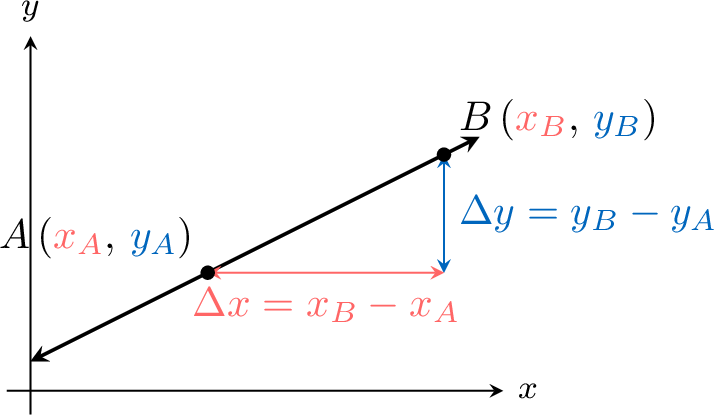
Example
Find the slope of the line \(\Line{AB}\) for \(A\left(\textcolor{colordef}{1}, \textcolor{colorprop}{2}\right)\) and \(B\left(\textcolor{colordef}{5}, \textcolor{colorprop}{4}\right)\).
Proposition Summary Table
| Line Type | Equation | Direction Vector |
| Non-vertical | \(y = mx + p\) | \(\begin{pmatrix} 1 \\ m \end{pmatrix}\) |
| Vertical | \(x = c\) | \(\begin{pmatrix} 0 \\ 1 \end{pmatrix}\) |
| General | \(ax + by + c = 0\) | \(\begin{pmatrix} -b \\ a \end{pmatrix}\) |
Intersection of Two Lines and Linear Systems
Finding the intersection of two lines \(d\) and \(d'\) in the plane means looking for a point \(M(x;y)\) that belongs to both lines at the same time. This problem is equivalent to finding the solution(s) of a system of two linear equations with two unknowns.
Method Determining the Intersection Point
To determine the intersection point of two non-parallel lines: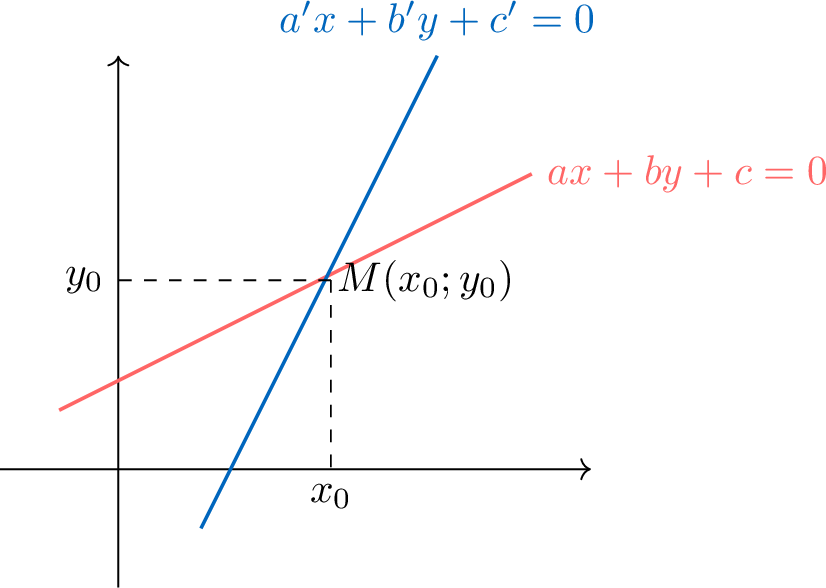
- Write the equations of both lines as a system: \(\begin{cases} ax + by + c = 0 \\ a'x + b'y + c' = 0 \end{cases}\)
- Solve the system using the substitution method or the elimination method.
- The calculated values \((x_0; y_0)\) are the coordinates of the intersection point.
Example
Find the intersection point of line \(d\) with equation \(x + y - 3 = 0\) and line \(d'\) with equation \(2x - y = 0\).
We solve the system: \((S) \begin{cases} x + y = 3 \\ y = 2x \end{cases}\)
Substituting \(y\) in the first equation:$$\begin{aligned}x + (2x) &= 3 \\ 3x &= 3 \\ x &= 1\end{aligned}$$Then, using \(y = 2x\), we find \(y = 2 \times 1 = 2\).
The intersection point is \(\boldsymbol{A(1; 2)}\).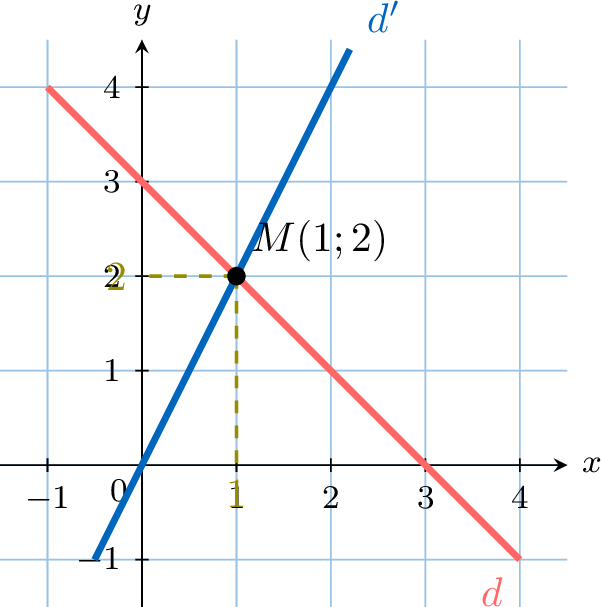
Substituting \(y\) in the first equation:$$\begin{aligned}x + (2x) &= 3 \\ 3x &= 3 \\ x &= 1\end{aligned}$$Then, using \(y = 2x\), we find \(y = 2 \times 1 = 2\).
The intersection point is \(\boldsymbol{A(1; 2)}\).
Proposition Number of Solutions
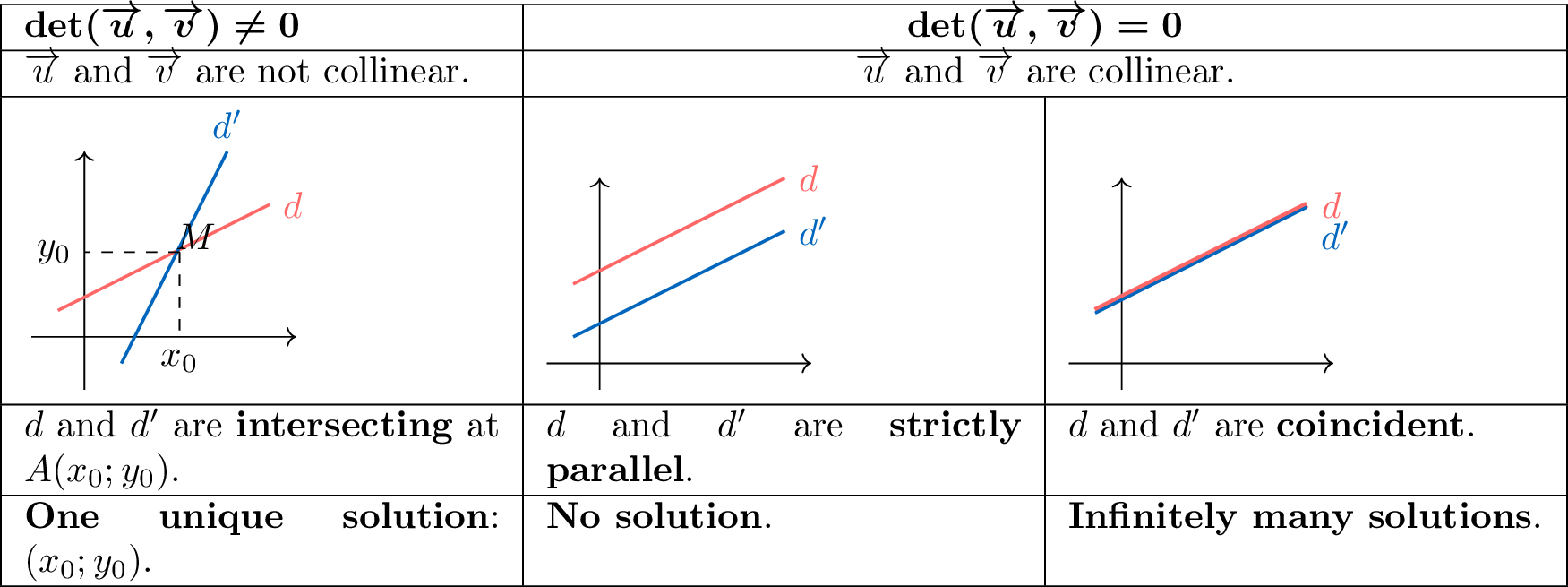
Let \(\Vect{u}=\begin{pmatrix} -b \\ a \end{pmatrix}\) and \(\Vect{v}=\begin{pmatrix} -b' \\ a' \end{pmatrix}\) be the direction vectors of lines \(d\) and \(d'\). Their determinant is \(\det(\vec{u}, \vec{v}) = ab' - a'b\).