Solving Equations and Inequalities
We can solve equations of the form \(f(x) = g(x)\) or inequalities like \(f(x) < g(x)\) using two main approaches: graphical (using the intersections of curves) or algebraic (using calculation).
Graphical Method
Method Solving Graphically
To solve equations and inequalities using the graphs of \(f\) and \(g\):
- For \(f(x) = g(x)\): Locate the intersection points of the two curves. The solutions are the x-coordinates (abscissas) of these points.
- For \(f(x) < g(x)\): Identify the intervals of \(x\) where the curve of \(f\) is below the curve of \(g\).
- For \(f(x) > g(x)\): Identify the intervals of \(x\) where the curve of \(f\) is above the curve of \(g\).
Example
The functions \(f\) and \(g\) are represented below. Solve \(f(x) = g(x)\) and \(f(x) \leq g(x)\).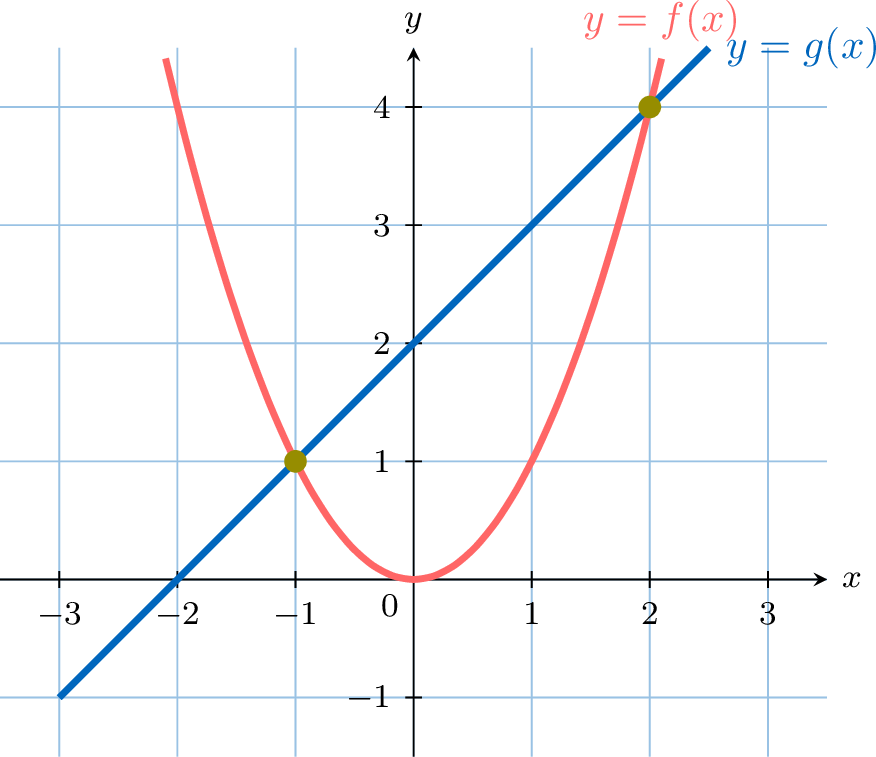
- Equation \(f(x) = g(x)\): The curves intersect at \(x = -1\) and \(x = 2\). The solution set is \(\boldsymbol{S = \{-1 ; 2\}}\).
- Inequality \(f(x) \leq g(x)\): The curve of \(f\) is below or touching the curve of \(g\) between the two intersection points. The solution set is the interval \(\boldsymbol{S = [-1 ; 2]}\).
Algebraic Method
Method Solving Algebraically
To solve \(f(x) = g(x)\) algebraically:
- Set the expressions for \(f(x)\) and \(g(x)\) equal to each other.
- Move all terms to one side of the equation to obtain an expression equal to zero (e.g., \(f(x) - g(x) = 0\)).
- Factorize or simplify to find the exact values of \(x\).
Example
Let \(f(x) = 3x + 1\) and \(g(x) = x + 7\). Solve \(f(x) = g(x)\).
$$\begin{aligned} f(x) &= g(x) \\
3x + 1 &= x + 7 \\
3x - x &= 7 - 1 \\
2x &= 6 \\
x &= 3\end{aligned}$$The solution is \(\boldsymbol{x = 3}\).