Kinematics
Kinematics is the study of the motion of objects without considering the forces that cause the motion. In this chapter, we use calculus to formally describe motion along a straight line. We will develop functions for displacement, velocity, and acceleration, and explore the relationships between them.
Displacement
Definition Displacement Function
For an object \(P\) in motion along a straight line, the displacement function \(s(t)\) gives the position of the object (its signed distance from a fixed origin) at any time \(t \ge 0\).
Example
A particle's displacement from an origin O is given by \(s(t) = t^2 - 4t + 3\) cm for \(0 \le t \le 5\) seconds.
- Find the initial displacement.
- Find when the particle is at the origin.
- Initial Displacement (\(t=0\)):
\(s(0) = 0^2 - 4(0) + 3 = 3\) cm. The particle starts 3 cm to the right of the origin (in the positive direction). - At the Origin (\(s(t)=0\)):
\(t^2 - 4t + 3 = 0 \implies (t-1)(t-3) = 0\).
The particle is at the origin at \(t=1\) s and \(t=3\) s.
Velocity
Definition Average Velocity
The average velocity of an object moving in the time interval from \(t=t_1\) to \(t=t_2\) is given by$$\begin{aligned} \text{average velocity} &= \frac{\text{change in displacement}}{\text{change in time}} \\
&= \frac{s(t_2) - s(t_1)}{t_2 - t_1}.\end{aligned}$$
Definition Velocity Function
The instantaneous velocity \(v(t)\) of an object is the rate of change of its displacement. It is found by differentiating the displacement function \(s(t)\):$$ \textcolor{colordef}{v(t) = s'(t) = \frac{ds}{dt}} $$
Note
- If \(v(t) > 0\), the object is moving to the right (in the positive direction).
- If \(v(t) < 0\), the object is moving to the left (in the negative direction).
- If \(v(t) = 0\), the object is instantaneously at rest.
Proposition Displacement from Velocity
The change in displacement over the interval \([t_1, t_2]\) is the definite integral of the velocity function:$$ s(t_2) - s(t_1) = \int_{t_1}^{t_2} v(t) \,dt. $$
Speed
Definition Speed
The speed of an object is the magnitude of its velocity:\(S(t) = |v(t)|\).
Proposition Distance
The total distance travelled over \([t_1, t_2]\) is the definite integral of the speed:$$ \text{Distance} = \int_{t_1}^{t_2} |v(t)| \,dt. $$
Acceleration
Definition Acceleration Function
The acceleration \(a(t)\) of an object is the rate of change of its velocity. It is the second derivative of the displacement function:$$ \textcolor{colordef}{a(t) = v'(t) = s''(t)} $$
The kinematic functions are related through differentiation and integration.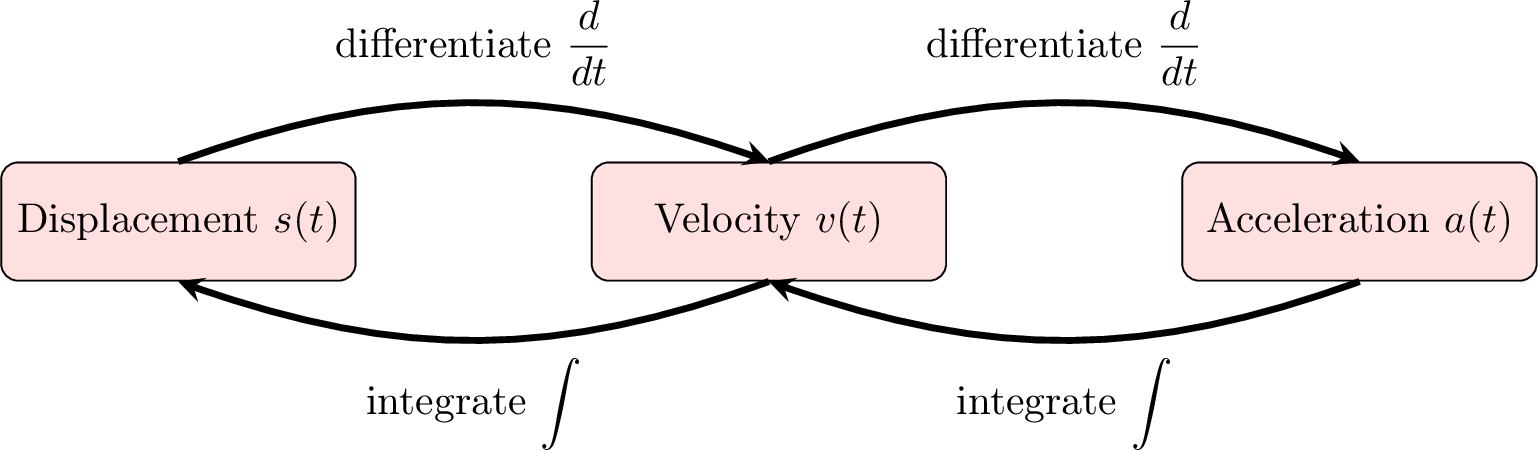
Proposition Sign Test for Speed
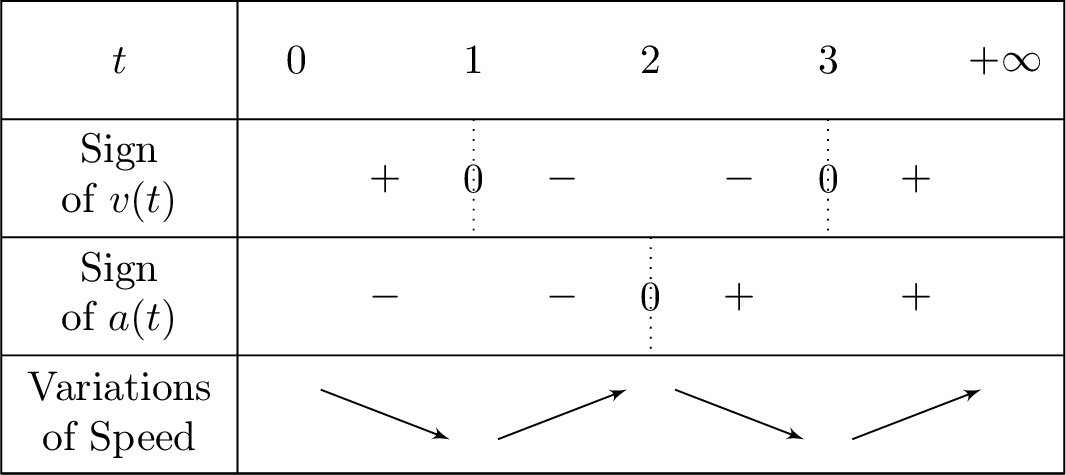
- Speed is increasing when \(v(t)\) and \(a(t)\) have the same sign.
- Speed is decreasing when \(v(t)\) and \(a(t)\) have opposite signs.
Example
The displacement of a particle is given by \(s(t) = t^3 - 6t^2 + 9t\) cm, for \(t \ge 0\).
- Find expressions for the velocity and acceleration.
- Find when the particle's speed is increasing.
- Velocity and Acceleration: $$ v(t) = s'(t) = 3t^2 - 12t + 9 \;\text{cm/s}, $$ $$ a(t) = v'(t) = 6t - 12 \;\text{cm/s}^2. $$
- Increasing Speed:
We need \(v(t)\) and \(a(t)\) to have the same sign. First, find the roots: $$ v(t) = 3(t^2-4t+3) = 3(t-1)(t-3) = 0 \implies t=1,\; 3, $$ $$ a(t) = 6(t-2) = 0 \implies t=2. $$ We build a sign table for both functions: