Graph Theory
Graphs are used to show how things are connected. They can be used to help solve problems in train scheduling, traffic flow, bed usage in hospitals, and project management.
The theory of graphs was developed centuries ago, but the application of the theoretical ideas is relatively recent. Real progress was made during and after the Second World War as mathematicians, industrial technicians, and members of the armed services worked together to improve military operations.
The theory of graphs was developed centuries ago, but the application of the theoretical ideas is relatively recent. Real progress was made during and after the Second World War as mathematicians, industrial technicians, and members of the armed services worked together to improve military operations.
Definitions
Definition Graph
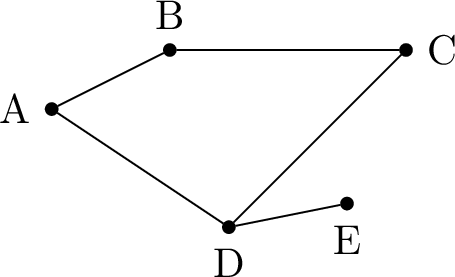
A graph (or network) is a structure which shows the physical connections or relationships between things of interest.
The things of interest are represented by vertices (singular: vertex), also called nodes or points.
The connections or relationships are represented by edges, also called lines or arcs.
The things of interest are represented by vertices (singular: vertex), also called nodes or points.
The connections or relationships are represented by edges, also called lines or arcs.
Example
Definition Degree of a Vertex
The degree of a vertex, denoted \(\deg(v)\), is the number of edges connected to it.
If a loop exists (an edge connecting a vertex to itself), it contributes 2 to the degree of that vertex.
If a loop exists (an edge connecting a vertex to itself), it contributes 2 to the degree of that vertex.
Example
Definition Undirected Graph
In an undirected graph, movement is allowed in either direction along the edges. The relationship is symmetric.
- Adjacent vertices are vertices connected by an edge.
- Adjacent edges are edges which share a common vertex.
Example
Definition Directed Graph
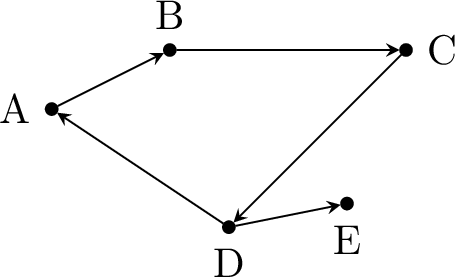
A directed graph (or digraph) contains arrows indicating the direction we can move along the edges.
- The in-degree is the number of edges coming into the vertex.
- The out-degree is the number of edges going out from the vertex.
Example
Definition Weighted Graph
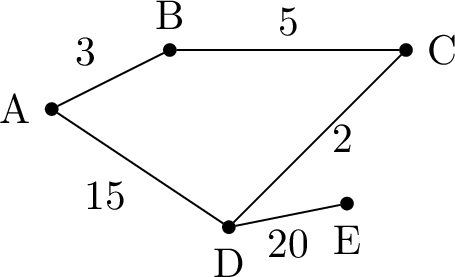
A weighted graph has numbers assigned to its edges. These numbers may represent the cost, time, or distance.
Example
Definition Walk\(\virgule\) Trail\(\virgule\) Path\(\virgule\) circuit and Cycle
- A walk is a sequence of vertices such that each successive pair is adjacent.
- A trail is a walk in which no edge is repeated.
- A path is a walk in which no vertex is repeated.
- A circuit is a walk in which no edge is repeated that starts and ends at the same vertex.
- A cycle is a walk in which no vertex is repeated except the first/last vertex that starts and ends at the same vertex.
Example
- \(A\rightarrow B\rightarrow C\) is a walk because there is an edge between \(A\) and \(B\) and an edge between \(B\) and \(C\).
- \(A\rightarrow B\rightarrow A\) is not a trail because the edge between \(A\) and \(B\) is repeated.
- \(A\rightarrow B\rightarrow C\rightarrow D\rightarrow A\) is not a path because the vertex \(A\) is repeated.
- \(A\rightarrow B\rightarrow C\rightarrow D\rightarrow A\) is a circuit (and a cycle).
Definition Subgraph
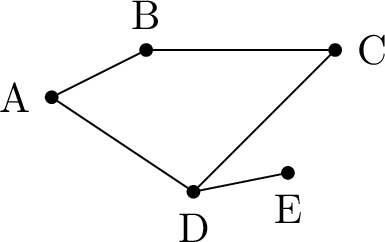
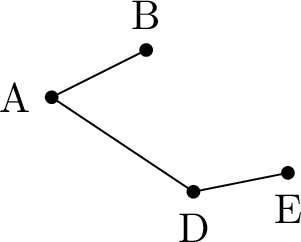
A subgraph is a graph that is made from a subset of the vertices and edges of another graph.
Example
Consider the original graph \(G\). We can create a subgraph \(H\) by selecting only a subset of the vertices (for example, removing vertex C) and only a subset of the edges.
| Graph \(G\) | Subgraph \(H\) |
 |  |
Properties of Graphs
Definition Simple Graph
A graph is called simple if it contains no loops and if there is a maximum of one edge joining any pair of distinct vertices.
Example
| Simple Graph | Not Simple (loop) | Not Simple (double edges) |
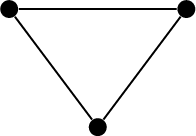 | 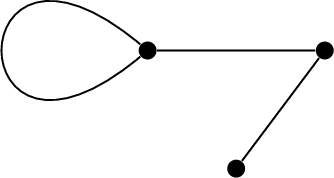 | 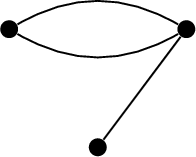 |
Definition Connected Graph
A graph is called connected if it is possible to travel from any vertex to any other vertex via a sequence of edges.
Example
| Connected | Disconnected |
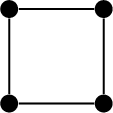 | 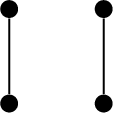 |
Definition Complete Graph
A complete graph is a simple undirected graph in which every vertex is connected by an edge to every other vertex.
The notation \(K_n\) is used to describe the complete graph with \(n\) vertices.
The notation \(K_n\) is used to describe the complete graph with \(n\) vertices.
Example
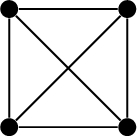
Adjacency Matrices
Definition Adjacency Matrix
For a graph with \(n\) vertices, the adjacency matrix \(\mathbf{M}\) is an \(n \times n\) matrix where the element \(m_{ij}\) represents the number of direct edges from vertex \(i\) to vertex \(j\).
Example
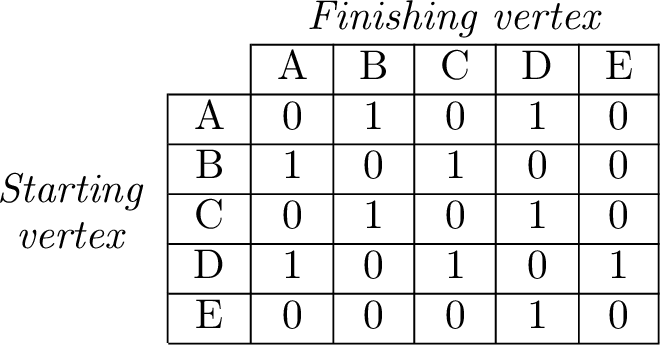
Proposition Multi-step Walks
If \(\mathbf{M}\) is the adjacency matrix, then the element \((i,j)\) of \(\mathbf{M}^k\) gives the number of walks of length \(k\) from vertex \(i\) to vertex \(j\).
Example
To understand why the powers of \(\mathbf{M}\) give the multi-step adjacency matrices, consider the 2-step matrix: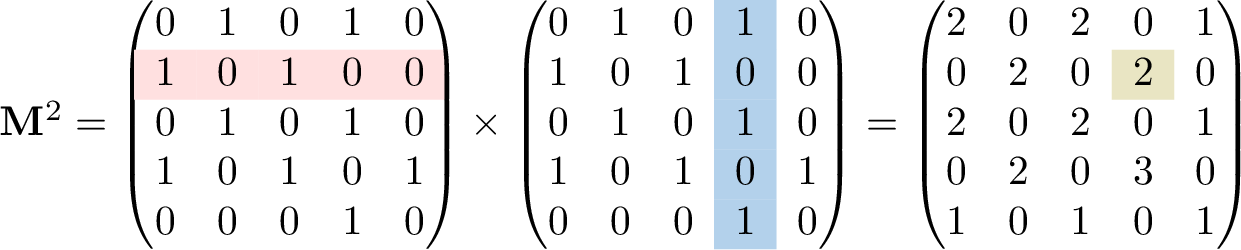
This value comes from the multiplication row 2 \(\times\) column 4 as follows:
This value comes from the multiplication row 2 \(\times\) column 4 as follows:
- \(1 \times 1 = 1\) walk from B to A \(\times\) 1 walk from A to D
- \(0 \times 0 = 0\) walks from B to B \(\times\) 0 walks from B to D
- \(1 \times 1 = 1\) walk from B to C \(\times\) 1 walk from C to D
- \(0 \times 0 = 0\) walks from B to D \(\times\) 0 walks from D to D
- \(0 \times 1 = 0\) walks from B to E \(\times\) 1 walk from E to D
Trees and Minimum Spanning Trees
Definition Tree
A tree is a connected graph with no cycles.
Example
Some examples of trees are shown below: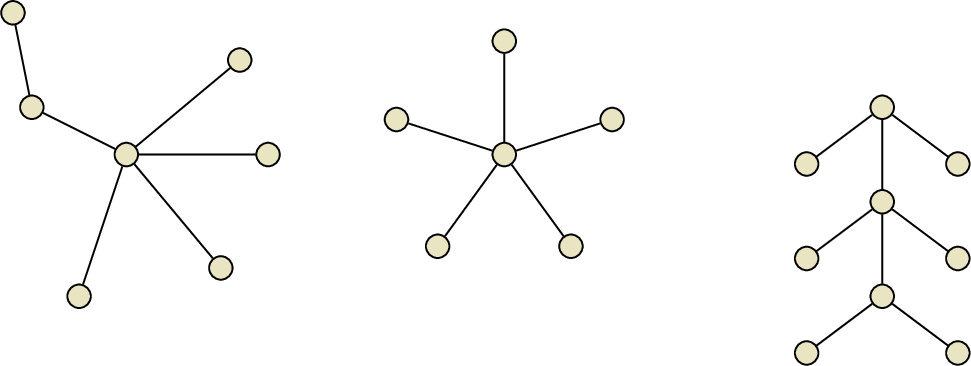
Definition Spanning Tree
A spanning tree of a connected graph is a subgraph that contains all the vertices of the original graph and is a tree (connected and with no cycles).
Example
Consider the following graph \(G\):
For instance, if we remove the edge connecting \(B\) and \(C\), we get a spanning tree (highlighted in blue):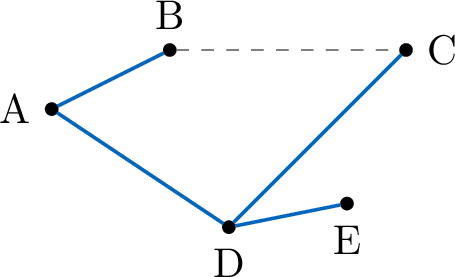
For instance, if we remove the edge connecting \(B\) and \(C\), we get a spanning tree (highlighted in blue):
Definition Minimum Spanning Tree
For a weighted connected graph, a minimum spanning tree (MST) is a spanning tree where the sum of the weights of the edges is minimized. It connects all vertices with the lowest possible total cost.
Example
Method Prim's Algorithm for MST
- Start with any vertex.
- Choose the edge with the lowest weight connecting a vertex in the tree to a vertex outside.
- Add the chosen edge and the new vertex. Repeat until all vertices connected.
Example
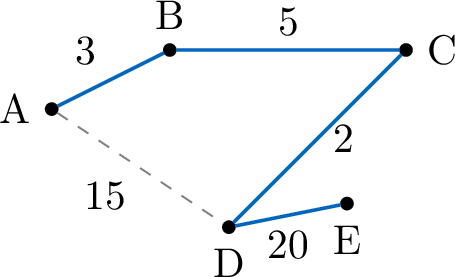
Let's apply Prim's algorithm to this graph.
- Start at A. The edges connected to A are AB (3) and AD (15).
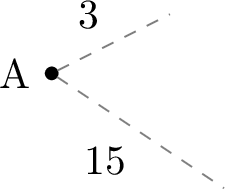
- Choose AB (weight 3) as it is the lowest. Our tree is \(\{A, B\}\).
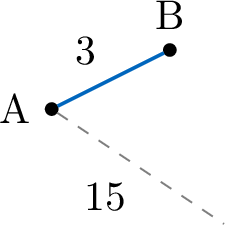
- Look at the edges connecting \(\{A, B\}\) to the outside: AD (15) and BC (5).
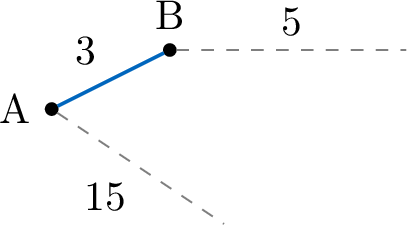
- Choose BC (weight 5). Our tree is \(\{A, B, C\}\).
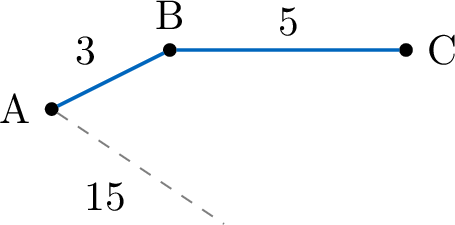
- Look at the edges connecting \(\{A, B, C\}\) to the outside: AD (15) and CD (2).
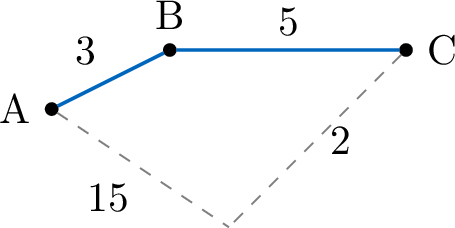
- Choose CD (weight 2). Our tree is \(\{A, B, C, D\}\).
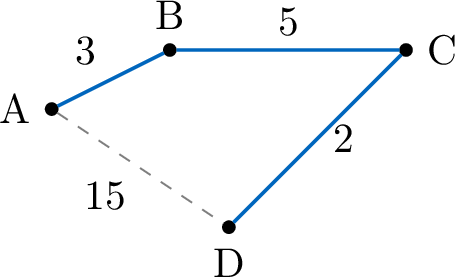
- Look at the edges connecting \(\{A, B, C, D\}\) to the outside: DE (20). Note that AD is now an internal edge (both endpoints are in the tree), so we ignore it.
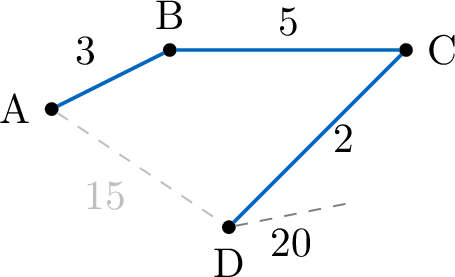
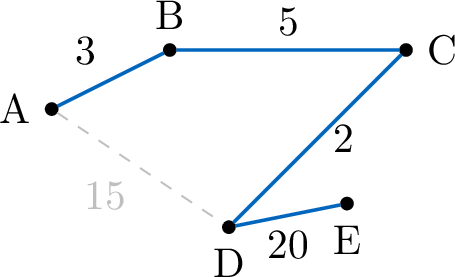
- Choose DE (weight 20).
Method Kruskal's Algorithm for MST
- List (or sort) all edges in non-decreasing order of weight.
- Start with an empty set of selected edges (a forest of isolated vertices).
- Consider edges in that order. For each edge, add it if it connects two different components (i.e. it does not create a cycle); otherwise skip it.
- Stop when you have selected \(n-1\) edges (equivalently, when all \(n\) vertices are connected).
Example
Let's apply Kruskal's algorithm to the same graph.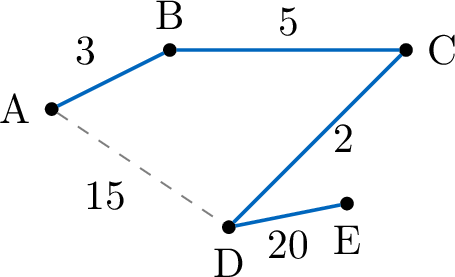
- List all edges by weight (ascending):
- CD (2)
- AB (3)
- BC (5)
- AD (15)
- DE (20)
- Select edges in order:
- Select CD (weight 2). No cycle.
- Select AB (weight 3). No cycle.
- Select BC (weight 5). No cycle.
- Consider AD (weight 15). Adding this edge would form a cycle (\(A-B-C-D-A\)). Reject.
- Select DE (weight 20). No cycle.
Eulerian Graphs
Definition Eulerian Graphs
- An Eulerian circuit is a trail which traverses every edge of the graph exactly once and starts and ends at the same vertex.
- An Eulerian trail traverses every edge exactly once but starts and ends at different vertices.
Proposition Conditions for Eulerian Graphs
- A connected graph has an Eulerian circuit if and only if every vertex has an even degree.
- A connected graph has an Eulerian trail if and only if it has exactly two vertices of odd degree.
Example
Consider the following undirected graph (a "bowtie" shape).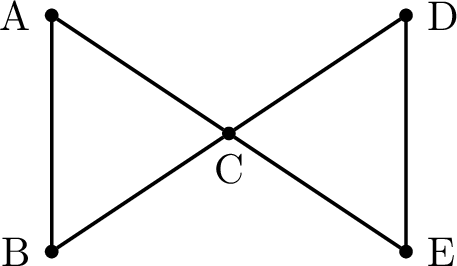
One possible circuit is: \(C \to A \to B \to C \to D \to E \to C\).
- \(\deg(A) = 2\)
- \(\deg(B) = 2\)
- \(\deg(C) = 4\) (connected to A, B, D, E)
- \(\deg(D) = 2\)
- \(\deg(E) = 2\)
One possible circuit is: \(C \to A \to B \to C \to D \to E \to C\).
The Chinese Postman Problem was posed by the mathematician Kwan Mei-Ko. The problem asks: how can a postman deliver mail along every road in a network and return to the depot traveling the minimum possible distance?
Mathematically, this means traversing every edge of a weighted graph at least once and returning to the start.
Mathematically, this means traversing every edge of a weighted graph at least once and returning to the start.
Method The Chinese Postman Problem
The goal is to find the shortest closed walk that traverses every edge at least once.
If the graph is not Eulerian, we must repeat edges to make all vertices even-degree.
If the graph is not Eulerian, we must repeat edges to make all vertices even-degree.
- Identify all vertices with odd degrees.
- Find all possible pairings of these odd vertices.
- For each pair, find the shortest path between them.
- Select the pairing that adds the minimum total weight.
- Add this weight to the total weight of the graph.
Example
Solve the Chinese Postman Problem for the following weighted graph.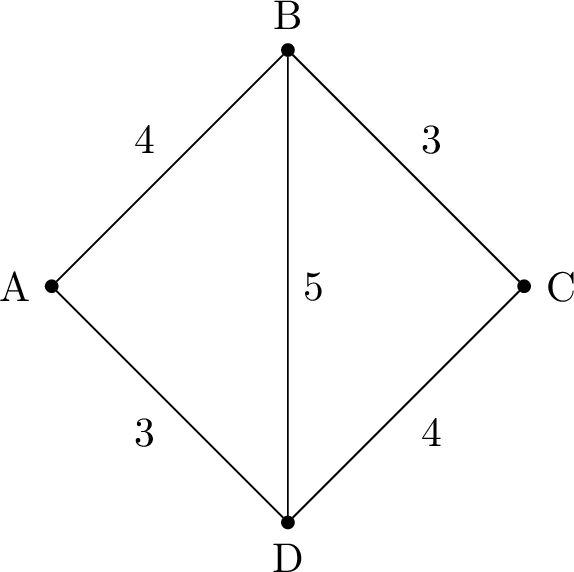
One possible optimal walk is:$$ A \to B \to D \to B \to C \to D \to A $$
- Total weight of the graph: \(4+3+4+3+5 = 19\).
- Identify odd degrees:
- \(\deg(A)=2\), \(\deg(C)=2\) (Even).
- \(\deg(B)=3\), \(\deg(D)=3\) (Odd).
- Find shortest path between odd vertices: The odd vertices must be paired. Since there are only two, the pair is (B, D).
Paths from B to D:- Direct: B \(\to\) D (weight 5).
- Via A: B \(\to\) A \(\to\) D (weight \(4+3=7\)).
- Via C: B \(\to\) C \(\to\) D (weight \(3+4=7\)).
- Calculate optimal distance: Total = Graph Weight + Shortest Path Addition Total = \(19 + 5 = 24\).
One possible optimal walk is:$$ A \to B \to D \to B \to C \to D \to A $$
Hamiltonian Graphs
Definition Hamiltonian Cycle and Path
- A Hamiltonian cycle is a cycle that visits every vertex of the graph exactly once.
- A Hamiltonian path visits every vertex exactly once but does not necessarily return to the start.
Example
Consider the following graph.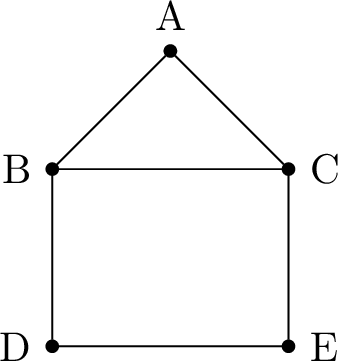
- A Hamiltonian Path: \(D \to B \to A \to C \to E\). (It visits every vertex exactly once, but does not return to \(D\)).
- A Hamiltonian Cycle: \(A \to B \to D \to E \to C \to A\). (It visits every vertex exactly once and returns to the start).
The Travelling Salesman Problem (TSP) describes a classic optimization scenario: A salesman must leave his home town, visit a specific set of other towns exactly once, and then return home. The objective is to find the walk that minimizes the total distance traveled.
In Graph Theory terms, this is walk to finding the Hamiltonian Cycle with the minimum total weight in a complete weighted graph.
In Graph Theory terms, this is walk to finding the Hamiltonian Cycle with the minimum total weight in a complete weighted graph.
Method The Travelling Salesman Problem (TSP)
The goal is to find the Hamiltonian cycle with the minimum total weight in a complete weighted graph.
Since finding the exact solution is hard, we find bounds:
Since finding the exact solution is hard, we find bounds:
- Upper Bound (Nearest Neighbour Algorithm): Start at a vertex, always move to the nearest unvisited vertex, and return to the start at the end.
- Lower Bound (Deleted Vertex Algorithm):
- Delete a vertex \(V\) and its edges.
- Find the MST of the remaining graph.
- Add the two shortest edges from \(V\) to the MST weight.
Example
Find the bounds for the optimal tour starting at A for the following graph.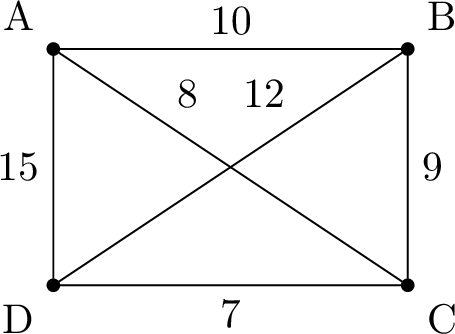
- Upper Bound (Nearest Neighbour from A):
- Start at A. Nearest unvisited neighbors: B(10), C(8), D(15). Choose C.
- From C. Unvisited: B(9), D(7). Choose D.
- From D. Unvisited: B(12). Choose B.
- From B, return to start (A). Weight 10.
- Walk: \(A \to C \to D \to B \to A\).
- Total Weight: \(8 + 7 + 12 + 10 = 37\).
- Lower Bound (Delete Vertex A):
- Remove A. Remaining vertices: B, C, D. Edges: BC(9), CD(7), BD(12).
- MST of remainder: Select CD(7), then BC(9). Total = 16.
- Edges from A: AB(10), AC(8), AD(15). Two shortest are 8 and 10.
- Total Weight: \(16 + 8 + 10 = 34\).