Solving Inequalities
An inequality is a mathematical statement that one expression is greater than or less than another. While an equation typically has one or a few specific solutions, an inequality describes a whole range (or interval) of values. Understanding inequalities is essential for modelling real-world constraints, such as budget limits, speed limits, or acceptable temperature ranges.
Inequalities
Definition Inequality
An inequality is a statement comparing two expressions using one of the following symbols:
- \(<\) (less than)
- \(>\) (greater than)
- \(\leq\) (less than or equal to)
- \(\geq\) (greater than or equal to)
Example
\(x + 3 < 5\) means that \(x + 3\) is less than \(5\), and we need to find all values of \(x\) that make this true.
Properties of Inequalities
Method Rules for Solving Inequalities
Solving inequalities is almost identical to solving equations. You can perform the same operation on both sides to isolate the variable, but with one critical exception.
- Adding or subtracting any number on both sides preserves the inequality.
- Multiplying or dividing both sides by a positive number preserves the inequality.
- Multiplying or dividing both sides by a negative number reverses the direction of the inequality symbol. For example, \(<\) becomes \(>\).
Example
Solve the inequality \(8 - 2x < 12\).
$$\begin{aligned}8 - 2x &< 12 \\
8 - 2x - 8 &< 12 - 8 && \text{(Subtract 8 from both sides; the inequality is preserved)} \\
-2x &< 4 && \\
\frac{-2x}{-2} &> \frac{4}{-2} && \text{(Divide by \(-2\); the inequality sign is reversed)}\\
x &> -2 &&\end{aligned}$$The solution is all real numbers greater than \(-2\). In interval notation: \(x \in (-2, +\infty)\).
Solving Non-Linear Inequalities using a Sign Table
When an inequality involves a product or quotient of factors, such as \((x-2)(x-1) > 0\), we cannot simply isolate \(x\). We must instead determine where the expression is positive or negative. The sign table (or sign chart) is a tool used to organize this analysis.
Method Constructing a Sign Table
To create a sign table for a factored expression:
- Find the critical values: Find the values of \(x\) that make each factor equal to zero. These are the points where the expression can change sign.
- Create the table: Draw a number line at the top, marked with the critical values in increasing order. List each factor in a separate row on the left, with the full expression in the last row.
- Determine the sign of each factor in the intervals created by the critical values. A linear factor \((x-a)\) is negative for \(x
- Determine the sign of the full expression in each interval by multiplying the signs of the factors in that column.
Example
Solve the inequality \((x-2)(x-1) \ge 0\).
- Critical values: The factors are \((x-1)\) and \((x-2)\).
- \(x-1=0 \implies x=1\)
- \(x-2=0 \implies x=2\)
- Construct the sign table:
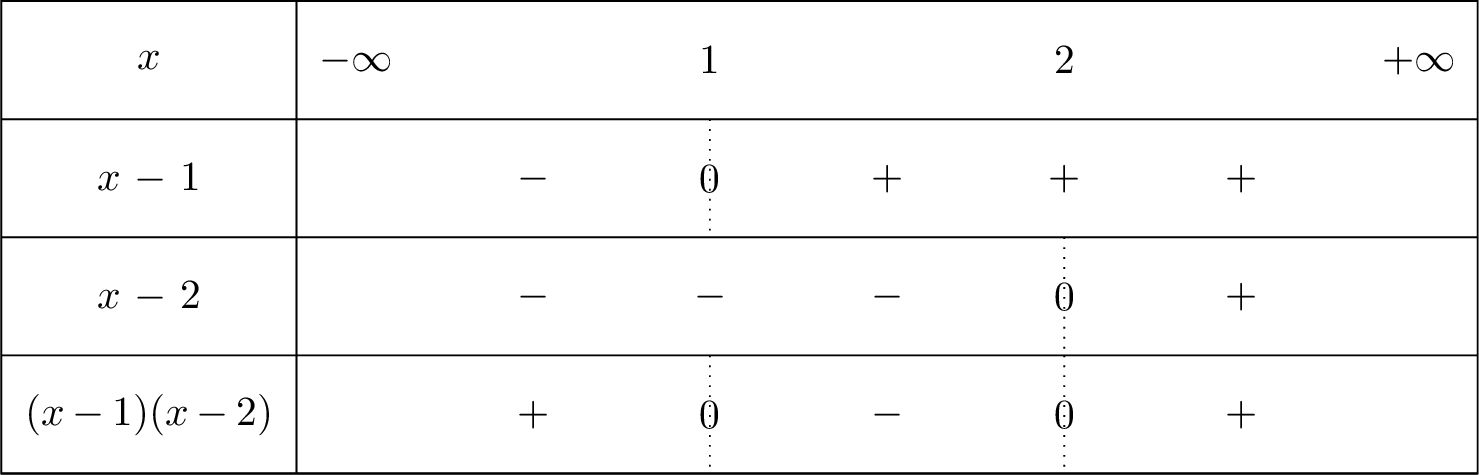
- Conclusion: The inequality asks for \((x-1)(x-2) \ge 0\), which means where the product is positive or zero. From the last row of the table, this occurs when \(x \le 1\) or \(x \ge 2\). In interval notation: \(x \in (-\infty,1] \cup [2,+\infty)\).