Transformations
Types of Transformations
Transformations are rules that take every point of a figure to another point in the plane.
They can move (translate), flip (reflect), turn (rotate), or resize (enlarge/reduce) a shape.
They can move (translate), flip (reflect), turn (rotate), or resize (enlarge/reduce) a shape.
Definition Object and Image
When a transformation is applied to a shape, the original shape is called the object.
The resulting shape after the transformation is called the image.
Often, if a point is called \(A\) in the object, its image is written \(A'\) (“\(A\) prime”).
The resulting shape after the transformation is called the image.
Often, if a point is called \(A\) in the object, its image is written \(A'\) (“\(A\) prime”).
Definition Types of Transformations
There are several types of transformations, including:
- Translation: Slides every point of a shape the same distance in the same direction.
It does not change the shape or size of the figure and does not change the orientation (it is a rigid motion).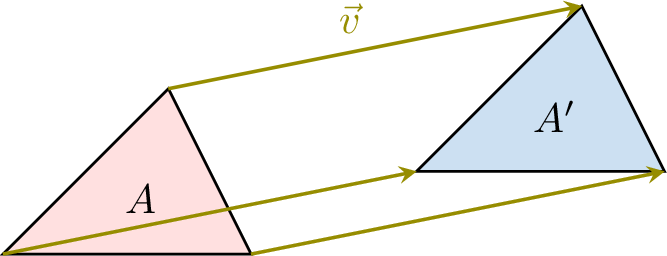
- Reflection: Flips a shape across a line (like a mirror), creating a mirror image.
This line is called the axis (line) of reflection.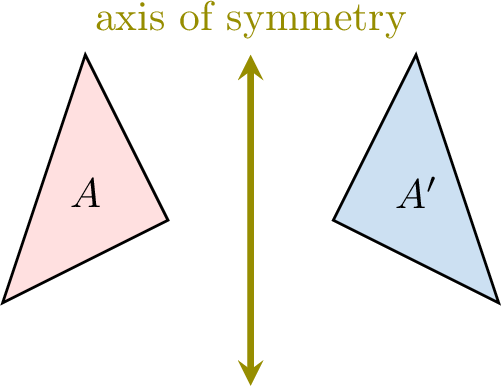
- Rotation: Turns a shape around a fixed point (the centre of rotation) by a certain angle.
A positive angle is usually taken to mean a counterclockwise rotation. Distances and angles are preserved.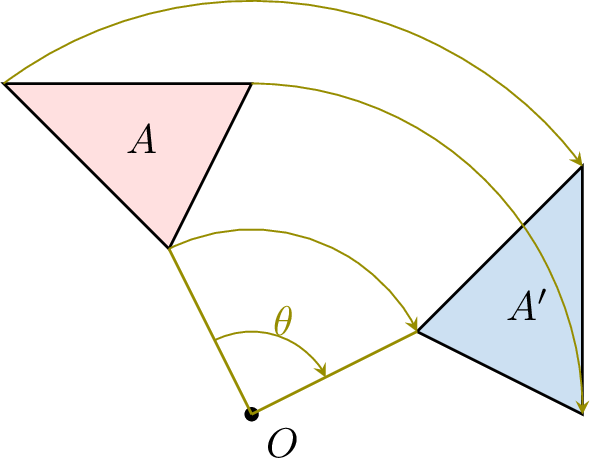
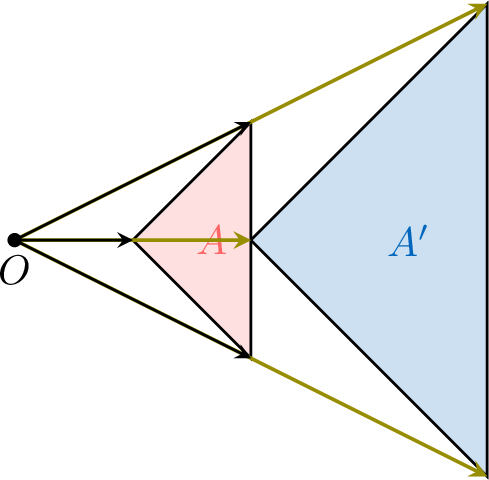
- Homothety (enlargement/reduction): Resizes a shape from a centre point by a constant scale factor, so that the image is similar to the original (angles are preserved, lengths are multiplied by the same factor).
Translation
A translation moves a figure from one place to another. Every point on the figure moves the same distance in the same direction.
Definition Translation
A translation by the vector \(\Vect{v}\) maps a point \(M\) to its image \(M'\) such that \(\Vect{MM'} = \Vect{v}\).
All points of the plane are shifted by the same vector \(\Vect{v}\).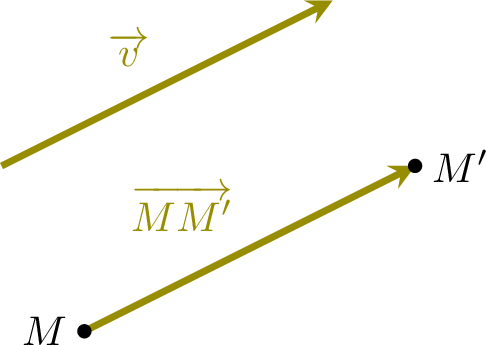
All points of the plane are shifted by the same vector \(\Vect{v}\).
Proposition Coordinates of the Image Point
In a coordinate system, if the point \(M\) has coordinates \((x, y)\) and the translation vector is \(\Vect{v} = \begin{pmatrix} a \\ b \end{pmatrix}\), then the image point \(M'\) has coordinates$$M'(x+a,\,y+b).$$ 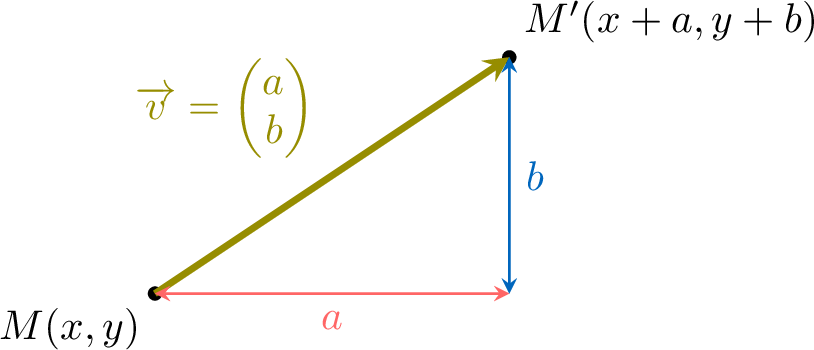
Let \(M'\) be the image point with coordinates \((x', y')\). Then$$\begin{aligned}\Vect{MM'} &= \Vect{v}\\
\begin{pmatrix} x'-x \\
y'-y \end{pmatrix} &= \begin{pmatrix} a \\
b \end{pmatrix}\\
x'-x &= a \quad \text{and}\quad y'-y= b\\
x' &= x+a \quad \text{and}\quad y'= y+b.\end{aligned}$$Therefore, \(M'(x+a,y+b)\).
Homothety
Definition Homothety
A homothety with center \(A\) and scale factor \(\textcolor{olive}{k}\) maps a point \(M\) to a point \(M'\) on the line \(AM\) such that$$\overrightarrow{AM'} = \textcolor{olive}{k}\,\overrightarrow{AM}.$$If \(|\textcolor{olive}{k}|>1\), the figure is enlarged; if \(0<|\textcolor{olive}{k}|<1\), the figure is reduced.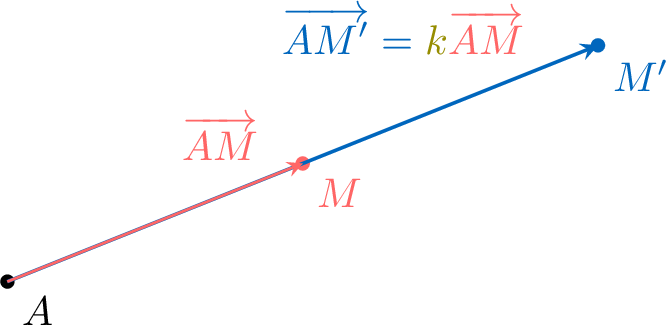
\(\dfrac{\textcolor{colorprop}{AM'}}{\textcolor{colordef}{AM}}=|\textcolor{olive}{k}|\)
\(\dfrac{\textcolor{colorprop}{AM'}}{\textcolor{colordef}{AM}}=|\textcolor{olive}{k}|\)
Proposition Coordinates of the Image Point
In a coordinate system, if the center \(A\) has coordinates \((a, b)\), the point \(M\) has coordinates \((x, y)\), and the scale factor is \(\textcolor{olive}{k}\), then the image point \(M'\) has coordinates$$M'\big(a + \textcolor{olive}{k}(x - a),\ b + \textcolor{olive}{k}(y - b)\big).$$
Let \(M'\) be the image point with coordinates \((x', y')\). Then$$\begin{aligned}\Vect{AM'} &= k \Vect{AM}\\
\begin{pmatrix} x'-a \\
y'-b \end{pmatrix} &= k \begin{pmatrix} x-a \\
y-b \end{pmatrix}\\
x'-a &= k(x-a) \quad \text{and}\quad y'-b= k(y-b)\\
x' &= a+k(x-a) \quad \text{and}\quad y'= b+k(y-b).\end{aligned}$$So \(M'\) has coordinates \(\big(a+k(x-a),\,b+k(y-b)\big)\).
Specific Reflections
Proposition Reflection over the \(x\)-axis
The image of the point \(M(x, y)\) under the reflection over the \(x\)-axis is \(M'(x, -y)\).
This reflection keeps the \(x\)-coordinate and changes the sign of the \(y\)-coordinate.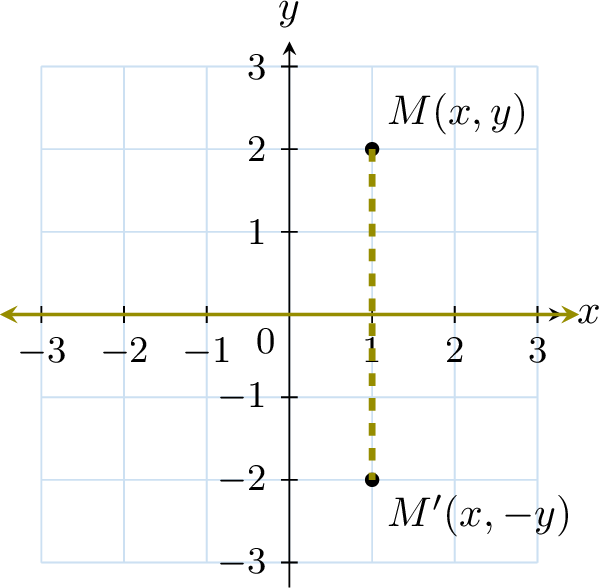
This reflection keeps the \(x\)-coordinate and changes the sign of the \(y\)-coordinate.
Proposition Reflection over the \(y\)-axis
The image of the point \(M(x, y)\) under the reflection over the \(y\)-axis is \(M'(-x, y)\).
This reflection keeps the \(y\)-coordinate and changes the sign of the \(x\)-coordinate.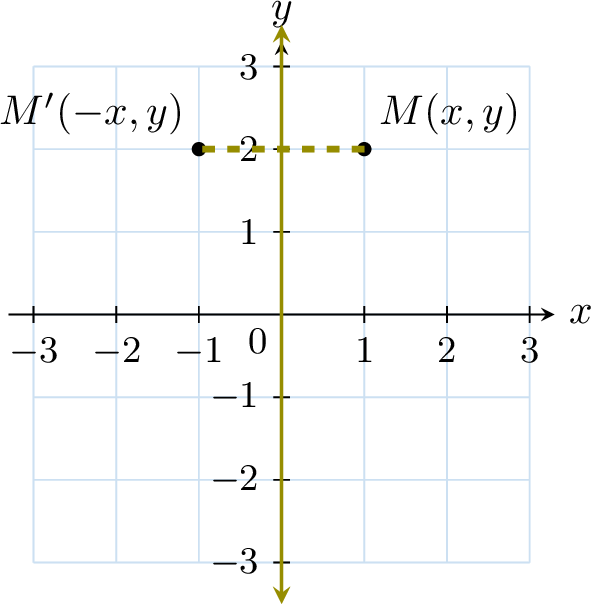
This reflection keeps the \(y\)-coordinate and changes the sign of the \(x\)-coordinate.
Proposition Reflection over the line \(y\equal x\)
The image of the point \(M(x, y)\) under the reflection \(M_{y=x}\) over the line \(y=x\) is \(M'(y, x)\).
The coordinates are swapped.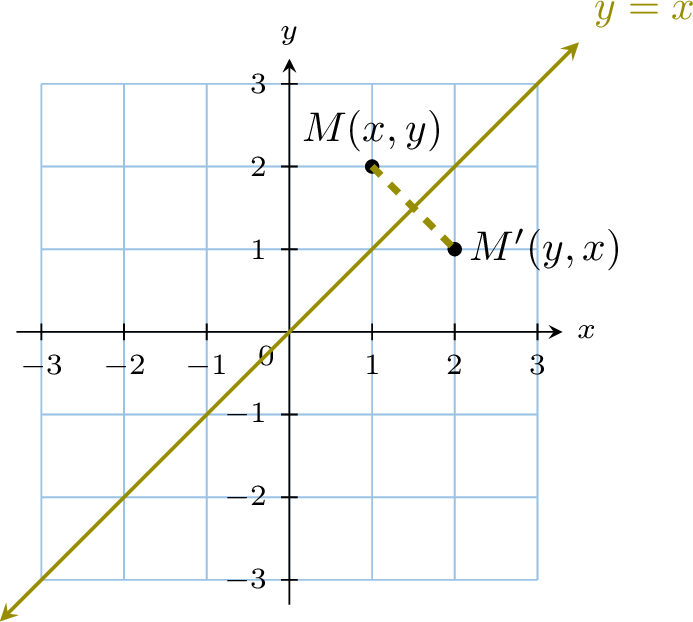
The coordinates are swapped.
Specific Rotations
Proposition Rotation of 90°
The image of the point \(M(x, y)\) under the rotation of \(90^\circ\) (counterclockwise) around the origin is \(M'(-y, x)\).
In coordinates, a \(90^\circ\) anticlockwise rotation sends \((x,y)\) to \((-y,x)\).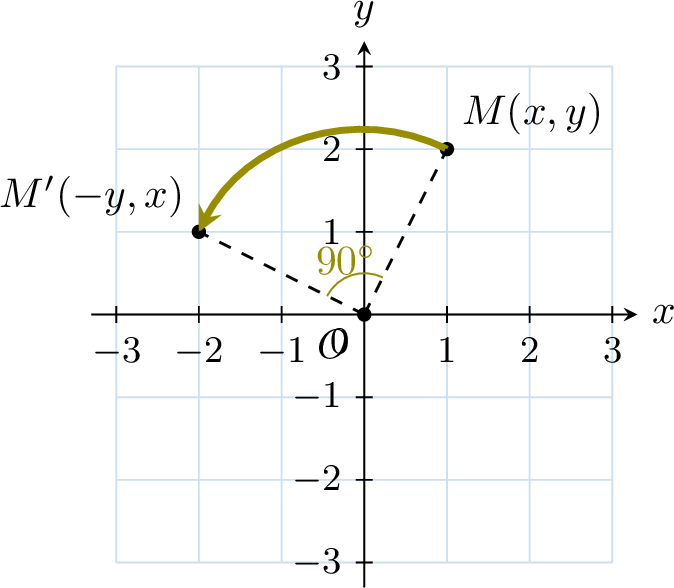
In coordinates, a \(90^\circ\) anticlockwise rotation sends \((x,y)\) to \((-y,x)\).
Proposition Rotation of -90°
The image of the point \(M(x, y)\) under the rotation of \(-90^\circ\) (clockwise) around the origin is \(M'(y, -x)\).
In coordinates, a \(90^\circ\) clockwise rotation sends \((x,y)\) to \((y,-x)\).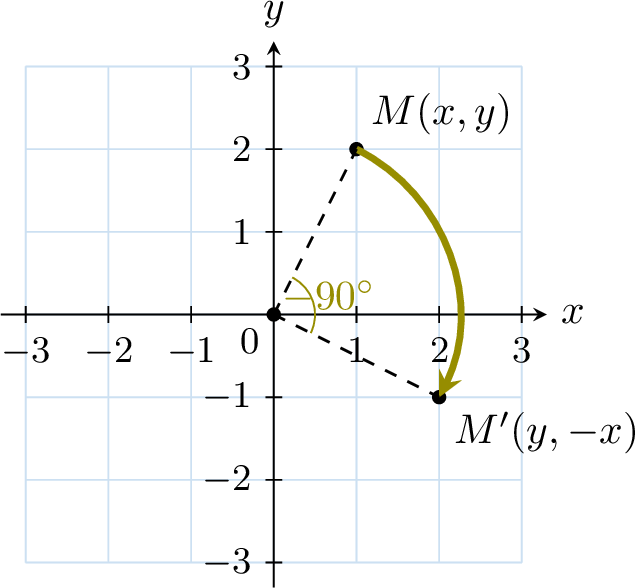
In coordinates, a \(90^\circ\) clockwise rotation sends \((x,y)\) to \((y,-x)\).
Proposition Rotation of 180°
The image of the point \(M(x, y)\) under the rotation of \(180^\circ\) around the origin is \(M'(-x, -y)\).
In coordinates, a half-turn about the origin sends \((x,y)\) to \((-x,-y)\).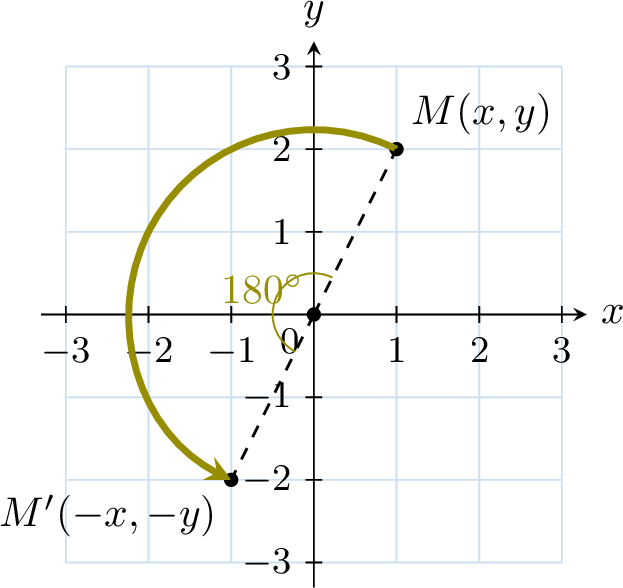
In coordinates, a half-turn about the origin sends \((x,y)\) to \((-x,-y)\).