Bearings
What is a Bearing?
Trigonometry is a powerful tool for navigation and surveying. To describe the direction of travel, we use a standardised system called bearings.
Definition True Bearings
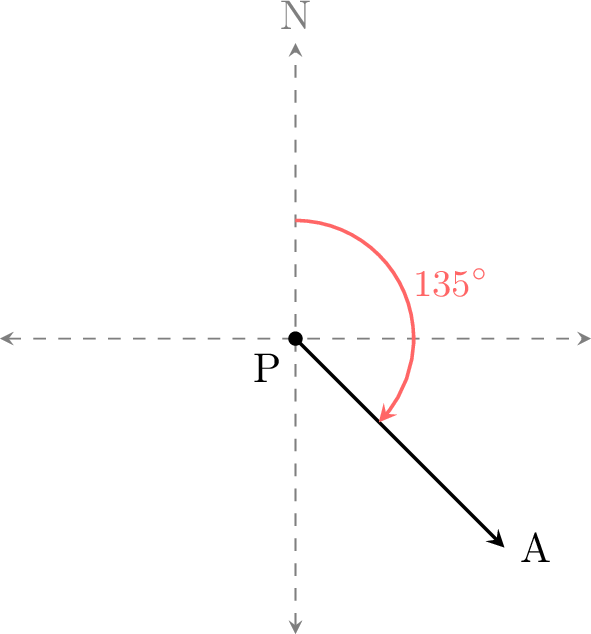
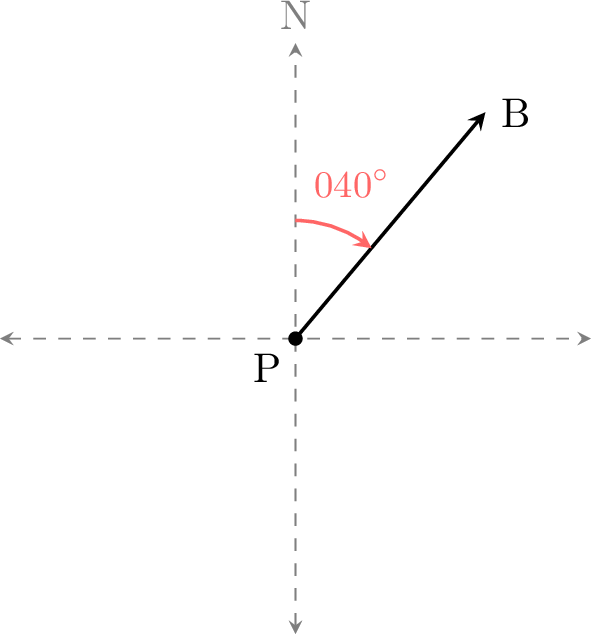
A true bearing is the direction to an object from a point, measured as an angle in a clockwise direction from the North line. The angle is measured in degrees from \(000^\circ\) to \(360^\circ\), and bearings are always written using three figures (for example, \(000^\circ\), \(040^\circ\), \(135^\circ\), \(270^\circ\)).
Example
- The bearing of A from P is \(135^\circ\).
- The bearing of B from P is \(040^\circ\).
Method Key Geometric Principles for Bearings
Solving bearing problems relies on two key geometric principles that arise from the fact that all North lines on a map or diagram are parallel.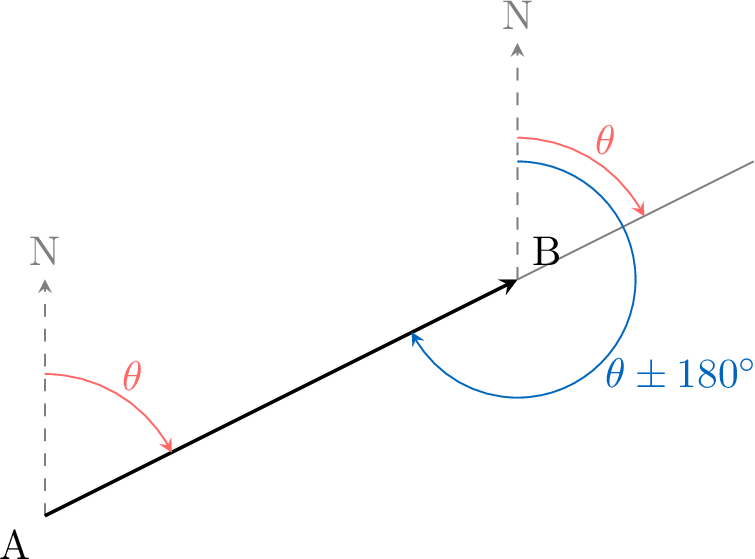
- Parallel Line Angles: Because North lines are parallel, you can use angle properties (such as alternate interior or co-interior angles) to transfer a direction from one point to another. This is essential for finding the internal angles of the triangle formed by the paths.
- Back Bearings: The bearing from point A to point B is the forward bearing. The bearing from point B back to point A is the back bearing. A back bearing always differs by \(180^\circ\) from the forward bearing (add or subtract \(180^\circ\) and, if necessary, bring the result back between \(000^\circ\) and \(360^\circ\)).
Problem Solving
Method Solving a Bearing Problem
- Sketch a Diagram: This is the most important step. Draw a clear diagram with a North line at every point involved. Label all given distances and bearings.
- Find an Internal Angle: Use parallel line properties (for example, alternate interior or co-interior angles) to find at least one angle inside the triangle formed by the journey.
- Apply the Law of Sines or the Law of Cosines: Use the Law of Cosines if you know two sides and the included angle (SAS) or all three sides (SSS). Use the Law of Sines if you know two angles and a side (AAS) or two sides and a non-included angle (SSA).
- Calculate and Conclude: Solve for the required distance or bearing. Make sure that any bearing in your final answer is a three-figure value between \(000^\circ\) and \(360^\circ\), measured clockwise from North.