Non-Right-Angled Triangle Trigonometry
While SOH CAH TOA only applies to right-angled triangles, many real-world problems involve triangles that are not right-angled (also called oblique triangles). To solve these, we use two key results: the Law of Sines and the Law of Cosines.
Convention for labeling triangles: In any triangle \(ABC\), the angles at the vertices are denoted by capital letters (\(A, B, C\)) and the sides opposite them are denoted by the corresponding lowercase letters (\(a, b, c\)).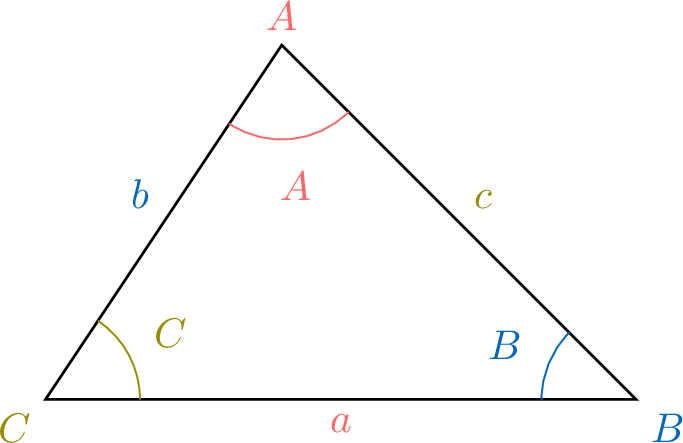
Convention for labeling triangles: In any triangle \(ABC\), the angles at the vertices are denoted by capital letters (\(A, B, C\)) and the sides opposite them are denoted by the corresponding lowercase letters (\(a, b, c\)).
Area of a Triangle
When two sides of a triangle and the angle between them (the included angle) are known, the area can be calculated using a formula involving the sine of this angle. This is particularly useful for non-right-angled triangles, where the height is not given directly.
Proposition Area Formula
The area of any triangle is half the product of two sides and the sine of their included angle:$$\text{Area} = \frac{1}{2} \times \textcolor{colordef}{\text{side}} \times \textcolor{colorprop}{\text{side}} \times \sin(\textcolor{olive}{\text{included angle}})$$For example, if the two sides have lengths \(b\) and \(c\) and the included angle is \(A\), then \(\text{Area} = \dfrac12 bc \sin A\).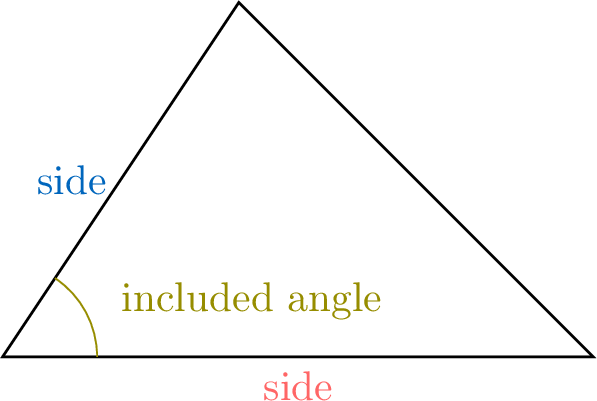
Consider triangle \(ABC\) with base \(a = BC\). Drop a perpendicular height \(h\) from vertex \(A\) to the base \(a\), meeting \(BC\) at point \(H\).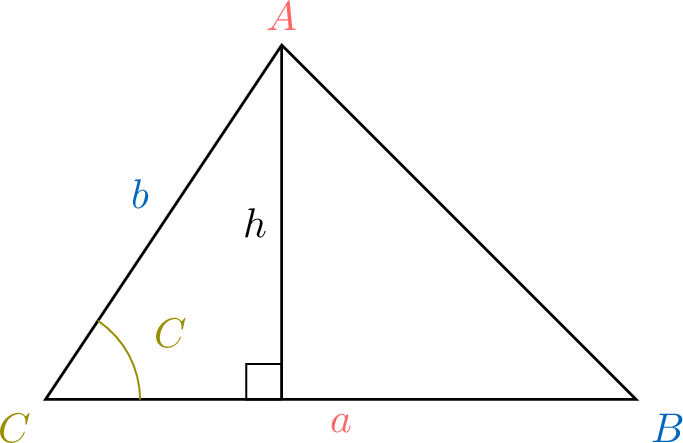
Example
For the triangle 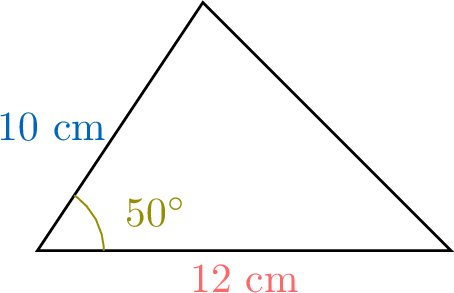 , find the area.
, find the area.
$$\begin{aligned}\text{Area} &= \frac{1}{2} \times \textcolor{colorprop}{10} \times \textcolor{colordef}{12} \times \sin(\textcolor{olive}{50^\circ})\\
& \approx 46 \, \text{cm}^2\end{aligned}$$
Law of Sines
The Law of Sines gives a relationship between the sides of a triangle and the sines of their opposite angles. It is used to solve triangles when you know at least one side–angle opposite pair, for example:
- Two angles and any side (AAS or ASA).
- Two sides and a non-included angle (SSA), which can lead to the ambiguous case (0, 1, or 2 possible triangles).
Proposition Law of Sines
For any triangle with sides \(\textcolor{colordef}{a}\), \(\textcolor{colorprop}{b}\), \(\textcolor{olive}{c}\) and opposite angles \(\textcolor{colordef}{A}\), \(\textcolor{colorprop}{B}\), \(\textcolor{olive}{C}\):$$\textcolor{colordef}{\frac{a}{\sin A}} = \textcolor{colorprop}{\frac{b}{\sin B}} = \textcolor{olive}{\frac{c}{\sin C}}$$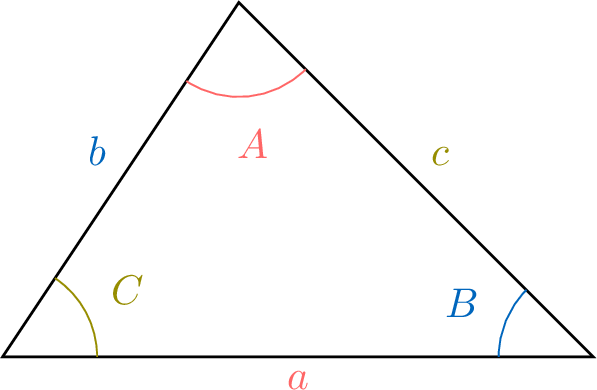
The area of the triangle can be expressed in three different ways using the formula from the previous section:$$ \text{Area} = \frac{1}{2} bc \sin A = \frac{1}{2} ac \sin B = \frac{1}{2} ab \sin C. $$Dividing each part of the equality by \(\frac{1}{2}abc\) gives:$$ \frac{bc \sin A}{abc} = \frac{ac \sin B}{abc}= \frac{ab \sin C}{abc}. $$So$$ \frac{\sin A}{a} = \frac{\sin B}{b}= \frac{\sin C}{c}. $$Taking the reciprocal of each term gives the Law of Sines:$$ \frac{a}{\sin A} = \frac{b}{\sin B} = \frac{c}{\sin C}. $$
Example
For the triangle 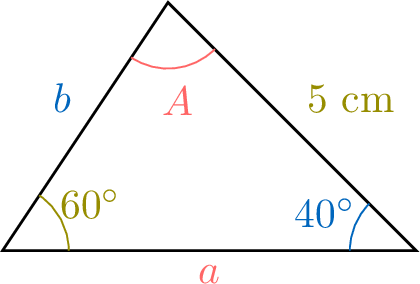 , find side \(a\).
, find side \(a\).
First, find angle \(A\): \(A = 180^\circ - 40^\circ - 60^\circ = 80^\circ\).
Using the Law of Sines with the pair \((a, A)\) and the pair \((c, C)\):$$\begin{aligned}\textcolor{colordef}{\frac{a}{\sin 80^\circ}} &= \textcolor{olive}{\frac{5}{\sin 60^\circ} }\\ a &= 5 \cdot \frac{\sin 80^\circ}{\sin 60^\circ}\\ a &\approx 5.69 \, \text{cm}\end{aligned}$$
Using the Law of Sines with the pair \((a, A)\) and the pair \((c, C)\):$$\begin{aligned}\textcolor{colordef}{\frac{a}{\sin 80^\circ}} &= \textcolor{olive}{\frac{5}{\sin 60^\circ} }\\ a &= 5 \cdot \frac{\sin 80^\circ}{\sin 60^\circ}\\ a &\approx 5.69 \, \text{cm}\end{aligned}$$
Law of Cosines
The Law of Cosines relates all three sides of a triangle to one of its angles. It is a generalization of the Pythagorean theorem and is used to solve triangles when given:
- Three sides (SSS).
- Two sides and their included angle (SAS).
Proposition Law of Cosines
For any triangle with sides \(\textcolor{colordef}{a}\), \(\textcolor{colorprop}{b}\), \(\textcolor{olive}{c}\) and opposite angles \(\textcolor{colordef}{A}\), \(\textcolor{colorprop}{B}\), \(\textcolor{olive}{C}\):$$\textcolor{olive}{c}^2 = \textcolor{colordef}{a}^2 + \textcolor{colorprop}{b}^2 - 2\textcolor{colordef}{a}\textcolor{colorprop}{b} \cos \textcolor{olive}{C}$$This can be rearranged to find an angle:$$\cos \textcolor{olive}{C} = \dfrac{\textcolor{colordef}{a}^2 + \textcolor{colorprop}{b}^2 -\textcolor{olive}{c}^2}{2\textcolor{colordef}{a}\textcolor{colorprop}{b}}$$Note that if \(C = 90^\circ\), then \(\cos C = 0\) and the formula reduces to \(c^2 = a^2 + b^2\), the Pythagorean theorem.
Drop a perpendicular height \(h\) from vertex \(A\) to the side \(a\) (line \(\Line{BC}\)), meeting it at point \(D\).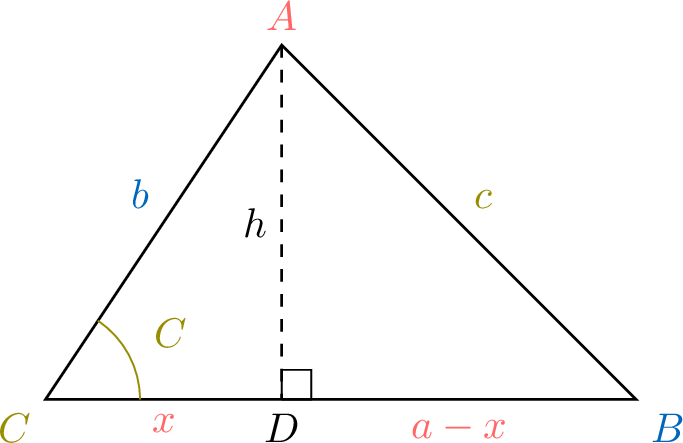
- By Pythagoras, \(h^2 + x^2 = b^2 \implies h^2 = b^2 - x^2\).
- \(\cos(C) = x/b \implies x = b\cos(C)\).
Example
For the triangle 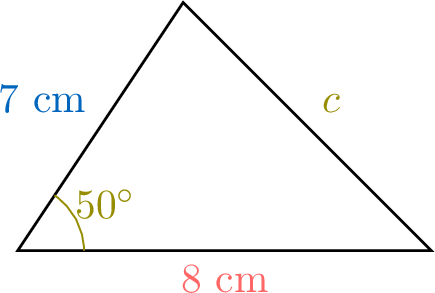 , find side \(c\).
, find side \(c\).
Using the Law of Cosines:$$\begin{aligned}\textcolor{olive}{c}^2 &= \textcolor{colordef}{8}^2 + \textcolor{colorprop}{7}^2 - 2 \times\textcolor{colordef}{8} \times\textcolor{colorprop}{7} \times \cos \textcolor{olive}{50^\circ}\\
\textcolor{olive}{c} &= \sqrt{\textcolor{colordef}{8}^2 + \textcolor{colorprop}{7}^2 - 2 \times\textcolor{colordef}{8} \times\textcolor{colorprop}{7} \times \cos \textcolor{olive}{50^\circ}}\\
\textcolor{olive}{c} &\approx 6.4 \, \text{cm}\\
\end{aligned}$$
Solving Real-World Problems Using Sine and Cosine Laws
The Laws of Sines and Cosines are powerful tools for solving a wide range of problems involving non-right-angled triangles, especially in real-world contexts. To solve these problems effectively, follow the structured steps below.
Method Solving Real-World Problems Using Sine and Cosine Laws
- Draw a clear diagram representing the situation described in the problem.
- Label the known and unknown sides and angles in the triangle.
- Identify the configuration (for example, two sides and the included angle for the Law of Cosines, or two angles and a side for the Law of Sines).
- Choose the appropriate law (Law of Sines for ratios of sides to sines of angles, Law of Cosines for relating sides and the cosine of an angle).
- Write and solve the equation, then check that your answer is reasonable (size, units, and shape of the triangle).