Function Transformations
Function transformations allow us to take a basic "parent" function and modify it to create a new, related function. By applying a sequence of transformations, we can shift, stretch, compress, or reflect the graph of the parent function.
Understanding these transformations is essential, as it allows us to predict the graph of a complex function based on a simpler one and to model real-world phenomena by adjusting a basic function to fit observed data. In this chapter, we will explore vertical and horizontal translations, dilations (stretches/compressions), and reflections.
Understanding these transformations is essential, as it allows us to predict the graph of a complex function based on a simpler one and to model real-world phenomena by adjusting a basic function to fit observed data. In this chapter, we will explore vertical and horizontal translations, dilations (stretches/compressions), and reflections.
Translation
Definition Vertical Translation by Adding a Constant
A vertical translation shifts the graph of a function up or down. The transformation is defined by:$$g(x) = f(x) + k$$This transformation maps a point \((x, y)\) on the graph of \(f\) to a new point \((x, y+k)\) on the graph of \(g\). 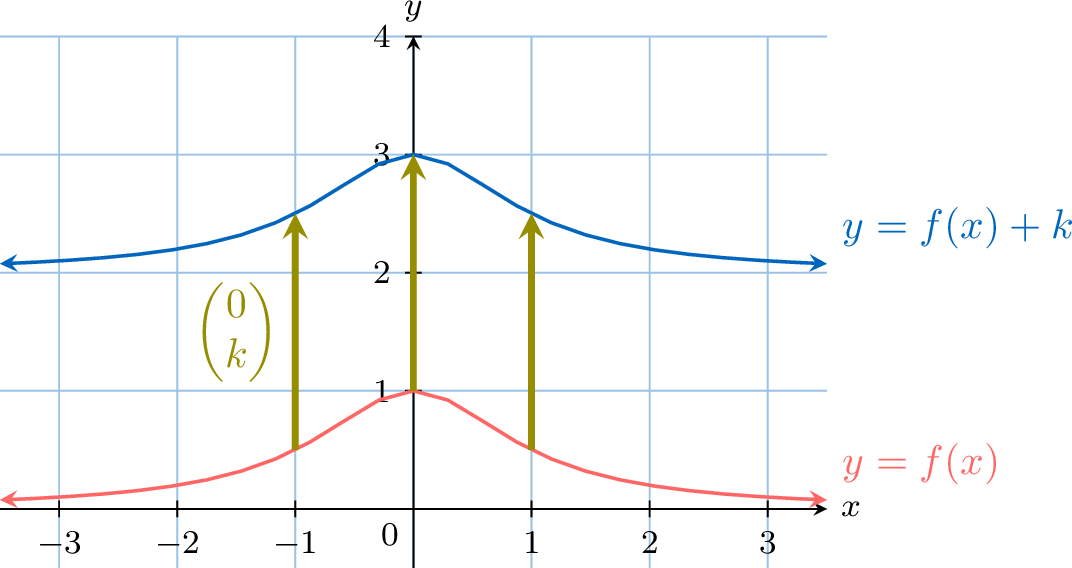
- If \(k>0\), the graph is translated \(\boldsymbol{k}\) units up.
- If \(k<0\), the graph is translated \(\boldsymbol{|k|}\) units down.
Definition Horizontal Translation
A horizontal translation shifts the graph of a function left or right. The transformation is defined by:$$g(x) = f(x-h)$$This transformation maps a point \((x, y)\) on the graph of \(f\) to a new point \((x+h, y)\) on the graph of \(g\).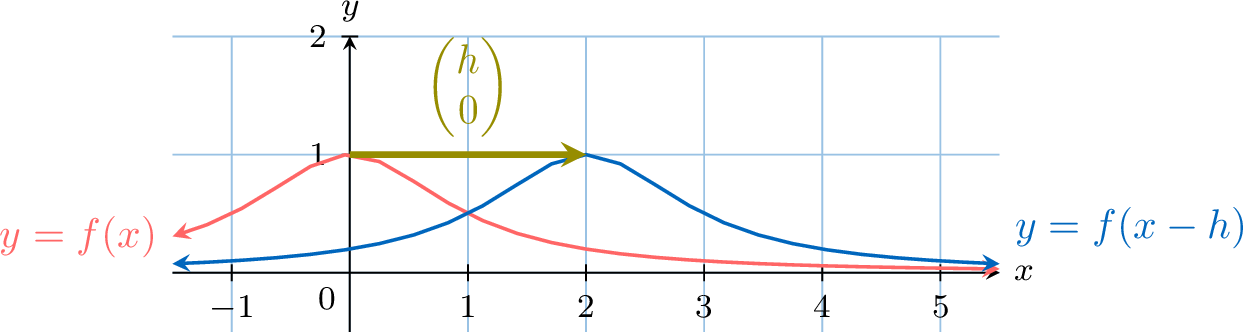
- If \(h>0\), the graph is translated \(\boldsymbol{h}\) units to the right.
- If \(h<0\), the graph is translated \(\boldsymbol{|h|}\) units to the left.
Dilation
Definition Vertical Dilation
A vertical dilation stretches or compresses the graph of a function vertically. It is defined by:$$g(x) = a \cdot f(x)$$This transformation maps a point \((x, y)\) to \((x, ay)\). 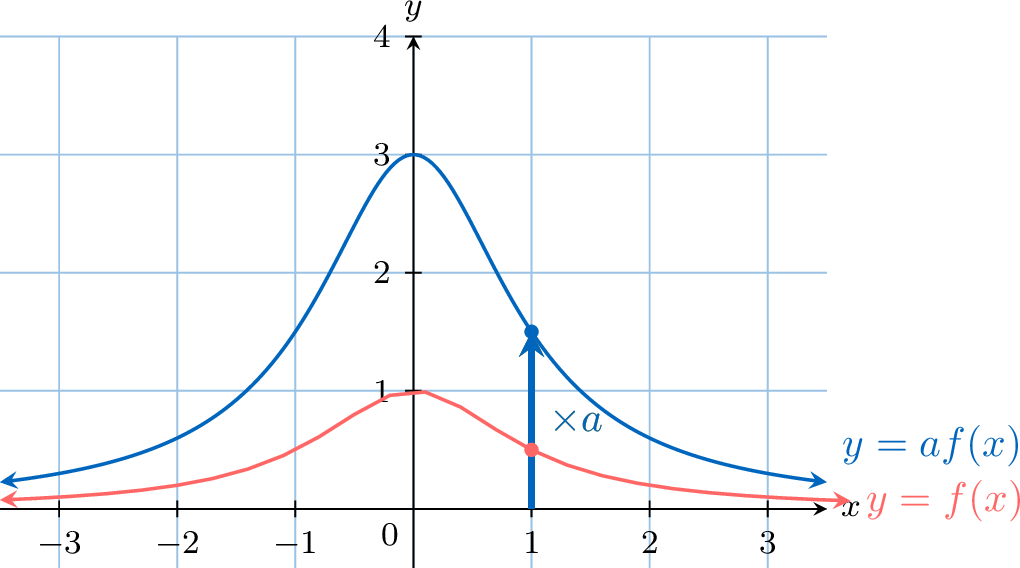
- If \(|a|>1\), the graph is stretched vertically by a factor of \(a\).
- If \(0 < |a| < 1\), the graph is compressed vertically by a factor of \(a\).
Definition Horizontal Dilation
A horizontal dilation stretches or compresses the graph of a function horizontally. It is defined by:$$g(x) = f(bx)$$This transformation maps a point \((x, y)\) to a new point \((\frac{x}{b}, y)\).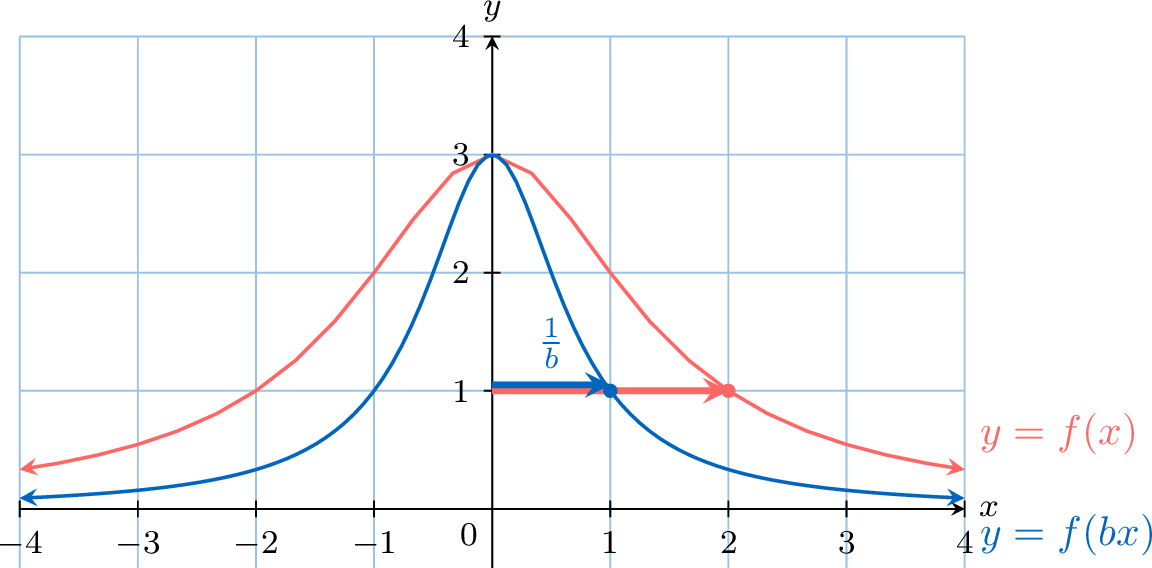
- If \(|b|>1\), the graph is compressed horizontally by a factor of \(\frac{1}{b}\).
- If \(0 < |b| < 1\), the graph is stretched horizontally by a factor of \(\frac{1}{b}\).
Reflection
Definition Reflection in the x-axis
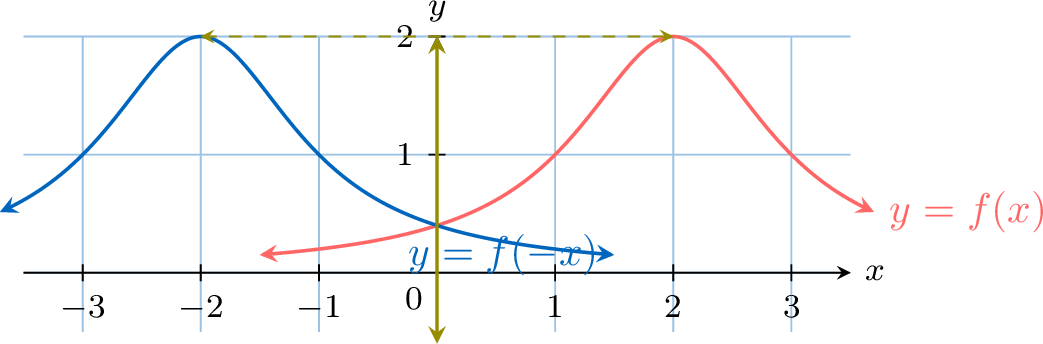
A reflection in the x-axis flips the graph of a function vertically. It is a special case of vertical dilation where \(a=-1\). It is defined by:$$g(x) = -f(x)$$This transformation maps a point \((x, y)\) to \((x, -y)\). 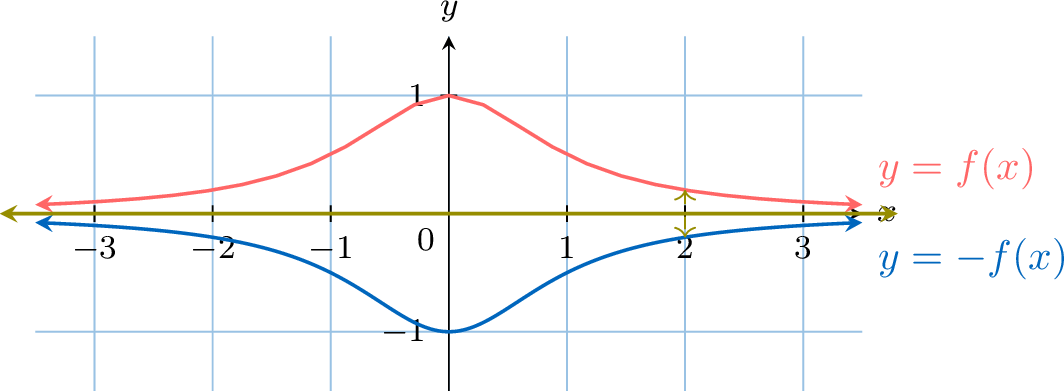
Definition Reflection in the y-axis
A reflection in the y-axis flips the graph of a function horizontally. It is a special case of horizontal dilation where \(b=-1\). It is defined by:$$g(x) = f(-x)$$This transformation maps a point \((x, y)\) to \((-x, y)\).