Roots
Square Roots
- When we square a number, we multiply it by itself. For example, \(3\) squared is \(3 \times 3\), which we write as \(3^2\).
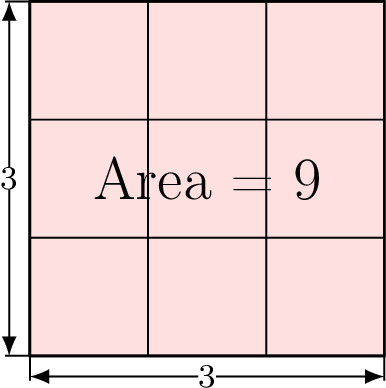
\(3^2 = 9\). The area of a square with side length \(3\) is \(9\) square units. - The square root is the inverse operation: it undoes squaring.
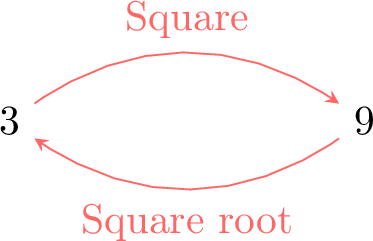
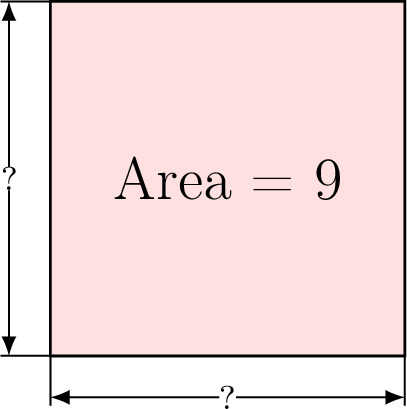
Definition Square root
The square root of a non-negative number \(a\) (that is, \(a \ge 0\)), written as \(\sqrt{a}\), is the non-negative number that, when multiplied by itself, gives \(a\).$$\left(\sqrt{a}\right)^2 = a$$
Note
- The square root symbol \(\sqrt{\quad}\) always asks for the positive root. For example, \(\sqrt{25} = 5\). It is a common mistake to think that \(\sqrt{25}\) is \(\pm 5\).
While it's true that both \(5^2 = 25\) and \((-5)^2 = 25\), the symbol \(\sqrt{25}\) refers only to the positive solution, which is \(5\). - Why can't we take the square root of a negative number (in the real numbers)?
Consider \(\sqrt{-9}\). To find this value, we need a number that, when multiplied by itself, gives \(-9\).- A positive number squared is positive (\(3 \times 3 = 9\)).
- A negative number squared is also positive (\(-3 \times -3 = 9\)).
Definition Perfect Squares
A perfect square is an integer that is the square of another integer. The square root of a perfect square is an integer.
Example
The first few perfect squares are:$$ 1, 4, 9, 16, 25, 36, 49, 64, 81, 100, \dots $$Their square roots are:$$ \sqrt{1} = 1, \quad \sqrt{4} = 2, \quad \sqrt{9} = 3, \quad \sqrt{16} = 4, \quad \dots $$
Definition Simplest Radical Form
A radical is written in simplest form if the number under the square root sign is as small as possible.
Calculating Square Roots
While the square roots of perfect squares are easy to find, most numbers are not perfect squares. We can estimate their square roots or use a calculator for a more precise value.
Method Use a calculator
On most calculators, you can find a square root using the \(\boxed{\sqrt{\;}}\) button.
Example
Use a calculator to find \(\sqrt{10}\), rounded to \(2\) decimal places.
Entering \(\sqrt{10}\) into a calculator gives approximately \(3.162277\ldots\)
Rounded to \(2\) decimal places, \(\sqrt{10} \approx 3.16\).
Rounded to \(2\) decimal places, \(\sqrt{10} \approx 3.16\).
Nth Roots
Just as the square root of a number is the side length of a square with a given area, the cube root \(\sqrt[3]{a}\) is the side length of a cube with volume \(a\).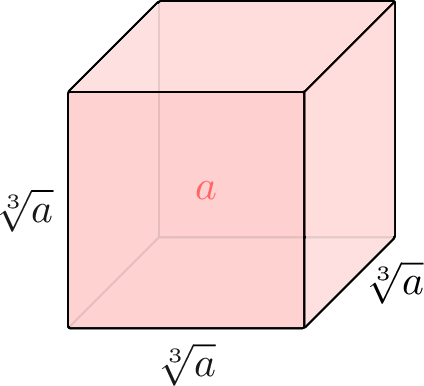
Definition Cube Root
The cube root of a real number \(a\), written \(\sqrt[3]{a}\), is the (real) number which, when cubed, gives \(a\):$$\left(\sqrt[3]{a}\right)^3 = a$$
Note
Unlike square roots, cube roots are defined for all real numbers, including negatives. For example, \(\sqrt[3]{-27} = -3\) because \((-3) \times (-3) \times (-3) = -27\).
Example
Find \(\sqrt[3]{125}\).
\(\sqrt[3]{125} = 5\) because \(5 \times 5 \times 5 = 125\).
Definition Nth Root
The concept of a root can be generalized. For a positive integer \(n\), the nth root of a real number \(a\), written \(\sqrt[n]{a}\), is the number which, when raised to the power of \(n\), gives \(a\):$$\left(\sqrt[n]{a}\right)^n = a.$$The rules for their domains depend on whether the index \(n\) is even or odd.
- Even roots (e.g.\ \(\sqrt[2]{a}, \sqrt[4]{a}, \dots\)): an even root of a negative number is not a real number. For even \(n\), \(\sqrt[n]{a}\) is only defined for \(\boldsymbol{a \ge 0}\).
- Odd roots (e.g.\ \(\sqrt[3]{a}, \sqrt[5]{a}, \dots\)): an odd root is defined for all real numbers \(a\).
Laws of Radicals
Expressions involving square roots are called radical expressions (or simply radicals). To simplify and manipulate these expressions, we use a set of important laws.
Proposition Multiplication Law
For any real numbers \(a,b \ge 0\):$$\textcolor{colorprop} {\sqrt{a} \times \sqrt{b} = \sqrt{ab}} $$
By definition, squaring a square root gives the original number. Let's square the expression \(\sqrt{a} \times \sqrt{b}\):$$\begin{aligned}[t]\left(\sqrt{a} \times \sqrt{b}\right)^2 &= (\sqrt{a} \times \sqrt{b}) \times (\sqrt{a} \times \sqrt{b}) \\
&= (\sqrt{a} \times \sqrt{a}) \times (\sqrt{b} \times \sqrt{b}) \\
&= a \times b = ab\end{aligned}$$Since squaring \(\sqrt{a} \times \sqrt{b}\) gives \(ab\), then by definition, \(\sqrt{a} \times \sqrt{b}\) must be the square root of \(ab\).
Example
Show that \(\sqrt{4} \times \sqrt{9} = \sqrt{36}\).
$$\begin{aligned}[t]\sqrt{4} \times \sqrt{9} &= \sqrt{4\times 9} \\
&= \sqrt{36} \\
&= 6\end{aligned}$$
Proposition Square Root of a Square
For any real number \(a \ge 0\):$$ \textcolor{colorprop}{\sqrt{a^2} = a} $$
This follows directly from the multiplication law:$$\sqrt{a^2} = \sqrt{a \times a} = \sqrt{a} \times \sqrt{a} = (\sqrt{a})^2 = a$$
Example
Find \(\sqrt{25}\).
$$\begin{aligned}[t]\sqrt{25}& = \sqrt{5^2} \\
&= 5\end{aligned}$$
Proposition Simplifying Law
For any real numbers \(a,b \ge 0\):$$ \textcolor{colorprop}{\sqrt{a^2 b} = a\sqrt{b}} $$
$$\begin{aligned}[t]\sqrt{a^2 b} &= \sqrt{a^2} \times \sqrt{b} && \text{(by Multiplication Law)} \\
&= a \times \sqrt{b} && \text{(by Square Root of a Square Law)} \\
&= a\sqrt{b}\end{aligned}$$
Example
Simplify \(\sqrt{12}\).
First, find the largest perfect square factor of \(12\), which is \(4\).$$\begin{aligned}[t]\sqrt{12} &= \sqrt{4 \times 3} \\
&= \sqrt{2^2 \times 3} \\
&= 2\sqrt{3}\end{aligned}$$
Proposition Division Law
For any real numbers \(a \ge 0\) and \(b>0\):$$ \textcolor{colorprop}{\sqrt{\frac{a}{b}} = \frac{\sqrt{a}}{\sqrt{b}}} $$
Let's square the expression \(\dfrac{\sqrt{a}}{\sqrt{b}}\):$$\begin{aligned}[t]\left(\frac{\sqrt{a}}{\sqrt{b}}\right)^2 &= \frac{\sqrt{a}}{\sqrt{b}} \times \frac{\sqrt{a}}{\sqrt{b}} \\
&= \frac{(\sqrt{a})^2}{(\sqrt{b})^2} \\
&= \frac{a}{b}\end{aligned}$$Since squaring \(\dfrac{\sqrt{a}}{\sqrt{b}}\) gives \(\dfrac{a}{b}\), it must be the square root of \(\dfrac{a}{b}\).
Example
Simplify \(\sqrt{\dfrac{9}{16}}\).
$$\sqrt{\frac{9}{16}} = \frac{\sqrt{9}}{\sqrt{16}} = \frac{3}{4}$$
Algebraic Operations with Radicals
- We can only add or subtract radicals if they are like radicals, which means they have the exact same number under the root sign.
Think of it like algebra: you can simplify \(2x+4x\) to \(6x\), but you cannot simplify \(2x+4y\). In the same way, you can simplify \(2\sqrt{3} + 4\sqrt{3}\), but you cannot simplify \(2\sqrt{3} + 4\sqrt{5}\). - When multiplying expressions with radicals, we use the same rules as in algebra, such as the distributive law for expanding brackets, together with the radical laws we have just seen.
Method Algebraic Operations
We can perform operations with radicals (square roots) in a similar way to ordinary numbers, provided we respect the radical laws. In particular:
- We can add and subtract like radicals (i.e.\ the same number under the root) in the same way that we add and subtract like algebraic terms:$$ \textcolor{colorprop}{c\sqrt{a} + d\sqrt{a} = (c + d)\sqrt{a}} $$
- We can use the usual rules for expanding brackets (such as the distributive law).
Example
Simplify: \(2\sqrt{3} + 4\sqrt{3}\)
Just like \(2x+4x=6x\), we can add the coefficients of the like radical:$$2\sqrt{3} + 4\sqrt{3} = (2+4)\sqrt{3} = \boldsymbol{6\sqrt{3}}$$
Example
Expand and simplify \(\sqrt{3}(5 - \sqrt{3})\).$$ \begin{aligned}\sqrt{3}(5 - \sqrt{3}) &= (\sqrt{3} \times 5) - (\sqrt{3} \times \sqrt{3}) \\
&= 5\sqrt{3} - 3\end{aligned} $$
Rationalizing the Denominator
In mathematics, it is standard practice to write expressions without radicals in the denominator. The process of removing a radical from the denominator is called rationalizing the denominator. This does not change the value of the expression but converts it to a standard form which is often easier to work with.
Method Rationalizing a Monomial Denominator
To rationalize a denominator of the form \(\sqrt{a}\) (where \(a>0\)), multiply the numerator and the denominator by \(\sqrt{a}\).$$ \frac{b}{\sqrt{a}} = \frac{b}{\sqrt{a}} \times \frac{\sqrt{a}}{\sqrt{a}} = \frac{b\sqrt{a}}{a} $$This works because multiplying by \(\frac{\sqrt{a}}{\sqrt{a}}\) is equivalent to multiplying by 1, which does not change the value.
Example
Rationalize the denominator of \(\frac{6}{\sqrt{2}}\).
We multiply the numerator and denominator by \(\sqrt{2}\).$$\begin{aligned}\frac{6}{\sqrt{2}} &= \frac{6}{\sqrt{2}} \times \frac{\sqrt{2}}{\sqrt{2}} \\
&= \frac{6\sqrt{2}}{2} \\
&= \boldsymbol{3\sqrt{2}}\end{aligned}$$
When the denominator is a binomial containing a square root, such as \(a+\sqrt{b}\), we use a special tool called the conjugate to rationalize it.
Definition Conjugate
The conjugate of a binomial expression \(x+y\) is \(x-y\).
Example
- The conjugate of \(a+\sqrt{b}\) is \(\boldsymbol{a-\sqrt{b}}\).
- The conjugate of \(a-\sqrt{b}\) is \(\boldsymbol{a+\sqrt{b}}\).
The power of the conjugate lies in its product, which follows the difference of squares identity: \((x+y)(x-y) = x^2 - y^2\).$$ (a+\sqrt{b})(a-\sqrt{b}) = a^2 - (\sqrt{b})^2 = a^2 - b $$The result is a rational number, which achieves our goal.
Method Rationalizing a Binomial Denominator
To rationalize a binomial denominator, multiply the numerator and the denominator by the conjugate of the denominator.
Example
Rationalize the denominator of \(\frac{4}{3+\sqrt{5}}\).
The denominator is \(3+\sqrt{5}\). Its conjugate is \(3-\sqrt{5}\). We multiply the numerator and denominator by this conjugate.$$\begin{aligned}\frac{4}{3+\sqrt{5}} &= \frac{4}{(3+\sqrt{5})} \times \frac{(3-\sqrt{5})}{(3-\sqrt{5})} \\
&= \frac{4(3 - \sqrt{5})}{3^2 - (\sqrt{5})^2} &&\color{gray}{\text{(Using }(x+y)(x-y)=x^2-y^2)}\\
&= \frac{12 - 4\sqrt{5}}{9 - 5} \\
&= \frac{12 - 4\sqrt{5}}{4} \\
&= \frac{4(3 - \sqrt{5})}{4} &&\color{gray}{\text{(Factor out 4 to simplify)}} \\
&= \boldsymbol{3 - \sqrt{5}}\end{aligned}$$