Right-Triangle Trigonometry
Trigonometry is a branch of mathematics that studies the relationships between the side lengths and angles of triangles, especially right-angled triangles. It is widely used in science, engineering, astronomy, architecture, and even video game development. In this chapter, we focus on three main trigonometric ratios: sine, cosine, and tangent.
Sides of a Right-Angled Triangle
Definition Right-Angled Triangle Sides
A right-angled triangle has one \(90^\circ\) angle. We name the sides relative to a chosen acute angle \(\theta\) (not the right angle).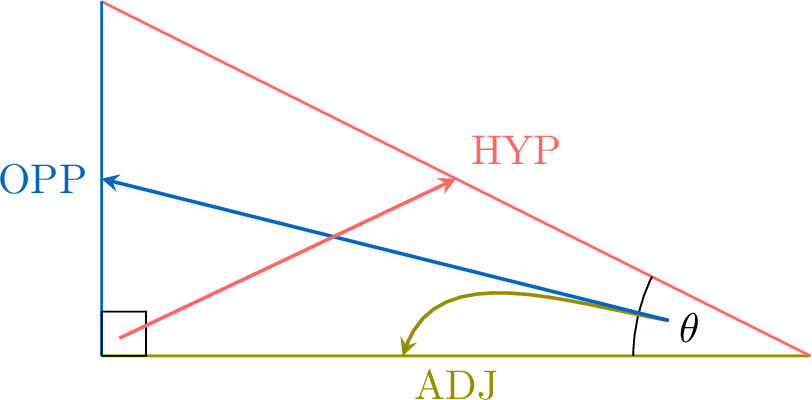
- The Hypotenuse (HYP) is the longest side, always opposite the right angle. It does not depend on the choice of \(\theta\).
- The Opposite (OPP) side is directly across from the angle \(\theta\); it does not touch \(\theta\).
- The Adjacent (ADJ) side is the leg next to the angle \(\theta\); it touches \(\theta\) but is not the hypotenuse.
Example
In the triangle below, the angle \(\theta\) is at vertex \(B\). Identify the hypotenuse, the adjacent side, and the opposite side relative to angle \(\theta\).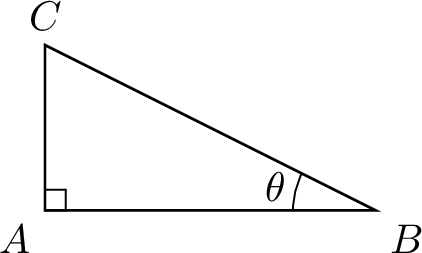
Relative to angle \(\theta\) at \(B\):
- Hypotenuse: \(\Segment{BC}\)
- Adjacent side: \(\Segment{AB}\)
- Opposite side: \(\Segment{AC}\)
Trigonometric Ratios
The Foundation of Trigonometric Ratios
Why do trigonometric ratios work? The answer lies in the properties of similar triangles.
Consider any two right-angled triangles that share a common acute angle, \(\theta\).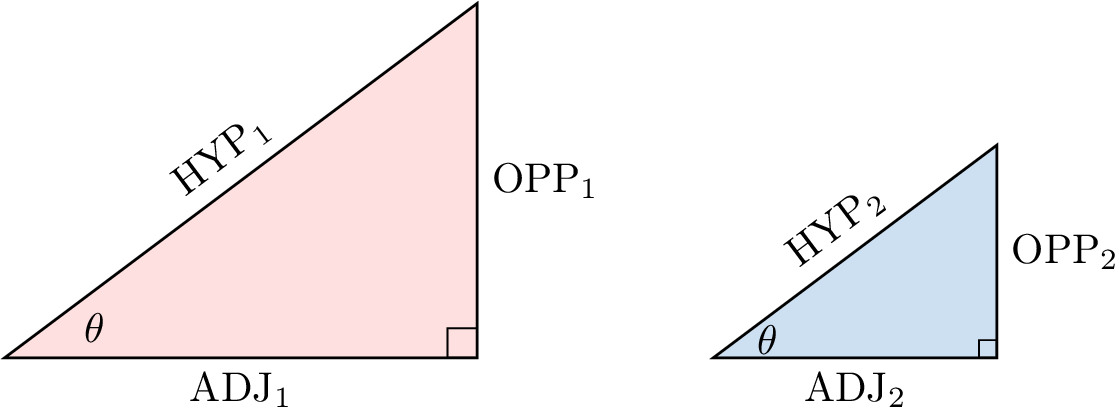
A fundamental property of similar triangles is that the ratios of their corresponding sides are equal. This means that for any right-angled triangle with angle \(\theta\):$$ \frac{\text{OPP}_1}{\text{HYP}_1} = \frac{\text{OPP}_2}{\text{HYP}_2}, \quad \frac{\text{ADJ}_1}{\text{HYP}_1} = \frac{\text{ADJ}_2}{\text{HYP}_2}, \quad \frac{\text{OPP}_1}{\text{ADJ}_1} = \frac{\text{OPP}_2}{\text{ADJ}_2}. $$Since these ratios are constant for any given angle \(\theta\), regardless of the size of the triangle, we can give them special names. These are the trigonometric ratios.
Consider any two right-angled triangles that share a common acute angle, \(\theta\).
A fundamental property of similar triangles is that the ratios of their corresponding sides are equal. This means that for any right-angled triangle with angle \(\theta\):$$ \frac{\text{OPP}_1}{\text{HYP}_1} = \frac{\text{OPP}_2}{\text{HYP}_2}, \quad \frac{\text{ADJ}_1}{\text{HYP}_1} = \frac{\text{ADJ}_2}{\text{HYP}_2}, \quad \frac{\text{OPP}_1}{\text{ADJ}_1} = \frac{\text{OPP}_2}{\text{ADJ}_2}. $$Since these ratios are constant for any given angle \(\theta\), regardless of the size of the triangle, we can give them special names. These are the trigonometric ratios.
Definition The Three Trigonometric Ratios
For an angle \(\theta\) in a right-angled triangle, we define the three main trigonometric ratios: sine, cosine, and tangent.$$\sin(\theta) = \frac{\text{Opposite}}{\text{Hypotenuse}}, \quad\cos(\theta) = \frac{\text{Adjacent}}{\text{Hypotenuse}}, \quad\tan(\theta) = \frac{\text{Opposite}}{\text{Adjacent}}.$$
A common mnemonic to remember these is SOH-CAH-TOA:
- Sin = Opposite / Hypotenuse
- Cos = Adjacent / Hypotenuse
- Tan = Opposite / Adjacent
Example
In the triangle below, find \(\cos \theta\), \(\sin \theta\), and \(\tan \theta\).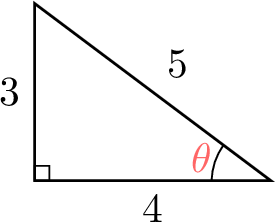
Relative to \(\theta\) at \(B\):
- Hypotenuse: \(BC = 5\)
- Adjacent side: \(AB = 4\)
- Opposite side: \(AC = 3\)
Proposition Tangent Formula
$$\tan \theta = \frac{\sin \theta}{\cos \theta}$$
$$\begin{aligned}\tan \theta &= \frac{\text{OPP}}{\text{ADJ}}\\
&= \frac{\text{OPP}/\text{HYP}}{\text{ADJ}/\text{HYP}}\\
&= \frac{\sin \theta}{\cos \theta}.\\
\end{aligned}$$
Method Using Calculator
Trigonometric ratios for any angle can be calculated using a scientific calculator in degree mode. Always check that your calculator is set to ``DEG'' (degrees) before calculating.
Example
In the triangle below, find \(x\).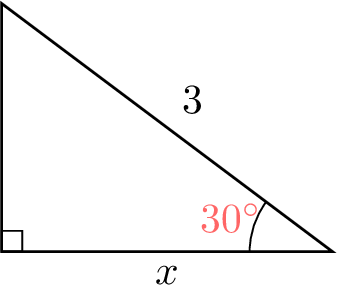
Relative to the angle \(30^\circ\) at \(B\), the side of length \(3\) is the hypotenuse and the side \(x\) is adjacent to the angle.$$\begin{aligned}\cos \theta &= \frac{\text{ADJ}}{\text{HYP}} \\
\cos(30^\circ) &= \frac{x}{3} \\
x &= 3 \times \cos(30^\circ) \\
x &\approx 3 \times 0.866 \\
x &\approx 2.6\,\text{cm}\end{aligned}$$
Inverse Trigonometric Functions
Trigonometric ratios can be used to find unknown angles in right-angled triangles when at least two side lengths are known.
Definition Inverse Trigonometric Functions
In a right-angled triangle with an angle \(\theta\):$$\theta = \cos^{-1}\left(\frac{\text{ADJ}}{\text{HYP}}\right), \quad\theta = \sin^{-1}\left(\frac{\text{OPP}}{\text{HYP}}\right), \quad\theta = \tan^{-1}\left(\frac{\text{OPP}}{\text{ADJ}}\right).$$
Example
In the triangle below, find the angle \(\theta\).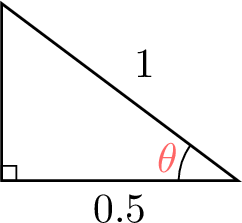
We know the lengths of the adjacent side (\(AB = 0.5\)) and the hypotenuse (\(BC = 1\)) relative to \(\theta\). We can use the inverse cosine function:$$\begin{aligned}\theta &= \cos^{-1}\left(\frac{\text{ADJ}}{\text{HYP}}\right) \\
&= \cos^{-1}\left(\frac{0.5}{1}\right) \\
&= 60^\circ.\end{aligned}$$
Solving Real-World Trigonometry Problems
Trigonometric ratios are powerful tools for solving a wide range of problems involving right-angled triangles, especially in real-world contexts. To solve these problems effectively, follow the structured steps below:
Method Solving Real-World Trigonometry Problems
- Draw a clear diagram representing the situation described in the problem.
- Label the unknown (side or angle) you need to find. Use \(x\) for a side and \(\theta\) for an angle if possible.
- Identify a right-angled triangle within your diagram.
- Write an equation relating an angle and two sides of the triangle using the appropriate trigonometric ratio.
- Solve the equation to find the unknown value.
- State your answer clearly, including appropriate units, in a complete sentence.