Pythagorean Theorem
One of the oldest and most famous mathematical concepts is the Pythagorean theorem. Named after the ancient Greek mathematician Pythagoras, this theorem establishes a fundamental relationship between the sides of a right-angled triangle.
Right-Angled Triangle
Definition Right-Angled Triangle
A right-angled triangle is a triangle that has one right angle (90°).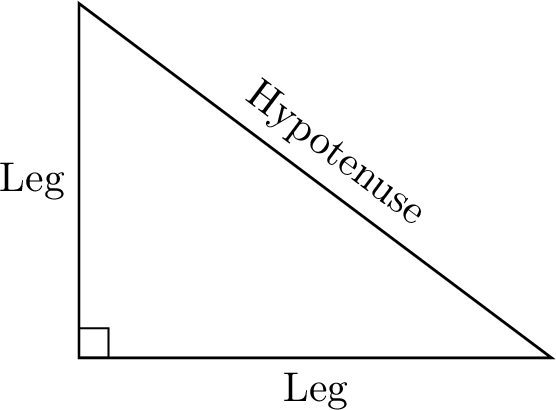
- The two sides that form the right angle are called the legs of the triangle.
- The side opposite the right angle, which is also the longest side, is called the hypotenuse.
Pythagorean Theorem
Theorem Pythagorean Theorem
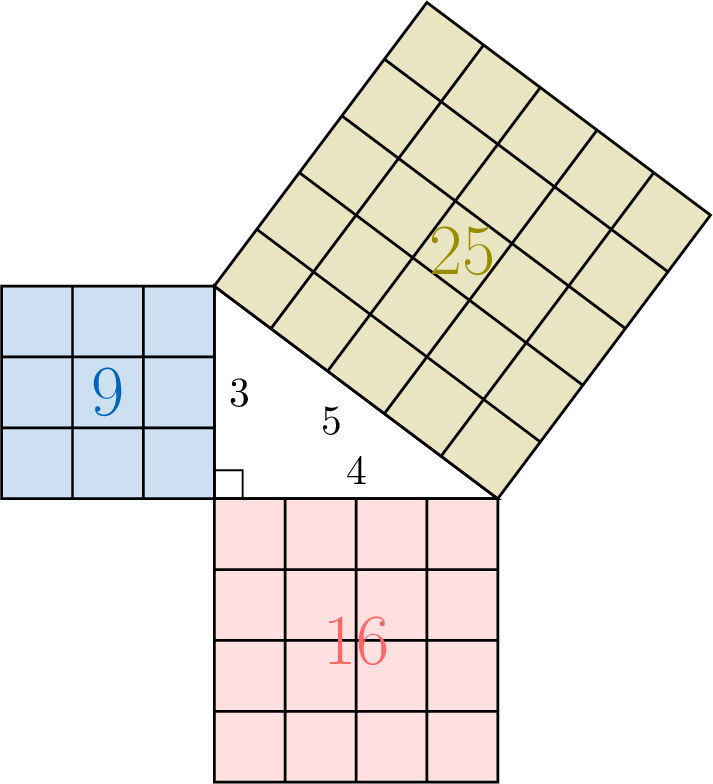
For any right-angled triangle with legs of length \(\textcolor{colordef}{a}\) and \(\textcolor{colorprop}{b}\) and a hypotenuse of length \(\textcolor{olive}{c}\), the square of the hypotenuse is equal to the sum of the squares of the legs:$$ \textcolor{colordef}{a^2} + \textcolor{colorprop}{b^2} = \textcolor{olive}{c^2}. $$This means the area of the square on the hypotenuse is equal to the sum of the areas of the squares on the other two sides.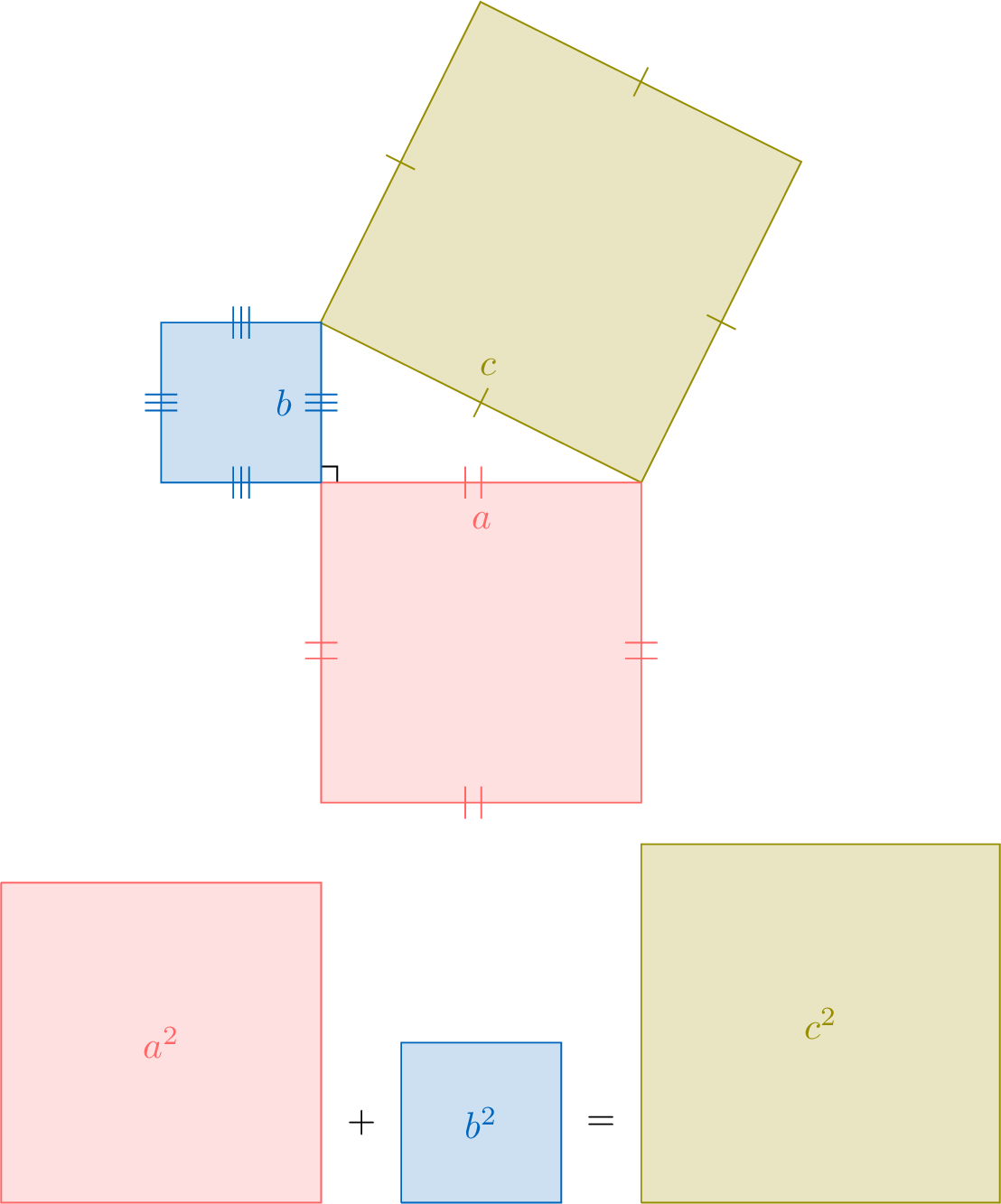
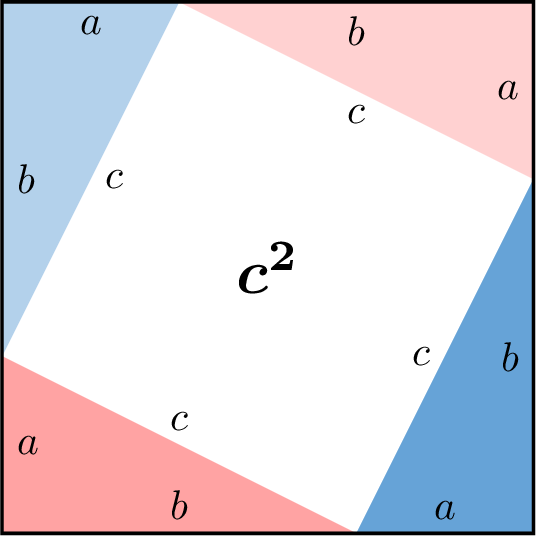
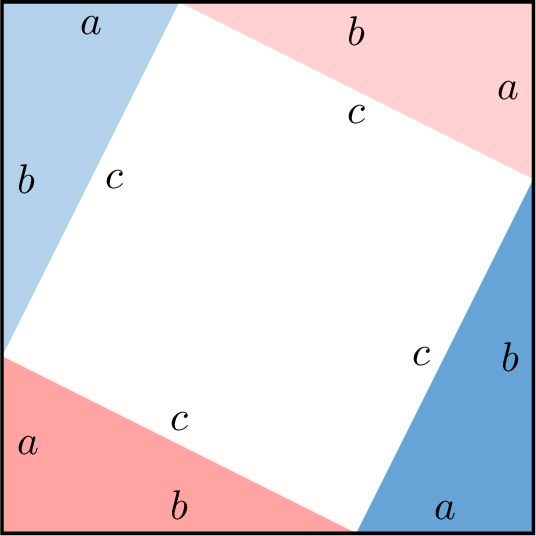
- The geometric proof involves rearranging four identical right-angled triangles within a square of side length \(a + b\).
- In the first arrangement, the four right-angled triangles form a smaller square in the center of the larger square:
- In the second arrangement, the four right-angled triangles form two smaller squares within the larger square:
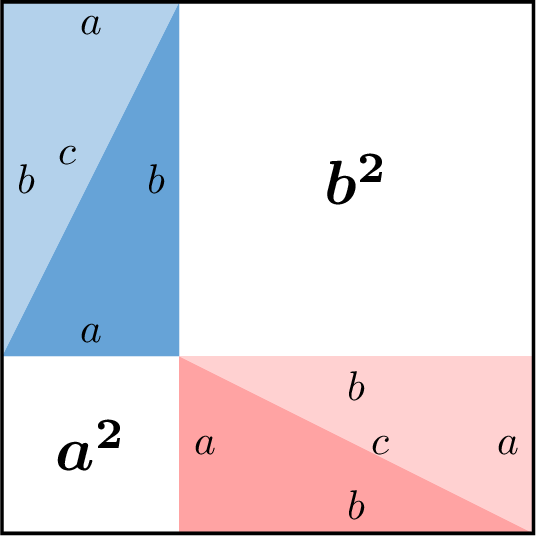
- Since the area not covered by the triangles is equal in both arrangements, we have:$$a^2 + b^2 = c^2.$$
- In the first arrangement, the four right-angled triangles form a smaller square in the center of the larger square:
- Algebraic proof: Using four copies of the same triangle arranged symmetrically around a central square with side \(c\), inside a larger square with side \(a + b\):
Example
Find the length of the hypotenuse, \(x\).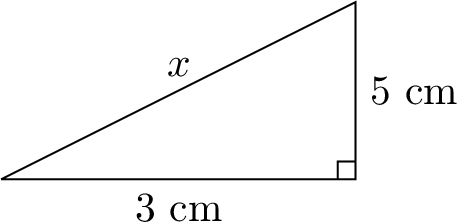
By the Pythagorean theorem:$$ \begin{aligned} a^2 + b^2 &= c^2 \\
3^2 + 5^2 &= x^2 \\
9 + 25 &= x^2 \\
34 &= x^2 \\
x &= \sqrt{34} \, \text{cm}\end{aligned} $$The hypotenuse has a length of \(\sqrt{34}\) cm (approximately 5.83 cm).
Example
Find the length of the unknown leg, \(y\).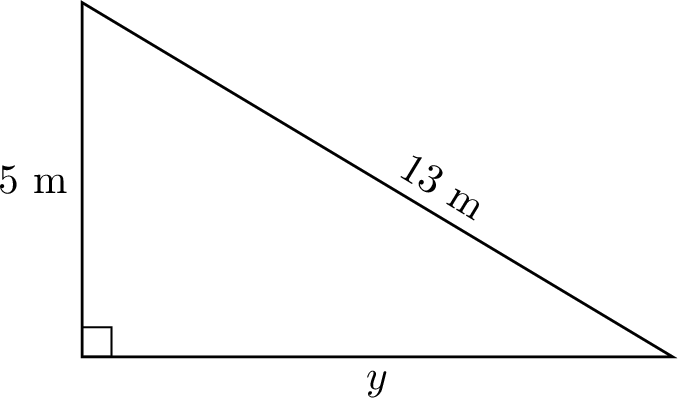
By the Pythagorean theorem, with \(c = 13\) being the hypotenuse:$$ \begin{aligned} a^2 + b^2 &= c^2 \\
y^2 + 5^2 &= 13^2 \\
y^2 + 25 &= 169 \\
y^2 &= 169 - 25 \\
y^2 &= 144 \\
y &= \sqrt{144} = 12 \, \text{m}\end{aligned} $$The unknown leg has a length of 12 m.
Verifying Right-Angled Triangles
Theorem Converse of the Pythagorean Theorem
If a triangle has side lengths \(a\), \(b\), and \(c\), where \(c\) is the longest side, and they satisfy \(a^2 + b^2 = c^2\), then the triangle is a right-angled triangle, and the right angle is opposite the longest side, \(c\).
Example
Is a triangle with side lengths 5 cm, 12 cm, and 13 cm a right-angled triangle?
We check if the sum of the squares of the two shorter sides equals the square of the longest side. The longest side is 13 cm.
- \( 5^2 + 12^2 = 25 + 144 = 169 \)
- \( 13^2 = 169 \)
Theorem Contrapositive of the Pythagorean Theorem
If a triangle has side lengths \(a\), \(b\), and \(c\), where \(c\) is the longest side, and the sum of the squares of the two shorter sides is not equal to the square of the longest side (\(a^2 + b^2 \neq c^2\)), then the triangle is not a right-angled triangle.
This theorem is the contrapositive of the original Pythagorean theorem. Since a statement and its contrapositive are logically equivalent, the contrapositive is also true.
Example
Is a triangle with sides of lengths 5, 8, and 9 right-angled?
The two shorter sides are 5 and 8, and the longest side is 9.
- \( 5^2 + 8^2 = 25 + 64 = 89 \)
- \( 9^2 = 81 \)