Formulas
Understanding Formulas
A formula is a special type of equation that describes a relationship between two or more variables. Formulas are powerful tools in mathematics and science because they provide a concise rule for modelling real-world phenomena, from calculating the area of a shape to predicting the distance an object travels.
Definition Formula
A formula is an equation that expresses one variable in terms of others. The single variable that is isolated on one side of the equation is called the subject of the formula.
Example
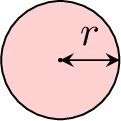 In the formula for the area of a circle, \(A = \pi r^2\), the subject is the area, \(A\).
Example
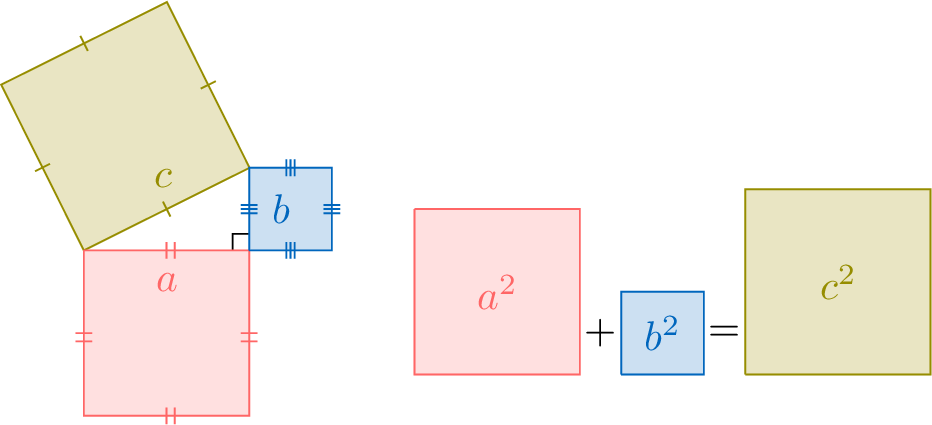 In the Pythagorean theorem, \(c^2 = a^2 + b^2\), the subject is \(c^2\).
Substituting into Formulas
Method Substituting Values
To find the value of a formula's subject, we can substitute known values for the other variables and evaluate the expression.
- Identify the formula required for the problem.
- Substitute the given values in place of their corresponding variables.
- Evaluate the resulting numerical expression to find the value of the subject.
Example
The formula for the area of a square is \(A = s^2\). Find the area of a square with a side length of \(4 \text{ cm}\).
- The formula is given: \(A = s^2\).
- Substitute the known value \(s = 4\): \(A = (4)^2\).
- Evaluate the expression: \(A = 16\).
Rearranging Formulas
Method Changing the Subject
We can rearrange a formula to make a different variable the subject. This is also known as "solving for a variable". The process uses the same rules as solving equations: apply inverse operations to both sides of the formula to isolate the desired variable.
Example
The formula for the area of a square is \(A = s^2\). Rearrange the formula to make the side length, \(s\), the subject.
To isolate \(s\), we must undo the "squaring" operation by taking the square root of both sides.$$\begin{aligned}A &= s^2 \\
\sqrt{A} &= \sqrt{s^2} \\
\sqrt{A} &= s\end{aligned}$$Since length must be positive, we only take the positive square root. The rearranged formula is \(s = \sqrt{A}\).
Constructing Formulas
Method Constructing a Formula
To construct a formula from a description or pattern:
- Define variables: Assign symbols (e.g., \(x, y, C\)) to represent the quantities involved.
- Identify the relationship: Describe in words how the variables are connected. Look for a fixed starting amount (a constant) and a rate of change (a coefficient).
- Translate to algebra: Write the relationship as an equation.
Example
A taxi charges a \(\dollar 3\) initial fee, plus \(\dollar 2\) for every kilometre travelled. Construct a formula for the total cost, \(C\), of a journey of \(d\) kilometres.
- Variables are defined: \(C\) for total cost and \(d\) for distance in kilometres.
- The relationship is: The total cost is the fixed fee of \(\dollar 3\) plus \(\dollar 2\) multiplied by the number of kilometres.
- The formula is: $$C = 2d + 3$$
Method Constructing a Formula from a Pattern
One of the most powerful skills in mathematics is the ability to observe a pattern and generalize it into a formula.
- Analyze specific cases: Start by collecting data from the first few examples in the pattern. Organize this data in a table.
- Identify the relationship: Look for a rule that connects the case number (e.g., diagram number, \(n\)) to the result (e.g., number of matchsticks, \(M\)). Look for a starting value and a common difference.
- Generalize the rule: Write down your observation as a formula using variables.
- Test your formula: Check if your formula works for the cases you analyzed and see if it can predict the next case.
Example
Derive the formula for the area of a rectangle.
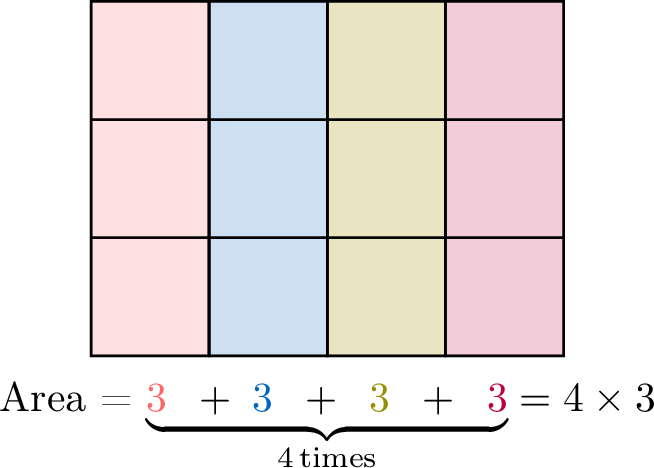
- Specific Case: Consider a rectangle with a width of 4 units and a height of 3 units. We can calculate its area by counting the unit squares inside, which can be seen as 4 columns of 3 squares each.
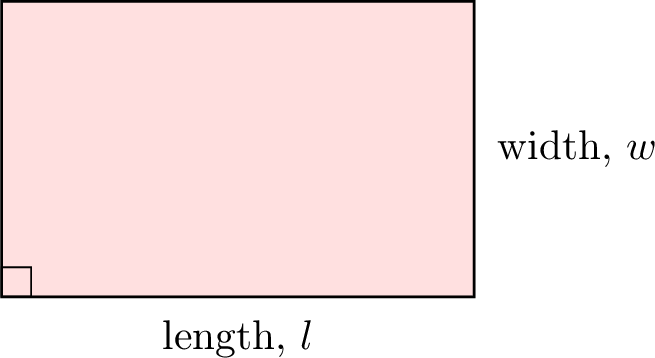
- General Case: We generalize this observation. For any rectangle with width \(w\) and length \(l\), the area \(A\) is given by the product of its dimensions.
Example
Examine the pattern of squares made from matchsticks: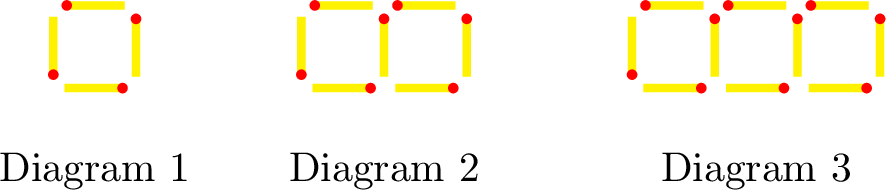
- Analyze specific cases: We count the matchsticks in each diagram and create a table.
Diagram Number (\(n\)) 1 2 3 Number of Matchsticks (\(M\)) 4 7 10 - Identify the relationship: We start with 4 matchsticks. To get to the next diagram, we add 3 more matchsticks each time. The common difference is 3. This indicates a linear relationship.
- Diagram 1: \(4\)
- Diagram 2: \(4 + 3\)
- Diagram 3: \(4 + 3 + 3 = 4 + 2 \times 3\)
- Generalize the rule: For Diagram \(n\), we start with 4 and add 3 a total of \((n-1)\) times. $$M = 4 + 3(n-1)$$ By expanding and simplifying, we get: $$M = 4 + 3n - 3 \implies M = 3n + 1$$
- Test the formula:
- For \(n=1\): \(M = 3(1) + 1 = 4\). Correct.
- For \(n=2\): \(M = 3(2) + 1 = 7\). Correct.
- For \(n=3\): \(M = 3(3) + 1 = 10\). Correct.