Solving Equations
What is an Equation?
Welcome to the Math Escape Room! Your team must solve a final puzzle to find the secret one-digit code (a number from \(0\) to \(9\)) and escape.
The clue is an equation where the code is represented by the symbol \(\triangle\):$$\triangle + 10 = 1 + 2 \times 6$$You only have one chance to enter the correct digit. Two of your teammates suggest different answers:
The clue is an equation where the code is represented by the symbol \(\triangle\):$$\triangle + 10 = 1 + 2 \times 6$$You only have one chance to enter the correct digit. Two of your teammates suggest different answers:
- Louis proposes entering \(\boxed{8}\).
- Su proposes entering \(\boxed{3}\).
To find the correct code, we test each suggestion to see which value for \(\triangle\) makes the equation a true statement.
First, simplify the right-hand side of the equation. Remember that we do the multiplication first:$$1 + 2 \times 6 = 1 + 12 = 13.$$So the equation becomes:$$\triangle + 10 = 13.$$
First, simplify the right-hand side of the equation. Remember that we do the multiplication first:$$1 + 2 \times 6 = 1 + 12 = 13.$$So the equation becomes:$$\triangle + 10 = 13.$$
- Test Louis's code: Substitute \(\textcolor{colordef}{\triangle = 8}\) into the equation. $$ \begin{aligned} \textcolor{colordef}{8} + 10 &= 18 \\ 18 &= 13 &&\text{(False)} \end{aligned} $$ Louis's code is incorrect.
- Test Su's code: Substitute \(\textcolor{colordef}{\triangle = 3}\) into the equation. $$ \begin{aligned} \textcolor{colordef}{3} + 10 &= 13 \\ 13 &= 13 &&\text{(True)} \end{aligned} $$ Su's code is correct.
Definition Equation and Solution
An equation is a mathematical statement that says two expressions are equal. It often contains a variable (or unknown), which is a symbol (like \(x\) or \(\triangle\)) representing a number we do not yet know.
Solving an equation means finding all value(s) of the variable that make the equation a true statement. Each of these values is called a solution of the equation.
Solving an equation means finding all value(s) of the variable that make the equation a true statement. Each of these values is called a solution of the equation.
Example
Show that \(x = 2\) is a solution to the equation \(3 + x = 5\).
We substitute \(\textcolor{colordef}{x = 2}\) into the equation and check if the left-hand side equals the right-hand side:$$\begin{aligned}3 + \textcolor{colordef}{(2)} &= 5 \\
5 &= 5 \quad &&\text{(This is a true statement.)}\end{aligned}$$Since the statement is true, \(x = 2\) is a solution.
Example
Show that \(x = 1\) is not a solution to \(3 + x = 5\).
We substitute \(\textcolor{colordef}{x = 1}\) into the equation:$$\begin{aligned}3 + \textcolor{colordef}{(1)} &= 5 \\
4 &= 5 &&\text{(This is a false statement.)}\end{aligned}$$Since the statement is false, \(x = 1\) is not a solution.
Solving by Inspection and Trial-and-Error
Method Trial and Error
Trial and error is a basic problem-solving method where we test different values for the variable until we find one that makes the equation true. For each value, we substitute it into the equation and check whether the left-hand side equals the right-hand side.
For simple equations, we can sometimes see the solution just by looking at the equation. This is called solving by inspection.
For simple equations, we can sometimes see the solution just by looking at the equation. This is called solving by inspection.
Example
Consider the equation \(2x + 3 = 11\).
Use the trial and error method to find the solution.
Use the trial and error method to find the solution.
We test different integer values for \(x\) to see which one makes the equation true.
- Try \(\textcolor{colordef}{x = 2}\): $$ \begin{aligned} 2 \times \textcolor{colordef}{(2)} + 3 &= 11 \quad &&\text{(Substitute)} \\ 4 + 3 &= 11 \\ 7 &= 11 \quad &&\text{(False)} \end{aligned} $$
- Try \(\textcolor{colordef}{x = 3}\): $$ \begin{aligned} 2 \times \textcolor{colordef}{(3)} + 3 &= 11 \quad &&\text{(Substitute)} \\ 6 + 3 &= 11 \\ 9 &= 11 \quad &&\text{(False)} \end{aligned} $$
- Try \(\textcolor{colordef}{x = 4}\): $$ \begin{aligned} 2 \times \textcolor{colordef}{(4)} + 3 &= 11 \quad &&\text{(Substitute)} \\ 8 + 3 &= 11 \\ 11 &= 11 \quad &&\text{(True)} \end{aligned} $$
The Principle of Balance
An equation is a statement that two expressions are equal. We can visualize this statement as a balanced scale, where the expression on the left side has the same value (weight) as the expression on the right.The equation \(x + 10 = 13\) can be represented as: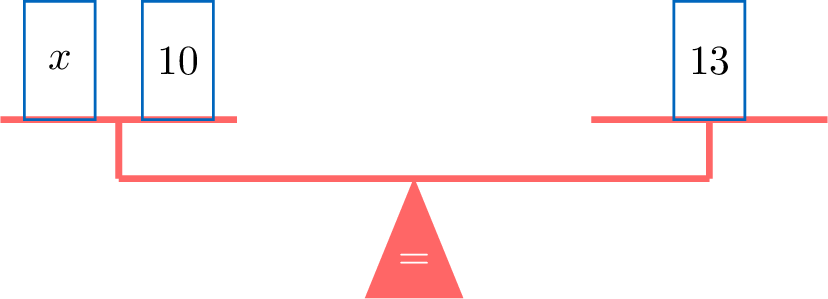
To keep the scale balanced, any operation we perform must be done on both sides equally. To isolate \(x\), we need to remove the weight of 10 from the left pan. To maintain balance, we must also remove a weight of 10 from the right pan.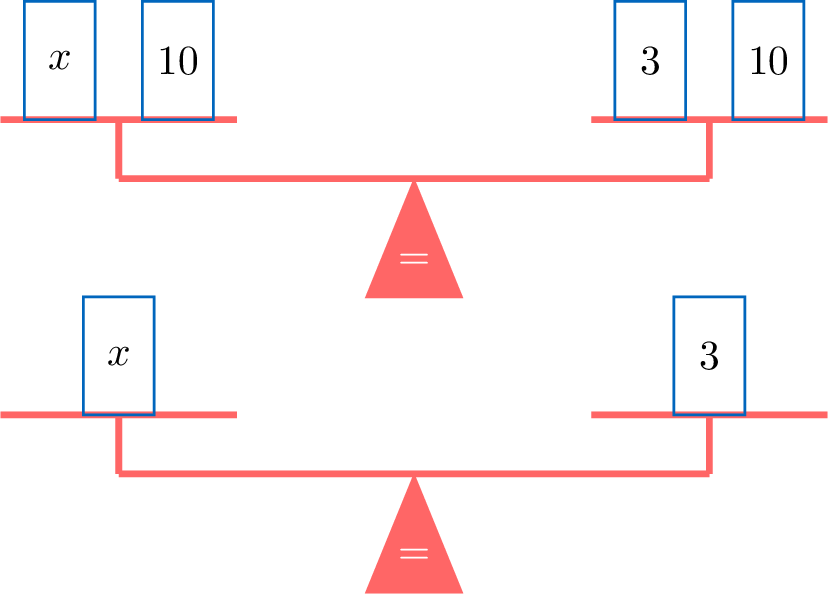
Definition Equivalent Equations
Two equations are equivalent if they have exactly the same solution(s). To solve an equation, we transform it into a series of simpler, equivalent equations until the solution is evident.
Proposition Golden Rules of Solving Equations
To create an equivalent equation, what you do to one side of the equation, you must do to the other side.
- Addition/Subtraction Property: Adding or subtracting the same number from both sides produces an equivalent equation.$$A=B \quad \Longleftrightarrow \quad A+c = B+c$$(and similarly \(A-c = B-c\))
- Multiplication/Division Property: Multiplying or dividing both sides by the same non-zero number produces an equivalent equation.$$A=B \quad \Longleftrightarrow \quad cA = cB \quad (c \neq 0)$$$$A=B \quad \Longleftrightarrow \quad \frac{A}{c} = \frac{B}{c} \quad (c \neq 0)$$
Solving by Reversing Operations
An algebraic expression like \(2x+1\) can be seen as a sequence of operations applied to a variable \(x\). To solve an equation involving this expression, our goal is to reverse this sequence to get back to \(x\).
Definition Inverse Operations
An inverse operation is an operation that "undoes" another operation.
- Addition and subtraction are inverse operations.\(\boxed{x}\xrightarrow{+a}\boxed{x+a}\xrightarrow{-a}\boxed{x}\)
- Multiplication and division are inverse operations.\(\boxed{x}\xrightarrow{\times a}\boxed{ax}\xrightarrow{\div a}\boxed{x} \quad \text{with }a\neq 0\)
Method Solving by Reversing
In many linear equations, we can isolate the variable by applying inverse operations in the reverse order.
- Identify the sequence of operations used to build the expression containing the variable.
- Reverse this sequence using the corresponding inverse operations, applying each step to both sides of the equation.
Example
Solve for \(x\):$$2x+1=7$$
- Sequence of operations on \(x\): First, \(x\) is multiplied by 2, then 1 is added. $$ \boxed{x}\xrightarrow{\times 2}\boxed{2x}\xrightarrow{+1}\boxed{2x+1} $$
- Reverse sequence with inverse operations: To isolate \(x\), we must first subtract 1, then divide by 2.$$ \boxed{2x+1}\xrightarrow{-1}\boxed{2x}\xrightarrow{\div 2}\boxed{x} $$
- Applying the steps: $$ \begin{aligned} 2x + 1 &= 7 \\ 2x + 1 - 1 &= 7 - 1 &&\text{(Subtract 1 from both sides)} \\ 2x &= 6 \\ \frac{2x}{2} &= \frac{6}{2} &&\text{(Divide both sides by 2)} \\ x &= 3 \end{aligned} $$ The solution is \(x = 3\).
Solving Product of Linear Factors
In the previous chapter, we learned how to factorize expressions. We will now see how this skill is essential for solving non-linear equations, especially when an equation can be written as a product of linear factors equal to zero. The power of factorization comes from a simple but fundamental property of the number zero.
Proposition Null Factor Law
If the product of two or more factors is equal to zero, then at least one of the factors must be equal to zero.If \(\textcolor{colordef}{A}\,\textcolor{colorprop}{B} = 0\) then \(\textcolor{colordef}{A=0}\) or \(\textcolor{colorprop}{B=0}\). Note: one or both of the factors can be zero.
Method Solving by Factorization
The Null Factor Law gives us a powerful strategy for solving equations of the form "product of factors = 0":
- Rearrange the equation so that all the terms are on one side and zero is on the other side.
- Factorize completely the side that contains the variable(s).
- Set each factor equal to zero and solve the resulting linear equations.
Example
Solve for \(x\): \(x(x+1)=0\)
The expression is already factored and equal to zero, so we can apply the Null Factor Law directly by setting each factor equal to zero:$$\begin{aligned}\textcolor{colordef}{x}\,\textcolor{colorprop}{(x+1)} &= 0 \\
\textcolor{colordef}{x=0} &\text{ or }\textcolor{colorprop}{(x+1)=0} &&\text{(Null Factor Law)}\\
\textcolor{colordef}{x=0} &\text{ or }\textcolor{colorprop}{x=-1}\,.\end{aligned}$$The equation has two solutions: \(x=0\) and \(x=-1\).
Solving Basic Quadratic Equations
Let's apply our factorization strategy to solve the quadratic equation \(x^2 = 9\).
- Rearrange to equal zero:$$x^2 - 9 = 0$$
- Factorize: this is a difference of two squares, \(x^2 - 3^2\).$$(\textcolor{colordef}{x-3})(\textcolor{colorprop}{x+3}) = 0$$
- Apply the Null Factor Law:$$\begin{aligned}\textcolor{colordef}{x-3=0} &\quad\text{or}\quad \textcolor{colorprop}{x+3=0} \\ \textcolor{colordef}{x=3} &\quad\text{or}\quad \textcolor{colorprop}{x=-3}\end{aligned}$$
Proposition Solutions of \(x^2 \equal k\)
Consider the equation \(x^2 = k\), where \(k\) is a real number. Looking for real solutions, we obtain:$$\begin{cases}x = \pm\sqrt{k} & \text{if } k > 0 \quad\text{(two real solutions)} \\
x = 0 & \text{if } k = 0 \quad\text{(one real solution)} \\
\text{No real solutions} & \text{if } k < 0\end{cases}$$In other words, solving \(x^2 = k\) means taking the square root of both sides and remembering that there are two opposite roots when \(k>0\).
Example
Solve for \(x\): \(x^2 = 3\)
Here \(k = 3 > 0\), so there are two real solutions:$$x = \sqrt{3} \quad \text{or} \quad x = -\sqrt{3}.$$This can be written more concisely as \(x = \pm\sqrt{3}\).