Fractions
Defining and Representing Fractions
Definition Rational Number
Any number that can be expressed as a fraction \(\dfrac{a}{b}\), where \(a\) and \(b\) are integers and \(b \neq 0\), is a rational number.
The components of a fraction are formally defined: 
A fraction can be represented in multiple ways.
The components of a fraction are formally defined:
- Symbolic Form:$$\frac{2}{3}$$
- Verbal Form:
"Two-thirds" or "Two over three" - Linear Model:

- Number Line Model:

Equivalent Fractions
Definition Equivalent Fractions
Equivalent fractions are fractions that represent the same numerical value, even though they are written with different numerators and denominators.
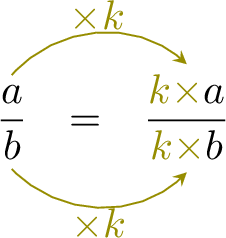
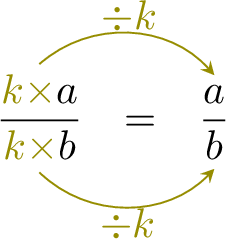
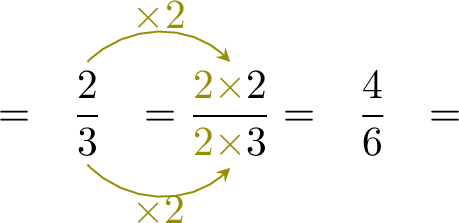
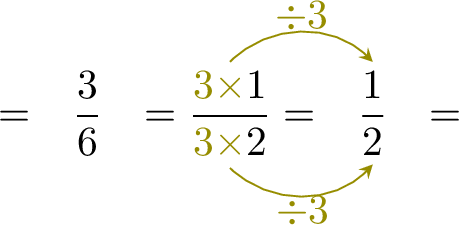
The fundamental rule for generating equivalent fractions is to multiply or divide both the numerator and the denominator by the same non-zero number.
The fundamental rule for generating equivalent fractions is to multiply or divide both the numerator and the denominator by the same non-zero number.
- When you multiply the numerator and the denominator by the same non-zero number (\(k\)), the fractions are equivalent:
- When you divide the numerator and the denominator by a common factor (\(k\)), the fractions are equivalent. This process is also known as simplification.
Example


Example


Simplification
Definition Simplest Form of a Fraction
A fraction is considered to be in its simplest form (or lowest terms) when its numerator and denominator share no common factors other than 1.
Example
- The fraction \(\frac{2}{3}\) is in simplest form because the only common factor of 2 and 3 is 1.
- The fraction \(\frac{4}{6}\) is not in simplest form because 4 and 6 share a common factor of 2. It can be simplified to the equivalent fraction \(\frac{2}{3}\).
Method Procedure for Simplifying a Fraction
To simplify a fraction, the numerator and denominator must be divided by their Greatest Common Factor (GCF). This can be achieved by canceling all common factors.
Example
Simplify the fraction \(\dfrac{4}{6}\).
$$\begin{aligned}[t]\dfrac{4}{6} &= \dfrac{2 \times \textcolor{olive}{\cancel{2}}}{3 \times \textcolor{olive}{\cancel{2}}}\quad \text{(Cancel the common factor 2)}\\
&= \dfrac{2}{3}\end{aligned}$$
Cross Multiplication
Proposition Cross Multiplication Property
For any numbers \(a,b,c,d\) with \(b\neq 0\) and \(d\neq 0\),
Let \(b\neq0\) and \(d\neq0\).$$\frac{a}{b} = \frac{c}{d}$$To eliminate the denominators, we can multiply both sides of the equation by a common multiple, such as \(b \times d\):$$\frac{a}{b} \times (b \times d) = \frac{c}{d} \times (b \times d)$$Simplifying both sides by canceling the common factors in the numerator and denominator yields:$$a \times d = c \times b$$This result, \(ad = bc\), is known as the cross-product. It provides a direct method for testing the equivalence of fractions and for solving for an unknown variable in a proportion.
Example
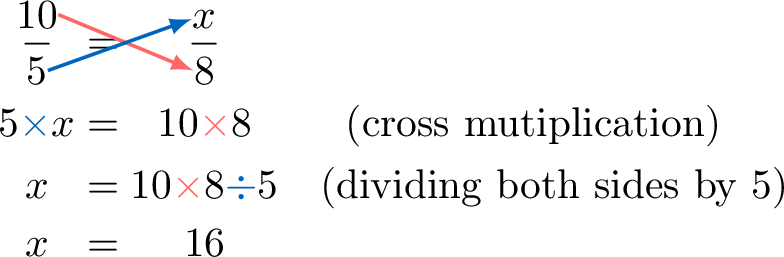
Solve \(x\) for \(\dfrac{10}{5}=\dfrac{x}{8}\).
Addition and Subtraction
Definition Addition and Subtraction of Fractions with Common Denominators
For any numbers \(a,b,c\) with \(c\neq 0\),
- To add fractions with common denominators, the numerators are added, and the denominator is retained.$$\frac{a}{c} + \frac{b}{c} = \frac{a+b}{c}$$
- To subtract fractions with common denominators, the numerators are subtracted, and the denominator is retained.$$\frac{a}{c} - \frac{b}{c} = \frac{a-b}{c}$$
Example
Calculate \(\dfrac{1}{4} + \dfrac{2}{4}\).
- $$\begin{aligned}[t]\dfrac{1}{4} + \dfrac{2}{4} &= \dfrac{1 + 2}{4} \\ &= \dfrac{3}{4}\end{aligned}$$
 \(+\)
\(+\)  \(=\)
\(=\) 
Method Procedure for Adding or Subtracting Fractions
To add or subtract fractions with unlike denominators, follow this three-step procedure:
- Find a Common Denominator: Identify a common multiple of the denominators.
- Create Equivalent Fractions: Convert each fraction to an equivalent fraction with the common denominator.
- Add or Subtract the Numerators: With the denominators now the same, perform the operation on the numerators and keep the common denominator.
Example
Calculate \(\dfrac{3}{4} + \dfrac{5}{6}\).
- Find a common denominator: To add fractions, they must have the same denominator.
- Multiples of 4: 4, 8, 12, 16, 20, \(\dots\)
- Multiples of 6: 6, 12, 18, 24, \(\dots\)
- The smallest common denominator is 12.
- \(\begin{aligned}[t]\dfrac{3}{4}+\dfrac{5}{6}&= \frac{3 \times \textcolor{olive}{3}}{4 \times \textcolor{olive}{3}}+\frac{5 \times \textcolor{olive}{2}}{6 \times \textcolor{olive}{2}}&&\\&=\dfrac{9}{12}+\dfrac{10}{12}&&\quad\text{(common denominator}= 12)\\&=\dfrac{9+10}{12}&&\quad\text{(adding numerators)}\\&=\dfrac{19}{12}&&\\\end{aligned}\)
- Visual representation:
 \(+\)
\(+\)
\(=\)  \(+\)
\(+\)
\(=\) 
Multiplying a Fraction by a Number
Multiplication by an integer can be understood as repeated addition. This principle extends to fractions. For instance, the expression \(3 \times \dfrac{1}{4}\) is equivalent to adding the fraction \(\dfrac{1}{4}\) to itself three times. Since these are like fractions, we can add their numerators.$$\begin{aligned}3 \times \dfrac{1}{4} &= \dfrac{1}{4} + \dfrac{1}{4}+\dfrac{1}{4}\\
&= \dfrac{1+1+1}{4}\\
&=\dfrac{3 \times 1}{4} \\
&= \dfrac{3}{4}\end{aligned}$$
\(3\times\)  | \(=\) | \(+\) \(+\) |
| \(=\) |  |
Definition Multiplication of a Fraction by an Number
To multiply a fraction by a number, multiply the number by the numerator of the fraction, and retain the original denominator.
For any numbers \(a,b,c\) with \(c\neq 0\),$$ a \times \frac{b}{c} = \frac{a \times b}{c} $$
For any numbers \(a,b,c\) with \(c\neq 0\),$$ a \times \frac{b}{c} = \frac{a \times b}{c} $$
Example
Calculate \(3 \times \dfrac{2}{5}\).
Applying the definition, we multiply the integer (3) by the numerator (2) and keep the denominator (5). $$ \begin{aligned} 3 \times \dfrac{2}{5} &= \dfrac{3 \times 2}{5} \\
&= \dfrac{6}{5} \end{aligned} $$The calculation can be visualized as the repeated addition of \(\dfrac{2}{5}\):
\(3\times\)  | \(=\) | \(+\) \(+\) |
| \(=\) |  |
Multiplication of Fractions
The multiplication of two fractions can be modeled by finding the area of a rectangle whose side lengths are given by those fractions. Consider the product \(\textcolor{colordef}{\dfrac{2}{3}} \times \textcolor{colorprop}{\dfrac{1}{2}}\). This corresponds to the area of the shaded rectangle within a unit square. 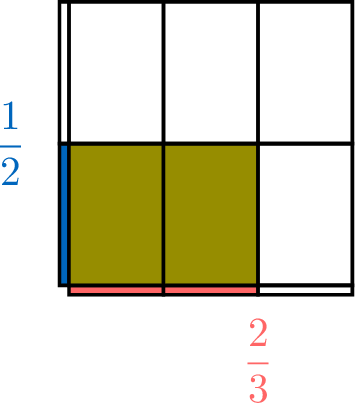
To determine the area of the shaded region, we observe the following:
- The unit square is partitioned into \(\textcolor{colordef}{3}\) columns and \(\textcolor{colorprop}{2}\) rows, resulting in a total of \(3 \times 2 = 6\) equal sub-rectangles. This determines the denominator of the resulting fraction.
- The shaded region covers \(\textcolor{colordef}{2}\) columns and \(\textcolor{colorprop}{1}\) row, comprising a total of \(2 \times 1 = \textcolor{olive}{2}\) of these sub-rectangles. This determines the numerator.
Definition Multiplication of Fractions
To multiply two fractions, one must multiply the numerators to find the numerator of the product, and multiply the denominators to find the denominator of the product.
For any numbers \(a,b,c,d\) with \(b\neq 0\) and \(d\neq 0\),$$\textcolor{colordef}{\frac{a}{b}} \times \textcolor{colorprop}{\frac{c}{d}} = \frac{\textcolor{colordef}{a} \times \textcolor{colorprop}{c}}{\textcolor{colordef}{b} \times \textcolor{colorprop}{d}}$$
For any numbers \(a,b,c,d\) with \(b\neq 0\) and \(d\neq 0\),$$\textcolor{colordef}{\frac{a}{b}} \times \textcolor{colorprop}{\frac{c}{d}} = \frac{\textcolor{colordef}{a} \times \textcolor{colorprop}{c}}{\textcolor{colordef}{b} \times \textcolor{colorprop}{d}}$$
Example
Calculate \( \dfrac{5}{2} \times \dfrac{3}{4}\).
Applying the rule for multiplication of fractions:$$\begin{aligned}[t]\dfrac{5}{2} \times \dfrac{3}{4} &= \dfrac{5 \times 3}{2 \times 4} \\
&= \dfrac{15}{8}\end{aligned}$$
Method Simplification by Canceling Common Factors
To simplify the multiplication process, any common factor that appears in both a numerator and a denominator can be canceled out before performing the multiplication. This is a direct application of simplification.
Example
Calculate \(\dfrac{31}{7} \times \dfrac{12}{31}\).
The number 31 is a factor in both a numerator and a denominator. It can be canceled before multiplying.$$\begin{aligned}[t]\dfrac{31}{7} \times \dfrac{12}{31}&= \dfrac{\textcolor{colordef}{\cancel{31}} \times 12}{7 \times \textcolor{colordef}{\cancel{31}}} \quad \text{(Cancel the common factor 31)} \\
&= \dfrac{12}{7}\end{aligned}$$
Division of Fractions
The operation of division is formally defined as the inverse of multiplication. To establish a procedure for dividing by a fraction, we must therefore utilize the concept of a multiplicative inverse. The multiplicative inverse is the value that "undoes" a multiplication, returning the result to the multiplicative identity, 1. This value is formally known as the reciprocal. Understanding the reciprocal is the necessary first step to developing the algorithm for fraction division.
Definition Reciprocal
For any non-zero number \(x\), its reciprocal is the number which, when multiplied by \(x\), yields the multiplicative identity, 1.
Proposition Reciprocal of a fraction
For a fraction \(\dfrac{a}{b}\) (where \(a\neq 0, b \neq 0\)), its reciprocal is the fraction \(\dfrac{b}{a}\).
The proof that \(\dfrac{b}{a}\) is the reciprocal of \(\dfrac{a}{b}\) is as follows:$$\begin{aligned}[t]\dfrac{a}{b} \times \dfrac{b}{a} &= \dfrac{a \times b}{b \times a} \\
&= \dfrac{ab}{ab} \\
&= 1\end{aligned}$$
Example
State the reciprocal of \(\dfrac{5}{7}\).
The reciprocal of \(\dfrac{5}{7}\) is \(\dfrac{7}{5}\).
Definition Division of fractions
To divide by a fraction, multiply by its reciprocal.
For any numbers \(a,b,c,d\) with \(b\neq 0, c\neq 0\) and \(d\neq 0\),$$\dfrac{a}{b} \div \dfrac{c}{d} = \dfrac{a}{b} \times \dfrac{d}{c}$$Equivalently, for a complex fraction:$$\dfrac{\frac{a}{b}}{\frac{c}{d}} = \dfrac{a}{b} \times \dfrac{d}{c}$$
For any numbers \(a,b,c,d\) with \(b\neq 0, c\neq 0\) and \(d\neq 0\),$$\dfrac{a}{b} \div \dfrac{c}{d} = \dfrac{a}{b} \times \dfrac{d}{c}$$Equivalently, for a complex fraction:$$\dfrac{\frac{a}{b}}{\frac{c}{d}} = \dfrac{a}{b} \times \dfrac{d}{c}$$
Example
Calculate \(\dfrac{2}{3} \div \dfrac{5}{7}\).
Applying the procedure for fraction division:$$\begin{aligned}[t]\frac{2}{3} \div \frac{5}{7} &= \frac{2}{3} \times \frac{7}{5} && \text{(Multiply by the reciprocal of the divisor)} \\
&= \frac{2 \times 7}{3 \times 5} && \text{(Multiply numerators and denominators)} \\
&= \frac{14}{15}\end{aligned}$$
Sign Conventions for Fractions
The sign of a fraction is determined by the rules of division for integers, as the fraction bar denotes division. Let us analyze the placement of a single negative sign.
Consider the division of \(-3\) by \(2\):$$\frac{-3}{2}=\overbrace{(-3)}^{\text{negative}} \div \overbrace{2}^{\text{positive}}=\overbrace{-\left(3\div 2\right)}^{\text{negative}}=-\frac{3}{2}$$Now consider the division of \(3\) by \(-2\):$$\frac{3}{-2}=\overbrace{3}^{\text{positive}} \div \overbrace{(-2)}^{\text{negative}}=\overbrace{-\left(3\div 2\right)}^{\text{negative}}=-\frac{3}{2}$$In both cases, the result is the same negative rational number, \(-\dfrac{3}{2}\). This demonstrates that a single negative sign in either the numerator or the denominator results in a negative fraction.
Consider the division of \(-3\) by \(2\):$$\frac{-3}{2}=\overbrace{(-3)}^{\text{negative}} \div \overbrace{2}^{\text{positive}}=\overbrace{-\left(3\div 2\right)}^{\text{negative}}=-\frac{3}{2}$$Now consider the division of \(3\) by \(-2\):$$\frac{3}{-2}=\overbrace{3}^{\text{positive}} \div \overbrace{(-2)}^{\text{negative}}=\overbrace{-\left(3\div 2\right)}^{\text{negative}}=-\frac{3}{2}$$In both cases, the result is the same negative rational number, \(-\dfrac{3}{2}\). This demonstrates that a single negative sign in either the numerator or the denominator results in a negative fraction.
Proposition Properties of Signs in Fractions
For any numbers \(a,b\) with \(b\neq 0\),
- A single negative sign results in a negative fraction. The sign can be placed with the numerator, the denominator, or in front of the fraction. $$ \frac{-a}{b} = \frac{a}{-b} = -\frac{a}{b} $$
- Two negative signs (one in the numerator and one in the denominator) result in a positive fraction, as the signs cancel each other out. $$ \frac{-a}{-b} = \frac{a}{b} $$
Example
Simplify the fraction \(\dfrac{-4}{-6}\).
The simplification follows these steps:$$\begin{aligned}[t]\frac{-4}{-6} &= \frac{4}{6} && \text{(Applying the sign rule: negative } \div \text{ negative } = \text{ positive)} \\
&= \frac{2 \times \cancel{2}}{3 \times \cancel{2}} && \text{(Factoring and canceling the common factor of 2)} \\
&= \frac{2}{3}\end{aligned}$$
Fractions as the Result of Division
Consider a scenario where two identical units (cakes) are to be shared equally among three individuals. 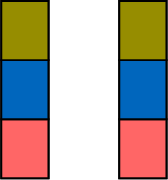
This scenario represents the division problem \(2 \div 3\). How can the result of this division be expressed as a fraction?
To solve this, each unit is divided into three equal parts (thirds). Each of the three individuals receives one part from each of the two units. 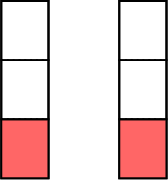
Each individual's total share consists of two pieces, where each piece is \(\dfrac{1}{3}\) of a unit. Therefore, each person receives a total of \(\dfrac{2}{3}\) of a unit. This demonstrates that the division \(2 \div 3\) is equal to the fraction \(\dfrac{2}{3}\).
Proposition The Fraction as a Quotient
For any integers \(a\) and \(b\) (where \(b \neq 0\)), the division of \(a\) by \(b\) is represented by the fraction \(\dfrac{a}{b}\).$$a \div b = \frac{a}{b}$$In this context:
- The numerator (\(a\)) corresponds to the dividend.
- The denominator (\(b\)) corresponds to the divisor.
Example
The fraction \(\dfrac{2}{3}\) is the same as saying "2 divided by 3". 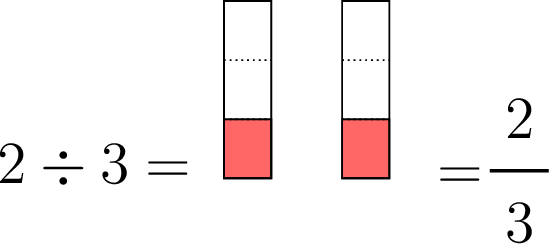
The fraction \(\dfrac{2}{3}\) is the number which, when multiplied by \(3\), gives \(2\):$$\dfrac{2}{3}\times 3 = 2 $$
Fraction as a Ratio and Operator
The mathematical justification for treating the expression "\(\dfrac{a}{b}\) of a number \(N\)" as a multiplication operation is derived from the principle of proportions. The procedure is as follows:
- Establish the known ratio: A fraction can represent a known ratio, \(\dfrac{a}{b}\).
- Set up an equivalent ratio: We want to find an unknown quantity, \(x\), that has the same ratio to the total, \(N\). This gives the ratio \(\dfrac{x}{N}\).
- Form a proportion: An equation is formed by stating that the two ratios are equivalent: $$ \frac{a}{b} = \frac{x}{N} $$
- Solve for the unknown: To isolate the variable \(x\), both sides of the equation are multiplied by \(N\). This yields the operational formula: $$ x = \frac{a}{b} \times N $$
Method From Ratio to Operation
To find a fraction of a quantity, multiply that quantity by the fraction:$$\textcolor{colorprop}{\frac{a}{b}\,\text{of }N=\frac{a}{b}\times N}$$
Example
In a class of 30 students, the ratio of girls to the total number of students is \(\dfrac{2}{3}\) (i.e., two thirds of the class are girls). How many girls are there?
The fraction \(\dfrac{2}{3}\) represents the part of the whole class that are girls.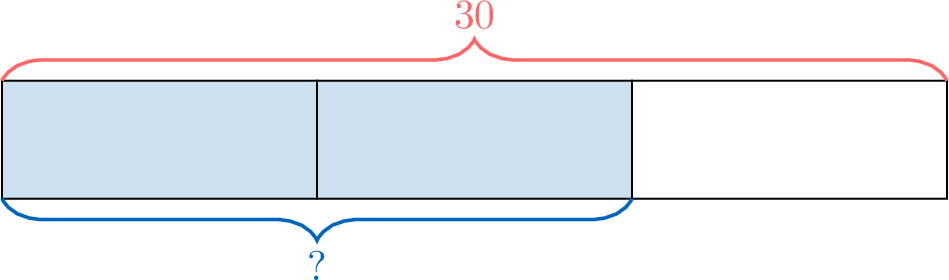
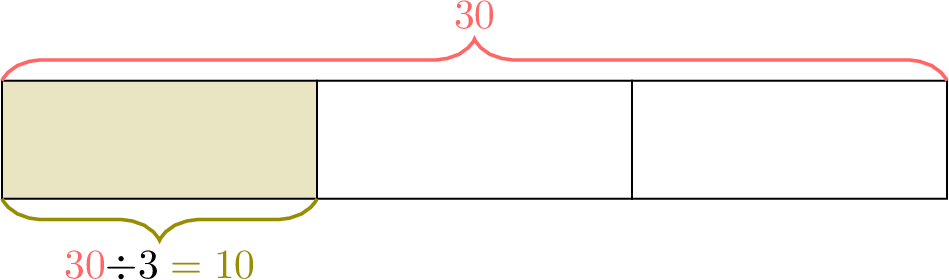
- Method 1 (unitary method). First find one part: \(30\div 3=10\). Then take two parts: \(10\times 2=\textcolor{colorprop}{20}\).
 \qquad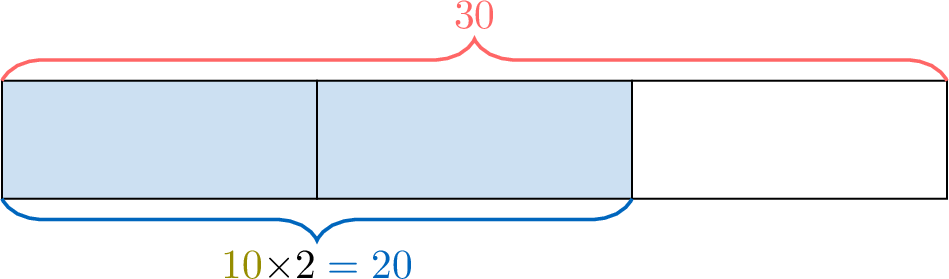
- Method 2 (formula).$$\begin{aligned}\textcolor{colorprop}{\text{Number of girls}}&=\frac{2}{3}\text{ of }\textcolor{colordef}{30}\\ &=\frac{2}{3}\times \textcolor{colordef}{30}\\ &=\frac{2\times 30}{3}\\ &=(2\times 30)\div 3\\ &=\textcolor{colorprop}{20}.\\ \end{aligned}$$
Fractions as Decimal Numbers
Fractions and decimals are two different notations for representing the same rational numbers. Both can describe values that lie between integers. The ability to convert between these two forms is a fundamental mathematical skill. For example, the quantity "one half" can be written as either a fraction or a decimal:$$ \frac{1}{2} = 0.5 $$This section will formalize the procedures for converting between these two representations.
Method Converting a Fraction to a Decimal Number
There are two primary methods for converting a fraction to its decimal equivalent.
- Method 1: Direct Division
Since a fraction \(\frac{a}{b}\) is equivalent to the division \(a \div b\), perform the division of the numerator by the denominator. - Method 2: Denominator as a Power of 10
Find an equivalent fraction where the denominator is a power of 10 (e.g., 10, 100, 1000). The numerator of this new fraction can then be written as a decimal.
Example
Convert \(\dfrac{3}{4}\) to a decimal number.
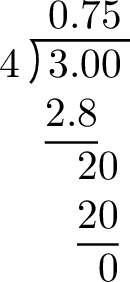
- Applying Method 1 (Direct Division): $$ \frac{3}{4} = 3 \div 4 = 0.75 $$
- Applying Method 2 (Power of 10): We seek a number to multiply the denominator (4) by to get a power of 10. We know \(4 \times 25 = 100\). $$ \frac{3}{4} = \frac{3 \textcolor{olive}{\times 25}}{4 \textcolor{olive}{\times 25}} = \frac{75}{100} $$ The fraction "seventy-five hundredths" is written as the decimal \(0.75\).
Method Converting a Decimal to a Fraction
The procedure for converting a terminating decimal to a fraction is as follows:
- Write the decimal as the numerator of a fraction without the decimal point.
- The denominator is 1 followed by as many zeros as there are decimal places in the original number.
- Simplify the fraction to its lowest terms, if necessary.
Example
Convert \(1.3\) to a fraction.
- The number \(1.3\) has one decimal place.
- Write the number without the decimal point as the numerator: 13.
- The denominator will be 1 followed by one zero: 10.
Representing Fractions Greater Than One
Fractions can represent values greater than one. Consider the fraction \(\dfrac{5}{2}\), which represents 5 half-sized parts of a unit.
Definition Proper and Improper Fractions
Fractions are classified based on the relationship between the numerator and the denominator.
- A proper fraction is a fraction where the numerator is less than the denominator. Its value is always less than 1. Example: \(\dfrac{2}{3}\).
- An improper fraction is a fraction where the numerator is greater than or equal to the denominator. Its value is always greater than or equal to 1. Example: \(\dfrac{5}{3}\).
Definition Mixed Number
A mixed number is an alternative way to represent an improper fraction. It consists of an integer part (the number of whole units) and a proper fraction part.
The improper fraction \(\dfrac{5}{2}\) can be visualized as two whole units and one half.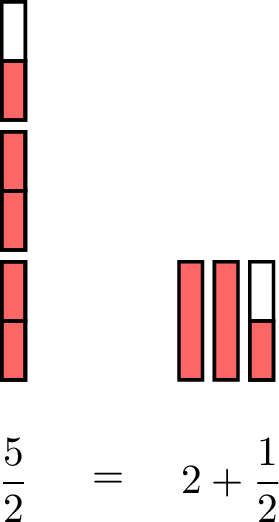
The improper fraction \(\dfrac{5}{2}\) can be visualized as two whole units and one half.
Order of Operations
Proposition The Fraction Bar as a Grouping Symbol
In the order of operations (PEMDAS), the fraction bar functions as a grouping symbol for both the entire numerator and the entire denominator. This means that any expressions in the numerator and denominator must be fully evaluated to a single value before the final division, represented by the fraction itself, is considered.
The expression \(\dfrac{A}{B}\) is mathematically equivalent to \((A) \div (B)\).
Therefore, the procedure is as follows:
The expression \(\dfrac{A}{B}\) is mathematically equivalent to \((A) \div (B)\).
Therefore, the procedure is as follows:
- Evaluate the entire expression in the numerator.
- Evaluate the entire expression in the denominator.
- Simplify the resulting fraction, if possible.
Example
Simplify the expression \(\dfrac{1+7}{3\times 4}\).
Applying the order of operations for fractions:$$\begin{aligned}[t]\frac{1+7}{3\times 4} &= \frac{(1+7)}{(3\times 4)} && \text{(Recognize the implicit grouping)} \\
&= \frac{8}{12} && \text{(Evaluate the numerator and denominator)} \\
&= \frac{2 \times \cancel{4}}{3 \times \cancel{4}} && \text{(Simplify by canceling the common factor 4)} \\
&= \frac{2}{3}\end{aligned}$$