Square Roots
What Are Square Roots?
- When we square a number, we multiply it by itself. For example, \(3\) squared is \(3 \times 3\), which we write as \(3^2\).
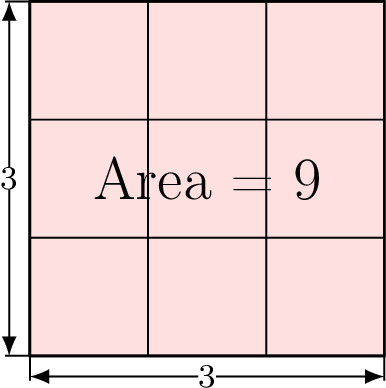
\(3^2 = 9\). The area of a square with side length \(3\) is \(9\) square units. - The square root is the inverse operation: it undoes squaring.
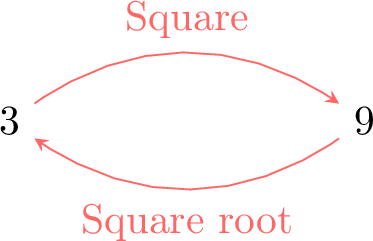
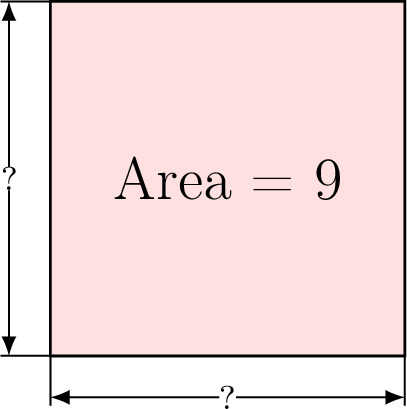
Definition Square root
The square root of a non-negative number \(a\) (that is, \(a \ge 0\)), written as \(\sqrt{a}\), is the non-negative number that, when multiplied by itself, gives \(a\).$$\left(\sqrt{a}\right)^2 = a$$
Note
- The square root symbol \(\sqrt{\quad}\) always asks for the positive root. For example, \(\sqrt{25} = 5\). It is a common mistake to think that \(\sqrt{25}\) is \(\pm 5\).
While it's true that both \(5^2 = 25\) and \((-5)^2 = 25\), the symbol \(\sqrt{25}\) refers only to the positive solution, which is \(5\). - Why can't we take the square root of a negative number (in the real numbers)?
Consider \(\sqrt{-9}\). To find this value, we need a number that, when multiplied by itself, gives \(-9\).- A positive number squared is positive (\(3 \times 3 = 9\)).
- A negative number squared is also positive (\(-3 \times -3 = 9\)).
Definition Perfect Squares
A perfect square is an integer that is the square of another integer. The square root of a perfect square is an integer.
Example
The first few perfect squares are:$$ 1, 4, 9, 16, 25, 36, 49, 64, 81, 100, \dots $$Their square roots are:$$ \sqrt{1} = 1, \quad \sqrt{4} = 2, \quad \sqrt{9} = 3, \quad \sqrt{16} = 4, \quad \dots $$
Calculating Square Roots
While the square roots of perfect squares are easy to find, most numbers are not perfect squares. We can estimate their square roots or use a calculator for a more precise value.
Method Use a calculator
On most calculators, you can find a square root using the \(\boxed{\sqrt{\;}}\) button.
Example
Use a calculator to find \(\sqrt{10}\), rounded to \(2\) decimal places.
Entering \(\sqrt{10}\) into a calculator gives approximately \(3.162277\ldots\)
Rounded to \(2\) decimal places, \(\sqrt{10} \approx 3.16\).
Rounded to \(2\) decimal places, \(\sqrt{10} \approx 3.16\).