Probability
Ever wondered if it will rain tomorrow or if you will win a game? That’s probability! It is a mathematical way to measure how likely an event is to happen.
Sample Spaces
Definition Outcome
An outcome is one possible result of a random experiment.
Example
What are all the possible outcomes when you flip a coin? 
The outcomes are Heads (H) =  and Tails (T) =
  .
.
and Tails (T) = .
Example
What are the outcomes when you roll a six-sided die?
The outcomes are\(1 = \) ,\(2 = \)
 ,\(3 = \)
 ,\(4 = \)
 ,\(5 = \)
 and \(6 = \)
 .
.
,\(2 = \),\(3 = \),\(4 = \),\(5 = \)and \(6 = \).
Definition Sample Space
The sample space is the set of all possible outcomes of a random experiment.
Example
What’s the sample space when you flip a coin?
The sample space is \(\{\text{Heads}, \text{Tails}\} = \{\),\(\}\), or just \(\{\text{H}, \text{T}\}\) for short.
,\(\}\), or just \(\{\text{H}, \text{T}\}\) for short.
Example
What’s the sample space when you roll a six-sided die?
The sample space is \(\{1, 2, 3, 4, 5, 6\} = \{\),,,,,\(\}\).
,,,,,\(\}\).Events
Once we know all the possible outcomes of an experiment (the sample space), we can focus on specific outcomes we are interested in. An event is a set of outcomes (it may contain one outcome, several outcomes, or even none at all).
Definition Event
An event (often denoted by a capital letter like \(E\)) is a subset of the sample space.
Example
For the experiment of rolling a die, list the outcomes in the event \(E\): “rolling an even number”.
Among the outcomes of the sample space \(\{1, 2, 3, 4, 5, 6\} = \{\),,,,,\(\}\), the event of rolling an even number is\(E = \{2, 4, 6\} = \{\),,\(\}\).
,,,,,\(\}\), the event of rolling an even number is\(E = \{2, 4, 6\} = \{\),,\(\}\).Complementary Events
In probability, it is often useful to consider the outcomes that do not belong to a specific event. This set of “other” outcomes is known as the complementary event. It represents everything in the sample space that is outside the original event. The complement of an event \(E\) is denoted by \(E'\).
Definition Complementary Event
The complementary event of an event \(E\), denoted \(E'\), \(E^c\), or \(\overline{E}\), is the set of all outcomes in the sample space that are not in \(E\).
Example
In the experiment of rolling a fair six-sided die, let \(E\) be the event “rolling an even number”. Find the complementary event, \(E'\).
The sample space is \(\{1, 2, 3, 4, 5, 6\} = \{\),,,,,\(\}\).
The event is \(E = \{2, 4, 6\} = \{\),,\(\}\).
The complementary event \(E'\) contains all outcomes in the sample space that are not in \(E\).
Therefore, \(E' = \{1, 3, 5\} = \{\),,\(\}\). This is the event “rolling an odd number”.
,,,,,\(\}\).The event is \(E = \{2, 4, 6\} = \{\)
,,\(\}\).The complementary event \(E'\) contains all outcomes in the sample space that are not in \(E\).
Therefore, \(E' = \{1, 3, 5\} = \{\)
,,\(\}\). This is the event “rolling an odd number”.Using Words to Describe Probability
We use special words to describe the chance of an event happening. We can place these words on a line from least likely to most likely.
Definition Probability Line

- Impossible: It can’t happen.
Example: Riding a dinosaur. - Less likely: It probably won’t happen.
Example: Rolling a die and getting a 3. - Even chance: It has the same chance to happen or not to happen.
Example: Tossing a coin and getting heads. - More likely: It will probably happen.
Example: Drinking water at school today. - Certain: It will happen.
Example: The sun will rise tomorrow.
Probability
When you flip a coin, there are two possible outcomes: heads or tails. The chance of getting heads is 1 out of 2. We can write this as a fraction:
Definition Probability
The probability of an event \(E\), written \(P(E)\), is a number that tells us how likely the event is to happen. It is always between \(0\) (impossible) and \(1\) (certain). In other words, for any event \(E\), we have \(0 \leq P(E) \leq 1\).
Equally Likely
Have you ever flipped a fair coin or rolled a fair die? In these experiments, each outcome is just as likely as the others. We call these equally likely outcomes.
Definition Equally Likely
When all the outcomes in the sample space are equally likely to occur, the probability of an event \(E\) is:$$P(E) = \frac{\text{number of outcomes in the event}}{\text{number of outcomes in the sample space}}$$
Example
What’s the probability of rolling an even number with a fair six-sided die?
- Sample space \(= \{1, 2, 3, 4, 5, 6\}\) (6 outcomes).
- \(E = \{2, 4, 6\}\) (3 outcomes).
- $$\begin{aligned}P(E) &= \frac{3}{6} \\ &= \frac{1}{2} \end{aligned}$$
Complement Rule
If there is a \(40\pourcent\) chance of rain tomorrow, what is the chance that it will not rain?\(100\pourcent - 40\pourcent = 60\pourcent\) This calculation is an application of the complement rule. It is a shortcut to find the probability that an event does not happen.
Proposition Complement Rule
For any event \(E\) and its complementary event \(E'\), their probabilities must add up to \(1\) (or \(100\pourcent\)):$$\textcolor{colorprop}{P(E) + P(E') = 1}$$This leads to the useful formula for finding the probability of the complement:$$\textcolor{colorprop}{P(E') = 1 - P(E)}$$
Example
Farid has a \(0.8\) (\(80\pourcent\)) chance of finishing his homework on time tonight (event \(E\)). What is the probability that he does not finish on time?
The complementary event \(E'\) is “Farid does not finish his homework on time”. Using the complement rule:$$\begin{aligned}P(E') &= 1 - P(E) \\
&= 1 - 0.8 \\
&= 0.2\end{aligned}$$There is a \(0.2\) (or \(20\pourcent\)) probability that he does not finish on time.
Experimental Probability
So far, we have calculated theoretical probability. This is what we expect to happen based on logic. For example, we expect a coin to land on heads half the time, so we say \(P(\text{Heads}) = \frac{1}{2}\).
But what if we can’t use logic? What if the outcomes are not equally likely? In these cases, we need to do an experiment to estimate the probability.
But what if we can’t use logic? What if the outcomes are not equally likely? In these cases, we need to do an experiment to estimate the probability.
Isaac wants to find the probability that a cone he drops will land on its base. The possible outcomes are “base down” or “on its side”.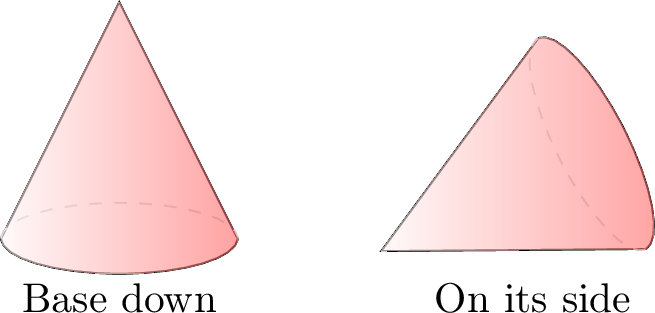
- Base down: 15 times.
- On its side: 35 times.
Definition Experimental Probability (Relative Frequency)
The experimental probability of an event is an estimate found by repeating an experiment many times. It is calculated with the formula:$$ \text{Experimental Probability} = \frac{\text{Number of times an event occurs}}{\text{Total number of trials}} $$The more trials we do, the better our estimate of the true probability will be.