Properties of Quadrilaterals
Quadrilateral Classification
Definition Quadrilateral
A quadrilateral is a polygon with four sides.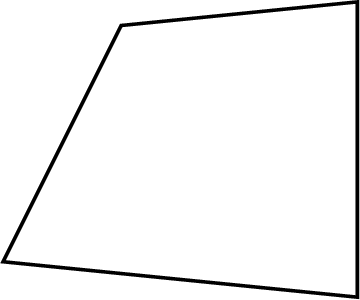
Definition Parallelogram
A parallelogram is a quadrilateral with two pairs of opposite sides parallel.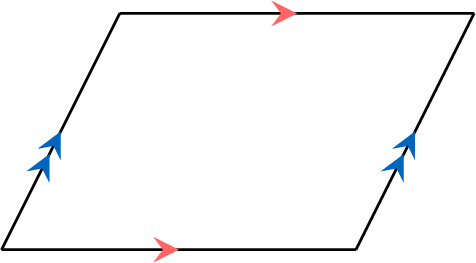
Definition Square
A square is a quadrilateral with four right angles and four equal sides.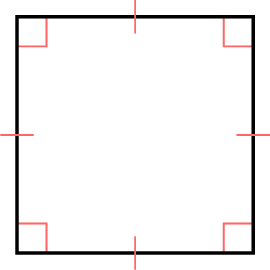
Definition Rectangle
A rectangle is a quadrilateral with four right angles.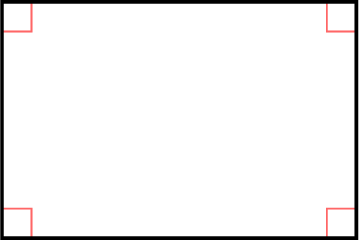
Definition Rhombus
A rhombus is a quadrilateral with four equal sides.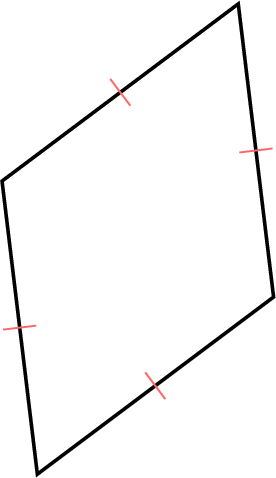
Definition Trapezium
A trapezium is a quadrilateral with one pair of opposite sides parallel (in some countries, this is called a trapezoid).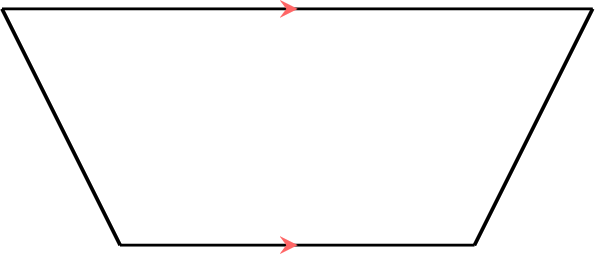
Properties
Proposition Properties of a Parallelogram
- The opposite sides are equal in length.
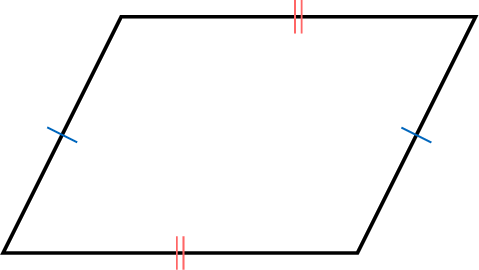
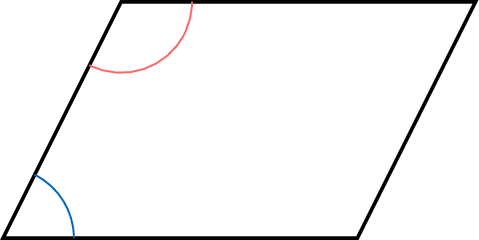
- The opposite angles are equal.
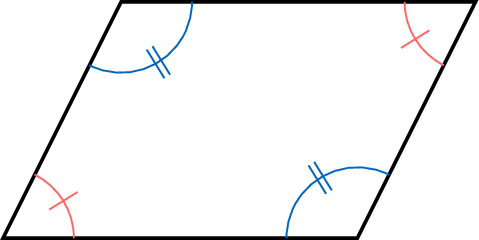
- The adjacent angles are supplementary (they add up to \(180^\circ\)).
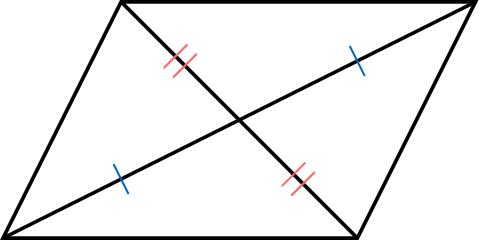
- The diagonals bisect each other (each one is cut in half by the other).
Proposition Properties of a Square
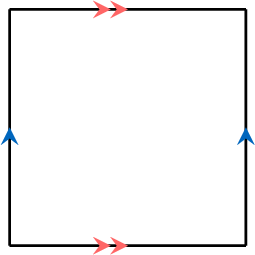
- The opposite sides are parallel.
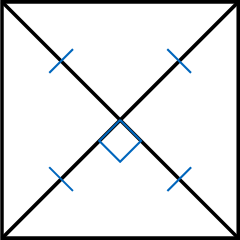
- The diagonals bisect each other, are perpendicular, and are equal in length.
Proposition Properties of a Rectangle
- The opposite sides are equal in length.
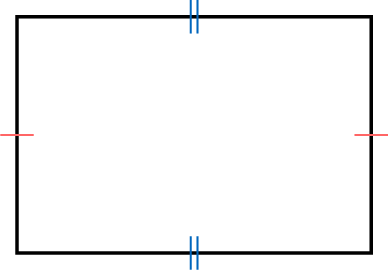
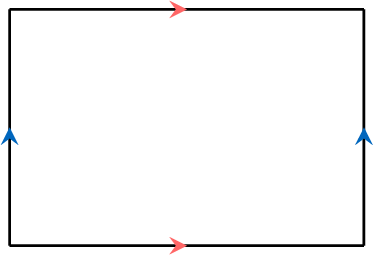
- The opposite sides are parallel.
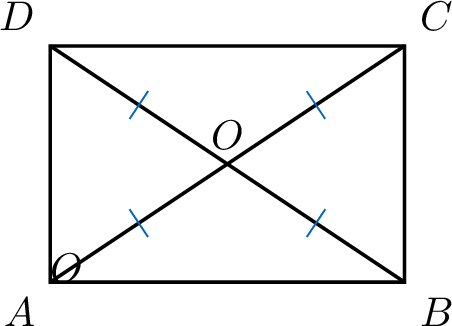
- The diagonals bisect each other and are equal in length.
Proposition Properties of a Rhombus
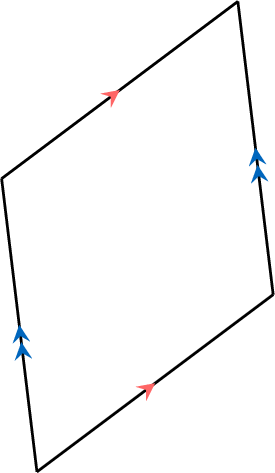
- The opposite sides are parallel.
- The opposite angles are equal.
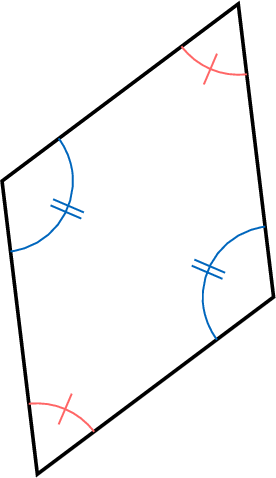
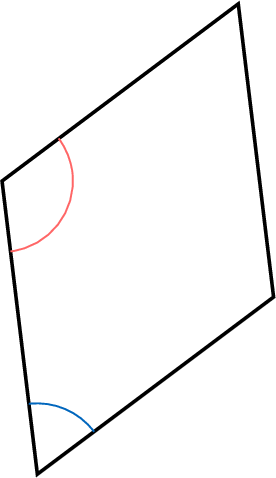
- The adjacent angles are supplementary (they add up to \(180^\circ\)).
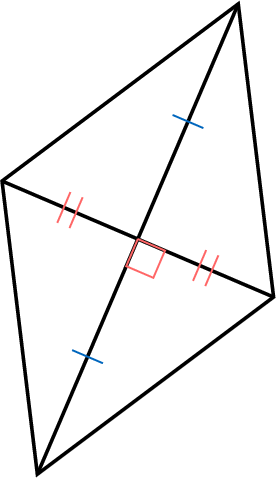
- The diagonals bisect each other at right angles.
Angles
Proposition Sum of the Angles of a Quadrilateral
The sum of the interior angles of a quadrilateral is \(360^\circ\).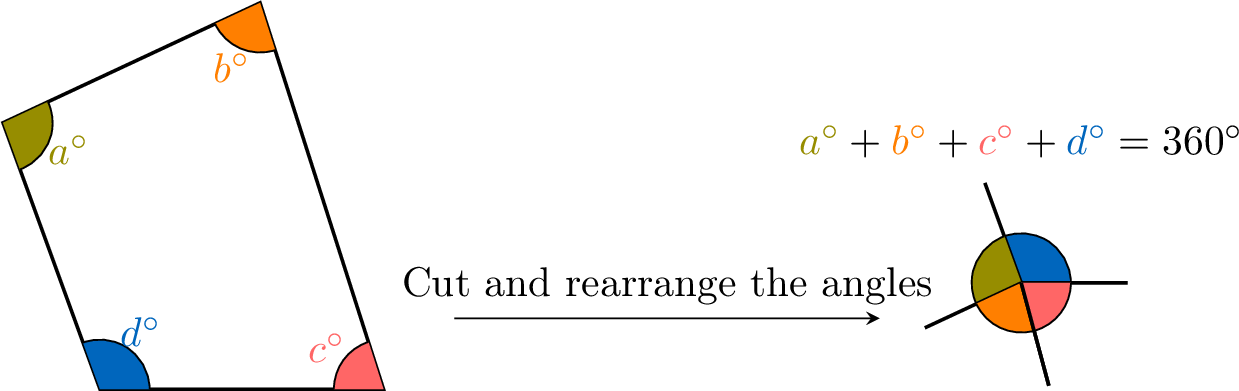
We divide the quadrilateral \(ABCD\) into two triangles, \(ABC\) and \(ACD\), using the diagonal \(AC\).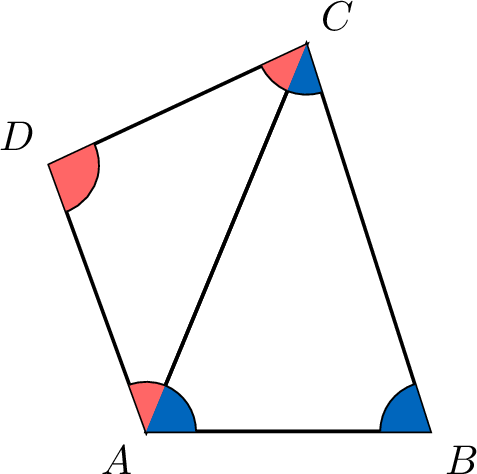
Example
Find the unknown angle \(x^\circ\).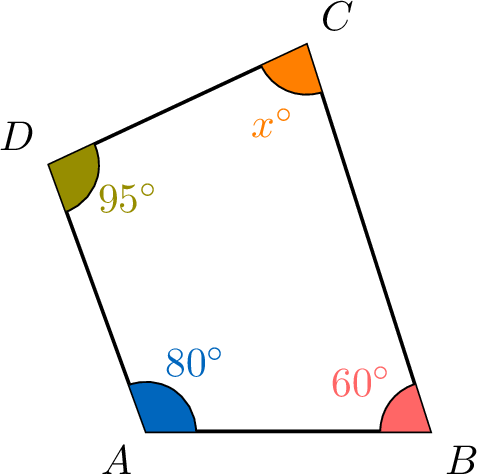
The sum of the angles of a quadrilateral is \(360^\circ\). The three known angles are \(60^\circ\), \(95^\circ\), and \(80^\circ\).$$\begin{aligned}x^\circ + 95^\circ + 80^\circ + 60^\circ &= 360^\circ \\
x^\circ + 235^\circ &= 360^\circ \quad &&\text{(adding the known angles)} \\
x^\circ &= 360^\circ - 235^\circ \quad &&\text{(subtracting \(235^\circ\) from both sides)} \\
x^\circ &= 125^\circ\end{aligned}$$