Relationships between Angles
In this chapter, we will explore relationships between angles that are essential for solving geometry problems. You will learn about complementary angles (angles whose measures sum to \(90^\circ\), forming a right angle), supplementary angles (angles whose measures sum to \(180^\circ\), forming a straight angle), opposite angles at a vertex (also called vertically opposite angles, formed by intersecting lines), and angles created by parallel lines and a transversal, including corresponding, alternate, and co-interior angles. These concepts build on your understanding of right angles (\(90^\circ\)), straight angles (\(180^\circ\)), and full angles (\(360^\circ\)). These special angle relationships will help you recognise parallel lines and calculate unknown angles in geometric figures.
Complementary and Supplementary Angles
Definition Complementary
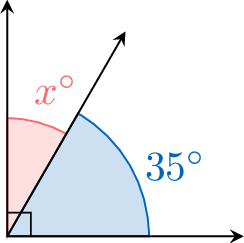
Two angles are complementary if the sum of their measures is \(90^\circ\). Complementary angles together form a right angle, like the corner of a square.
Example
Calculate the measure of the unknown angle \(x^\circ\) if it is complementary to a \(35^\circ\) angle.
Definition Supplementary
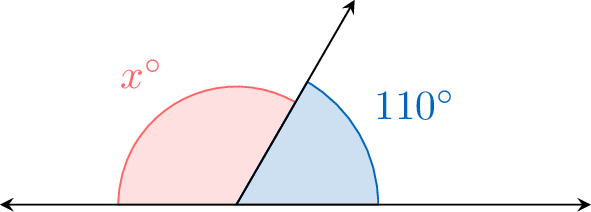
Two angles are supplementary if the sum of their measures is \(180^\circ\). Supplementary angles together form a straight angle (a straight line).
Example
Calculate the measure of the unknown angle \(x^\circ\) if it is supplementary to a \(110^\circ\) angle.
Opposite Angles at a Vertex
Definition Opposite Angles at a Vertex
Opposite angles at a vertex (also called vertically opposite angles) are pairs of angles that lie opposite each other when two lines intersect. They share a common vertex.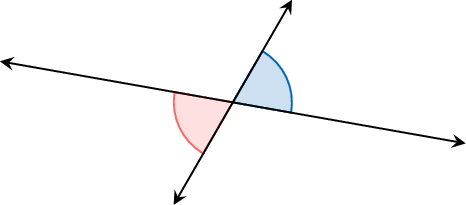
Proposition Equality of Opposite Angles at a Vertex
Opposite angles at a vertex are equal.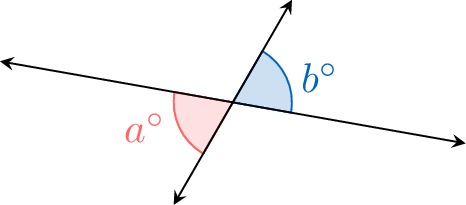
\(\textcolor{colordef}{a^\circ} = \textcolor{colorprop}{b^\circ}\)
\(\textcolor{colordef}{a^\circ} = \textcolor{colorprop}{b^\circ}\)
Consider two lines intersecting at a point, forming opposite angles \(a^\circ\) and \(b^\circ\), and an adjacent angle \(c^\circ\).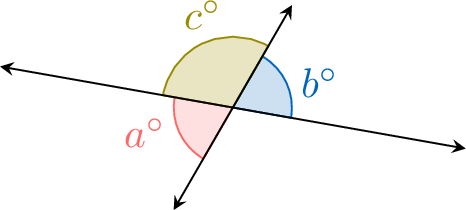
Example
Calculate the measure of the unknown angle \(x^\circ\).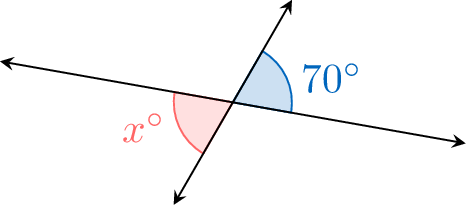
Opposite angles at a vertex are equal.$$\begin{aligned}x^\circ &= 70^\circ \quad (\text{opposite angles are equal})\end{aligned}$$
Corresponding, Alternate, and Co-interior Angles
Definition Corresponding, Alternate, and Co-interior Angles
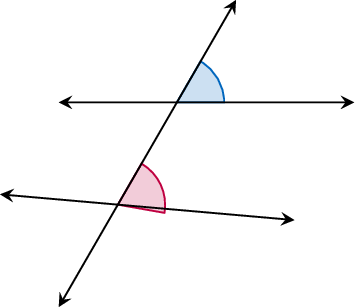
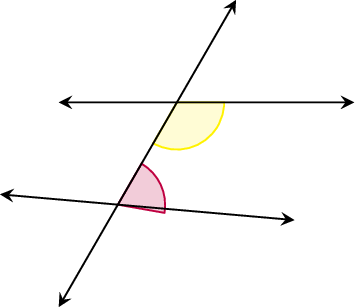
- Corresponding angles are on the same side of a transversal that intersects two lines and are in matching corners relative to the intersected lines, like the top-right corners of each intersection.
- Alternate angles (alternate interior angles) are on opposite sides of a transversal and lie between the two intersected lines, forming a "Z" shape.
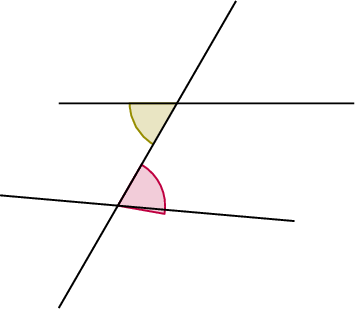
- Co-interior angles (also called consecutive interior angles) are on the same side of a transversal and between the two intersected lines, forming a "C" shape.
Example
Identify the following for the given diagram: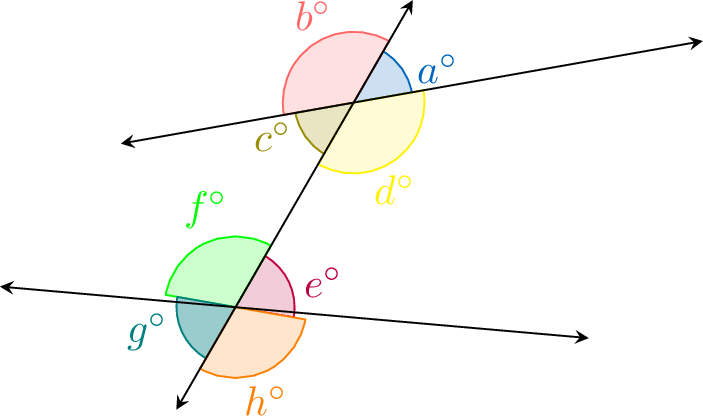
- The corresponding angles.
- The alternate angles.
- The co-interior angles.
- Corresponding angles: \(\textcolor{colorprop}{a^\circ}\) and \(\textcolor{purple}{e^\circ}\), \(\textcolor{colordef}{b^\circ}\) and \(\textcolor{green}{f^\circ}\), \(\textcolor{olive}{c^\circ}\) and \(\textcolor{teal}{g^\circ}\), \(\textcolor{yellow}{d^\circ}\) and \(\textcolor{orange}{h^\circ}\).
- Alternate angles: \(\textcolor{olive}{c^\circ}\) and \(\textcolor{purple}{e^\circ}\), \(\textcolor{yellow}{d^\circ}\) and \(\textcolor{green}{f^\circ}\).
- Co-interior angles: \(\textcolor{olive}{c^\circ}\) and \(\textcolor{green}{f^\circ}\), \(\textcolor{yellow}{d^\circ}\) and \(\textcolor{purple}{e^\circ}\).
Properties of Parallel Lines
Proposition Properties of Parallel Lines
If two lines are parallel and intersected by a transversal, then: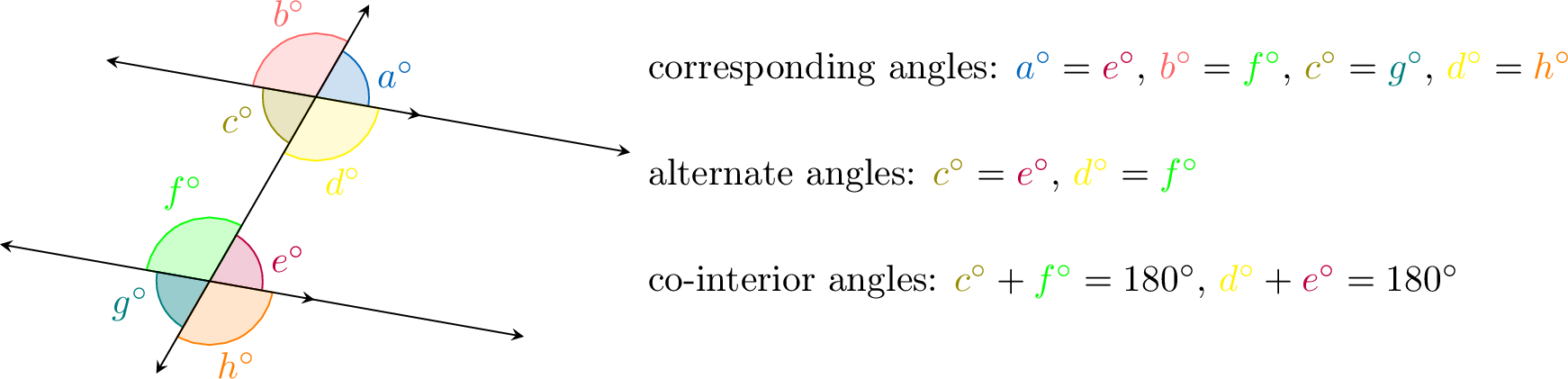
- Corresponding angles are equal.
- Alternate angles are equal.
- Co-interior angles are supplementary (their measures sum to \(180^\circ\)).
Example
Calculate the measure of the unknown angle \(x^\circ\), given that the lines are parallel.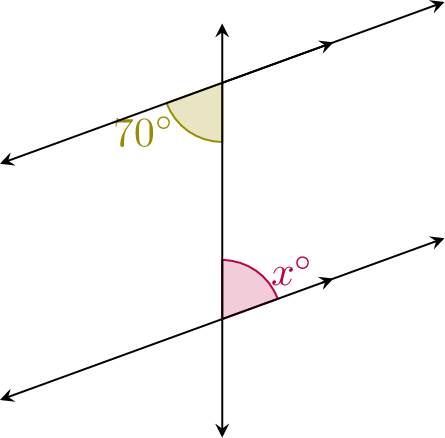
Since the angles are alternate and the lines are parallel, they are equal.$$\begin{aligned}x^\circ &= 70^\circ \quad (\text{alternate angles are equal})\end{aligned}$$
Proposition Parallel Lines from Equal Angles
If two corresponding angles or two alternate angles formed by the same transversal are equal, then the lines are parallel.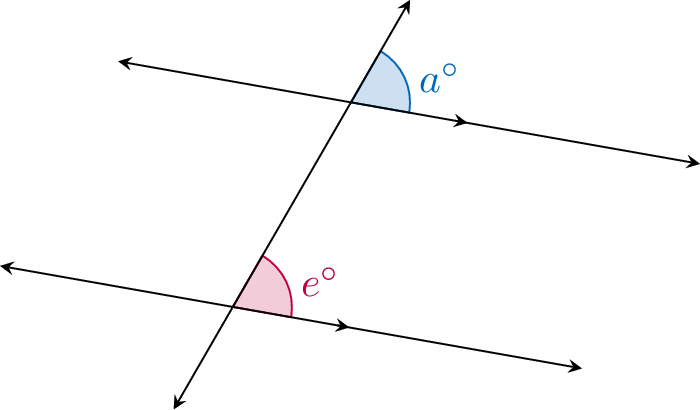
Example
Show that the lines are parallel, given the angle measures.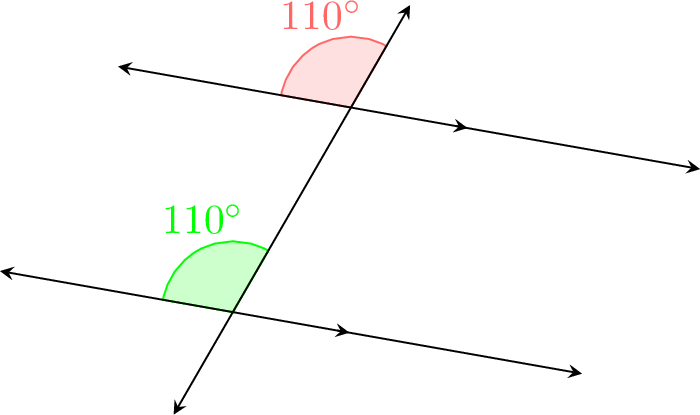
Since the corresponding angles are equal (\(110^\circ = 110^\circ\)), the lines are parallel.