Proportionality
What is Proportionality?
Imagine you are buying cookies. Each cookie costs \(\dollar 2\). The number of cookies is \(\textcolor{colordef}{x}\) and the total cost is \(\textcolor{colorprop}{y}\). We have:

| \(\textcolor{colordef}{1}\) cookie costs | \(\textcolor{colorprop}{2} = \textcolor{olive}{2} \times \textcolor{colordef}{1}\) |
| \(\textcolor{colordef}{2}\) cookies cost | \(\textcolor{colorprop}{4} = \textcolor{olive}{2} \times \textcolor{colordef}{2}\) |
| \(\textcolor{colordef}{3}\) cookies cost | \(\textcolor{colorprop}{6} = \textcolor{olive}{2} \times \textcolor{colordef}{3}\) |
| \(\textcolor{colordef}{4}\) cookies cost | \(\textcolor{colorprop}{8} = \textcolor{olive}{2} \times \textcolor{colordef}{4}\) |
| \(\textcolor{colordef}{x}\) cookies cost | \(\textcolor{colorprop}{y} = \textcolor{olive}{2} \times \textcolor{colordef}{x}\) |
- Ratio definition: No matter how many cookies you buy, the ratio \(\dfrac{\textcolor{colorprop}{y}}{\textcolor{colordef}{x}}\) is always the same and equal to the price of one cookie:$$\dfrac{\textcolor{colorprop}{8}}{\textcolor{colordef}{4}} =\dfrac{\textcolor{colorprop}{6}}{\textcolor{colordef}{3}} = \dfrac{\textcolor{colorprop}{4}}{\textcolor{colordef}{2}} = \dfrac{\textcolor{colorprop}{y}}{\textcolor{colordef}{x}} =\textcolor{olive}{2}.$$
- Linearity definition: The total cost can also be expressed with a formula (a linear function):$$\textcolor{colorprop}{y} = \textcolor{olive}{2} \times \textcolor{colordef}{x}.$$
Definition Proportional
Two variables \(\textcolor{colordef}{x}\) and \(\textcolor{colorprop}{y}\) are proportional if the ratio \(\dfrac{\textcolor{colorprop}{y}}{\textcolor{colordef}{x}}\) is constant, equal to a value \(\textcolor{olive}{k}\) called the coefficient of proportionality:$$\dfrac{\textcolor{colorprop}{y}}{\textcolor{colordef}{x}} = \textcolor{olive}{k}.$$Equivalently, \(\textcolor{colorprop}{y}\) is proportional to \(\textcolor{colordef}{x}\) if, for the same constant \(\textcolor{olive}{k}\),$$ \textcolor{colorprop}{y} = \textcolor{olive}{k}\times \textcolor{colordef}{x}.$$
Example
Does this table represent a proportional relationship?
| \(\textcolor{colordef}{x}\) | \(\textcolor{colordef}{1}\) | \(\textcolor{colordef}{2}\) | \(\textcolor{colordef}{3}\) |
| \(\textcolor{colorprop}{y}\) | \(\textcolor{colorprop}{15}\) | \(\textcolor{colorprop}{30}\) | \(\textcolor{colorprop}{45}\) |
Yes. The table represents a proportional relationship because each ratio is equal:$$\dfrac{\textcolor{colorprop}{15}}{\textcolor{colordef}{1}} = \dfrac{\textcolor{colorprop}{30}}{\textcolor{colordef}{2}} = \dfrac{\textcolor{colorprop}{45}}{\textcolor{colordef}{3}} = \textcolor{olive}{15}.$$
Calculating a Fourth Proportional
Method Calculating a Fourth Proportional
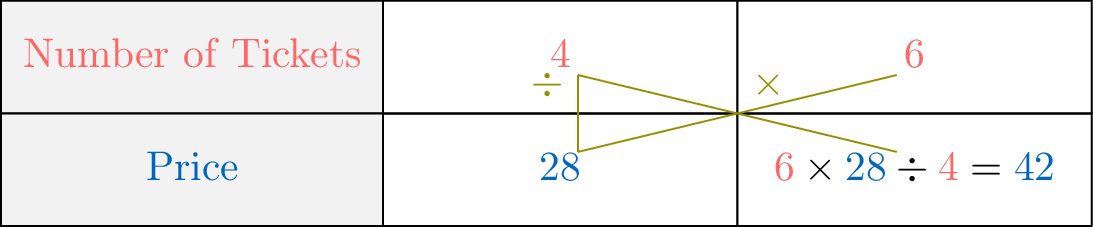
If 4 tickets cost \(\dollar 28\), how much do 6 tickets cost if each ticket costs the same?
- Method 1: Using the Coefficient of Proportionality
Find the unit price (price for 1 ticket):$$\text{Unit price} = \dfrac{28}{4} = 7.$$Now multiply by 6 for 6 tickets:$$\text{Total for 6 tickets} = 7 \times 6 = 42.$$ - Method 2: Proportion Equation$$\begin{aligned}\dfrac{\textcolor{colorprop}{28}}{\textcolor{colordef}{4}} &= \dfrac{\textcolor{colorprop}{x}}{\textcolor{colordef}{6}} \\ \textcolor{colordef}{4} \times \textcolor{colorprop}{x} &= \textcolor{colorprop}{28} \times \textcolor{colordef}{6} && \text{(cross-multiplication)} \\ \textcolor{colorprop}{x} &= \dfrac{\textcolor{colorprop}{28} \times \textcolor{colordef}{6}}{\textcolor{colordef}{4}} \\ \textcolor{colorprop}{x} &= \textcolor{colorprop}{42}\end{aligned}$$
- Method 3: Unit Rate with Equivalent Ratios
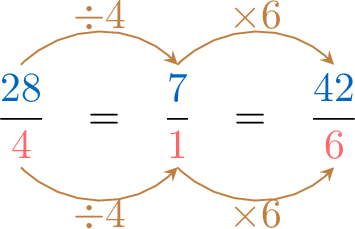
- Method 4: Cross-multiplication (Product in Cross)