Sequences
Numerical Sequence
In mathematics, a sequence is more than just a pattern; it's an ordered list of numbers where each number has a specific position (its place in the list). To work with sequences effectively, we use a special notation to distinguish a term's position from its value.
Definition Numerical Sequence
A numerical sequence is an ordered list of numbers, called terms. We use the notation \(u_n\) to describe a term in the sequence.
- The subscript \(n\) is the index, which tells us the position of the term (often starting from \(n=0\)). The index \(n\) usually takes integer values: \(0,1,2,\dots\)
- \(u_n\) represents the value of the term at that specific position.
| Index (\(n\)) | 0 | 1 | 2 | \(\dots\) |
| Term (\(u_n\)) | \(u_0\) | \(u_1\) | \(u_2\) | \(\dots\) |
Example
Given the sequence defined by the table below, find the value of the term \(u_4\).
| \(n\) | 0 | 1 | 2 | 3 | 4 | 5 | \(\dots\) |
| \(u_n\) | 3 | 5 | 7 | 9 | 11 | 13 | \(\dots\) |
To find \(u_4\), we look in the table for the column where the index is \(n=4\). The value in the row below it is \(11\).
Therefore, \(u_4 = 11\).
Therefore, \(u_4 = 11\).
Recursive Definition
Let’s consider a sequence where the first term is \(2\), and each term is obtained by adding \(3\) to the previous term. The terms are: 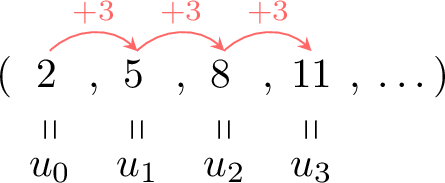
Here the sequence is indexed starting from \(n=0\): \(u_0 = 2\), \(u_1 = 5\), \(u_2 = 8\), \(u_3 = 11\), etc.We can describe the relationship between the terms using formal notation: 
- \(5 = 2\textcolor{colordef}{+3} \longrightarrow u_1 = u_0\textcolor{colordef}{+3} \longrightarrow u_{0+1} = u_0+3\)
- \(8 = 5\textcolor{colordef}{+3} \longrightarrow u_2 = u_1\textcolor{colordef}{+3} \longrightarrow u_{1+1} = u_1+3\)
- \(11 = 8\textcolor{colordef}{+3} \longrightarrow u_3 = u_2\textcolor{colordef}{+3} \longrightarrow u_{2+1} = u_2+3\)
Definition Recursive Definition
A recursive definition of a sequence includes two parts:
- The first term (or initial term), denoted for example by \(u_0\) or \(u_1\). This is the starting point.
- The recursive rule (or recurrence relation), which is a formula that connects the next term, \(u_{n+1}\), to the current term, \(u_n\), for all appropriate integers \(n\) (such as \(n \ge 0\) or \(n \ge 1\)).
Example
A sequence is defined recursively by:
- \(u_1 = 5\) (The first term is \(5\)).
- \(u_{n+1} = u_n + 3\) (The rule is to add \(3\) to the previous term, for all integers \(n \ge 1\)).
Let's build the sequence step-by-step using the recursive definition.$$5 \textcolor{olive}{\xrightarrow{\;+3\;}} 8 \textcolor{olive}{\xrightarrow{\;+3\;}} 11 \textcolor{olive}{\xrightarrow{\;+3\;}} 14 \textcolor{olive}{\xrightarrow{\,+3\,}} 17$$ The first five terms are: \(5, 8, 11, 14, 17\).
- 1\(^{\text{st}}\) term: The starting term is given: \(\boldsymbol{u_1 = 5}\).
- 2\(^{\text{nd}}\) term: Use the rule with \(n=1\). \(\boldsymbol{u_2} = u_1 + 3 = 5 + 3 = 8\).
- 3\(^{\text{rd}}\) term: Use the rule with \(n=2\). \(\boldsymbol{u_3} = u_2 + 3 = 8 + 3 = 11\).
- 4\(^{\text{th}}\) term: Use the rule with \(n=3\). \(\boldsymbol{u_4} = u_3 + 3 = 11 + 3 = 14\).
- 5\(^{\text{th}}\) term: Use the rule with \(n=4\). \(\boldsymbol{u_5} = u_4 + 3 = 14 + 3 = 17\).
Arithmetic Sequence
An arithmetic sequence is the most common type of sequence that follows a recursive rule. It is defined by a starting term and a constant change between consecutive terms.
Definition Arithmetic Sequence
An arithmetic sequence is a sequence where each term after the first is found by adding a constant value to the previous term. This constant is called the common difference, denoted by \(d\). It can be positive, negative, or zero.
The recursive definition of an arithmetic sequence is:$$u_{n+1} = u_n + d \quad \text{for all integers } n.$$
The recursive definition of an arithmetic sequence is:$$u_{n+1} = u_n + d \quad \text{for all integers } n.$$
Example
An arithmetic sequence has a first term \(u_1 = 5\) and a common difference \(d = 3\).
Find the first five terms of this sequence.
Find the first five terms of this sequence.
The recursive rule is \(u_{n+1} = u_n + 3\). We start with \(u_1 = 5\) and apply the rule repeatedly.
- \(u_1 = \boldsymbol{5}\) (given)
- \(u_2 = u_1 + 3 = 5 + 3 = \boldsymbol{8}\)
- \(u_3 = u_2 + 3 = 8 + 3 = \boldsymbol{11}\)
- \(u_4 = u_3 + 3 = 11 + 3 = \boldsymbol{14}\)
- \(u_5 = u_4 + 3 = 14 + 3 = \boldsymbol{17}\)
Geometric Sequence
A geometric sequence is another fundamental type of sequence that follows a recursive rule. It is defined by a starting term and a constant multiplicative factor: to get from one term to the next, you always multiply by the same number.
Definition Geometric Sequence
A geometric sequence is a sequence where each term after the first is found by multiplying the previous term by a constant non-zero value. This constant is called the common ratio, denoted by \(r\).
The recursive definition of a geometric sequence is:$$u_{n+1} = r \times u_n \quad \text{for all integers } n.$$
The recursive definition of a geometric sequence is:$$u_{n+1} = r \times u_n \quad \text{for all integers } n.$$
Example
A geometric sequence has a first term \(u_1 = 2\) and a common ratio \(r = 2\).
Find the first five terms of this sequence.
Find the first five terms of this sequence.
The recursive rule is \(u_{n+1} = u_n \times 2\). We start with \(u_1 = 2\) and apply the rule repeatedly.
- \(u_1 = \boldsymbol{2}\) (given)
- \(u_2 = 2 \times u_1 = 2 \times 2 = \boldsymbol{4}\)
- \(u_3 = 2 \times u_2 = 2 \times 4 = \boldsymbol{8}\)
- \(u_4 = 2 \times u_3 = 2 \times 8 = \boldsymbol{16}\)
- \(u_5 = 2 \times u_4 = 2 \times 16 = \boldsymbol{32}\)