Percentages
What is a Percentage?
Definition Percentage
A percentage is a ratio out of \(100\).
The symbol \(\pourcent\) means "percent," which comes from the phrase "per centum," meaning "out of one hundred."
The symbol \(\pourcent\) means "percent," which comes from the phrase "per centum," meaning "out of one hundred."
Example
This grid has 100 squares. Since \(\textcolor{colorprop}{23}\) out of \(\textcolor{colordef}{100}\) squares are colored, we say that \(\textcolor{colorprop}{23}\textcolor{colordef}{\pourcent}\) of the grid is colored.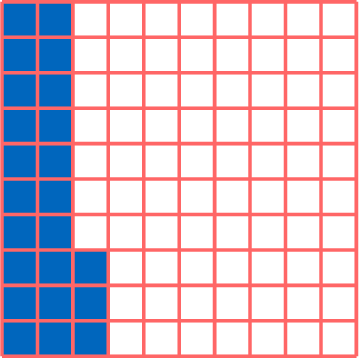
Converting Between Forms
Percentages, fractions, and decimals are three different ways to talk about the same value. For example, \(\textcolor{colorprop}{50}\textcolor{colordef}{\pourcent}\), the fraction \(\dfrac{\textcolor{colorprop}{1}}{\textcolor{colordef}{2}}\), and the decimal \(0.5\) all mean "half." Being able to convert between these forms is a very useful skill.
Remark: A very important idea is that \(100\pourcent = \dfrac{100}{100} = 1\).
Since \(100\pourcent\) is just another way of writing the number \(1\), you can multiply any number by \(100\pourcent\) without changing its value. This is a very useful trick for converting decimals and fractions into percentages.
Remark: A very important idea is that \(100\pourcent = \dfrac{100}{100} = 1\).
Since \(100\pourcent\) is just another way of writing the number \(1\), you can multiply any number by \(100\pourcent\) without changing its value. This is a very useful trick for converting decimals and fractions into percentages.
Method Percentage to Fraction
To convert a percentage to a fraction, write it as a fraction over 100, then simplify if possible. 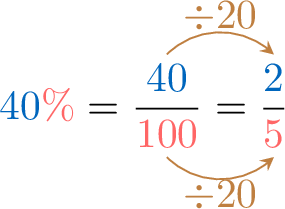
Method Fraction to Percentage
To convert a fraction like \(\dfrac{\textcolor{colorprop}{3}}{\textcolor{colordef}{4}}\) to a percentage, you have two common methods:
- Method 1: Equivalent Fractions. Find an equivalent fraction with a denominator of 100.
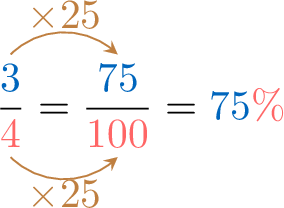
- Method 2: Multiply by \(100\pourcent\). This works because multiplying by \(100\pourcent\) is the same as multiplying by 1. $$ \begin{aligned} \dfrac{\textcolor{colorprop}{3}}{\textcolor{colordef}{4}} &= 0.75 \quad (\text{since } 3 \div 4 = 0.75) \\ &= 0.75 \times \textcolor{colordef}{100\pourcent} \\ &= \textcolor{colorprop}{75}\textcolor{colordef}{\pourcent} \end{aligned} $$
Method Percentage to Decimal
To convert a percentage to a decimal, divide by 100. A quick way to do this is to move the decimal point two places to the left.$$ \textcolor{colorprop}{45}\textcolor{colordef}{\pourcent} = \textcolor{colorprop}{45} \div \textcolor{colordef}{100} = 0.45 $$
Method Decimal to Percentage
To convert a decimal to a percentage, multiply by 100. A quick way to do this is to move the decimal point two places to the right and add the percent sign (\(\pourcent\)).$$ 0.68 = 0.68 \times 100\pourcent = \textcolor{colorprop}{68}\textcolor{colordef}{\pourcent} $$
Ratio to Percentage
Percentages are one of the best ways to compare a part to a whole.
For example, if a class of \(\textcolor{colordef}{20}\) students has \(\textcolor{colorprop}{12}\) girls, what percentage of the class is female? To solve this, we can set up a proportion to find an equivalent fraction with a denominator of 100:$$\begin{aligned}\frac{\text{part}}{\text{whole}} = \frac{\textcolor{colorprop}{12}}{\textcolor{colordef}{20}} &= \frac{\textcolor{colorprop}{x}}{\textcolor{colordef}{100}}\\ \textcolor{colorprop}{x} &= \frac{\textcolor{colorprop}{12}}{\textcolor{colordef}{20}} \times \textcolor{colordef}{100} && \text{(multiplying both sides by }\textcolor{colordef}{100})\\ \textcolor{colorprop}{x} &= \textcolor{colorprop}{60}\\ \end{aligned}$$The percentage of girls in the class is \(\textcolor{colorprop}{60}\textcolor{colordef}{\pourcent}\). This means for every \(\textcolor{colordef}{100}\) students, \(\textcolor{colorprop}{60}\) would be girls.
For example, if a class of \(\textcolor{colordef}{20}\) students has \(\textcolor{colorprop}{12}\) girls, what percentage of the class is female? To solve this, we can set up a proportion to find an equivalent fraction with a denominator of 100:$$\begin{aligned}\frac{\text{part}}{\text{whole}} = \frac{\textcolor{colorprop}{12}}{\textcolor{colordef}{20}} &= \frac{\textcolor{colorprop}{x}}{\textcolor{colordef}{100}}\\ \textcolor{colorprop}{x} &= \frac{\textcolor{colorprop}{12}}{\textcolor{colordef}{20}} \times \textcolor{colordef}{100} && \text{(multiplying both sides by }\textcolor{colordef}{100})\\ \textcolor{colorprop}{x} &= \textcolor{colorprop}{60}\\ \end{aligned}$$The percentage of girls in the class is \(\textcolor{colorprop}{60}\textcolor{colordef}{\pourcent}\). This means for every \(\textcolor{colordef}{100}\) students, \(\textcolor{colorprop}{60}\) would be girls.
Method Ratio to Percentage
To convert a part-to-whole ratio into a percentage, use the following formula:$$\text{Percentage}= \frac{\textcolor{colorprop}{\text{part}}}{\textcolor{colordef}{\text{whole}}} \times \textcolor{colordef}{100}\pourcent$$
Example
You took a math quiz and answered \(\textcolor{colorprop}{21}\) questions correctly out of a total of \(\textcolor{colordef}{24}\) questions. Calculate your percentage score.
- The \(\textcolor{colorprop}{\text{part}}\) is the number of correct answers: \(\textcolor{colorprop}{21}\).
- The \(\textcolor{colordef}{\text{whole}}\) is the total number of questions: \(\textcolor{colordef}{24}\).
- \(\begin{aligned}[t]\text{Percentage Score} &= \frac{\textcolor{colorprop}{21}}{\textcolor{colordef}{24}} \times \textcolor{colordef}{100}\pourcent\\ &= 0.875 \times 100\pourcent \\ &= \textcolor{colorprop}{87.5}\textcolor{colordef}{\pourcent}\end{aligned}\)
Comparing Ratios Using Percentages
In Parliament A, there are \(\textcolor{colorprop}{26}\) women out of \(\textcolor{colordef}{50}\) members. In Parliament B, there are \(\textcolor{colorprop}{30}\) women out of \(\textcolor{colordef}{80}\) members. Hugo says, "Since there are more women in Parliament B, women have better representation there."
Is this statement a fair comparison?
Is this statement a fair comparison?
To make a fair comparison, we must compare the percentages, not the absolute numbers.
- Parliament A:
\(\text{Percentage of women} = \frac{\textcolor{colorprop}{26}}{\textcolor{colordef}{50}} \times 100\pourcent = \textcolor{colorprop}{52}\textcolor{colordef}{\pourcent}\) - Parliament B:
\(\text{Percentage of women} = \frac{\textcolor{colorprop}{30}}{\textcolor{colordef}{80}} \times 100\pourcent = \textcolor{colorprop}{37.5}\textcolor{colordef}{\pourcent}\)
Method Comparing with Percentages
When comparing different part-to-whole ratios, converting them to percentages provides a common baseline (out of 100), which allows for a fair and direct comparison.
- Step 1: Calculate the percentage for each group.
- Step 2: Compare the percentages to draw a conclusion.
Finding the Part or the Whole
Method Finding the Part
To find a part of a total, multiply the percentage by the whole.$$\textcolor{colorprop}{\text{Part}} = \text{Percentage} \times \textcolor{colordef}{\text{Whole}}$$Remember to convert the percentage to a decimal or fraction before calculating.
Example
In a school with \(\textcolor{colordef}{200}\) students, \(\textcolor{colorprop}{60}\textcolor{colordef}{\pourcent}\) are girls. Calculate the number of girls.
Method 1: Using the formula$$\begin{aligned}\textcolor{colorprop}{\text{Number of girls}} &= \textcolor{colorprop}{60}\textcolor{colordef}{\pourcent} \times \textcolor{colordef}{200} \\
&= 0.60 \times \textcolor{colordef}{200} \\
&= \textcolor{colorprop}{120}\end{aligned}$$There are \(\textcolor{colorprop}{120}\) girls in the school.Method 2: Cross-Multiplication
Set up a proportion where \(x\) is the number of girls.$$\begin{aligned}\frac{\textcolor{colorprop}{60}}{\textcolor{colordef}{100}} &= \frac{\textcolor{colorprop}{x}}{\textcolor{colordef}{200}} \\ \textcolor{colordef}{100} \times \textcolor{colorprop}{x} &= \textcolor{colorprop}{60} \times \textcolor{colordef}{200} \\ \textcolor{colorprop}{x} &= \frac{12000}{100} = \textcolor{colorprop}{120}\end{aligned}$$
Set up a proportion where \(x\) is the number of girls.$$\begin{aligned}\frac{\textcolor{colorprop}{60}}{\textcolor{colordef}{100}} &= \frac{\textcolor{colorprop}{x}}{\textcolor{colordef}{200}} \\ \textcolor{colordef}{100} \times \textcolor{colorprop}{x} &= \textcolor{colorprop}{60} \times \textcolor{colordef}{200} \\ \textcolor{colorprop}{x} &= \frac{12000}{100} = \textcolor{colorprop}{120}\end{aligned}$$
Method Finding the Whole
To find the whole when you know a part and its percentage, divide the part by the percentage.$$\textcolor{colordef}{\text{Whole}} = \frac{\textcolor{colorprop}{\text{Part}}}{\text{Percentage}}$$Remember to convert the percentage to a decimal or fraction before calculating.
Example
In a class, \(\textcolor{colorprop}{40}\textcolor{colordef}{\pourcent}\) of the students are girls. If there are \(\textcolor{colorprop}{14}\) girls, what is the total number of students?
Method 1: Using the formula$$\begin{aligned}\textcolor{colordef}{\text{Total students}} &= \frac{\textcolor{colorprop}{14}}{\textcolor{colorprop}{40}\textcolor{colordef}{\pourcent}} \\
&= \frac{\textcolor{colorprop}{14}}{0.40} \\
&= \textcolor{colordef}{35}\end{aligned}$$There are \(\textcolor{colordef}{35}\) students in the class.Method 2: Cross-Multiplication
Set up a proportion where \(x\) is the total number of students.$$\begin{aligned}\frac{\textcolor{colorprop}{40}}{\textcolor{colordef}{100}} &= \frac{\textcolor{colorprop}{14}}{\textcolor{colordef}{x}} \\ \textcolor{colorprop}{40} \times \textcolor{colordef}{x} &= \textcolor{colorprop}{14} \times \textcolor{colordef}{100} \\ \textcolor{colordef}{x} &= \frac{1400}{40} = \textcolor{colordef}{35}\end{aligned}$$
Set up a proportion where \(x\) is the total number of students.$$\begin{aligned}\frac{\textcolor{colorprop}{40}}{\textcolor{colordef}{100}} &= \frac{\textcolor{colorprop}{14}}{\textcolor{colordef}{x}} \\ \textcolor{colorprop}{40} \times \textcolor{colordef}{x} &= \textcolor{colorprop}{14} \times \textcolor{colordef}{100} \\ \textcolor{colordef}{x} &= \frac{1400}{40} = \textcolor{colordef}{35}\end{aligned}$$
Percentage Increase and Decrease
Quantities often change by a certain percentage. For example:
- A store offers a 20\(\pourcent\) discount (a decrease).
- A salary increases by 7\(\pourcent\).
- A city's population grows by 10\(\pourcent\).
Method Two-Step Method for Percentage Change
- Calculate the change amount: $$\text{Change} = \text{Percentage} \times \text{Original Value}$$
- Calculate the new value:
- For an increase: $$\text{New Value} = \text{Original Value} + \text{Change}$$
- For a decrease: $$\text{New Value} = \text{Original Value} - \text{Change}$$
Example
The original price of a shirt is \(\dollar\)50. Calculate the final price after a 20\(\pourcent\) discount.
- Calculate the decrease amount:$$\begin{aligned} \text{Decrease} &= 20\pourcent \text{ of }\dollar 50\\ &= 20\pourcent \times \dollar 50\\ & = 0.20 \times \dollar 50 \\ &= \dollar 10\\ \end{aligned}$$
- Calculate the new price:$$\text{New Price} = \dollar 50 - \dollar 10 = \dollar 40$$
Percentage Change
Percentage Change is a way to express a change in a quantity as a percentage of the original amount. This allows us to understand the scale of the change, whether it's an increase or a decrease.
Definition Percentage Change
Percentage change is a signed value that indicates both the direction and magnitude of a change.
- If a quantity increases, the percentage change is positive. An increase of 15\(\pourcent\) means a percentage change of \(+15\pourcent\).
- If a quantity decreases, the percentage change is negative. A decrease of 15\(\pourcent\) means a percentage change of \(-15\pourcent\).
Method Calculating New Value with a Multiplier
A fast way to find the new value after a percentage change is to use a multiplier.$$ \text{New Value} = \text{Original Value} \times (1 + \text{Percentage Change}) $$The term \((1 + \text{Percentage Change})\) is the multiplier. Remember to express the percentage change as a decimal in this formula.
Example
Find the new amount for increasing \(\dollar\)200 by \(10\pourcent\).
The percentage change is \(+10\pourcent = +0.10\).$$\begin{aligned}\text{New amount} &= \dollar200 \times (1 + 0.10) \\
&= \dollar 200 \times 1.10 \\
&= \dollar 220\end{aligned}$$
Example
Find the new amount for decreasing \(\dollar\)200 by \(25\pourcent\).
The percentage change is \(-25\pourcent = -0.25\).$$\begin{aligned}\text{New amount} &= \dollar 200 \times (1 - 0.25) \\
&= \dollar 200 \times 0.75 \\
&= \dollar 150\end{aligned}$$
Calculating the Percentage Change
Method Formula for Percentage Change
To find the percentage change when you know the original and new values, use this formula:$$\text{Percentage Change} = \frac{\text{Change in Value}}{\text{Original Value}} \times 100\pourcent = \frac{\text{New Value} - \text{Original Value}}{\text{Original Value}} \times 100\pourcent$$
We start from the multiplier formula:$$\begin{aligned}\text{New Value} &= \text{Original Value} \times (1 + \text{Percentage Change}) \\
\frac{\text{New Value}}{\text{Original Value}} &= 1 + \text{Percentage Change} && \text{(Divide by Original Value)} \\
\frac{\text{New Value}}{\text{Original Value}} - 1 &= \text{Percentage Change} && \text{(Subtract 1)} \\
\frac{\text{New Value} - \text{Original Value}}{\text{Original Value}} &= \text{Percentage Change} && \text{(Combine into a single fraction)}\end{aligned}$$In this final step, the percentage change is in decimal form. We multiply by \(100\pourcent\) to express it as a percentage.
Example
Find the percentage change when a weight increases from 25 kg to 28 kg.
The weight increases, so we expect a positive result.$$\begin{aligned}\text{Percentage Change} &= \frac{28 - 25}{25} \times 100\pourcent \\
&= \frac{3}{25} \times 100\pourcent \\
&= +12\pourcent\end{aligned}$$This is a \(12\pourcent\) increase.
Example
Find the percentage change when a price drops from \(\dollar\)500 to \(\dollar\)420.
The price decreases, so we expect a negative result.$$\begin{aligned}\text{Percentage Change} &= \frac{420 - 500}{500} \times 100\pourcent \\
&= \frac{-80}{500} \times 100\pourcent \\
&= -16\pourcent\end{aligned}$$This is a \(16\pourcent\) decrease.