Time
Time is a fundamental part of our world. It helps us measure and organize our lives. Understanding time allows us to plan our days, coordinate with others, and explore history. As we learn more about time, we can answer important questions such as:
- What time does the school bus arrive?
- How long until my birthday?
- How do we convert hours into minutes?
- When did the ancient Egyptians build the pyramids?
Units of Time
A unit of time is a standard way to measure how long something lasts. We choose the best unit based on the duration of the event.
Definition Common Units of Time
Here are the most common units, from smallest to largest:
- Second (s): For very short moments, like blinking an eye.
- Minute (min): For short durations, like the time it takes to brush your teeth.
- Hour (h): For longer activities, like a lesson at school or a movie.
- Day (d): A full cycle of daytime and nighttime.
- Week (wk): A group of 7 days.
- Month (mo): Used to divide a year into parts, such as the months in a season.
- Year (yr): A long period, used to measure our age or the time between holidays.
Example
Which unit of time is most appropriate for measuring how long it takes to run a 100-meter sprint?
A 100-meter sprint is a very fast event, usually lasting only a few seconds.
- An hour or a minute would be far too long.
- The best unit for this quick action is seconds (s).
Converting Units of Time
Definition Converting Units of Time
To convert between units, we must know their relationships: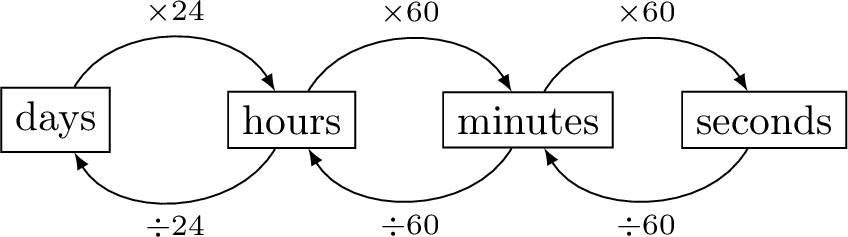
- 1 minute = 60 seconds
- 1 hour = 60 minutes
- 1 day = 24 hours
- 1 week = 7 days
- 1 year = 12 months \(\approx 52\) weeks = 365 days
Method How to Convert Units
- To convert from a larger unit to a smaller one, you multiply. (There are many smaller units in one larger unit.)
- To convert from a smaller unit to a larger one, you divide. (You are putting many small units together to make a bigger unit.)
Example
Convert 2 minutes to seconds.
We are going from a larger unit (minutes) to a smaller one (seconds), so we multiply.
Since 1 minute = 60 seconds:$$\begin{aligned}[t]2 \, \text{min} &= 2 \times 60 \, \text{s} \\ &= 120 \, \text{s}\end{aligned}$$So, 2 minutes is 120 seconds.
Since 1 minute = 60 seconds:$$\begin{aligned}[t]2 \, \text{min} &= 2 \times 60 \, \text{s} \\ &= 120 \, \text{s}\end{aligned}$$So, 2 minutes is 120 seconds.
Example
Convert 120 seconds to minutes.
We are going from a smaller unit (seconds) to a larger one (minutes), so we divide.
Since 1 minute = 60 seconds:$$\begin{aligned}[t]120 \div 60 &= 2 \\ 120 \, \text{s} &= 2 \, \text{min}\end{aligned}$$So, 120 seconds is 2 minutes.
Since 1 minute = 60 seconds:$$\begin{aligned}[t]120 \div 60 &= 2 \\ 120 \, \text{s} &= 2 \, \text{min}\end{aligned}$$So, 120 seconds is 2 minutes.
Converting to Mixed Time Units
Method Converting Seconds into Minutes and Seconds
To write a time given in seconds as a combination of minutes and seconds, we use division. This method helps us find how many full groups of 60 seconds (minutes) we can make.
- Divide by 60. Since there are 60 seconds in 1 minute, divide the total number of seconds by 60.
- The quotient is the minutes. The whole-number answer you get (the quotient) is the number of full minutes.
- The remainder is the seconds. The number left over from the division (the remainder) is the number of seconds that are left.
Example
You run a race in 140 seconds. How many minutes and seconds is that?
Let’s use our method to convert 140 seconds.
- Step 1: Divide by 60.

- Step 2: Identify the quotient and remainder.
- The quotient is 2.
- The remainder is 20.
- Step 3: Interpret the result.
- The quotient (2) means we have 2 full minutes.
- The remainder (20) means we have 20 seconds left over.
24-Hour Time Format
Definition 24-Hour Time
The 24-hour clock is a system for telling time that avoids using AM and PM. The day runs from 00:00 (midnight) to 23:59. Sometimes 24:00 is used to show midnight at the very end of the day; it is the same moment as 00:00 on the next day. This format is used in many parts of the world, in the military, and for travel schedules to avoid confusion.
Example
Write 6:15 PM in 24-hour format.
To convert a PM time to 24-hour format, you add 12 to the hour.$$\begin{aligned}[t]6:15 \, \text{PM} &= 12 \, \text{h} + 6 \, \text{h} + 15 \, \text{min} \\
&= 18 \, \text{h} + 15 \, \text{min} \\
&= 18:15\end{aligned}$$So, 6:15 PM becomes 18:15.
Reading Clock Times
Method How to Read an Analog Clock
To read time to the exact minute, we look at both hands and the small tick marks on the clock face.
- Read the Hour Hand (the short hand): As the minutes pass, the hour hand slowly moves from one hour to the next. The hour is the number that the hand has most recently passed.
- Read the Minute Hand (the long hand): This is a two-step process:
- First, find the last big number the minute hand has passed. Each big number stands for 5 minutes, so multiply that number by 5 to get the main minutes.
- Then, count the small tick marks from that big number to where the minute hand is pointing. Each tick mark is 1 minute. Add these to your total.
Example
What time does this clock show? It is morning.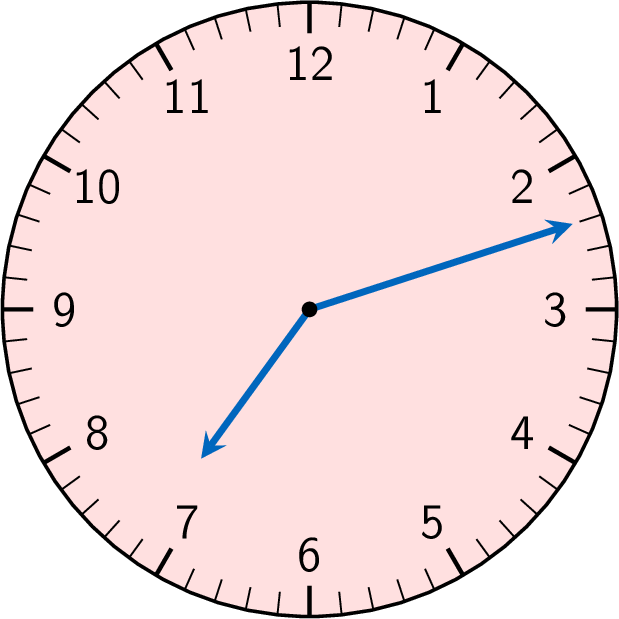
Let’s follow the steps to read the time: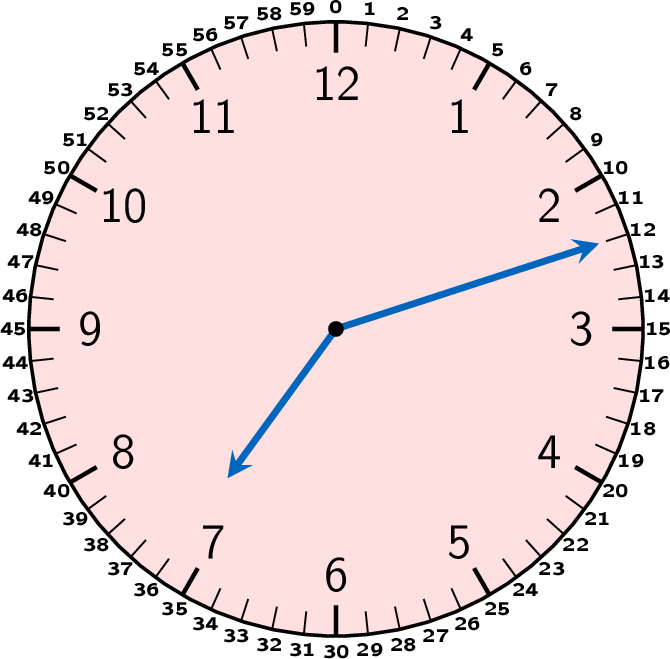
- Hour Hand: The short hand has passed the 7 but has not yet reached the 8. Therefore, the hour is 7.
- Minute Hand: The long hand has passed the 2.
- The 2 represents \(2 \times 5 = 10\) minutes.
- It is pointing 2 small tick marks past the 2.
- We add the minutes together:$$\begin{aligned}10 \,\text{minutes} + 2 \,\text{minutes} = 12 \,\text{minutes}\end{aligned}$$
- Combine and add AM/PM: Since it is morning, the time is 7:12 AM.
Calculating with Time Durations
Method Adding Time Durations
To add time durations, follow these steps:
- Add the minutes together.
- Regroup the minutes if the total is 60 or more. Since \(60\) minutes \(= 1\) hour, subtract \(60\) from the minute total and add \(1\) to the hours.
- Add the hours together.
Example
You play a game for 2 hours 30 minutes and read a book for 1 hour 45 minutes. What is the total duration?
- Step 1 (Add minutes): \(30 \, \text{min} + 45 \, \text{min} = 75 \, \text{min}\).
- Step 2 (Regroup minutes): 75 minutes is more than 1 hour. We can regroup it: \(75 \, \text{min} = 60 \, \text{min} + 15 \, \text{min} = 1 \, \text{h} \, 15 \, \text{min}\).
- Step 3 (Add hours): Add the original hours, then add the extra hour from regrouping: \(2 \, \text{h} + 1 \, \text{h} = 3 \, \text{h}\), then \(3 \, \text{h} + 1 \, \text{h} = 4 \, \text{h}\).
- Combine: The total duration is 4 hours and 15 minutes.
Method Subtracting Time Durations
To subtract time durations, follow these steps:
- Subtract the minutes. If the minutes in the starting time are less than the minutes you are subtracting, you must regroup (or borrow) from the hours.
- To regroup, take 1 hour from the hour column (reducing it by 1) and add 60 minutes to the minute column.
- Subtract the hours.
Example
You have 4 hours and 15 minutes of free time. You play a game for 1 hour and 45 minutes. How much time is left?
- Step 1 (Subtract minutes): We cannot subtract 45 from 15, so we need to regroup.
- Step 2 (Regroup): Borrow 1 hour from the 4 hours, leaving 3 hours. Add those 60 minutes to the 15 minutes: \(15 + 60 = 75\) minutes. Our starting time is now 3 hours and 75 minutes.
- Step 3 (Subtract minutes now): \(75 \, \text{min} - 45 \, \text{min} = 30 \, \text{min}\).
- Step 4 (Subtract hours): \(3 \, \text{h} - 1 \, \text{h} = 2 \, \text{h}\).
- You have 2 hours and 30 minutes left.
Solving Word Problems with Time
Method Solving Time Problems
To solve time problems, first identify the goal. Are you finding a total, a difference, a repeated amount, or splitting time into equal groups? This will tell you which operation to use.
Example
You spend 3 hours 30 minutes at school this morning and 2 hours 15 minutes studying this evening. How long is that altogether?
Analysis: The word altogether tells us to find a total, so we need to add.$$\begin{aligned} & 3 \, \text{h} \, 30 \, \text{min} \\
+ \, & 2 \, \text{h} \, 15 \, \text{min} \\
\hline & 5 \, \text{h} \, 45 \, \text{min}\end{aligned}$$You spent 5 hours and 45 minutes in total.
Example
A train journey starts at 11:20 and arrives at 13:30. How long does the trip take?
Analysis: To find the duration between a start time and an end time, we subtract.$$\begin{aligned} & 13 \, \text{h} \, 30 \, \text{min} \\
- \, & 11 \, \text{h} \, 20 \, \text{min} \\
\hline & 2 \, \text{h} \, 10 \, \text{min}\end{aligned}$$The train trip takes 2 hours and 10 minutes.
Example
Hugo has to prepare 20 nems for a party. It takes him 2 minutes to make each nem. How long will it take to prepare all the nems?
Analysis: The action (making one nem) is repeated 20 times. For repeated addition of the same amount, we multiply.$$\begin{aligned}20 \times 2 \, \text{minutes} &= 40 \, \text{minutes}\end{aligned}$$It will take Hugo 40 minutes to prepare all the nems.
Example
You have 1 hour for an exam. Each exercise takes you 4 minutes. How many exercises can you do?
Analysis: We are splitting a total amount of time (1 hour) into equal groups (4 minutes each) to see how many groups we can make. This requires division. First, we must convert all units to be the same.
- Step 1: Convert. 1 hour = 60 minutes.
- Step 2: Divide.
Example
A teacher has 36 minutes to grade tests. Each test takes 3 minutes to grade. How many tests can the teacher grade?
Analysis: We are finding how many equal groups of 3 minutes fit into a total of 36 minutes. This is a division problem.$$\begin{aligned}36 \, \text{minutes} \div 3 \, \text{minutes per test} &= 12 \, \text{tests}\end{aligned}$$The teacher can grade 12 tests.
Timelines
Definition Timeline
A timeline is a graphical representation of events in chronological order. It uses a scaled line to show when events occurred, the time that passed between them, and the duration of specific periods.
Timelines are essential tools in history and other subjects to visualize sequences of events. They help us understand cause and effect, compare different historical periods, and analyze how long events or eras lasted.
Example
This timeline shows the reigns of two famous kings of France. The bar shows the duration of Louis XIII’s reign, and the arrow shows when Louis XIV’s reign begins.

- According to the timeline, the reign of Louis XIII starts in 1610.
- His reign ends, and Louis XIV's begins, in 1643.
- To find the duration, we subtract the start year from the end year.
Definition BCE and CE
To date events in history, historians often use a system that divides time into two major eras. You may have seen the abbreviations BC and AD; in modern academic and historical work, we usually use the neutral terms BCE and CE.
- BCE stands for “Before the Common Era”. Years in BCE count backwards from year 1. For example, 100 BCE happened before 50 BCE.
- CE stands for “Common Era”. This is the era we live in. Years in CE count forwards from year 1.
Example
This timeline shows two major events in Roman history.

To find the duration between a BCE date and a CE date, we combine the years from both sides of the timeline and remember that there is no year 0.
- From 100 BCE to 1 BCE, there are 99 years.
- From 1 CE to 70 CE, there are 69 years.
- There is 1 year between 1 BCE and 1 CE.
- We add these three parts together.