Angles
Angles are one of the basic ideas in geometry. An angle is formed when two rays meet at a single point. This point is called the vertex of the angle.
What is an Angle?
Definition Angle
An angle is the amount of turn between two rays that start from the same point, called the vertex. Each ray is called an arm (or side) of the angle.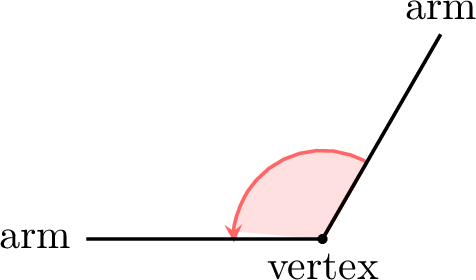
Definition Naming Angles with Three Points
An angle is named using three points with the symbol \(\Angle{ABC}\), where \(B\) is the vertex of the angle, and \(A\) and \(C\) are points on the two sides of the angle. The vertex \(B\) is always written in the middle to indicate the angle’s center.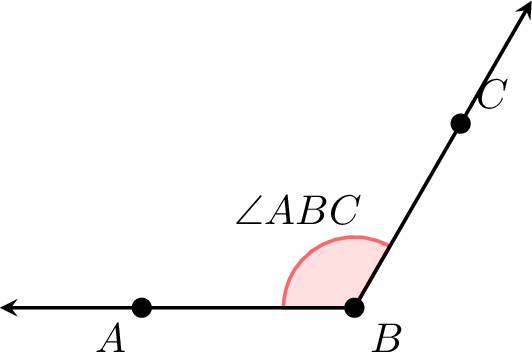
Degrees
A full turn, or complete circle, can be divided into 360 equal parts. Each part is called one degree.
Definition Degree Unit
A degree, written with the symbol \(^\circ\), is a unit of angle measurement. A full turn measures \(360^\circ\).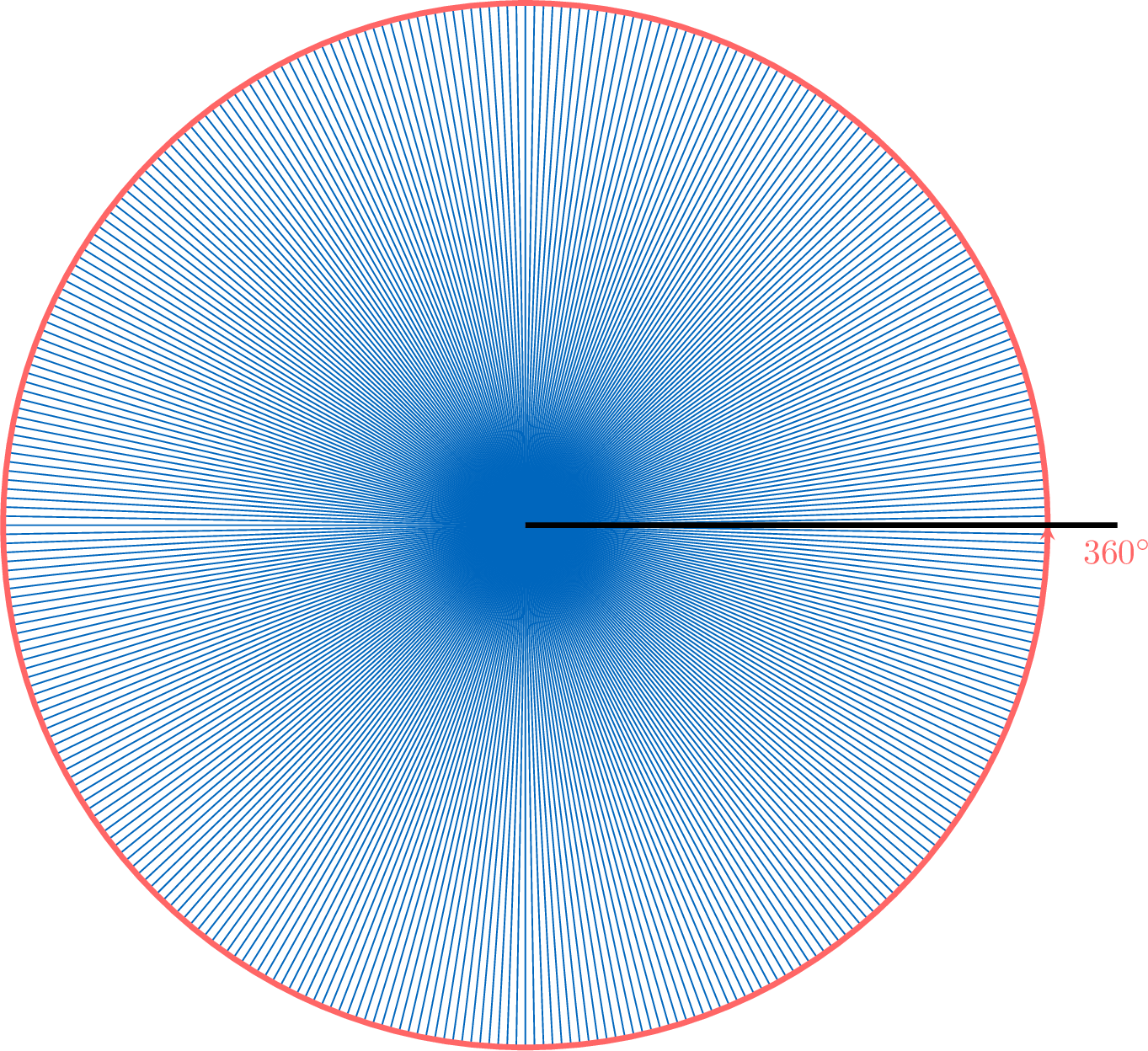
Definition Measure of an Angle in Degrees
The measure of an angle in degrees tells us what fraction of a full turn the angle is.
Example
Calculate the measure of an angle that represents one-third of a full turn.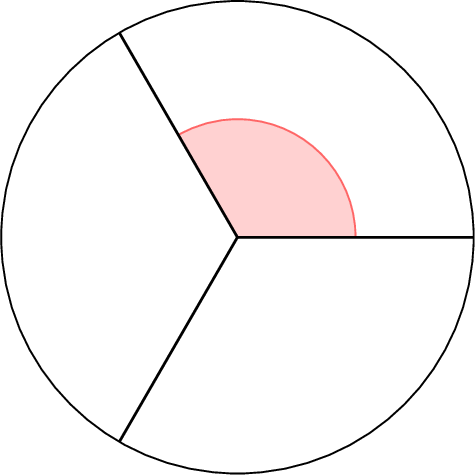
$$\begin{aligned}\text{Angle} &= \frac{1}{3} \text{ of } 360^\circ \\
&= 360^\circ \div 3 \\
&= 120^\circ\end{aligned}$$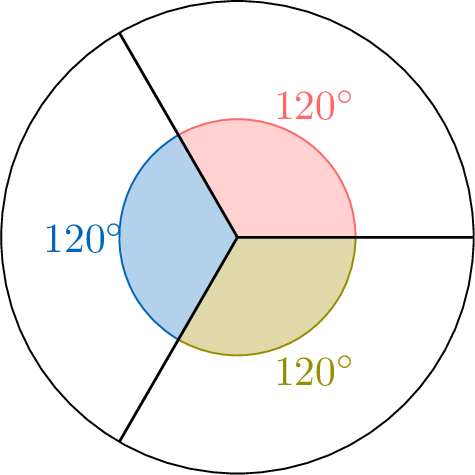
Measuring and Drawing Angles with a Protractor
Definition Protractor
A protractor is a tool used to measure and draw angles in degrees. It is typically a semi-circular tool with a scale marked from \(0^\circ\) to \(180^\circ\).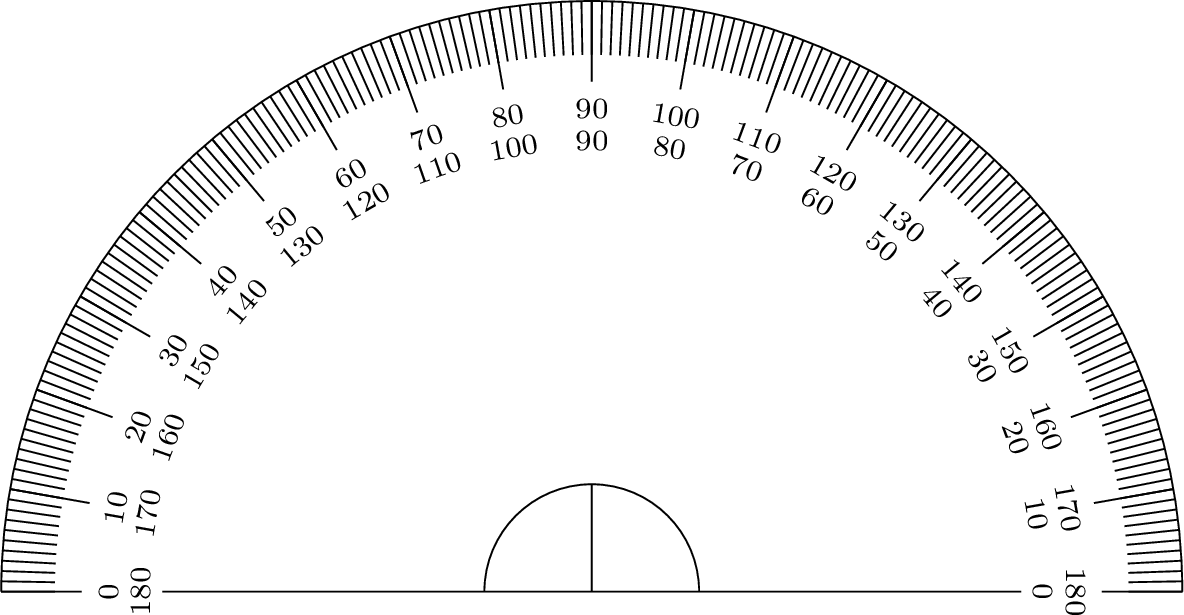
Method Measuring an Angle with a Protractor
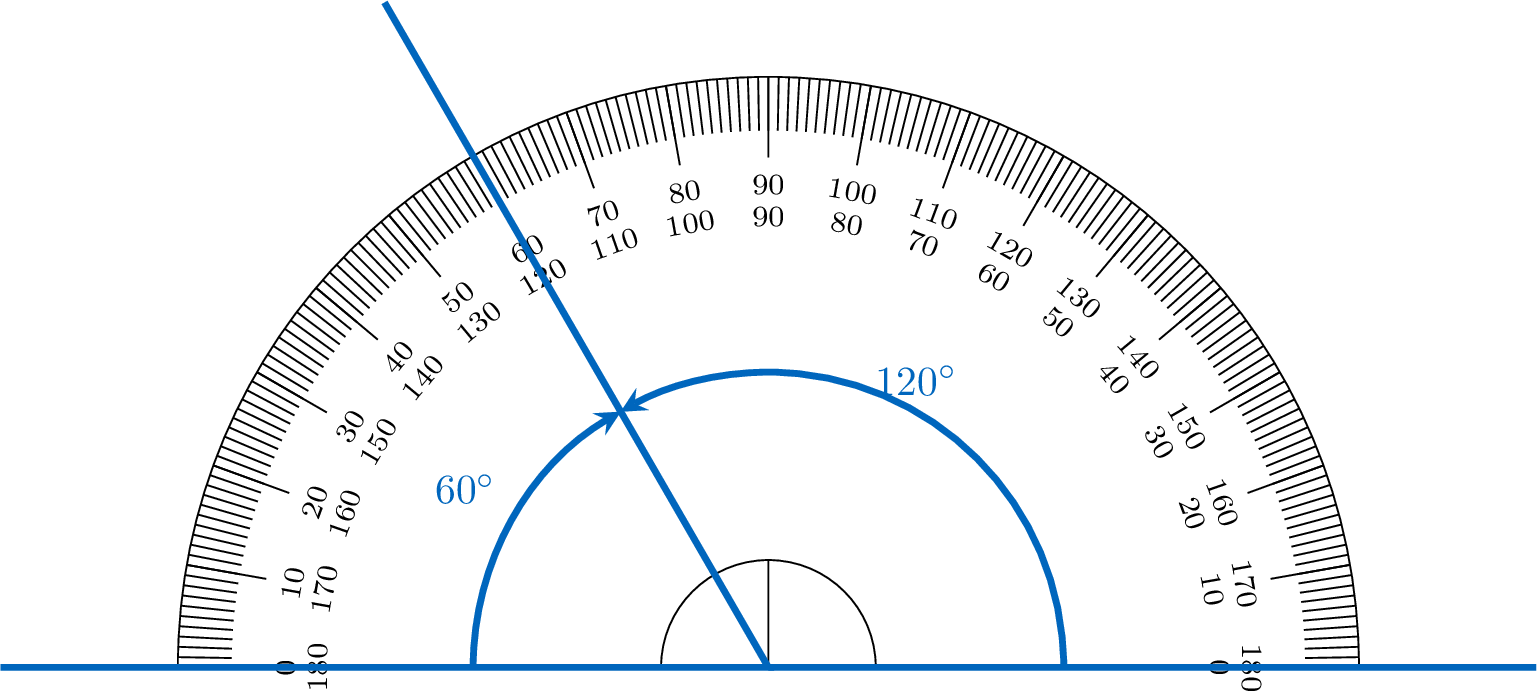
- Place the protractor’s origin (center point) over the vertex of the angle.
- Align one ray of the angle with the protractor’s baseline (the \(0^\circ\) mark).
- Observe where the other ray intersects the protractor’s scale.
- Read the angle measure in degrees from the correct scale (the one that starts at \(0^\circ\) on your first ray).
Example
Measure the following angle.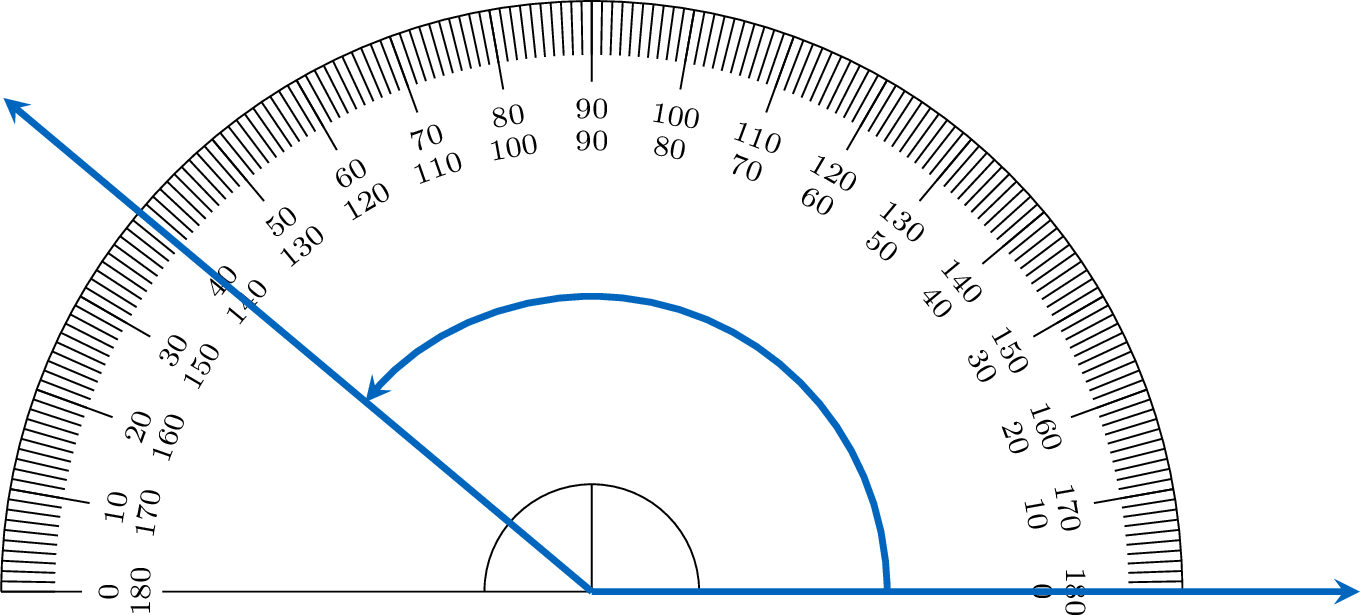
The second ray points to \(140^\circ\) on the protractor, so the angle measures \(140^\circ\).
Method Drawing an Angle with a Protractor
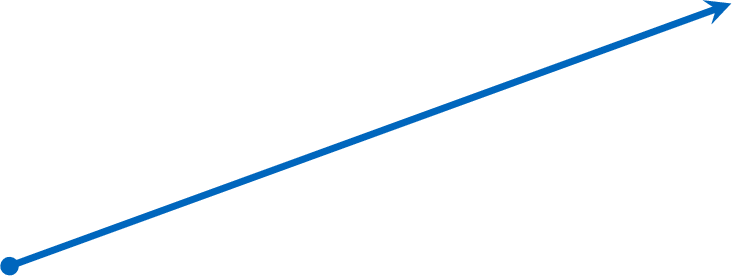
- Draw a ray starting from a point (the vertex).
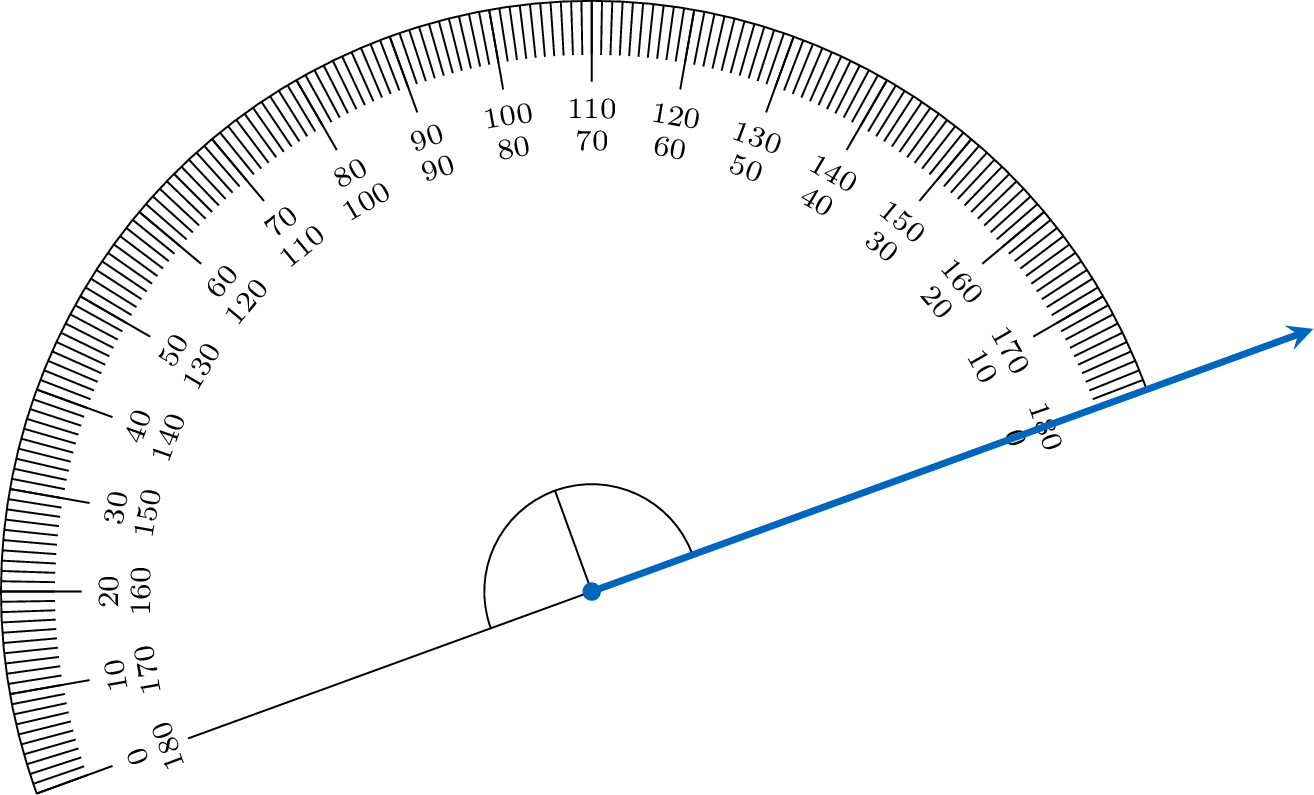
- Place the protractor’s origin over the vertex and align the baseline with the ray.
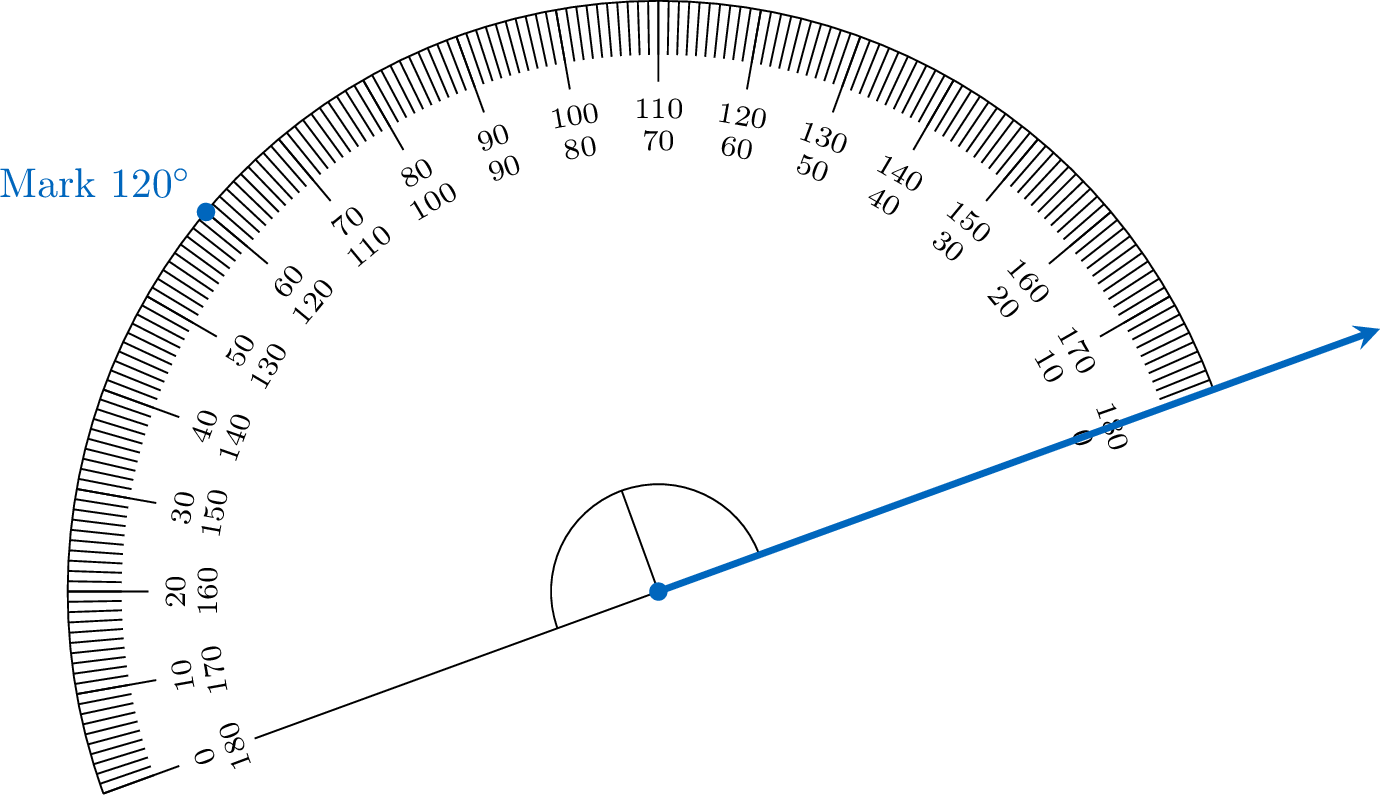
- Locate the desired angle measure on the protractor’s scale and mark the point.
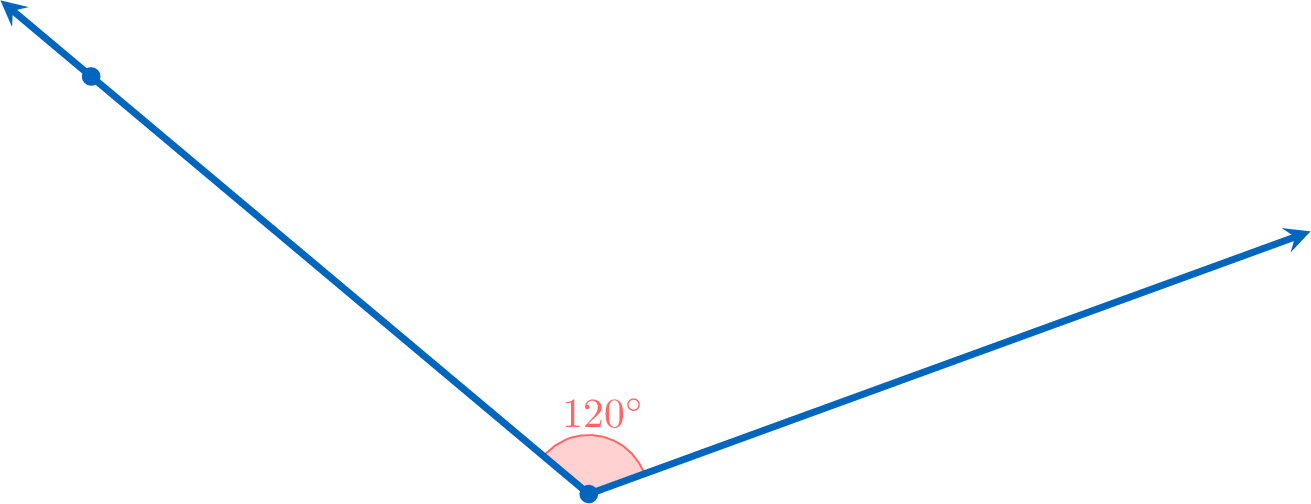
- Draw a second ray from the vertex through the marked point to form the angle.
Classification of Angles
In geometry, angles are classified based on their measure. The table below defines four main types of angles: acute, right, obtuse, and straight.
Definition Classification of Angles
| Name | Fraction of a Full Turn | Angle Measure | Figure |
| Acute Angle | Less than \(\dfrac{1}{4}\) of a full turn | Less than \(90^{\circ}\) | 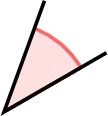 |
| Right Angle | \(\dfrac{1}{4}\) of a full turn | Exactly \(90^{\circ}\) | 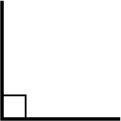 |
| Obtuse Angle | Between \(\dfrac{1}{4}\) and \(\dfrac{1}{2}\) of a full turn | Between \(90^{\circ}\) and \(180^{\circ}\) | 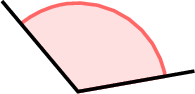 |
| Straight Angle | \(\dfrac{1}{2}\) of a full turn | Exactly \(180^{\circ}\) | 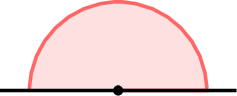 |
Angle Addition
Proposition Angle Addition Postulate
When two angles are adjacent (they share a common vertex and a common side), the measure of the angle formed by their other sides is equal to the sum of their measures.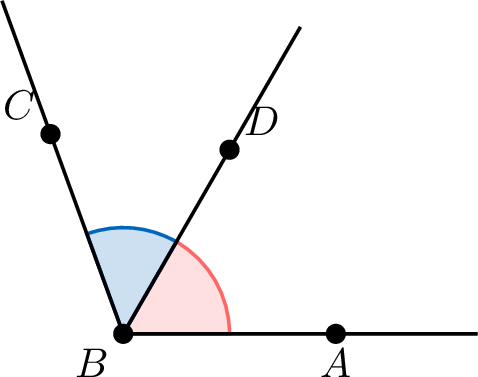
\(\Angle{ABC} = \textcolor{colordef}{\Angle{ABD}} + \textcolor{colorprop}{\Angle{DBC}}\)
\(\Angle{ABC} = \textcolor{colordef}{\Angle{ABD}} + \textcolor{colorprop}{\Angle{DBC}}\)
Method Calculating an Angle
To find the measure of an unknown angle, use the measures of related known angles. If the unknown angle is formed by two smaller adjacent angles that share a common vertex and a common side, add the measures of the smaller angles using the angle addition postulate.
Example
Calculate \(\Angle{ABC}\) without using a protractor.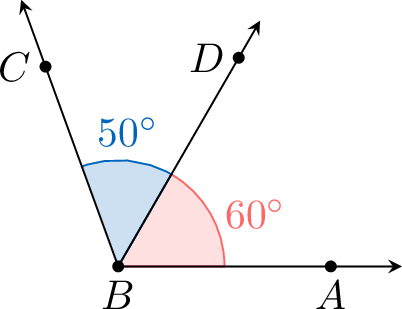
Angles \(\Angle{ABD}\) and \(\Angle{DBC}\) are adjacent and form \(\Angle{ABC}\). Using the angle addition postulate:$$\begin{aligned}\Angle{ABC} &= \textcolor{colordef}{\Angle{ABD}} + \textcolor{colorprop}{\Angle{DBC}} \\
&= \textcolor{colordef}{60^\circ} + \textcolor{colorprop}{50^\circ} \\
&= 110^\circ\end{aligned}$$
Angle Properties
Proposition Angle Properties
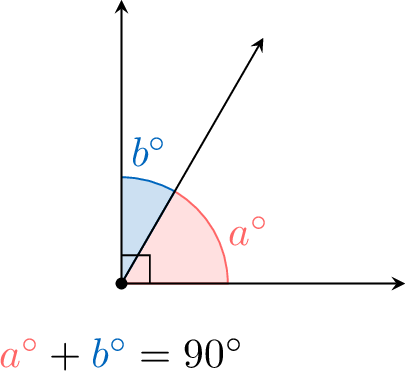
- Right Angle: If two adjacent angles form a right angle, the sum of their measures is \(90^\circ\) (they are complementary angles).
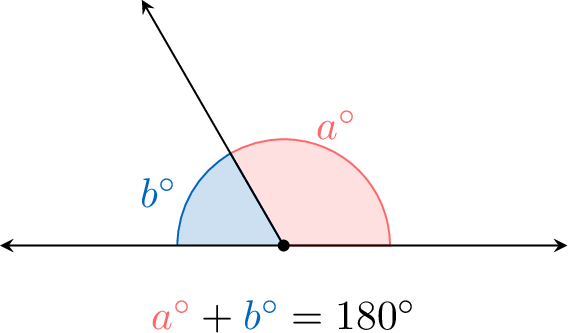
- Straight Angle: If two adjacent angles form a straight angle, the sum of their measures is \(180^\circ\) (they are supplementary angles).
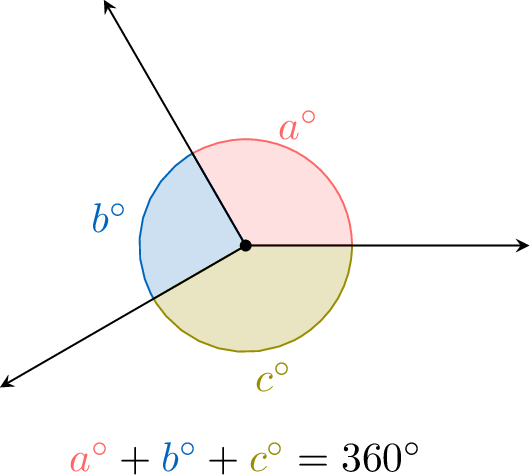
- Full Angle: If several angles meet at a point and form a full turn around that point, the sum of their measures is \(360^\circ\).
Example
Calculate \(x^{\circ}\).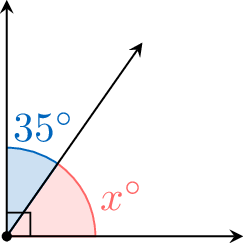
Since the two angles form a right angle, their measures add up to \(90^\circ\):$$\begin{aligned}x^\circ + 35^\circ &= 90^\circ \\
x^\circ &= 90^\circ - 35^\circ \\
x^\circ &= 55^\circ\end{aligned}$$