Sequences
Numerical Sequence
Definition Numerical Sequence
A numerical sequence is a list of numbers that follows a specific rule.
- The first number is called the 1\(^{\text{st}}\) term.
- The second number is called the 2\(^{\text{nd}}\) term.
- The third number is called the 3\(^{\text{rd}}\) term.
- And so on.
Example
What is the 6\(^{\text{th}}\) term of this sequence?
| \(n\) | 1 | 2 | 3 | 4 | 5 | 6 |
| \(n^{\text{th}}\) term | 3 | 5 | 7 | 9 | 11 | 13 |
The 6\(^{\text{th}}\) term is \(13\).
Recursive Definition
Definition Recursive Definition
A sequence is defined recursively when the rule explains how to get each new term from the term that comes just before it. To do this, you always need two key pieces of information:
- The first term of the sequence (the starting point).
- The recursive rule that tells you how to get each term from the previous term.
Example
A sequence is defined by the following recursive rule:
- The first term is 5.
- The rule is: “add 3 to the previous term to get the next term.”
Let's build the sequence step by step:$$5 \textcolor{olive}{\xrightarrow{\;+3\;}} 8 \textcolor{olive}{\xrightarrow{\;+3\;}} 11 \textcolor{olive}{\xrightarrow{\;+3\;}} 14 \textcolor{olive}{\xrightarrow{\;+3\;}} 17$$ The first five terms are: \(5, 8, 11, 14, 17\).
- 1\(^{\text{st}}\) term: The starting point is 5.
- 2\(^{\text{nd}}\) term: Take the previous term (5) and add 3. \(\rightarrow 5 + 3 = 8\)
- 3\(^{\text{rd}}\) term: Take the previous term (8) and add 3. \(\rightarrow 8 + 3 = 11\)
- 4\(^{\text{th}}\) term: Take the previous term (11) and add 3. \(\rightarrow 11 + 3 = 14\)
- 5\(^{\text{th}}\) term: Take the previous term (14) and add 3. \(\rightarrow 14 + 3 = 17\)
Arithmetic Sequence
Definition Arithmetic Sequence
An arithmetic sequence is a list of numbers where the same number is added or subtracted each time to get the next number.
The difference between two consecutive terms (two numbers that are next to each other in the sequence) is called the common difference.
The difference between two consecutive terms (two numbers that are next to each other in the sequence) is called the common difference.
Example
What is the 6\(^{\text{th}}\) term of this sequence?
| \(n\) | 1 | 2 | 3 | 4 | 5 | 6 |
| \(n^{\text{th}}\) term | 3 | 5 | 7 | 9 | 11 | ? |
The 6\(^{\text{th}}\) term is \(13\), because each term increases by \(2\).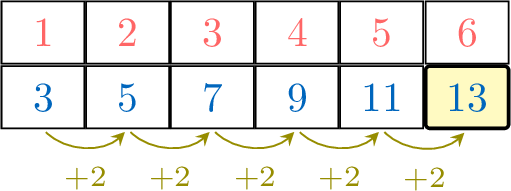
Geometric Sequence
Definition Geometric Sequence
A geometric sequence is a list of numbers where the same number is multiplied or divided each time to get the next number.
The ratio of two consecutive terms is called the common ratio.
The ratio of two consecutive terms is called the common ratio.
Example
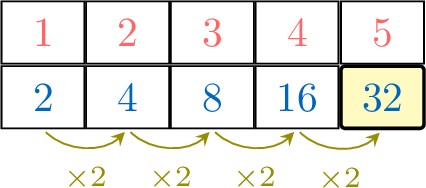
What is the 5\(^{\text{th}}\) term of this sequence?
| \(n\) | 1 | 2 | 3 | 4 | 5 |
| \(n^{\text{th}}\) term | 2 | 4 | 8 | 16 | ? |
The 5\(^{\text{th}}\) term is \(32\), because each term is multiplied by \(2\).