Scale Drawings
Definitions
When designing a house, an architect creates a drawing that is much smaller than the actual building. To do this, every measurement of the real house is proportionally reduced. This proportional relationship is called the scale.
For house plans, a common scale is \(1{:}100\). This means every length on the drawing is 100 times smaller than the actual length in reality. These types of drawings are called scale drawings.\includegraphics[width=0.5\textwidth]{\imagepath floorplan2.png}
For house plans, a common scale is \(1{:}100\). This means every length on the drawing is 100 times smaller than the actual length in reality. These types of drawings are called scale drawings.
Definition Scale Drawing and Scale Factor
A scale drawing is a drawing that represents a real object with its dimensions proportionally reduced or enlarged. This relationship is defined by the scale, which is expressed as a ratio 1:scale factor.
The fundamental relationship is:$$\frac{\textcolor{colorprop}{1}}{\textcolor{colordef}{\text{Scale Factor}}}= \frac{\textcolor{colorprop}{\text{Drawn Length}}}{\textcolor{colordef}{\text{Actual Length}}}$$
The fundamental relationship is:$$\frac{\textcolor{colorprop}{1}}{\textcolor{colordef}{\text{Scale Factor}}}= \frac{\textcolor{colorprop}{\text{Drawn Length}}}{\textcolor{colordef}{\text{Actual Length}}}$$
Formulae
Proposition Formulae
From the main relationship, we can derive three useful formulae:$$\begin{aligned}\text{Actual Length} &= \text{Drawn Length} \times \text{Scale Factor}\\
\text{Drawn Length} &= \frac{\text{Actual Length}}{\text{Scale Factor}}\\
\text{Scale Factor} &= \frac{\text{Actual Length}}{\text{Drawn Length}}\end{aligned}$$Note: To calculate the scale factor, both lengths must be in the same unit.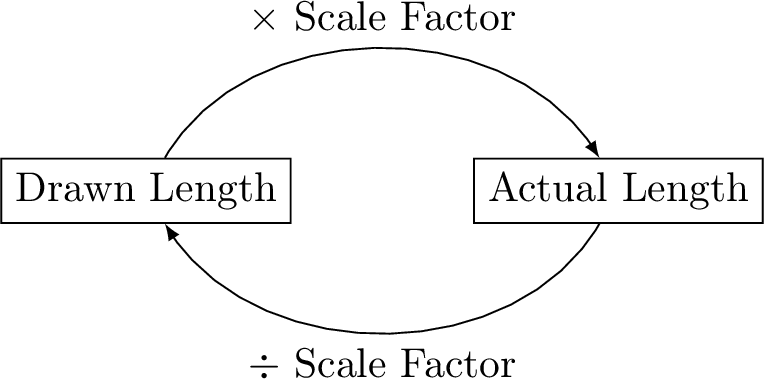
Starting with the main proportion:$$\frac{\textcolor{colorprop}{1}}{\textcolor{colordef}{\text{Scale Factor}}}= \frac{\textcolor{colorprop}{\text{Drawn Length}}}{\textcolor{colordef}{\text{Actual Length}}}$$By cross-multiplication, we get:$$\textcolor{colorprop}{1} \times \textcolor{colordef}{\text{Actual Length}} = \textcolor{colorprop}{\text{Drawn Length}} \times \textcolor{colordef}{\text{Scale Factor}}$$This simplifies to our main formula:$$\textcolor{colordef}{\text{Actual Length}} = \textcolor{colorprop}{\text{Drawn Length}} \times \textcolor{colordef}{\text{Scale Factor}}$$
Example
Calculate the actual width of this house.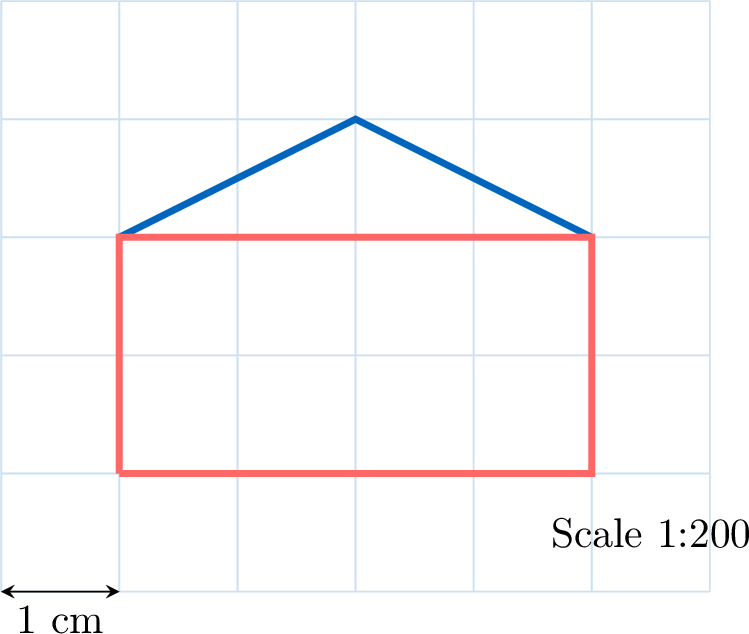
The drawn width of the house is \(4\,\mathrm{cm}\). The scale \(1{:}200\) means the scale factor is \(200\).$$\begin{aligned}\text{Actual width} &= \text{Drawn width} \times \text{Scale factor}\\
&= 4\,\mathrm{cm} \times 200 \\
&= 800\,\mathrm{cm} \\
&= 8\,\mathrm{m}\end{aligned}$$The actual width of the house is \(8\) meters.
Example
For a scale of \(1{:}200\), find the drawn length corresponding to an actual length of \(6\,\mathrm{m}\).
The scale factor is \(200\).$$\begin{aligned}\text{Drawn length} &= \frac{\text{Actual length}}{\text{Scale factor}}\\
&= \frac{6\,\mathrm{m}}{200}\\
&= \frac{600\,\mathrm{cm}}{200} &&(\text{unit conversion})\\
&= 3\,\mathrm{cm}\end{aligned}$$A \(6\,\mathrm{m}\) actual length is represented by a \(3\,\mathrm{cm}\) drawn length.
Example
A drawn length of \(2\,\mathrm{cm}\) represents an actual length of \(5\,\mathrm{m}\). Find the scale factor and the scale.
First, convert lengths to the same unit. Let's use cm.
Actual length = \(5\,\mathrm{m} = 500\,\mathrm{cm}\).$$\begin{aligned}\text{Scale factor} &= \frac{\text{Actual length}}{\text{Drawn length}}\\ &= \frac{500\,\mathrm{cm}}{2\,\mathrm{cm}}\\ &= 250\end{aligned}$$The scale factor is \(250\). The scale is written as \(1{:}250\).
Actual length = \(5\,\mathrm{m} = 500\,\mathrm{cm}\).$$\begin{aligned}\text{Scale factor} &= \frac{\text{Actual length}}{\text{Drawn length}}\\ &= \frac{500\,\mathrm{cm}}{2\,\mathrm{cm}}\\ &= 250\end{aligned}$$The scale factor is \(250\). The scale is written as \(1{:}250\).