Ratios
What is a Ratio?
Definition Ratio
A ratio is a comparison of two quantities. The ratio of \(\textcolor{colordef}{2}\) to \(\textcolor{colorprop}{3}\) can be expressed as the fraction \(\dfrac{\textcolor{colordef}{2}}{\textcolor{colorprop}{3}}\).
Definition Part-Part Ratio
A part-part ratio compares two distinct parts of a whole.$$\textcolor{colordef}{\text{Part 1}}:\textcolor{colorprop}{\text{Part 2}}$$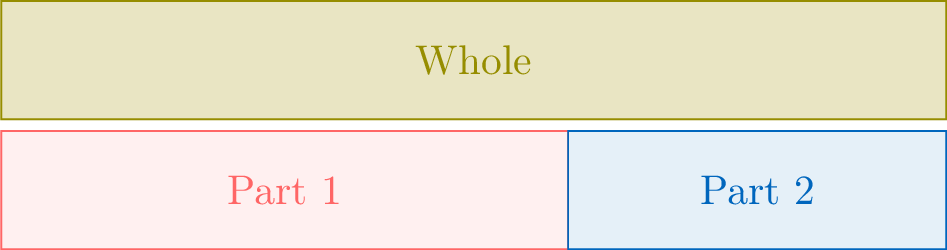
Example
A fruit bowl contains 3 cherries and 2 apples. What is the ratio of cherries to apples?
The ratio of cherries to apples is \(\textcolor{colordef}{3}:\textcolor{olive}{2}\). This compares the two parts of the fruit collection to each other.
Definition Part-Whole Ratio
A part-whole ratio compares one part of a whole to the whole.$$\textcolor{colordef}{\text{Part 1}}:\textcolor{olive}{\text{Whole}}\text{ or }\textcolor{colorprop}{\text{Part 2}}:\textcolor{olive}{\text{Whole}}$$
Example
A juice is made with 1 lemon and 2 oranges. What is the ratio of oranges to the total number of fruits?
- First, determine the total number of fruits. The total is \(1 + 2 = 3\) fruits.
- The ratio of oranges (the part) to the total number of fruits (the whole) is \(\textcolor{orange}{2}:3\).
- This part-to-whole ratio can also be expressed as the fraction \(\dfrac{\textcolor{orange}{2}}{3}\).
Equivalent Ratios
Definition Equivalent Ratios
Two ratios are equivalent if they represent the same relationship. You can find equivalent ratios by multiplying or dividing both parts of the ratio by the same number.
Example
The ratio of red apples to all apples is \(\dfrac{2}{4}\), which is equivalent to \(\dfrac{1}{2}\) (half of the apples are red). 
Method Using Fractions
To check if two ratios are equivalent, we can compare their fractions. If the fractions are equivalent, then the ratios are equivalent.
Example
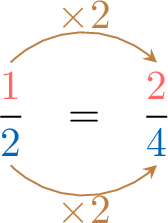 , the ratios are equivalent: \(\textcolor{colordef}{1}:\textcolor{colorprop}{2}=\textcolor{colordef}{2}:\textcolor{colorprop}{4}\)
Proportion
- For one glass of juice, you need \(\textcolor{colordef}{1}\) lemon and \(\textcolor{colorprop}{2}\) oranges. The ratio of lemons to oranges is \(\textcolor{colordef}{1}:\textcolor{colorprop}{2}\).
- To make two glasses of juice, you need to double the ingredients: \(\textcolor{colordef}{2}\) lemons and \(\textcolor{colorprop}{4}\) oranges. The new ratio is \(\textcolor{colordef}{2}:\textcolor{colorprop}{4}\).
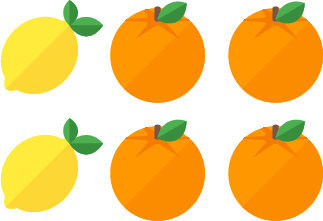
- The amount of fruit is proportional because the ratios are equivalent: \(\dfrac{\textcolor{colordef}{1}}{\textcolor{colorprop}{2}} = \dfrac{\textcolor{colordef}{2}}{\textcolor{colorprop}{4}}\).
Definition Proportion
A proportion is an equation stating that two ratios are equivalent.
Example
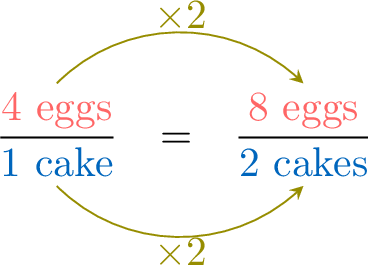
To make \(\textcolor{colorprop}{1}\) chocolate cake, you need \(\textcolor{colordef}{4}\) eggs. How many eggs are needed for \(\textcolor{colorprop}{2}\) cakes?
For \(\textcolor{colorprop}{1}\) cake, you need \(\textcolor{colordef}{4}\) eggs. To find the number of eggs for \(\textcolor{colorprop}{2}\) cakes, we set up a proportion: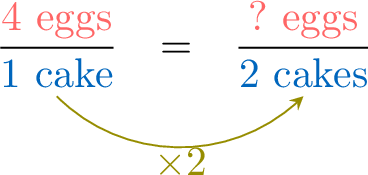
Unitary Method
The unitary method is a great technique to solve proportion problems. The main idea is to first find the value of one unit, and then use that value to find the quantity you need.
Method Unitary Method
If \(\textcolor{colordef}{5}\) apples cost \(\dollar\textcolor{colorprop}{10}\), how much do \(\textcolor{colordef}{8}\) apples cost?
- Step 1: Find the cost of 1 apple (the unit cost).
Divide the total cost by the number of apples.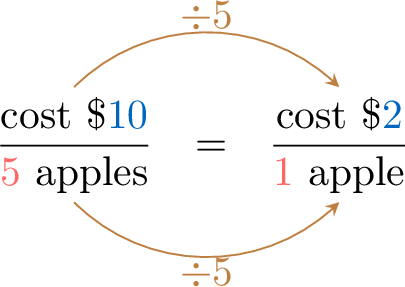
- Step 2: Find the cost of 8 apples.
Multiply the unit cost by the number of apples you want.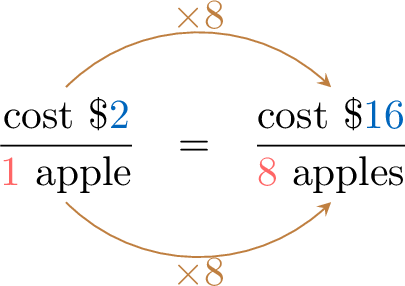
Cross-Multiplication Method
Cross-multiplication is a shortcut to solve proportion problems. It allows you to find a missing value by multiplying numbers diagonally.
Method Cross-Multiplication in Table
If \(\textcolor{colordef}{5}\) apples cost \(\dollar\textcolor{colorprop}{10}\), how much do \(\textcolor{colordef}{8}\) apples cost?
- Step 1: Set up the table. Organize the information with matching units in the same row.
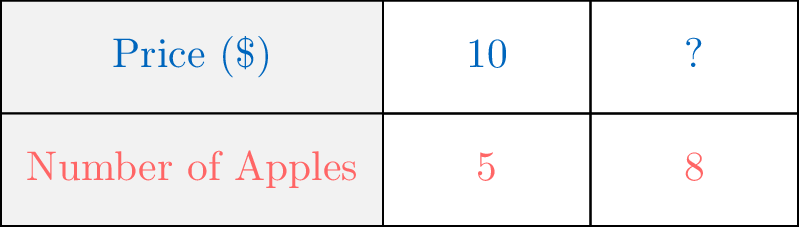
- Step 2: Cross-multiply and divide. Multiply the two numbers that are diagonal to each other, and then divide by the remaining number.
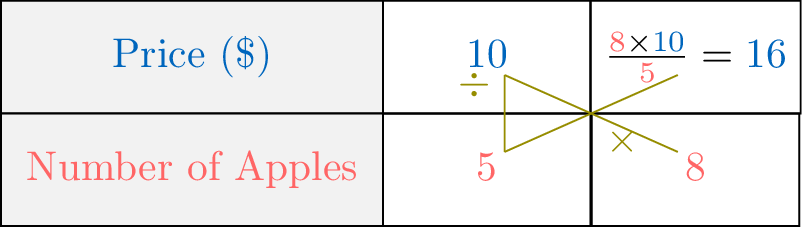
- So, \(\textcolor{colordef}{8}\) apples cost \(\dollar\textcolor{colorprop}{16}\).
Method Cross-Multiplication with Fractions
If \(\textcolor{colordef}{5}\) apples cost \(\dollar\textcolor{colorprop}{10}\), how much do \(\textcolor{colordef}{8}\) apples cost?
- Step 1: Set up the proportion. Let \(x\) be the unknown cost.
\(\dfrac{\dollar\textcolor{colorprop}{10}}{\textcolor{colordef}{5} \text{ apples}} = \dfrac{\dollar\textcolor{colorprop}{x}}{\textcolor{colordef}{8} \text{ apples}}\) - Step 2: Cross-multiply and solve for \(x\). Multiply the numbers that are diagonal to each other.
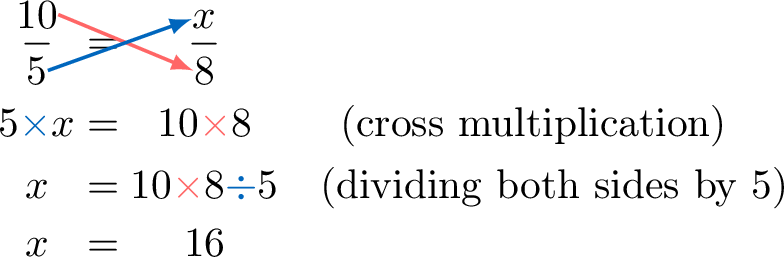
- So, \(\textcolor{colordef}{8}\) apples cost \(\dollar\textcolor{colorprop}{16}\).