Decimal Numbers
What Are Decimals?
In our number system, the position of a digit tells us its value. Let's look at the number 235.\(235=\) 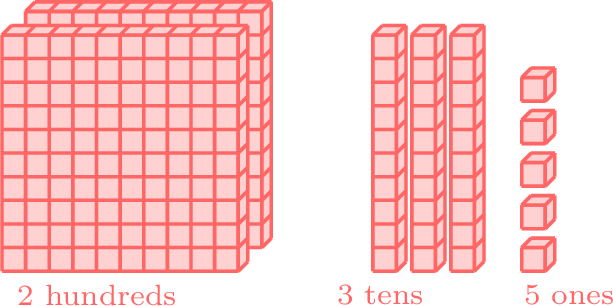
It is made of three parts:
We get a piece called a tenth. A tenth is a fraction, written as \(\dfrac{1}{10}\).
To write numbers that include these smaller pieces, we use a decimal point to separate the whole part from the fraction part.\(35.4\) = 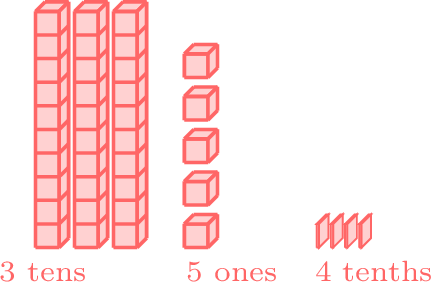
This number means 3 tens, 5 ones, and 4 tenths.
- The 5 is in the Ones place, meaning 5 ones (\(5\)).
- The 3 is in the Tens place, meaning 3 tens (\(30\)).
- The 2 is in the Hundreds place, meaning 2 hundreds (\(200\)).
- When we move left \(\leftarrow\), each place is 10 times bigger. (10 ones make a ten, 10 tens make a hundred).
- When we move right \(\rightarrow\), each place is 10 times smaller. (A hundred divided by 10 is a ten, a ten divided by 10 is a one).
We get a piece called a tenth. A tenth is a fraction, written as \(\dfrac{1}{10}\).
To write numbers that include these smaller pieces, we use a decimal point to separate the whole part from the fraction part.
Definition Decimal Number
A decimal number uses a decimal point to show a value that includes parts smaller than one. We can represent a decimal number in different ways:
- Standard Form:
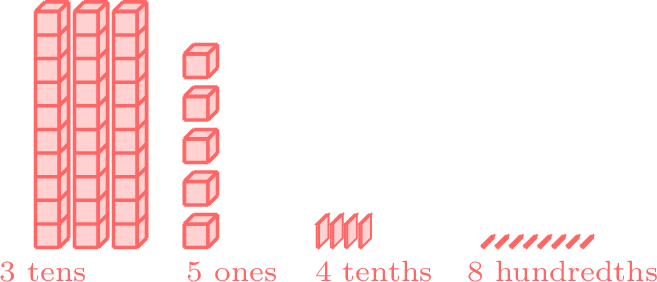
\(35.48\) - Expanded Form$$\begin{aligned} 3\text{ tens} &+& 5\text{ ones} &+& 4\text{ tenths}& +& 8\text{ hundredths} \\ 30 &+& 5 &+& \frac{4}{10} &+& \frac{8}{100}\\ 3\times 10 &+& 5\times 1 &+& 4\times \frac{1}{10} &+& 8\times \frac{1}{100}\\ \end{aligned}$$
- Place Value Table:
Tens Ones . Tenths Hundredths 3 5 . 4 8 - Base Ten Cubes:
Decimals on a Number Line
A number line is like a map for numbers. Decimals have their own special place on it.
- Finding Tenths
If we take the space between two whole numbers, like 0 and 1, and divide it into 10 equal parts, each part is one tenth (0.1).
- Finding Hundredths
If we "zoom in" on a small section, like the one between 0 and 0.1, and divide it into 10 equal parts, each new part is one hundredth (0.01).
Method Placing a Decimal on a Number Line
To place a decimal like 2.27 on a number line:
- Find the start and end points. The number 2.27 is between 2.2 and 2.3.
- Draw the line and divide it into 10 equal parts. Each part will represent a hundredth.
- Count up from the start. The marks will be 2.21, 2.22, 2.23, and so on. Find the 7th mark to place 2.27.
Ordering Decimals
Method Comparing Decimals Step-by-Step
To find out which decimal number is bigger, follow these steps:
- Line them up: Place the numbers one above the other, making sure the decimal points are perfectly aligned.
- Make them the same length: Add zeros to the end of the shorter number until both have the same number of decimal places. This doesn't change their value.
- Compare from left to right: Starting from the left, compare the digits in each place value column. The first number with a larger digit is the larger number.
Example
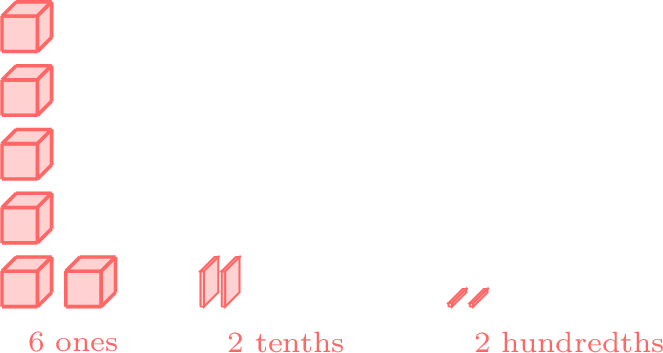
Compare 6.22 and 6.3.
- Line them up:
\(6.22\)
\(6.3\) - Make them the same length: We add a zero to 6.3 to make it 6.30.
\(6.22\)
\(6.30\) - Compare:
- Ones place: Both have a 6. (It's a tie)
- Tenths place: The top number has a 2, the bottom has a 3.
 \(\lt\)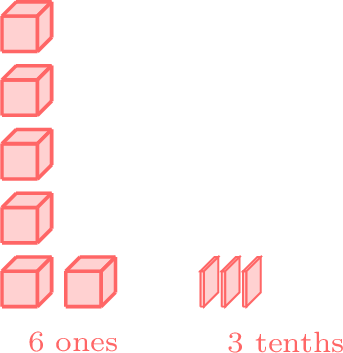
Rounding Decimals
Method The Four-Step Rounding Rule
- Underline the target digit: Find and underline the digit in the place you are rounding to.
- Look at the next digit: Look at the digit immediately to the right of your underlined digit.
- Decide to round up or down:
- If the next digit is 5 or more, add one to your underlined digit (round up).
- If the next digit is 4 or less, your underlined digit stays the same.
- Drop the rest: All digits to the right of your underlined digit are dropped.
Example
Round the number \(12.346\) to the nearest tenth.
Let's follow the steps:
- Underline the digit (the tenths place): \(12.\underline{3}46\)
- Look at the next digit: The digit to the right is 4.
- Decide: Since 4 is "4 or less," the circled digit 3 stays the same.
- Drop the rest: The 4 and 6 are dropped.
Multiplying by Powers of 10
When we multiply a number by 10, it gets 10 times larger. This means every digit moves one spot to the left in the place value chart. A simple shortcut is to move the decimal point to the right.
Method Moving the Decimal Point to Multiply
To multiply by a power of 10, move the decimal point to the right by the number of zeros in the power of 10.
- Multiply by 10 (1 zero) \(\rightarrow\) move 1 place right.
- Multiply by 100 (2 zeros) \(\rightarrow\) move 2 places right.
- Multiply by 1000 (3 zeros) \(\rightarrow\) move 3 places right.
Example
Calculate \(10\times 5.24 \)

Dividing by Powers of 10
When we divide a number by 10, it gets 10 times smaller. This means every digit moves one spot to the right. The shortcut is to move the decimal point to the left.
Method Moving the Decimal Point to Divide
To divide by a power of 10, move the decimal point to the left by the number of zeros.
- Divide by 10 (1 zero) \(\rightarrow\) move 1 place left.
- Divide by 100 (2 zeros) \(\rightarrow\) move 2 places left.
- Divide by 1000 (3 zeros) \(\rightarrow\) move 3 places left.
Example
Calculate \(23.2\div 10\)
