Whole Numbers
Building Numbers
We have learned to group ones, tens, and hundreds. The pattern continues! To build even bigger numbers, we group thousands.
We group 10 thousands together to make 1 ten thousand:  = \(10\) thousands = \(1\) ten thousand =
Our place value table now needs a new, larger column for Ten Thousands.
We group 10 thousands together to make 1 ten thousand:
= \(10\) thousands = \(1\) ten thousand = | Ten Thousands | Thousands | Hundreds | Tens | Ones |
| 1 | 2 | 4 | 3 | 5 |
| |  |  |  |  |
Definition 5-Digit Number
In the base 10 system, the place of a digit in a number determines its value. We can show a number like \(12\,435\) in many different ways:
- With digits: $$12\,435$$
- In expanded form: $$\begin{aligned}[t] 1\text{ ten thousand }&+& 2\text{ thousands }&+& 4\text{ hundreds }&+& 3\text{ tens }&+& 5\text{ ones }\\ 10\,000 &+& 2\,000 &+& 400 &+& 30 &+& 5 \\ 1\times 10\,000 &+& 2\times 1\,000 &+& 4\times 100 &+& 3\times 10 &+& 5\times 1 \\ \end{aligned}$$
- With words: twelve thousand, four hundred thirty-five
- In a place value table:
Ten Thousands Thousands Hundreds Tens Ones 1 2 4 3 5 - With blocks:

On the Number Line
A number line helps us see numbers in order. We can use it to count by ones, or we can make bigger jumps to count faster. With large numbers, we can imagine number lines that jump by hundreds or even thousands at a time!
- Counting by tens: 0, 10, 20, 30...
- Counting by hundreds: 0, 100, 200, 300...
- Counting by thousands: 0, 1 000, 2 000, 3 000...
Definition Number Line
A number line is a line that shows numbers in order. Moving right adds by same number.
Big Numbers
In mathematics, our number system is organized to handle numbers of any magnitude. To read, write, and understand large numbers such as millions and billions, we group digits into sets of three.
Definition Place Value Periods
Each period has a specific name and consists of three place values: ones, tens, and hundreds. The periods increase in value by a factor of one thousand.
- A thousand is \(1,000\) ones.
- A million is \(1,000\) thousands (\(1,000,000\)).
- A billion is \(1,000\) millions (\(1,000,000,000\)).
- Place Value Chart:

- Standard Form: $$340,120,000,000$$
- Word Form:
Three hundred forty billion, one hundred twenty million - Expanded Form: $$300,000,000,000 + 40,000,000,000 + 100,000,000 + 20,000,000$$
Example Visualizing the Scale of Large Numbers
To comprehend the magnitude of these numbers, consider the height of a stack of single one-dollar bills:
- One Thousand Dollars (\(\dollar 1,000\)) would be approximately \(10\) centimeters high.
- One Million Dollars (\(\dollar 1,000,000\)) would be approximately \(100\) meters high, similar to a skyscraper.
- One Billion Dollars (\(\dollar 1,000,000,000\)) would be approximately \(100\) kilometers high, reaching into space.
Comparing Numbers
Definition Comparing Numbers
Comparing is looking at two or more numbers to see which is greater (bigger), less (smaller), or if they are equal (the same amount).
Definition Comparison Symbols
We use special symbols to write down our comparisons:
| Symbol | Meaning | Example |
| \(=\) | is equal to |  |
| \(>\) | is greater than |  |
| \(<\) | is less than | 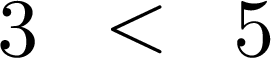 |
Helpful Trick: The Alligator Mouth
Think of the \(>\) and \(<\) symbols as a hungry alligator's mouth. The alligator always wants to eat the bigger number! \(\quad\)
Think of the \(>\) and \(<\) symbols as a hungry alligator's mouth. The alligator always wants to eat the bigger number!
\(\quad\)
Method Procedure for Comparing Whole Numbers
To compare any two whole numbers, follow this systematic procedure:
- Compare the number of digits. The number with more digits is the greater number. If they have the same number of digits, proceed to the next step.
- Compare the leftmost digits. Begin with the digit in the largest place value for each number. The number with the larger digit in this position is the greater number.
- Proceed to the next digit if necessary. If the leftmost digits are identical, move one place value to the right and compare the digits in that position.
- Repeat the process. Continue this process from left to right until you find a position where the digits differ. The number with the larger digit in this position is the greater number. If all digits are identical, the numbers are equal.
Example
Compare 352 and 289.
- Both numbers have 3 digits. We proceed to compare the leftmost digit (hundreds place).
- The number 352 has a 3 in the hundreds place.
- The number 289 has a 2 in the hundreds place.
- Since \(3 > 2\), it is concluded that 352 > 289. No further comparison is necessary.
Bounding a Number
Definition Bounding a Number
Bounding a number involves identifying the two consecutive multiples of a given place value (e.g., ten, hundred, thousand) between which the number lies. This is also known as "framing" or "bracketing" the number.
Method Procedure for Bounding
To bound a number by a specific place value:
- Determine the lower bound. Keep the digits to the left of the target place value and zero out the digits to its right.
- Determine the upper bound. Add one to the digit in the target place value and replace all digits to its right with zeros.
Example
Bound the number \(365\) by the nearest hundred.
- The target place value is the hundreds. The digit is 3.
- Lower Bound: Keep the 3, replace subsequent digits with zeros. The lower bound is 300.
- Upper Bound: Add 1 to the hundreds digit (\(3+1=4\)), replace subsequent digits with zeros. The upper bound is 400.
- Therefore, 365 is bounded by 300 and 400. This can be written as \(300 \leq 365 < 400\).
Rounding Numbers
Imagine you have 29 marbles. If a friend asks how many you have, you could count every single one. But what if you wanted to give a quick answer? You might say, "I have about 30 marbles."
When you do this, you are rounding. We round numbers to make them simpler and easier to work with.
When you do this, you are rounding. We round numbers to make them simpler and easier to work with.
Method Standard Procedure for Rounding
To round a number to a specific place value, the following procedure is applied:
- Identify the target digit: Locate the digit in the place value to which you are rounding.
- Examine the adjacent digit: Observe the digit immediately to the right of the target digit.
- Apply the rounding rule:
- If the adjacent digit is 5 or greater (5, 6, 7, 8, 9), increment the target digit by one. This is termed rounding up.
- If the adjacent digit is 4 or less (0, 1, 2, 3, 4), the target digit remains unchanged. This is termed rounding down.
- Zero out subsequent digits: Replace all digits to the right of the target digit with zeros.
Example
Round the number \(365\) to the nearest hundred.
The procedure is executed as follows:$$\begin{aligned}[t]&\textcolor{colordef}{\underline{3}}65 && \text{1. The target digit in the hundreds place is } \textcolor{colordef}{3}.\\
&\textcolor{colordef}{3}\textcolor{colorprop}{\underline{6}}5 && \text{2. The digit to its right is } \textcolor{colorprop}{6}.\\
&&&\text{3. As } \textcolor{colorprop}{6} \ge 5, \text{ the target digit is rounded up: } \textcolor{colordef}{3}+1 = \textcolor{olive}{4}.\\
&\textcolor{olive}{4}\textcolor{purple}{00} && \text{4. Subsequent digits are replaced with zeros.}\end{aligned}$$Therefore, \(365\) rounded to the nearest hundred is \(400\).