\( \definecolor{colordef}{RGB}{249,49,84} \definecolor{colorprop}{RGB}{18,102,241} \)

Enlargement and Reduction

What are Enlargement and Reduction?


Look at the rectangles below. They have the same shape but different sizes. This happens when all side lengths are multiplied by the same number.
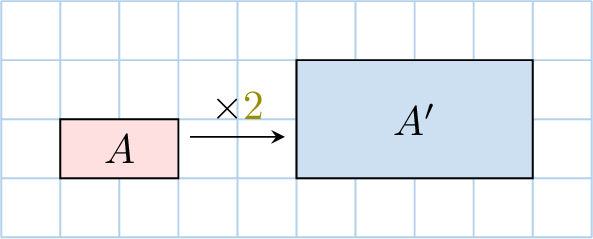
Rectangle \( A \) is enlarged to \( A' \) by doubling its side lengths (multiplying each side by 2). Notice how the width and height both double.

Definition Enlargement and Reduction
  • An enlargement makes a shape larger by multiplying all side lengths by a number called the scale factor. In an enlargement, the scale factor is greater than 1.
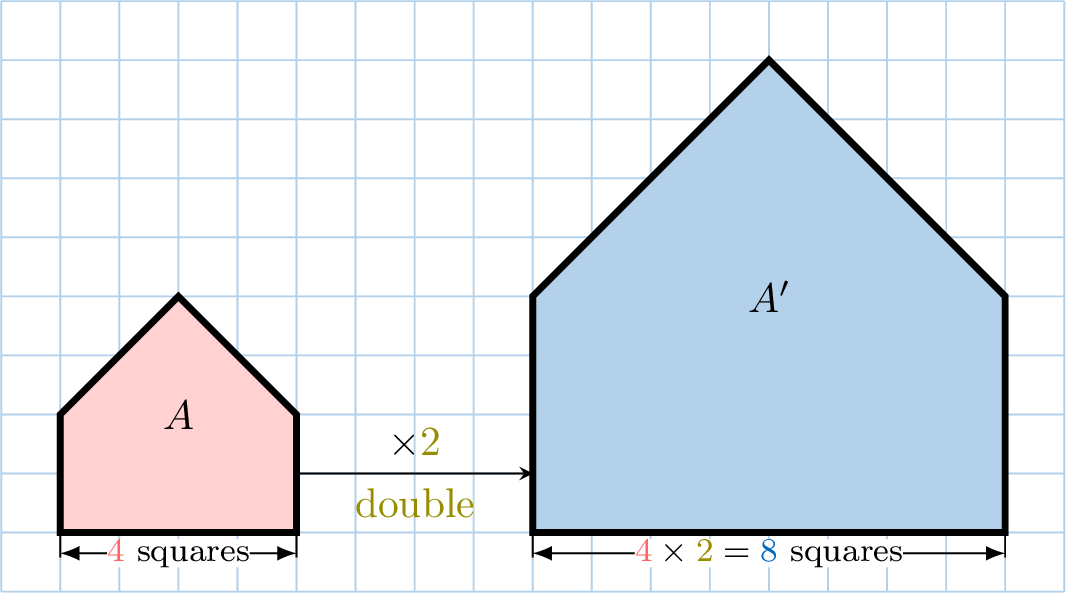
    In this example, shape \( A \) is enlarged to \( A' \) by multiplying each side length by \(\textcolor{olive}{2}\) (scale factor \(=\textcolor{olive}{2}\)). The bottom side grows from 4 to 8 squares.
  • A reduction makes a shape smaller. One way to do this is to divide all side lengths by the same number. This is the same as multiplying all side lengths by a scale factor between 0 and 1.
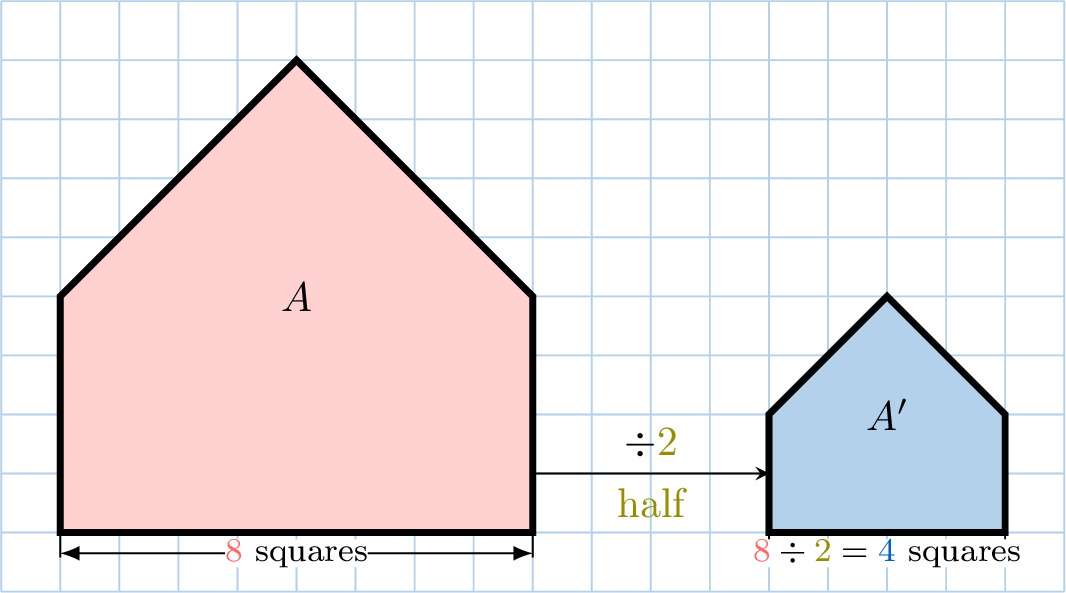
    In this example, shape \( A \) is reduced to \( A' \) by dividing its side lengths by \(\textcolor{olive}{2}\). This is the same as multiplying by the scale factor \(\dfrac12\). The bottom side shrinks from 8 to 4 squares.