Volume
Definition
Definition Volume
The volume of an object is the amount of space it takes up. We measure volume by counting how many cubic units can fit inside it. A cubic unit is a cube with sides that are 1 unit long.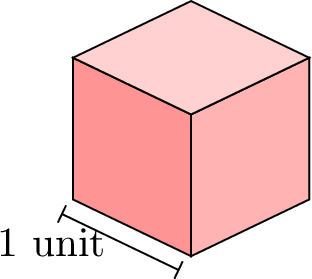
Method Counting Cubes to Find Volume
To find the volume of a shape made of blocks, simply count the total number of blocks (cubic units) it is made from. A good strategy is to count the blocks in each layer.
Example
Find the volume of the shape below.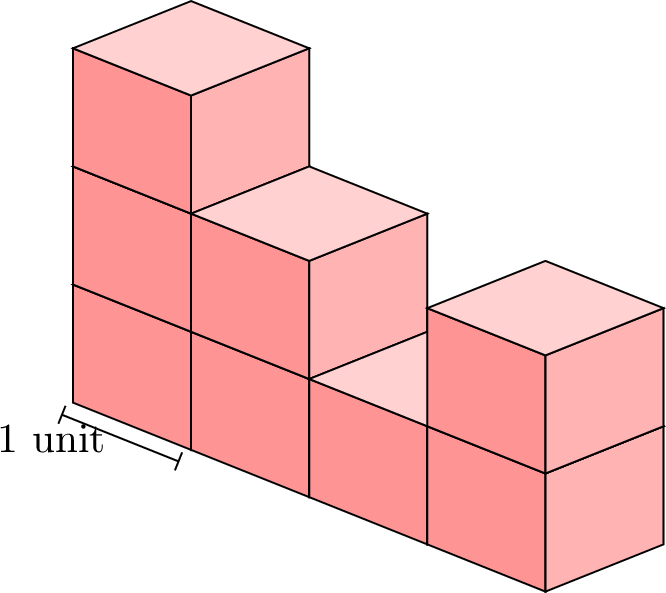
We can find the volume by counting the cubes in the shape. Each small cube has a volume of 1 cubic unit.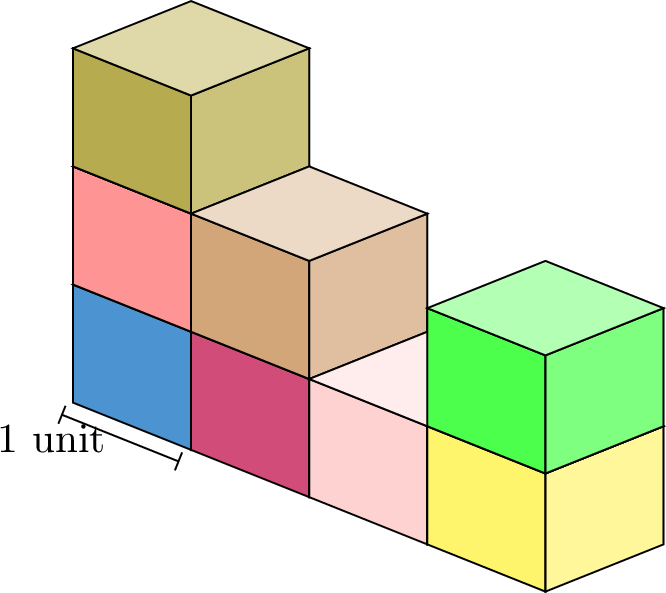
Units of Volume
When we measure volume, it is important to use standard units so that everyone gets the same measurement. Non-standard units, like different-sized building blocks, can give different answers.
For volume, we use standard units like the cubic centimeter, written \(\text{cm}^3\), and the cubic meter, written \(\text{m}^3\).
For volume, we use standard units like the cubic centimeter, written \(\text{cm}^3\), and the cubic meter, written \(\text{m}^3\).
Definition Units of Volume
- Cubic Millimeter \(\left(\mathrm{mm}^3\right)\): the volume of a cube with sides 1 m long. This is about the size of a tiny grain of sand.


- Cubic Centimeter \(\left(\mathrm{cm}^3\right)\): The volume of a cube with sides 1 cm long. This is about the size of an ice cube.


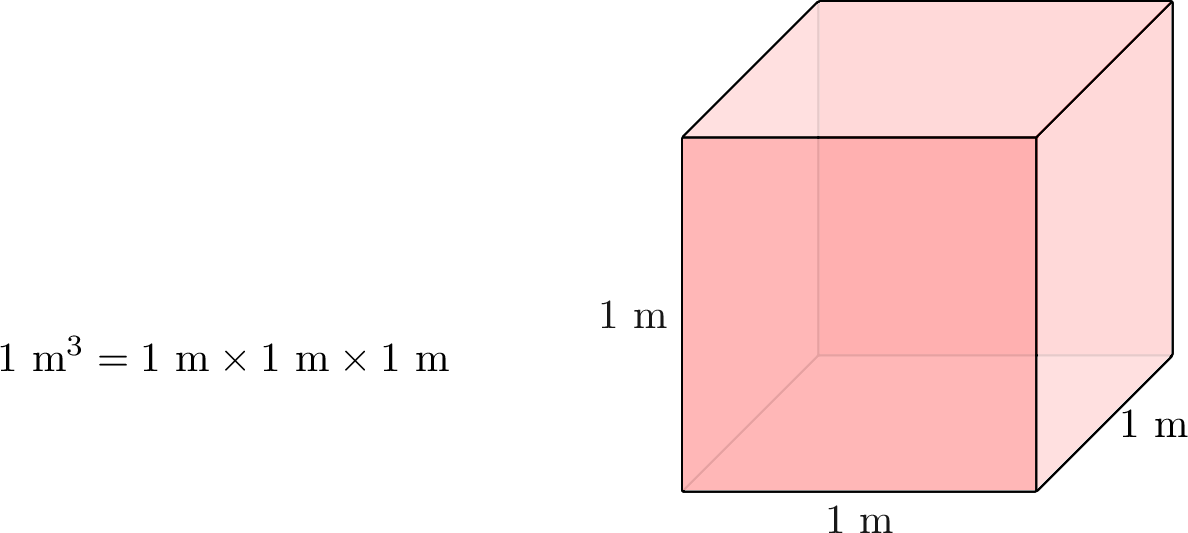
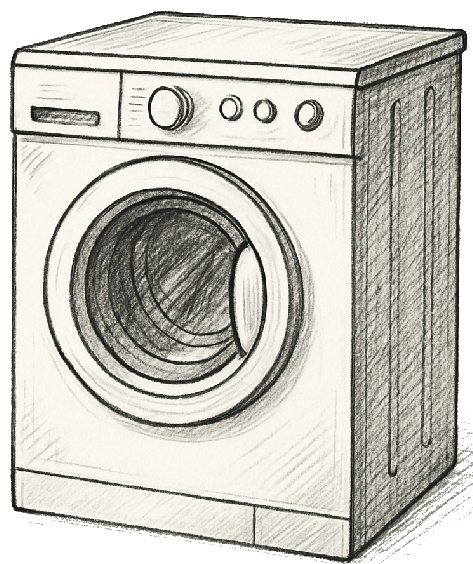
- Cubic Meter \(\left(\mathrm{m}^3\right)\): the volume of a cube with sides 1 m long. This is about the volume of a washing machine.
Volume of a Rectangular Cuboid
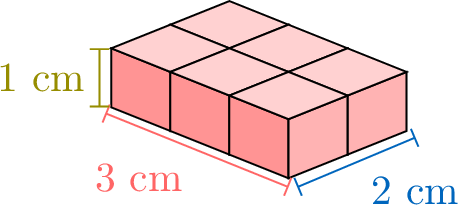
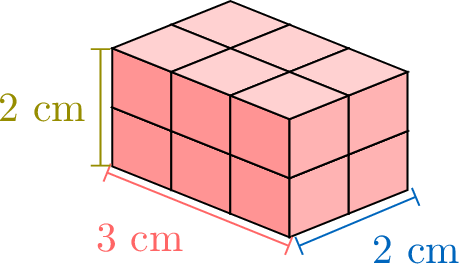
Counting every little cube inside a rectangular box (rectangular cuboid) gives its volume, but that is slow. Instead, imagine making the box taller one layer at a time and watching how the volume grows.
Each new layer adds the same number of cubes. By counting layer by layer, we spot a pattern and get a quick rule for volume: we can multiply the \(\textcolor{colordef}{length}\), the \(\textcolor{colorprop}{width}\), and the \(\textcolor{olive}{height}\).
Each new layer adds the same number of cubes. By counting layer by layer, we spot a pattern and get a quick rule for volume: we can multiply the \(\textcolor{colordef}{length}\), the \(\textcolor{colorprop}{width}\), and the \(\textcolor{olive}{height}\).
 \(\quad\quad\)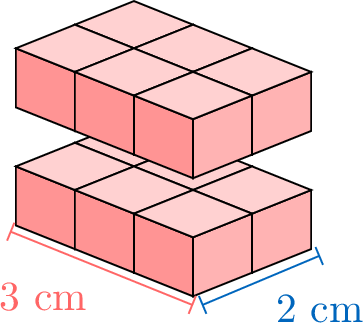
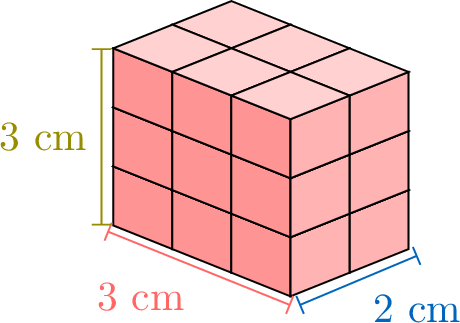 \(\quad\quad\)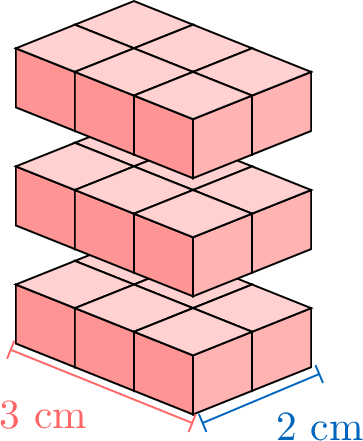
 \(\quad\quad\)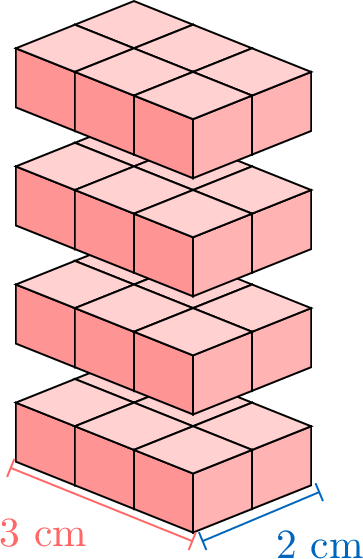
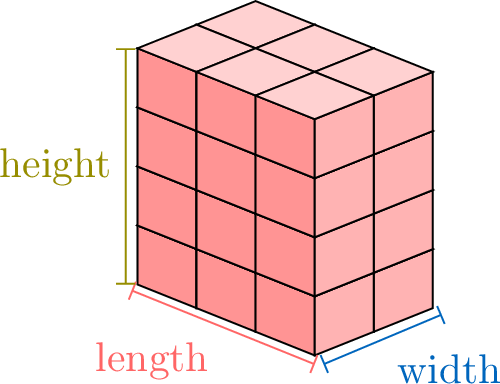
Proposition Volume of a Rectangular Cuboid
The volume of a rectangular cuboid (also called a rectangular prism) is found by multiplying its length, width, and height:$$\text{Volume} = \textcolor{colordef}{\text{length}} \times \textcolor{colorprop}{\text{width}} \times \textcolor{olive}{\text{height}}$$$$V = \textcolor{colordef}{l} \times \textcolor{colorprop}{w} \times \textcolor{olive}{h}$$
Example
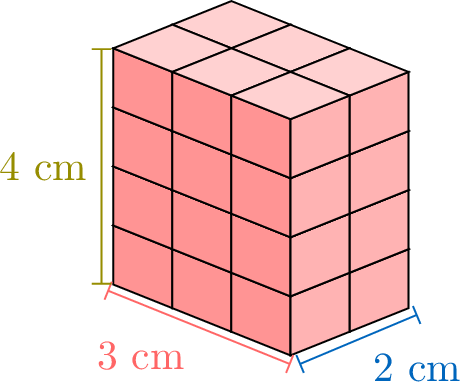
Find the volume of this rectangular cuboid.
Using the formula for the volume of a rectangular cuboid:$$\begin{aligned}\text{Volume} &= \textcolor{colordef}{\text{length}} \times \textcolor{colorprop}{\text{width}} \times \textcolor{olive}{\text{height}}\\
&= 3\times 2 \times 4 \\
&= 24 \, \text{cm}^3\end{aligned}$$
Conversion of Volume Units
Let’s explore how volume units are related. Consider a cube with a volume of 1 \(\mathrm{cm}^3\). Since \(1 \,\text{cm} = 10 \,\text{mm}\), each side of this cube is \(10 \,\text{mm}\) long.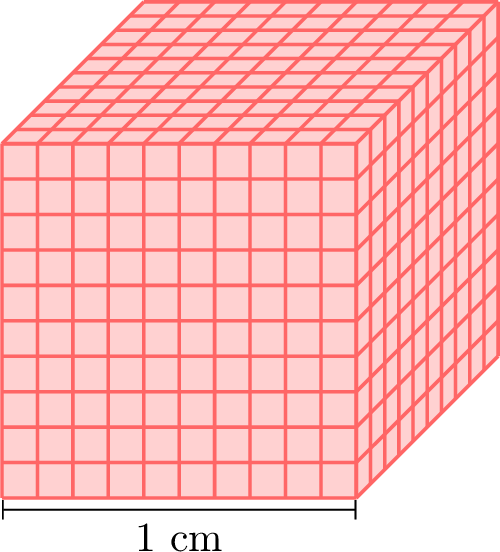
The bottom layer has \(10 \times 10 = 100\) small cubes. Since the height is \(10 \,\text{mm}\), there are 10 layers.
Therefore, the total number of \(1 \,\mathrm{mm}^3\) cubes is \(100 \times 10 = 1\,000\).
$$\begin{aligned}1 \, \text{cm}^3 &= 1 \, \text{cm} \times 1 \, \text{cm} \times 1 \, \text{cm} \\ &= 10 \, \text{mm} \times 10 \, \text{mm} \times 10 \, \text{mm} \quad (1 \, \text{cm} = 10 \, \text{mm}) \\ &= 1\,000 \, \text{mm}^3\end{aligned}$$So \(1 \,\text{cm}^3\) is the same as \(1\,000 \,\text{mm}^3\). This shows that when converting volume units, the conversion factor is cubed (for example, \(10\) becomes \(10^3 = 1\,000\)).
The bottom layer has \(10 \times 10 = 100\) small cubes. Since the height is \(10 \,\text{mm}\), there are 10 layers.
Therefore, the total number of \(1 \,\mathrm{mm}^3\) cubes is \(100 \times 10 = 1\,000\).
$$\begin{aligned}1 \, \text{cm}^3 &= 1 \, \text{cm} \times 1 \, \text{cm} \times 1 \, \text{cm} \\ &= 10 \, \text{mm} \times 10 \, \text{mm} \times 10 \, \text{mm} \quad (1 \, \text{cm} = 10 \, \text{mm}) \\ &= 1\,000 \, \text{mm}^3\end{aligned}$$So \(1 \,\text{cm}^3\) is the same as \(1\,000 \,\text{mm}^3\). This shows that when converting volume units, the conversion factor is cubed (for example, \(10\) becomes \(10^3 = 1\,000\)).
Proposition Conversion of Volume Units
- \(1 \, \text{cm}^3 = (10 \times 10 \times 10) \, \text{mm}^3 = \mathbf{1\,000} \, \text{mm}^3\)
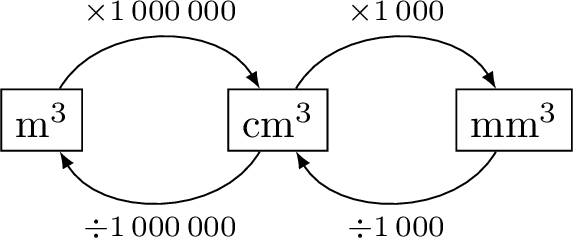
- \(1 \, \text{m}^3 = (100 \times 100 \times 100) \, \text{cm}^3 = \mathbf{1\,000\,000} \, \text{cm}^3\)
Method Converting Using Multiplication or Division
- Use multiplication to go from a larger unit to a smaller one (like cubic meters to cubic centimeters).
- Use division to go from a smaller unit to a larger one (like cubic centimeters to cubic meters).
Method Converting Using a Table
For volume, each unit in the place value table is split into three columns. Let's convert 10.5 \(\mathrm{m}^3\) to \(\mathrm{cm}^3\).
- Draw the volume conversion table. Each unit has three columns.

- Place the number in the table. The rule is: the digit in the ones place goes into the right-hand column of the starting unit. For \(10.5 \,\mathrm{m}^3\), the ones digit is 0, so it goes in the right-hand column of \(\mathrm{m}^3\).

- Move the decimal point to the right side of your target unit's columns. Our target is \(\mathrm{cm}^3\). Fill any empty columns with zeros.

- Read the final number.
So, \(10.5 \,\mathrm{m}^3 = 10\,500\,000 \,\mathrm{cm}^3\).
Capacity
We often need to measure liquids like water, milk, or juice. Instead of using cubic centimeters, there’s an easier way to talk about these amounts: we use the liter (L).
One liter is the same as 1 000 cubic centimeters \((1\,000 \,\text{cm}^3)\). So 1 milliliter \((1\,\text{mL})\) is the same as 1 cubic centimeter \((1\,\text{cm}^3)\).
Using liters and milliliters makes liquid amounts easier to compare and understand.
One liter is the same as 1 000 cubic centimeters \((1\,000 \,\text{cm}^3)\). So 1 milliliter \((1\,\text{mL})\) is the same as 1 cubic centimeter \((1\,\text{cm}^3)\).
Using liters and milliliters makes liquid amounts easier to compare and understand.
Definition Liter
A liter is a unit we use to measure the volume (capacity) of liquids.
- 1 liter is the volume of a cube that measures \(10 \,\text{cm}\) on each side.$$1 \,\text{L} = 1\,000 \,\text{cm}^3 \quad\text{and}\quad 1\,000 \,\text{L} = 1 \,\text{m}^3$$
- We write it with the symbol L (a capital “L”).
- A smaller unit, the centiliter (cL), is often used for smaller volumes: \(\;1 \,\text{L} = 100 \,\text{cL}\).
- An even smaller unit, the milliliter (mL), is used for very small volumes:$$1 \,\text{L} = 1\,000 \,\text{mL} \quad\text{and}\quad 1 \,\text{cL} = 10 \,\text{mL} \quad\text{and}\quad \,1 \,\text{mL} = 1 \,\text{cm}^3$$
Example
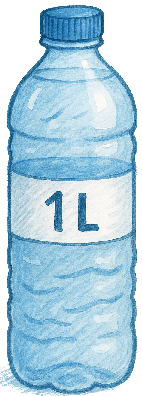
- A big water bottle holds about \(1 \,\text{L}\) of water, which is \(100 \,\text{cL}\) or \(1\,000 \,\text{mL}\):
- A small soda can holds about \(0.33 \,\text{L}\), which is \(33 \,\text{cL}\) (about \(330 \,\text{mL}\)):