Operations with Decimal Numbers
Column Addition and Subtraction
Method Column addition and subtraction
- Step 1: Line up the decimal points. Write the numbers one under the other so their decimal points are in a vertical line.
- Step 2: Fill in the gaps. Add zeros to the end of the numbers so they all have the same length after the decimal point.
- Step 3: Add or subtract. Work from right to left, column by column, as you would with whole numbers.
- Step 4: Place the decimal point. Bring the decimal point straight down into your answer.
Example
Calculate \(3.83 + 2.7\).
- Line up the decimal points and add a zero:
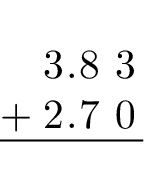
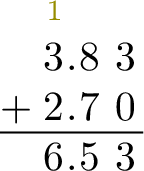
- Add column by column from right to left, carrying over when needed.
- Hundredths: \(3 + 0 = 3\)
- Tenths: \(8 + 7 = 15\). Write down 5, carry over 1.
- Ones: \(1 + 3 + 2 = 6\).
- Bring down the decimal point.
Example
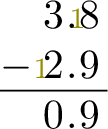
Calculate \(3.8 - 2.9\).
- Line up the decimal points. No zeros are needed.
- Subtract from right to left, borrowing when needed.
- Tenths: We can't do \(8 - 9\). Borrow 1 from the ones place, changing the 3 to a 2 and the 8 to an 18. Now, \(18 - 9 = 9\).
- Ones: \(2 - 2 = 0\).
- Bring down the decimal point.
Column Multiplication
Method Column multiplication
- Step 1: Ignore the decimals. Write the calculation as if the numbers were whole numbers. You do not need to line up the decimal points.
- Step 2: Multiply. Perform the multiplication as you would with whole numbers.
- Step 3: Count the decimal places. Count the total number of digits after the decimal point in the original numbers.
- Step 4: Place the decimal point. In your answer, place the decimal point so it has the same number of decimal places you counted in Step 3.
Example
Calculate \(3.48 \times 2.9\).
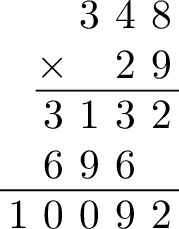
- Multiply as whole numbers (\(348 \times 29\)).
- Count the decimal places in the original numbers.
- \(3.48\) has \textcolor{colordef}{2} decimal places.
- \(2.9\) has \textcolor{colordef}{1} decimal place.
- Total: \(2 + 1 = \textcolor{colorprop}{3}\) decimal places.
- Place the decimal point in the answer (10092) so it has \textcolor{colorprop}{3} decimal places. $$ 10.092 $$
Long Division
Method Long Division by a Whole Number
- Step 1: Set up the division. Write the problem in the long division format.
- Step 2: Pop the decimal up. Place the decimal point in the answer space, directly above the decimal point in the number being divided.
- Step 3: Divide from left to right. Divide as you would with whole numbers, ignoring the decimal point now.
Example
Calculate \(34.4 \div 4\).
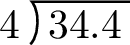
- Set up and pop the decimal up.
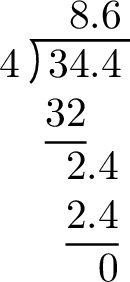
- Divide.
- How many 4s in 34? 8. (\(8 \times 4 = 32\))
- Subtract: \(34 - 32 = 2\).
- Bring down the 4 to make 24.
- How many 4s in 24? 6. (\(6 \times 4 = 24\))
- Subtract: \(24 - 24 = 0\). The division is complete.
Method Long Division by a Decimal Number
In long division, first convert the divisor to a whole.
- Step 1: Make the divisor whole. Move the decimal point in the divisor all the way to the right. Count how many places you moved it.
- Step 2: Move the other decimal. Move the decimal point in the dividend the same number of places to the right.
- Step 3: Divide. Now the problem is a "division by a whole number" problem. Follow the steps from the method above.
Example
Calculate \(4.56 \div 1.2\).
- Make the divisor (1.2) whole. Move the decimal point one place right to make it 12.
- Move the other decimal. We must also move the decimal in 4.56 one place right. It becomes 45.6.
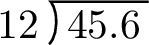
- The new problem is \(45.6 \div 12\).
- Divide.